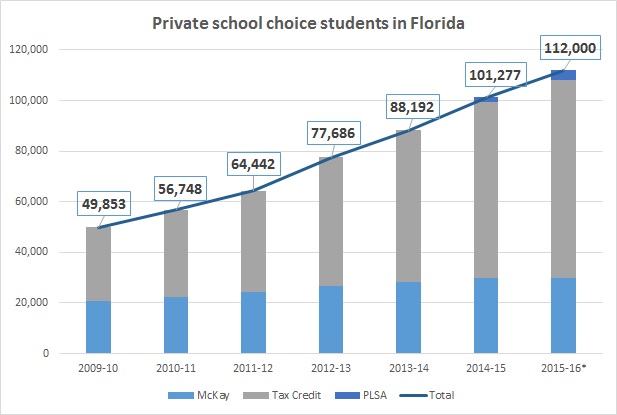
Florida's three private-school choice programs serve roughly 112,000 students this year. *2015-16 totals are rounded and preliminary. Numbers could change before the school year ends.
Florida may be home to the largest private-school choice program in the nation, but its level of participation ranks no. 3 in the country, according to new data from the Friedman Foundation for Educational Choice.
The no. 1 state (Arizona) should come as no surprise. The no. 2 state (Vermont) might, though it's home to one of the oldest school choice traditions in the United States.
The Friedman Foundation added up the number of private-school choice students in each state. In Florida, that's about 30,000 on McKay Scholarships, more than 78,000 on tax credit scholarships, and roughly 4,000 using Gardiner Scholarships during the 2015-16 school year. It then divided the total by the number of "taxpayer-supported" students, including the nearly 2.8 million attending public schools. Florida's private school choice participation rate came to about 4.1 percent. (Tax credit scholarships are supported with private, tax-credited donations, while the other two programs receive direct state funding). (more…)
A new report argues supporters of private school choice can learn from public charter schools and should look for ways to "break down the walls" between the two sectors.
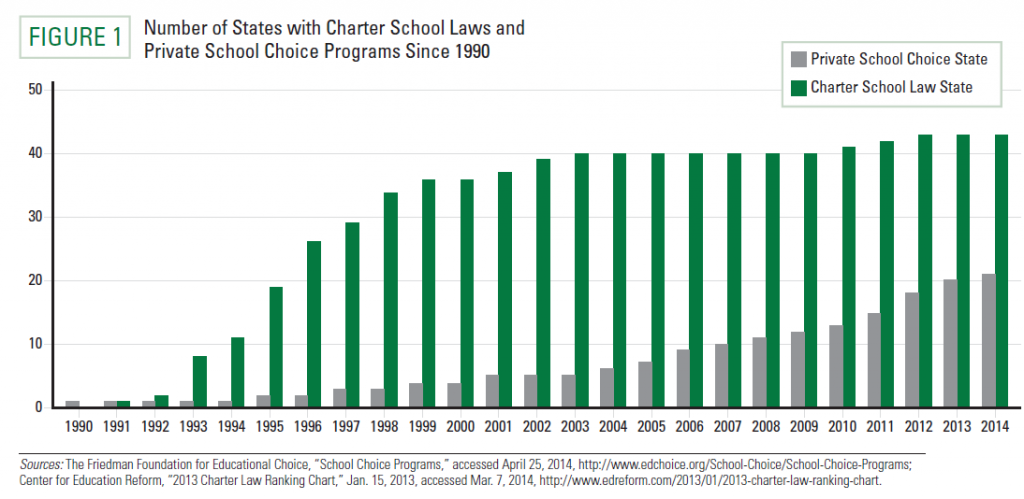
While most states have authorized charter schools for more than a decade, private school choice programs are starting to become more widespread. Chart from the Friedman Foundation's report.
Private school choice programs serve only a few hundred thousand students nationally, a fraction of the 2.3 million enrolled in charters. But more states have created tax credit scholarship and voucher programs in recent years, and existing programs, including the tax credit and McKay scholarships in Florida, are growing.
A report released this morning by the Friedman Foundation for Educational Choice argues that as private school choice programs grow and proliferate, they can draw a few lessons from the charter sector about how to create more quality options for students.
Report author Andy Smarick - a consultant at Bellwether Education Partners who's among the leading proponents of a "three-sector approach" to education reform - writes that private schools could learn from charters' use of networks and incubators to improve their operations. He also advocates for a charter-style approach to accountability, in which participating schools get screened by authorizers — agencies that hold them to performance-based contracts in exchange for more freedom to operate.
That idea may prove controversial among private schools that have traditionally not seen as much regulation as their publicly funded counterparts. But as states debate how they will regulate private school choice programs, Smarick writes that authorizers would be in a position to fine tune their judgement calls about how private schools are evaluated. For example: Should they be publicly accountable for the performance of all their students, or just the performance of students who receive tuition subsidies through tax credit or voucher programs?
"The contractual relationship, if implemented properly, will also be more nuanced - rendering fairer judgments and respecting the unique characteristics of private schools - than, say, a single letter grade for a school that would be generated via a state’s accountability system," he writes.
Other insights from the charter sector are more straightforward, such as the use of incubators and networks. (more…)
Public support may be growing nationally for school voucher programs, but so is opposition, according to a new survey by a pro-parental choice think tank.
The Friedman Foundation for Educational Choice polled more than 1,007 U.S. adults in its latest annual survey on a wide range of education-related topics, from school spending to Common Core State Standards.
The results of the 2014 Schooling in America Survey, released Thursday, show nearly two out of three Americans support vouchers, and suggest more people are forming opinions about them. The survey found support for vouchers has climbed seven percentage points over the past two years, while opposition grew by five percentage points.
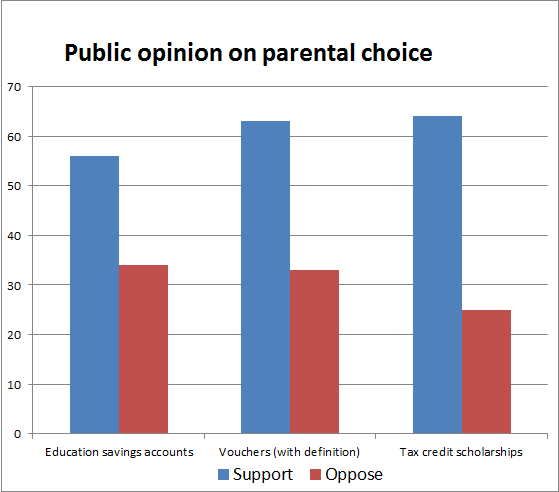
A Friedman Foundation survey gauges public opinion on parental choice options.
The survey first asked people whether they support "school vouchers" without providing a definition, and found 43 percent in support and 21 percent in opposition. Support rose to 63 percent, and opposition to 33 percent, after people were given this definition:
A school voucher system allows parents the option of sending their child to a school of their choice, whether that school is public or private, including both religious and non-religious schools. If this policy were adopted, tax dollars currently allocated to a school district would be allocated to parents in the form of a "school voucher" to pay partial or full tuition for their child's school.
A separate question provided a definition of tax credit scholarship programs and found a similar level of support (64 percent) but less opposition (25 percent) than it did for vouchers. Florida has both voucher and tax credit programs. While vouchers are funded directly through the state budget, tax credit scholarships allow companies to reduce their tax bills by donating money to scholarship funding organizations like Step Up For Students, which co-hosts this blog.
The survey found less support but still a majority (56 percent) in favor of education savings accounts, which will soon be available to special needs students in Florida under legislation signed last week by Gov. Rick Scott.
The survey also shows people younger than 34 are more likely to support vouchers than those older than 55.
The results contrast with a Florida-based survey published earlier this year. The Sunshine State News poll showed "voters" narrowly oppose voucher programs. Because it surveyed likely voters and not the general population, it included a greater proportion of older people, who were less likely to support private school choice programs. It also worded its question differently, asking about scholarships for "low-income" students.
The Friedman Foundation has a mission of promoting educational choice. It provides a breakdown of its findings, methods and survey questions along with the full report. The American Enterprise Institute this afternoon will host a panel discussion and webcast on the results.
 As Florida lawmakers voted this year to strengthen a scholarship for low-income students, critics took repeated aim at issues of accountability, arguing the students don’t take standardized tests and the schools are “unaccountable” and “unregulated.” But a new national report, “Public Rules on Private Schools,” by Andrew Catt of the Friedman Foundation, demonstrates that such claims are exaggerated.
Friedman, a free-market education think tank, actually ranks the Florida tax credit scholarship as the most regulated state scholarship law in the nation. Participating private schools in Florida are required to administer standardized tests and, as far as accountability to the public goes, face twice as many reporting requirements as non-participating private schools. Friedman also ranked the Florida scholarship as third most regulated among all 23 state voucher and tax credit scholarship programs combined.
Catt analyzed private school regulations before and after the passage of 23 private school choice programs from around the nation. Each regulatory statute is weighted -3 to +3 and assigned to one of nine categories such as, “paperwork, reporting,” “testing, accountability,” and “curriculum, instruction.” Negative scores represented regulatory requirements/burdens while positive scores represented protections for schools such as funding parity or regulatory cost reimbursements. The further the score is from zero, the bigger the impact.
“Paperwork, reporting” turns out to have the largest impact on school choice program scores, owing to the sheer number of state statutes requiring private schools to report information to the state. This does not mean reporting regulations are a bigger burden than something like uniform testing and curriculum requirements.
States across the nation already imposed regulations on private schools, such as health and safety requirements, before passing school choice programs into law. The amount of pre-school choice regulations varies from state to state. Once a school choice program passes into law, most states impose additional new regulatory burdens for private schools that wish to participate.
The new school choice regulations varied considerably depending on the type of program. Private schools participating in voucher programs saw far more new regulations than private schools participating in tax credit scholarship programs. Private schools participating in Arizona’s education savings accounts saw the least. This mirrors the findings of Andrew Coulson’s 2010 Cato Institute report. (more…)
When it comes to urban private schools competing against free public charter schools the adage “if you can’t beat ‘em, join ‘em” rings true. Charter schools have considerably more freedom than traditional public schools and this allows them to offer a private-school-style education without the private-school-education price tag. Since it is very hard to compete against a “free” education, many urban private schools, especially Catholic schools, have closed, consolidated or converted to charter schools.
A new report, “Switchers: Why Catholic Schools Convert to Charters and What Happens Next,” by education researchers Michael Q. McShane and Andrew P. Kelly, examines the how, what and why of Catholic school conversion to charters.
It is worth noting that the Catholic dioceses interviewed by the researchers oppose use of the terms “switchers” and “converting.” Catholic leaders maintain the religious mission is fundamental to a Catholic school education and since this aspect is lacking in the charter school curriculum, the new schools are completely different entities even if they rent the same building, employ the same teachers and enroll the same students.
The report examines several Catholic private schools in Indianapolis, Miami and Washington D.C. In all instances, the schools suffered severe enrollment drops in the years leading up to closure and conversion.
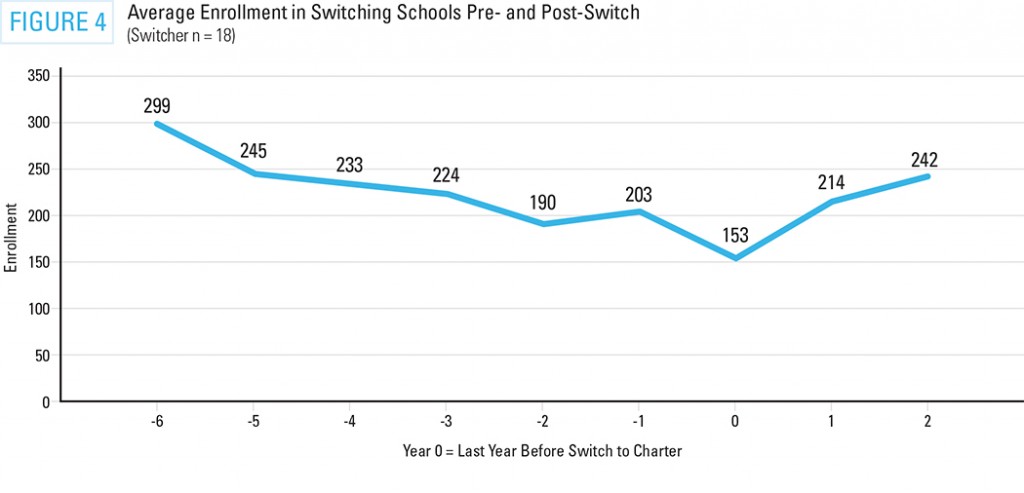 On average, Catholic schools lost 7.3 students per year with an average enrollment of just 153 students in the school’s final year of operation. Upon closing and converting the space to a charter school, the schools saw an enrollment growth of 34.4 students per year.
These new charter schools also saw a significant increase in minority students. Minority enrollment climbed from 79 percent during the Catholic schools’ final year to 93 percent within two years of re-opening as a charter school. (more…)
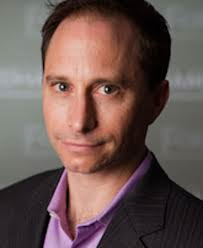
Petrilli
Is parental choice alone accountability enough for private schools that accept students with vouchers and tax credit scholarships?
The pro-school-choice Fordham Institute says no. In a policy toolkit released this week, it again made the case for some measure of regulatory accountability – and promptly drew fire from other school choice stalwarts at the Friedman Foundation, the Cato Institute and elsewhere (see here and here).
To continue the debate, Fordham Executive Vice President Mike Petrilli will be our guest next week for a live, hour-long chat.
The chat is like a press conference, only it’s in writing and open to anyone with a good question. To participate, just come back to the blog on Tuesday. We’ll start promptly at 10 a.m. All you have to do is click in to the live chat program, which you’ll find here.
In the meantime, you can send questions in advance. Either leave them here in the comment section, send them to rmatus@sufs.org, tweet them to @redefinEDonline and/or post them on our facebook page. See you next week!
 So here’s a new finding from a leading school choice group that might make some school choice supporters sigh: When it comes to reforms they think will best improve schools, Americans put school vouchers in the middle of the pack.
School vouchers finished behind smaller class sizes, technology and accountability in the survey released Tuesday by the Friedman Foundation for Educational Choice, but ahead of teachers’ unions, merit pay and a longer school day. The report notes respondents made those choices after generally rating public schools between poor and fair.
“The fact that respondents would rate schools so low but still show preference for the structural status quo indicates choice supporters have much work to do to overcome an ideology favorable to the types of the schools the vast majority of Americans attend and to which they send their children,” the report says.
On another interesting note, the report found Americans are more likely to favor private school tax credits and school vouchers for all over vouchers limited to low-income students or students with disabilities. That could mean a re-thinking, the report says, in how some school choice supporters have strategized the adoption of new choice programs.
“The first modern choice programs – in Milwaukee and Cleveland – were limited to urban, low-income families,” the report says. “But if the ultimate goal is universal choice – whether through vouchers or tax-credit scholarships – incrementalism may no longer be a necessary strategy, at least as measured by public support for reasons for choice.”
Like any survey, the latest from Friedman has a lot of nuance and caveats. It also offers a lot of worthy background about similar surveys. Check it out for yourself here. Press release here.
Editor’s note: Robert Enlow is the president and CEO of the Friedman Foundation for Educational Choice, the school choice legacy foundation of Milton and Rose D. Friedman. This is the second post in our #schoolchoiceWISH series.
Robert Enlow
Google “Top Christmas Toys of 2013” and you’ll find the first result, Target, allows users to search potential presents by age, gender, price, category, and even brand. To make education just as customizable, I have two items on my policy wish-list this holiday season.
First, increase the size and permissible uses of school choice.
Take Arizona’s education savings accounts (ESAs), which families can use to cover private school tuition, tutors, therapies, online courses – or a combination of those tools – and even college expenses. As the Heritage Foundation’s Lindsey Burke found, 34.5 percent of ESA recipients used their funds for multiple education services, proving many kids need dramatically different learning environments beyond just existing public, and private, schools.
Unfortunately, Arizona’s ESAs continue a trend of missed opportunity in the school choice movement: making programs open to a select few. ESAs are available to only 20 percent of Arizona students. School choice is about much – and many – more.
Milton Friedman wrote in 2000, “I have nothing but good things to say about voucher programs…that are limited to a small number of low-income participants. … But such programs are on too small a scale, and impose too many limits, to encourage the entry of innovative schools or modes of teaching. The major objective of educational vouchers is…to drag education out of the 19th century – where it has been mired for far too long – and into the 21st century, by introducing competition on a broad scale. Free market competition can do for education what it has done already for other areas, such as agriculture, transportation, power, communication and, most recently, computers and the Internet.”
That leads to my second hoped-for policy present: Parent-driven accountability.
To make Milton Friedman’s desired outcome a reality, accountability cannot mean solely the application of, and performance on, standardized tests. Imposing “too many limits” on private schools discourages the creation of new educational models and encourages educators to mimic the decades-old public institutions many families want to escape.
Parents are up to the challenge when it comes to holding schools accountable. (more…)
This week, we posed that question to many of you on Twitter and got an amazing response: more than 1,000 tweets!
In the meantime, we also posed it to some stalwarts in the school choice movement, and asked them to write a short blog post in response. Next week, we’ll begin publishing their fun, thoughtful and provocative answers.
Here’s the all-star line-up:
Monday, Dec. 23: Jon Hage, founder and CEO of Charter Schools USA.
Tuesday, Dec. 24: Robert Enlow, president and CEO of the Friedman Foundation for Educational Choice.
Thursday, Dec. 26: Joe McTighe, executive director of the Council for American Private Education
Friday, Dec. 27: Dr. Howard Fuller, board chair, Black Alliance for Educational Options
Monday, Dec. 30: Julio Fuentes, president and CEO, Hispanic Council for Reform and Educational Options
Tuesday, Dec. 31: Peter Hanley, executive director, American Center for School Choice
We hope you enjoy the posts as much as the #schoolchoiceWISH event. It was a hit! (more…)
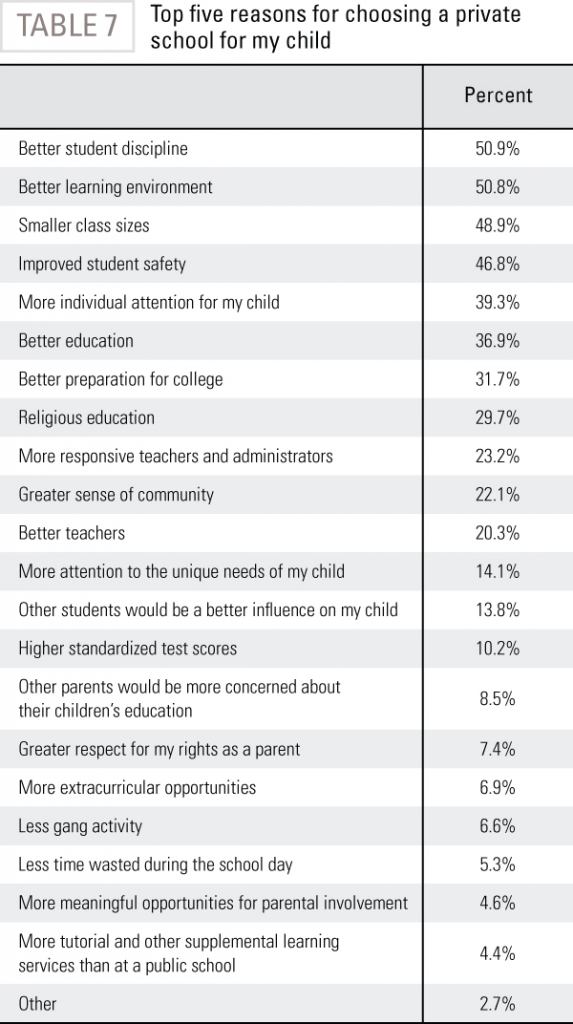
When it comes to reasons why parents move from public to private schools, standardized test scores are nowhere near the top of the list, but concerns about classroom discipline and atmosphere are, according to a new report from the Friedman Foundation For Educational Choice.
Based on a survey of 754 parents of tax credit scholarship students in Georgia, “More Than Scores” finds the five top reasons are better discipline, better learning environment, smaller class sizes, improved safety and more individual attention. When asked the single most important reason for choosing a private school, 28.2 percent of parents said a “better education.” In second place, 28.1 percent said a “religious education.”
No parents chose “higher test scores” as their top reason. Only 4.2 percent listed the reason in their Top 3 and just 10.2 percent listed it in their Top 5.
When given a list of 21 possible reasons why they chose a private school, parents most often chose “better learning environment” (85.1 percent). “Religious education” came in at No. 5 (64.1 percent). “Higher standardized test scores” came in at No. 15 (34.6 percent).
The relatively low regard for test scores led the authors to conclude that “public officials should resist the temptation to impose national or state standards and testing on private schools or demand that private schools publish ‘report cards’ emphasizing test score performance.”
Full disclosure: I’m also a research fellow for the Friedman Foundation.
Other coverage: Rick Hess at the American Enterprise Institute weighs in here. The report’s authors weigh in at Jay P. Greene’s Blog here.