by Ron Sachs
Ron Sachs
The first time Florida saw a massive statewide teachers' strike was in the spring of 1968. As editor of the student paper at Miami Norland Senior High, I skipped school to cover the protests. My principal wound up suspending me for two weeks, but it was worth it.
I saw teachers walk out of class, spurred by the advocacy of their union. The educators I talked to weren't demanding higher salaries. They wanted better teaching materials and more resources for their classrooms. I came to see unions as champions for quality education.
Throughout the '70s, '80s, and even into the '90s, when I was proud to serve as communications director of the Florida Education Association, Florida's two teachers unions were deeply involved in almost every significant education reform enacted in the state.
They backed local control and school-based accountability. Their leaders understood that to be relevant in Tallahassee, they needed to offer something other than the word "no."
But as Republicans gained power in the state Legislature, and GOP governors became the norm rather than an anomaly, the unions stopped trying to gain a seat at the table. Instead, they kept trying to flip the table over.
Rather than embrace the new definition of public education, which gained momentum in 1996 after Gov. Lawton Chiles signed the law authorizing Florida's first charter schools, the teachers unions resisted it with everything they had. Rather than collaborate in meaningful reform, they fought many of the policies Gov. Jeb Bush put in place to help Florida vault toward the top of the national pack for educational quality.
Now, the new definition of public education has become mainstream. All over the country, it’s picking up support from Democrats as well as Republicans.
Florida is now a national leader in offering programs that allow all families to choose the school that best meet their needs.
More than thirty percent of the 2.8 million children funded by Florida taxpayers don't attend their zoned public school. They attend magnets, charters, virtual schools. They dual enroll with classes at universities and community colleges. In the McKay and Gardiner voucher programs, they use money from the state treasury to attend private, faith-based schools.
The Florida tax credit scholarship program is also a vital part of this new definition. It helps more than 93,000 mostly low-income children afford private school tuition. Sadly, the teachers union is trying to fight the scholarships in court.
This isn't the first time the union has taken to the courts after losing in the political arena. Ten years ago, they scored a victory against a school voucher program Bush created.
But tax credit scholarships are different. Their funding doesn't come out of the public-school system. Multiple studies have shown they actually help the bottom line of Florida's public schools.
This latest lawsuit feels more like a Hail Mary. The teachers union is going after a program that has grown over past 15 years because it helps address the needs of underprivileged children who struggle in public schools. It's one piece of the puzzle that helps ensure all children, regardless of their station in life, can have an equal opportunity to get a quality education.
With this lawsuit, the union hasn't just squashed what was left of its credibility with the Republican powers that be in Tallahassee. By attacking the educational choices of tens of thousands of families, it's ceded the moral authority its members earned when they took to the streets to demand better schools for all Florida's children.
As I wrote this week in the Tallahassee Democrat:
Ignoring the pleas of 10,000 people who marched on Tallahassee to Drop the Suit,” the FEA presses on in the immoral equivalent of a war on children. The nearly 100,000 potential child casualties this lawsuit might cost would etch the saddest, darkest chapter in the union’s mostly proud history. The FEA is spending hard-working public school teachers’ dues on multi-million-dollar legal fees to advance this suit. It’s just plain wrong.
Back in the day, I saw teachers marching for empowerment. In January of this year, I saw over 10,000 scholarship parents and children doing the same. In both cases, it was easy for me to decide which side to be on.
The author of this post is CEO of Sachs Media Group, which runs advertising and media campaigns for the Save Our Scholarships Coalition, an organization defending the tax credit scholarship program. Step Up For Students, which publishes this blog, helps administer the scholarships.
It's time to take the fight over the nation's largest private school choice program out of the courts and into the policy arena.
That's what John Romano, a Tampa Bay Times columnist who's been a leading critic of tax credit scholarships, argues in this morning's paper.
Florida's First District Court of Appeal dismissed the lawsuit challenging the program in a unanimous decision Tuesday. The court held that the Florida Education Association and other groups did not have standing to bring the case. Among other things, the three-judge panel found the plaintiffs could not show the program harms public schools, and that the case attempts to address policy issues that aren't for courts to decide. The lawsuit's backers have less than a month to decide whether to appeal once more.
A unanimous three-judge panel this morning dismissed a lawsuit challenging the nation's largest private school choice program.
The First District Court of Appeal ruled the statewide teachers union and other groups did not have legal standing to challenge Florida tax credit scholarships because they "failed to allege any concrete harm whatsoever" caused by the program, which is expected to provide scholarships to more than 90,000 low-income children in the coming school year.
The plaintiffs filed the lawsuit, McCall v. Scott, in 2014, arguing the scholarships violated the state constitution because they supported a "parallel" public education system by offering children scholarships to attend private schools. They also argued it violated the state's prohibition on public aid to religious institutions.
A trial court judge dismissed the case last year after finding the plaintiffs could not show the scholarship program harmed public school funding, and did not qualify for a legal exception that would have allowed them to challenge the program as taxpayers. The appellate judges agreed.
"[D]espite arguing that public funds have been diverted from the public school system, [the plaintiffs] make no argument whatsoever that public school funding has actually declined," they wrote. Further, the court called the diversion theory "incorrect as a matter of law."
The appellate judges held the case centered on political questions about school choice and education funding, and wrote that the ultimate "remedy is at the polls."
"This is precisely the type of dispute into which the courts must decline to intervene under the separation of powers doctrine," they wrote. (more…)
We're a bit slow to log this in, but Florida's First District Court of Appeal last week denied an attempt to fast-track a wide-ranging education lawsuit to the state Supreme Court.
It's worth noting what was at stake.
The groups behind the adequacy lawsuit argue elected officials have violated the Florida Constitution by under-funding public schools and saddling them with unworkable accountability rules. They also argue a range of school choice programs — including charter schools, tax credit scholarships for low-income students, and McKay Scholarships for special needs students — contribute to the problem.
In December, Judge George Reynolds ruled the plaintiffs did not have standing to challenge the tax credit scholarship program. Then, in May, he dismissed the rest of the lawsuit after finding Florida's public education system is not in such bad shape that it warrants judicial intervention. (more…)
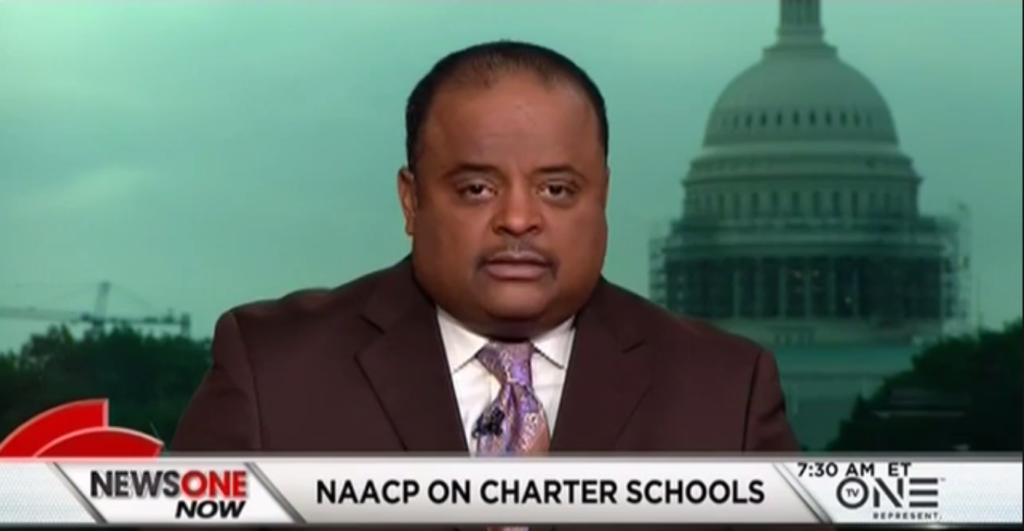
Washington-based TV host Roland Martin hosted a debate on the NAACP's stance against charter schools.
Yesterday, on a morning news broadcast in the nation's capital, host Roland Martin asked the question: "Is the NAACP out of step with black folks?"
He was grilling Hilary Shelton, the director of the NAACP's Washington bureau, about the national civil rights organization's latest stand against school choice.
In mid-July, the organization's members approved a resolution that called for restricting the growth of charter schools. They've passed resolutions critical of charters before, but the new one, which recently started making the rounds on blogs critical of education reform, goes further. It calls for an outright moratorium "on the proliferation of privately managed charter schools."
The ensuing controversy mirrors recent events in Florida, where educators and black clergy members who support the NAACP have taken issue with its role in a lawsuit challenging a private school choice program* for low-income children.
Martin, a prominent journalist at the black-owned D.C. outlet News One, is an unabashed supporter of school choice who speaks at charter school conferences and spars with critics on his Twitter feed. He told Shelton that surveys show African-Americans are more likely to support charters. He wanted to know whether NAACP leaders would get more input before they meet in the fall, when the resolution could become official policy for the organization.
"Are you going to bring in black folks who run charter schools to get their perspective?" he asked, adding: "I can give you a list." (more…)
One of the most emotionally potent arguments against educational choice – that it cripples public schools financially – is slowly unraveling in a Florida court of law. Teacher union attorneys, who seek to abolish tax credit scholarships for 78,000 low-income children, are stumbling to make the case.
This is no small matter. The claim that scholarships and vouchers and charter schools financially undercut public education has been repeated so often for so long that it tends to get treated as though it were fact. The money is commonly described as being “diverted” or “siphoned” from public schools, pitting choice schools against neighborhood schools and creating understandable anguish for parents who want only for their children to have the best education possible.
The Florida case, McCall v. Scott, is shining an unforgiving light on that assertion. The backdrop is the issue of standing – the typically arcane calculation of whether someone is connected to and harmed by a legal matter the court can resolve. Because the union is challenging a scholarship that involves no direct appropriation of tax dollars, the attorneys are being asked to prove their clients suffer “special injury.”
They are quite conspicuously failing.
In the original complaint, filed Aug. 28, 2014, the Florida Education Association (FEA) attorneys said their clients “have been and will continue to be injured by the scholarship program’s diversion of resources from the public schools.” They bolstered the case with two arguments: 1) The tax-credited contributions that are made to private nonprofits to pay for scholarships reduce state taxes that would otherwise fund public schools; and 2) School districts lose funding for each student who leaves a public school to attend a scholarship school.
During the arguments in trial court, Leon Circuit Judge George Reynolds was openly skeptical. “You could do away with this program tomorrow morning,” he said at one point, “and the budget for the school system might change not one iota.” He then dismissed the case on May 18, 2015, ruling: “Whether any diminution of public school resources resulting from the Tax Credit Program will actually take place is speculative, as is any claim that any such diminution would result in reduced per-pupil spending or in any adverse impact on the quality of education.” (more…)
The lead plaintiff in a lawsuit challenging the nation's largest private school choice program and an advocate who helped establish it squared off Wednesday on Southwest Florida public radio.
McCall
The rare public exchange between Joanne McCall, the president of Florida Education Association, and John Kirtley, the chairman and founder of Step Up For Students*, came the week after the case was argued in a state appellate court. The full WGCU broadcast can be heard here.
A key issue at this stage of the case is whether the plaintiffs adequately alleged that the tax credit scholarship program, which serves more than 78,000 low-income children, actually harms the plaintiffs in the lawsuit, or whether they just dislike it politically.
Kirtley pointed to multiple studies by state economists showing the scholarship program saves the state money. In recent years, as the program has grown by tens of thousands of students, per-pupil public-school funding has gone up, he said. If school districts suddenly had to absorb nearly 80,000 students, "per-pupil spending would go down."
What's more, public schools would have to build new space for them, at a time when many are struggling to handle existing growth. In fast-growing Central Florida, for example, WFTV recently reported that Osceola County expects to add 10,000 students in the next five years, and is hoping charter schools can help accommodate them. There are nearly 3,000 students in the district on scholarships. (more…)
The statewide teachers union and other groups told a Florida appellate court this afternoon that a lawsuit attacking the constitutionality of the nation's largest private school choice program should be allowed to proceed.
The Florida Education Association, the state NAACP chapter, the League of Women Voters and other groups are challenging the constitutionality of tax credit scholarships, which allow 78,000 low-income students to attend private schools.
A Tallahassee judge dismissed their case last year, after finding the groups could not show the program harmed public schools and did not have standing as taxpayers to challenge its constitutionality.
The groups behind the lawsuit took their case to the First District Court of Appeal. During a 40-minute hearing Tuesday, they contended the scholarships draw students — and therefore state funding — away from public schools.
Supporters of the program counter that it results in a net savings for taxpayers, and that funding for public schools has increased, both per-student and overall, as the scholarship program has grown.
Florida funds schools on a per-student basis. If its enrollment dropped for any reason (including, for example, if parents decided to home-school their child), a public school would receive less money, but it would also have fewer expenses.
Lynn Hearn, arguing for the groups challenging the program, said students receiving scholarships are spread unevenly across the state. The program affects public schools "by drawing students out of the system and sending the funding away," she said, and schools don't always reap savings from having fewer children to educate.
"You'll have a few from this school and a few from that school, and so the school is left with exactly the same expenses," she said.
Judge Lori Rowe, part of a three-judge panel that heard the case, was skeptical. (more…)
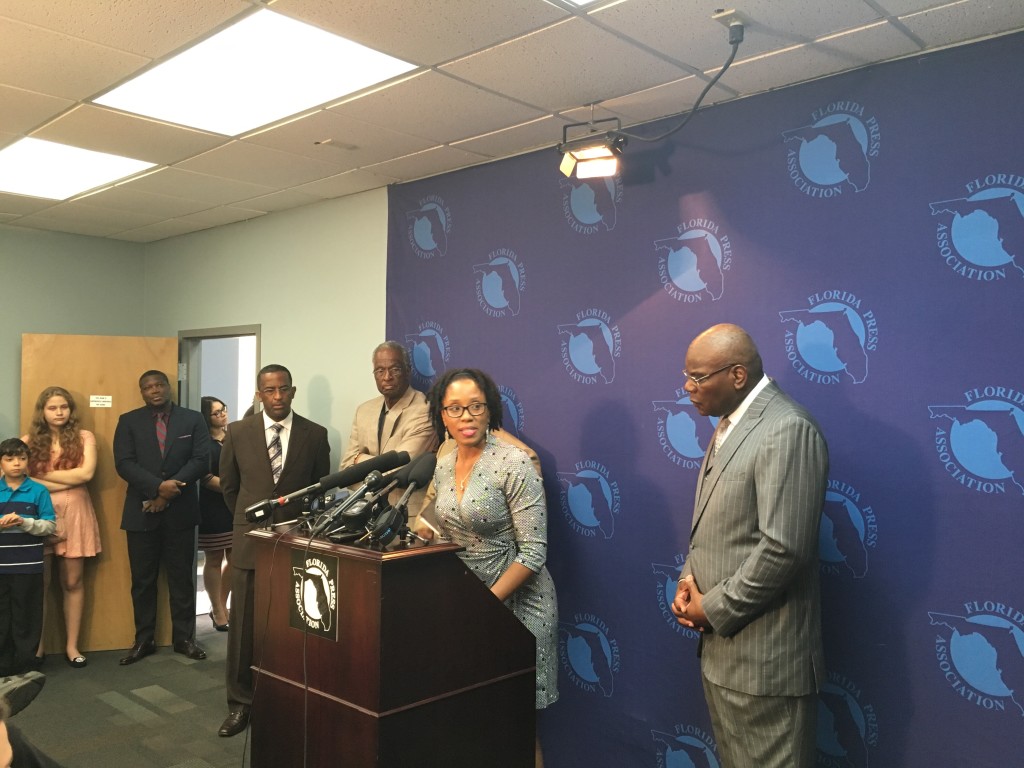
Scholarship parent Cheryl Joseph speaks at a Tallahassee press conference.
A Florida appeals court this afternoon will hear arguments in a lawsuit challenging the state's tax credit scholarship program, which allows more than 78,000 low-income students to attend private schools.
The statewide teachers union, the state chapter of the NAACP, the League of Women voters and other groups challenged the program in August of 2014, but a Leon County circuit court judge dismissed the case in May 2015.
Groups representing school boards and school administrators have since dropped out of the suit, but the remaining plaintiffs are taking the case to the First District Court of Appeal, and Joanne McCall, the lead plaintiff and president of the Florida Education Association, has said she plans to fight the lawsuit all the way to the Florida Supreme Court.
Ahead of the hearing, a group of scholarship parents and African-American ministers called a press conference, where they presented a petition signed by 100 prominent religious leaders and by 5,000 others online, calling on the NAACP to drop out of the suit. Several clergy members who say they generally align with the civil rights organization have criticized its involvement in the case.
"We are friends of the NAACP," Rev. R.B. Holmes, pastor of Tallahassee's Bethel Missionary Baptist Church, said, noting he is a lifelong member. "My great organization is on the wrong side of history on this."
The petition states:
We see no principled reason to fight an education program that is targeted exclusively at low-income children and has a 14-year track record of helping black students succeed. We believe in public education, and believe this scholarship makes it stronger.
According to Politico Florida, Adora Obi Nweze, president of Florida's NAACP chapter, responded that the program has undermined public schools, an argument the plaintiffs have also made in court. (more…)
From the News Service of Florida
A state appeals court will hear arguments May 10 in a lawsuit led by the Florida Education Association challenging the state's Tax Credit Scholarship Program.
The 1st District Court of Appeal last week set the hearing date after Leon County Circuit Judge George Reynolds tossed out the lawsuit in May 2015 because he ruled the plaintiffs did not have legal "standing." The voucher-like Tax Credit Scholarship program provides tax credits to companies that donate money to non-profit entities that help pay for low-income children to attend private schools. In a brief filed in August with the appeals court, the plaintiffs argued they have standing to challenge the constitutionality of the program. (more…)

