by Holly Sagues
Florida Virtual School began as an idea developed in the Florida Legislature. With a $200,000 “break the mold” grant, a small group was charged with attempting something truly disruptive: create the nation’s first online public school. From those early moments 16 years ago to present day, Florida Virtual School has changed the landscape of public education in Florida and nationwide. In 1997, FLVS had 77 students. In fiscal year 2011-12, we had more than 149,000 students in Florida alone.
 Florida Virtual School keeps the student at the center of every decision we make. Seeing every student as an individual is one of the key reasons so many FLVS students achieve and exceed expectations. With our students in the center, FLVS has concerns with the way the language of two Florida House bills, HB 5101 and HB 7029, account for student access and opportunity.
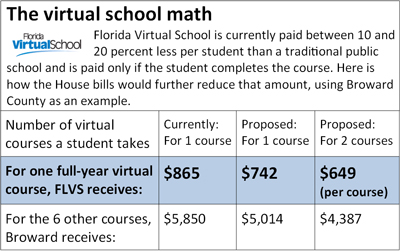
The language used in these bills changes the lens through which the Legislature sees student funding. It moves from addressing unique student needs to a “one-size-fits-all” model that pits district against district. Essentially, the proposed language caps the amount that can be spent on an individual student to a single full-time equivalent (1.0 FTE). This dollar amount is static, and it does not change based upon the number of courses a student successfully completes.
Each student has individual reasons for taking FLVS courses, reasons that vary from acceleration to credit recovery to grade forgiveness and others. Most FLVS students are concurrently enrolled in a brick-and-mortar school, and many take FLVS courses in addition to their six- or seven-period day.
If HB 7029’s and HB 5101’s changes are implemented, the FTE associated with a student taking a full load at a zoned school will be divided between the two (or more) providers of that student’s education, based upon the individual district’s FTE calculation, which varies based upon district. The bill language says “proportionately” but this word is incorrect because FLVS already receives a reduced amount compared to brick-and-mortar schools. (more…)

