In 2018, new rules will change the way Florida public schools calculate graduation rates. They will have to include students who transfer to private online learning providers late in their academic careers.
TC Palm reported the change could cause graduation rates to dip 2 or 3 percentage points in some districts. A Tallahassee Democrat report from last year suggests the impact could be substantial in districts like Leon County, where graduation rates have surged.
But other districts may feel no effect at all. That's because they don't use the system described this spring by the Bradenton Herald. Districts would pay online learning providers like Smart Horizons Career Online Education something like $1,295 per student. Students would transfer from their public schools to the online vendor, in whole or in part, depending on whether they were likely to receive a diploma.
The Herald described it this way:
Almost all of Manatee County’s transfers at the end of the year are students who were dual-enrolled in Smart Horizons, an accredited online private school, during the second semester of their senior year, Greene said. Smart Horizons students take electives and career-training courses while at the same time taking core classes in a Manatee high school, completing remediation and retaking the state test.
If the student never passes the state test, has a 2.0 grade-point average in their core classes and successfully completes the Smart Horizons career training program, they will be transferred out of Manatee schools at the end of the year and earn a diploma from Smart Horizons. If they pass the state test while in Smart Horizons, they will earn a diploma from a Manatee high school, and the program will have served as a backup plan to ensure the student doesn’t join the ranks of the degree-less, Greene said.
Florida’s high school graduation rate remains one of the lowest in the country, but continues to be among the fastest rising, according to the latest graduation rate report from Education Week.
Florida’s graduation rate was 75 percent in 2012, ranking it at No. 43 with Alabama, shows the report released Thursday afternoon. The national average was 81 percent.
Between 2007 and 2012, Florida’s rate jumped 10 percentage points. That puts it in a tie with five other states for the fourth-fastest rate increase. New Mexico led the pack with a 15 point increase, followed by South Carolina (+13), California (+11) and Louisiana (+11). The national rate improved 7 points over that span.
Previous Education Week reports showed a higher ranking for Florida, and a smaller gap between the Florida and national averages. (Last year’s report put Florida at No. 34 with a 72.9 percent graduation rate in 2010, just below the national average of 74.7). Education Week normally crunches federal data using its own graduation rate formula, but could not this year because, “Unfortunately, the release of that federal database has been significantly delayed.”
Reading and math scores for Florida high school seniors remained flat between 2009 and 2013 on a respected national test, according to results released Wednesday.
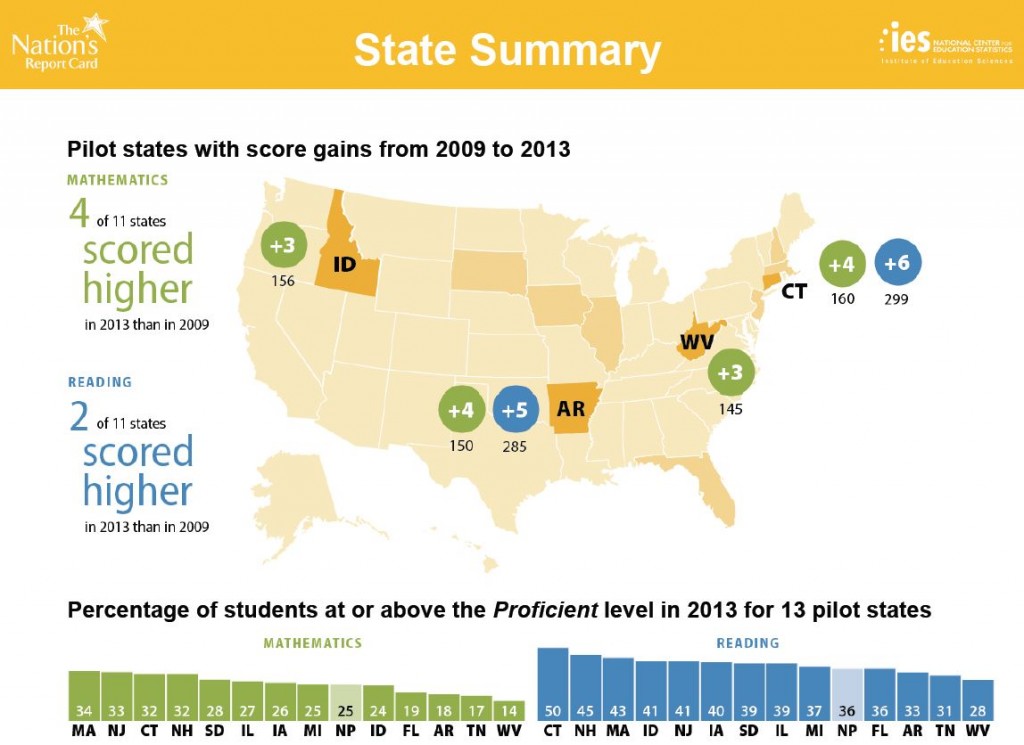 Florida’s reading scores moved from from 283 to 286 on the National Assessment of Educational Progress, better known as “the nation’s report card,” while its math scores inched up from 148 to 149. Neither increase is considered statistically significant.
Nationally, NAEP scores were also flat in both subjects. In math, 25 percent of students tested at proficient or above; in reading, 36 percent. (The corresponding numbers for Florida: 19 percent and 36 percent.)
U.S. Secretary of Education Arne Duncan called the results "troubling."
"We project that our nation’s public schools will become majority-minority this fall – making it even more urgent to put renewed attention into the academic rigor and equity of course offerings and into efforts to redesign high schools," he said in a written statement. "We must reject educational stagnation in our high schools, and as nation, we must do better for all students, especially for African-American and Latino students.”
Unlike NAEP results for fourth- and eighth-graders, which receive widespread attention when they are reported every two years, NAEP results for 12th graders come with significant caveats.
That could help explain why the national scores are stagnant at a time when graduation rates are climbing, said John Q. Easton, director of the Institute of Education Sciences.
The test sample now “includes more lower-performing students who would have dropped out in the past,” he told reporters in a conference call Tuesday. “So we’re sampling from a population that includes more weaker students than we had when the graduation rate was lower.”
Florida scores, then, would seem to be especially impacted. Over the past decade, it ranks No. 2 among states in improving grad rates, climbing 23 percentage points between 2000 and 2010, according to an Education Week analysis. (more…)
 Another year, another report, another Top 10 academic ranking for Florida's oft-criticized public schools.
The Sunshine State ranks No. 7 in K-12 achievement this year, up from No. 12 last year, says Education Week in its latest annual “Quality Counts” report.
Released Thursday morning, the report for the first time since 2008 did not include overall grades or ranks for each state. (Florida ranked No. 11, No. 5, No. 8, No. 11 and No. 6 over those years.) It did, though, continue to offer grades and ranks for six separate categories, including the one that matters the most.
In K-12 achievement, Florida earned a C, up from a C- last year. Massachusetts and Maryland earned the highest grade, a B; New Jersey, a B-; and the others ahead of Florida, a C+. The nation as a whole earned a C-.
Florida has a far greater percentage of low-income students than the states ahead of it or immediately behind it (roughly 10 to 30 percentage points more). It also stands out because of how aggressively it has pursued school choice and top-down accountability.
Gov. Rick Scott credited teachers: “Today’s news that Florida jumped to 7th nationwide in K-12 achievement is the result of great work by our teachers," he said in a written statement. Florida families depend on an education system that provides every student with a quality education, and that’s why in our last budget we fought to provide our teachers with a pay raise and secured more than $1 billion in additional investments for K-12 education.”
 Every year the National Center for Education Statistics (NCES) releases its School and Staffing Survey, a treasure mine of interesting education tidbits for education data geeks.
According to the latest (collected from 14,000 schools during the 2011-12 school year), 64 percent of private school 12th graders will go on to a 4-year college or university but only 39.5 percent of traditional public school students and 37.2 percent of charter school students will do the same.
But don’t get too excited. Some caution is needed before making a conclusion about the impact of these schools because there are big differences regarding students and teachers at these schools. For example, private schools are much whiter and more affluent than public schools. That might explain some of the 25 percentage point advantage in college enrollment rates.
But if being whiter and more affluent helps private schools, it doesn’t seem to do much for traditional public schools when compared to charter schools. (more…)
FCAT: Florida releases scores today for reading, math and science. Miami Herald.
Graduation rates: Florida sees strong growth in grad rates, report finds. Gradebook. Florida's high school graduation rates for Hispanics tops nation. Orlando Sentinel and Miami Herald.
 Charter school conversion: Rowlett parents weigh the benefits of converting their district school into a charter school. Bradenton Herald.
Advanced Placement: Report praises Orange County schools for improving black students' AP passing rates. Orlando Sentinel.
Teacher conduct: A Skycrest Elementary School teacher faces firing for allegedly abusing two special needs students earlier this year. Tampa Bay Times.
School hiring: Pinellas Superintendent Mike Grego names a new area superintendent and three executive directors for elementary, middle and high school education. Tampa Bay Times. New principal appointments at Campbell Park Elementary, Blanton Elementary, Largo Middle, and Northwest Elementary. Tampa Bay Times. A former principal charged with stealing school property will become the principal of a Boynton Beach charter school. Palm Beach Post.
Teacher unions: Jackson County teachers OK salary proposals. Jackson County Floridian. Monroe County teachers' union and district talk about unpaid furloughs, other negotiations. Keynoter.
Nonrenewed: A Hillsborough County school board candidate loses his job as a district teacher. Tampa Bay Times. (more…)
Florida’s high school graduation rate rocketed 23 percentage points to 72.9 percent between 2000 and 2010, putting the Sunshine State at No. 2 among states for progress over that span but still behind the national average, according to a new national report.
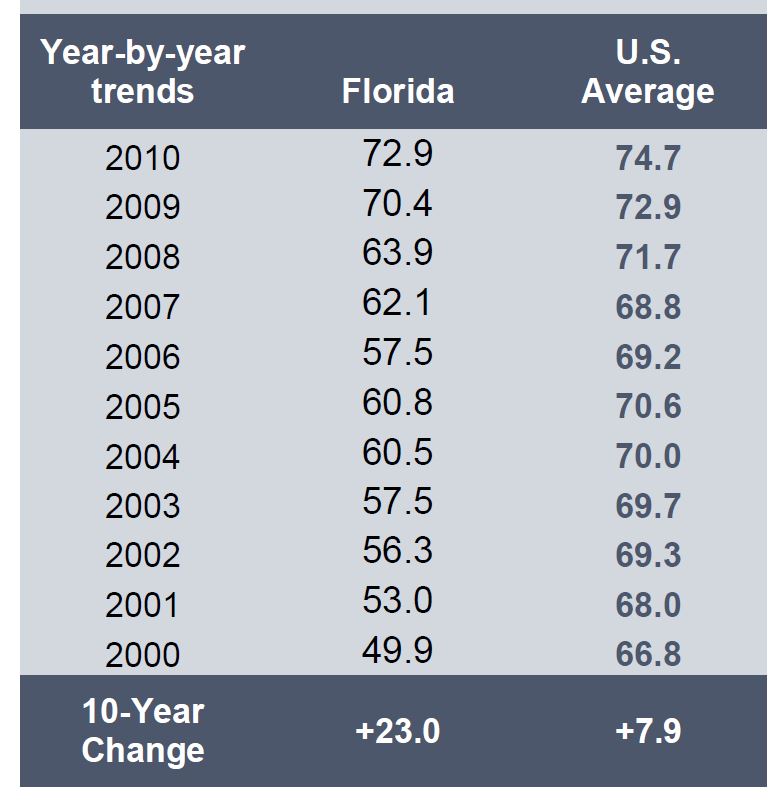
From Education Week
Only Tennessee did better, with a 31.5 percentage point gain, shows the annual Diplomas Count report from Education Week. The national rate was up 7.9 percent, to 74.7 percent.
Education Week, the country’s highly respected paper of record for education news, uses its own formula to calculate graduation rates.
Its findings are the latest in a stack from credible, independent sources that show Florida students and teachers are making some of the biggest academic gains in the country under a model distinguished by a tough, top-down accountability system and expanded parental school choice.
Florida ranks No. 44 in the percentage of students eligible for free- and reduced-price lunch (with the ranking going from lowest rate to highest), according to the latest federal figures. But the Education Week data puts it at No. 34 in graduation rates, ahead of states with less challenging student populations - and arguably better academic reputations - like Washington, North Carolina and Utah.
The gains also come despite tougher standards than other states. Among other things, Florida requires more academic credits to graduate than most states (24 to the national average of 21.1) and the passing of an exit exam (only 23 other states do). (more…)
Common Core. A new Florida group calls the Common Core standards "monstrous." Daytona Beach News Journal.
Black males. An endangered species in Florida, given the Schott Foundation's calculation of grad rates. Politics365.
Vals and sals. Hernando school board members tell Superintendent Brian Blavatt to reinstate the designations. Tampa Bay Times.
Graduation. Remembering the ones who are gone. Tampa Bay Times.
Teacher conduct. A Clay County teacher charged with child abuse enters a pre-trial diversionary program under a plea bargain, reports Florida Times Union. The Pasco principal accused of making anti-gay remarks is retiring, reports the Tampa Tribune. Polk is taking steps to fire a teacher who repeatedly lied about her health to avoid work, including claims of kidney stones, ovarian cysts and a brain condition, reports the Lakeland Ledger.
Teachers unions. Pasco union leader Lynne Webb says it's not the union's fault that contract negotiations have yet to begin. Gradebook. (more…)
School recognition funds. About 1,700 schools will get about $134 million, reports Gradebook. More from SchoolZone, Miami Herald, South Florida Sun Sentinel, TCPalm.com, Florida Times Union, Naples Daily News.
Charter schools. Palm Beach Post: "Palm Beach County has pledged to help a nonprofit charter school sell $10.5 million in mostly tax-exempt bonds so it can open a new campus in Juno Beach — a move that has upset County Commissioner Paulette Burdick, who questions whether the county should aid privately run charters that pull students away from the public school district." More on Cape Coral charter schools asking the Lee County school district for facilities funding from NBC2.
Pre-K. Florida's pre-K isn't the reason its students are surging ahead of Nevada's. Heartland Institute.
Parent trigger. Lakeland Ledger weighs in.
Zero tolerance. Despite changes in the law, thousands of students are still arrested in Florida schools every year for minor infractions. StateImpact Florida.
FCAT. Time again for students to "brace" for the "dreaded" test, reports the South Florida Sun Sentinel. This year, teachers and students better prepared for tougher writing standards, reports the Orlando Sentinel.
Grad rates. Another report notes Florida's rate is low but improving. SchoolZone. (more…)
 Grad rates. Not good for Florida, according to this new report from the U.S. Department of Education. In 2009-10, the state’s rate was 70.8 percent, putting it No. 44 among all 50 states and Washington D.C. And unlike other estimates, the federal numbers show modestly improving trend lines rather than strong gains.
For what it’s worth, the U.S. DOE says the formula used for this report isn’t as accurate as others – and, in fact, is being phased out and replaced by a more precise formula. Coverage from Gradebook and StateImpact Florida. Nationally, the rate reached its highest point in decades. Coverage from Los Angeles Times, Washington Post, Huffington Post.
Teacher pay raises. Gov. Rick Scott will seek them in his budget proposal, with an announcement set for today. Karen Aronowitz, president of United Teachers of Dade in Miami, tells the Tampa Bay Times, “Tell him to send the money, but no one is fooled by this. He’s just restoring money that was already stolen from teachers." More from South Florida Sun Sentinel and News Service of Florida.
Teach for America. EdFly Blog: “Teach for America recruits bright, motivated university graduates and puts them in classrooms with low-income, disadvantaged kids. Normally, liberals would latch on to such a notion – think Peace Corps in urban neighborhoods.” But no.
Teacher evaluations. The new system is on the right track, but it needs more work to be meaningful, editorializes TCPalm.com.
Guts. Somehow, Florida’s decision to participate in PIRLS and other international assessments is being spun in some circles as a negative. The Quick and The Ed blog credits Florida for not shying away from what could be unflattering comparisons.
Tony Bennett. He'll be in the spotlight this legislative session. Sunshine State News.
Parent power. Florida still ranks No. 2 in the Center for Education Reform’s revised Parent Power Index. SchoolZone.
Charter schools. After two F's in a row, Lee Charter Academy in Fort Myers will have to close. Fort Myers News Press. (more…)

