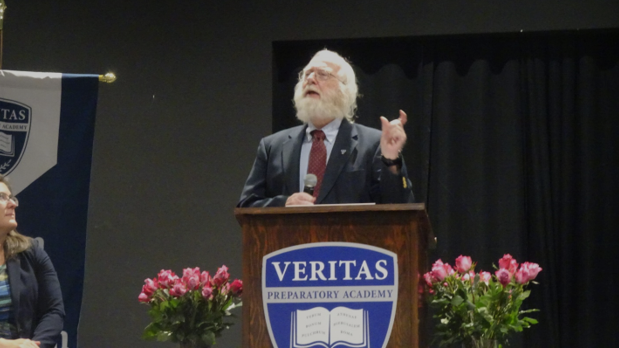
Mike Sullivan, who taught Classical Languages and Humane Letters at Veritas Preparatory Academy for 20 years, retires at the end of this school year. Before coming to Veritas, he was a private practice attorney and served the University of Minnesota in its Student Legal Services department after serving in the U.S. Army Intelligence corps as a translator and interpreter.
Veritas Preparatory Academy, a founding member of the prestigious Great Hearts Academy in the Phoenix metropolitan area, held a joyous retirement ceremony for one of its founding faculty members, Mike Sullivan, on May 20. Great Hearts recruited Sullivan, a 60-year-old attorney living in Wisconsin, to teach Latin and Greek.
Sullivan had enjoyed a career in the military followed by a legal career before finishing strong in the classroom for two decades. His most recent career holds a valuable lesson for policymakers.
Students, colleagues, and students who went on to became colleagues all related fond memories and valued lessons imparted by beloved sage-curmudgeon during the event. Veritas Prep’s first headmaster, Andrew Ellison, told of hosting the visiting Sullivan on a recruiting visit.
Ellison felt a growing sense of desperation over the course of the day, thinking he just had to have Sullivan join the faculty. Sullivan at one point told Ellison that he had been waiting all day for Ellison “to say something wrong” so he could get on a plane and go back to Wisconsin.
“But it hasn’t happened yet, and I don’t think it’s going to happen,” Sullivan said. Ellison described this as “the moment Veritas Prep was born.”
Policy decisions impact lives, sometimes in incredibly positive ways. It is worth noting that many states would not have allowed Mike Sullivan to launch his second career in teaching without jumping through a number of useless hoops. And, yes, I can demonstrate the uselessness of the hoops.
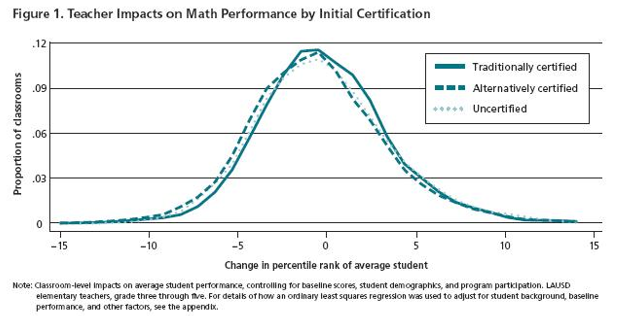 If you look very, very closely at this chart that comes from a study of student learning gains conducted by the Brookings Institution, you will see a dotted curve along with the line and dash curves. The three curves show the learning gains/declines from the students of traditionally certified teachers (the line curve), alternatively certified teachers (the dash curve), and finally from uncertified teachers (the dot curve).
Notice the lack of any meaningful difference in the overall curves; they all have highly effective teachers and highly ineffective teachers. But also note the difference between a right side of the bell-curve teacher and left-side is gigantic. As explained by the authors of the Brookings study:
Moving up (or down) 10 percentile points in one year is a massive impact. For some perspective, the black-white achievement gap nationally is roughly 34 percentile points. Therefore, if the effects were to accumulate, having a top-quartile teacher rather than a bottom-quartile teacher four years in a row would be enough to close the black-white test score gap.
Arizona lawmakers wisely gave charter school leaders the flexibility to recruit from any of the three curves in search of highly effective instructors. Ipsi prudenter elegerunt!
Veritas Prep found Mike Sullivan practicing law in a distant state and had the flexibility to coax him into a next great career. The adoration of Sullivan’s students and colleagues seems like a much greater compensation than any provided by a law firm.
More Sullivan-like instructors are likely awaiting discovery at some unexpected place. Find them and get them in the classroom!
Great Hearts Academy is the largest operator of classical charter schools in the U.S., with 33 schools serving 22,000 students in Arizona and Texas.
Editor’s note: This commentary about the largest operator of classical charter schools in the U.S. from Robert Pondiscio, a senior fellow at the American Enterprise Institute, appears in the Spring 2022 issue of Education Next.
Remote learning is hard to love. The nation’s forced experiment in online education the past few years has been a disaster for kids. Educators and parents alike have come to view virtual learning as a necessary evil at best, an ad hoc response to a national crisis.
In a survey by McKinsey & Company, 60% of teachers rated the effectiveness of remote learning between 1 and 3 out of 10. Many attribute remote learning to the catastrophic decline in academic outcomes and an alarming spike in mental health problems, with plummeting test scores and rising rates of depression and anxiety among students.
It’s also assumed to widen achievement gaps. The challenges of remote instruction “apply in affluent, English-speaking, two-parent households,” my colleague Rick Hess recently wrote. “Things get tougher still for single parents, families in tight quarters, or parents trying to communicate about all this in a second tongue.”
Online charter schools in particular had a poor reputation even before Covid, associated in many minds with low-rigor credit recovery, poor performance, and mediocre graduation rates. A recent Brookings study of virtual charter schools and online learning during Covid was particularly grim, concluding that “the impact of attending a virtual charter on student achievement is uniformly and profoundly negative.”
Given that bleak and unpromising landscape, an outlier may be emerging: The online version of Great Hearts Academies is proving to be both an academic standout and popular with families. That has officials at the Arizona-based charter school network quietly thinking about launching a low-cost, online, private-school model to bring classical education to anyone who wants it at a price point below—even far below—other options, including Catholic schools. It’s one of several initiatives Great Hearts is weighing to expand its offerings.
To continue reading, click here.

