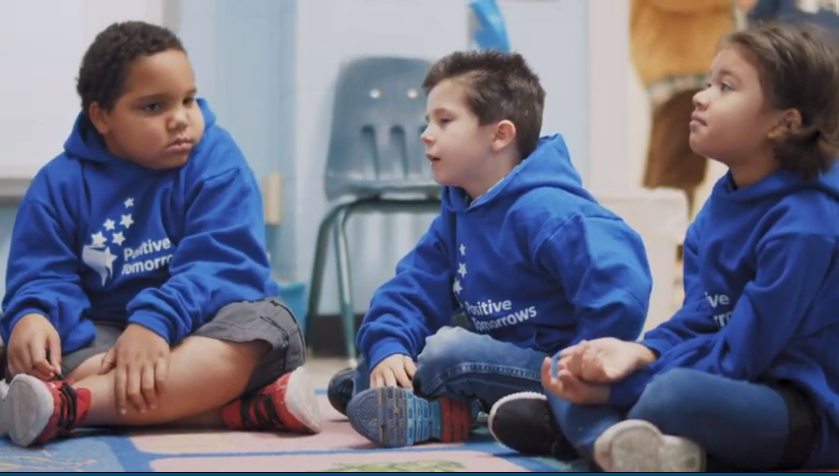
Positive Tomorrows, a private school in Oklahoma City, serves homeless students using a multi-pronged approach to address education and social service needs.
Susan Agel wants her students to gain experience. Silicon Valley internships and trips abroad would be nice, but for the students she serves, the needs are more basic.
Like riding in a car. Or going to a store — any store.
Agel’s school, Positive Tomorrows, is a private school serving homeless children in Oklahoma City. She says they enrolled one student who “had never been in a retail establishment. He had never seen his parents buy anything.” His only transportation was the occasional trip on a city bus.
“We’re a little different than most private schools,” Agel says, with a touch of understatement. One out of every five students at Positive Tomorrows is “couch homeless,” which means students sleep in motels, cars, on floors and do not have a home of their own, while another two-thirds live in homeless shelters.
“It’s these children who are living in deep poverty and are bouncing around [from] place to place and attend multiple schools in a school year,” Agel says. “They fall behind academically, they fall behind socially.”
Agel’s school specializes in providing wrap-around services for students and their families. She wants to help families out of homelessness and poverty and set them on their way to financial independence while students pursue academic independence.
“We help them find housing, make sure there is food and clothing and identify some goals that [parents] want to accomplish,” Agel explains — goals such as earning a GED or learning marketable skills.
“Once the families are stable and the kids are doing well in school, we will help them transition back into a public school,” Agel says.
Positive Tomorrows serves the “poorest in our community,” she says, and so her school “scholarships everybody for everything.” This nearly constant state of fundraising makes the uncertain economic times ushered in by the pandemic especially challenging.
“We turn away kids every year, and we don’t want to do that. We don’t like to do that,” Agel says.
Enter Oklahoma Gov. Kevin Stitt’s decision to use a portion of federal COVID relief spending for K-12 private school scholarships. Stitt set aside $10 million for these scholarships, while traditional schools received $161 million from the federal pandemic stimulus bill enacted in March. The governor’s office estimates that 1,500 students will have access to scholarships worth up to $6,500. Stitts set aside another $8 million for “digital wallet grants,” allowing 5,000 low-income families to use up to $1,500 for “curriculum content, tutoring services and/or technology.”
Gov. Stitt specifically recognized the need to help homeless students and the private schools that serve their families when he announced the scholarships.
Parents also are paying more attention to private schools this summer as traditional districts — such as Oklahoma City Public Schools — reopen exclusively online, while private schools such as Positive Tomorrows are preparing to open in-person. Given these decisions, national media have been quick to cite equity concerns, to which Positive Tomorrows and the new Oklahoma scholarships appear to answer.
“With the students we are serving, it’s highly important for them to be face-to-face in school,” Agel says. Most of the families in her school do not have internet access, nor do they have room to create temporary classrooms in homeless shelters.
Positive Tomorrows has a new facility built with the idea of expansion in mind — Oklahoma has some 26,000 homeless children, and Agel’s school enrolls 118 — so Agel hopes to use the extra space this fall to keep students in small groups.
As explained on redefinED, South Carolina Gov. Henry McMaster created similar K-12 private school scholarship options using federal COVID spending measures. New Hampshire Gov. Chris Sununu has also done so. Fiscal hawks (the few who still exist) should be concerned about current congressional debates for more pandemic spending since lawmakers toss around figures such as $3.5 trillion as though there is more to be found in between the cushions of the couch in the speaker’s office.
If more federal spending is coming, policymakers would do well to watch Oklahoma’s example. Such learning options should dominate educational equity discussions, turning the name of Agel’s school from an aspiration to a promise.
 Zach Bonner first made headlines in Tampa, Fla. in 2004, a plucky 7-year-old pulling a wagon through his neighborhood to collect donations for victims of Hurricane Charley.
Today, he and his mom travel the country in an RV, raising money for social causes. His nonprofit foundation, appropriately named Little Red Wagon, is widely recognized for its work with homeless youth.
Now, there’s even a movie about him playing in theaters. Not bad for a 14-year-old, but Zach, like other teenagers, still has to go to school.
Lucky for him, he can go whenever he wants.
Zach is enrolled in Florida Virtual School, the largest, state-funded public online education program in the nation. It offers students free courses taught by certified teachers. And, for students like Zach, who has become famous for his awareness-raising, cross-country walks, it offers flexibility.
“I have great teachers who understand what I’m doing,’’ said Zach, a freshman this year. “They know I travel around the country to help the homeless.’’
We caught up with Zach recently in Phoenix, where the film “Little Red Wagon” was premiering, and talked about how this nontraditional school setting enabled him to pursue his passion for philanthropy.
Florida Virtual, one of the state’s many school choice options, gave him the freedom to set his own schedule and take classes from home – or from any place that had a computer connection. Two years ago, he received school credits while he and his family spent six months on the road during a 2,478-mile trek that ended at the Santa Monica Pier in California.
Twelve at the time, Zach said he started the hike during winter break in December so he wouldn’t miss too much school. There were a few late nights, when Zach got back to the RV and had to fire up his computer to do homework. But because he could take courses at his own pace, Zach said he could easily take time off when he needed and make up work later. (more…)

