
Authors Daron Acemoglu and James A. Robinson distinguished between “inclusive” and “extractive” institutions in their 2012 book "Why Nations Fail." Inclusive political institutions allow broad political participation and are a precursor to inclusive economic institutions, which broadly protect individual property rights and provide incentives for workers to increase labor productivity. By contrast, Acemoglu and Robinson define extractive economic institutions as excluding large segments of the population from the distribution of income from their own activities. Extractive economic institutions benefit only elites.
Slavery would clearly qualify as extractive, but other institutions contain mixed elements. Public education systems can be thought of as falling on a spectrum between extractive and inclusive. All public education systems use involuntary taxation, which is extractive. Public education also allows for universal participation for school age children, which is inclusive.
To the extent that public education systems broadly equip students with the knowledge, skill and habits required for success, they are more inclusive. If, however, an institution provides such outcomes only to a subset of elite students, they become more exclusive. The extent that electoral participation in public education systems is broad, it is inclusive, to the extent that it is narrow, it becomes less inclusive. International examinations of student achievement have disappointing results for American students. Among countries that spend at least half as much per pupil as the United States (29 countries), America scored below all but one (see Figure 1) below.

We can judge the relative inclusivity of the American education system by seeing how our low-income children compare to low-income children in countries spending at least half of what the United States spends per pupil. Scores by family income data are available in the 2022 PISA exam, displayed in Figure 2 below.
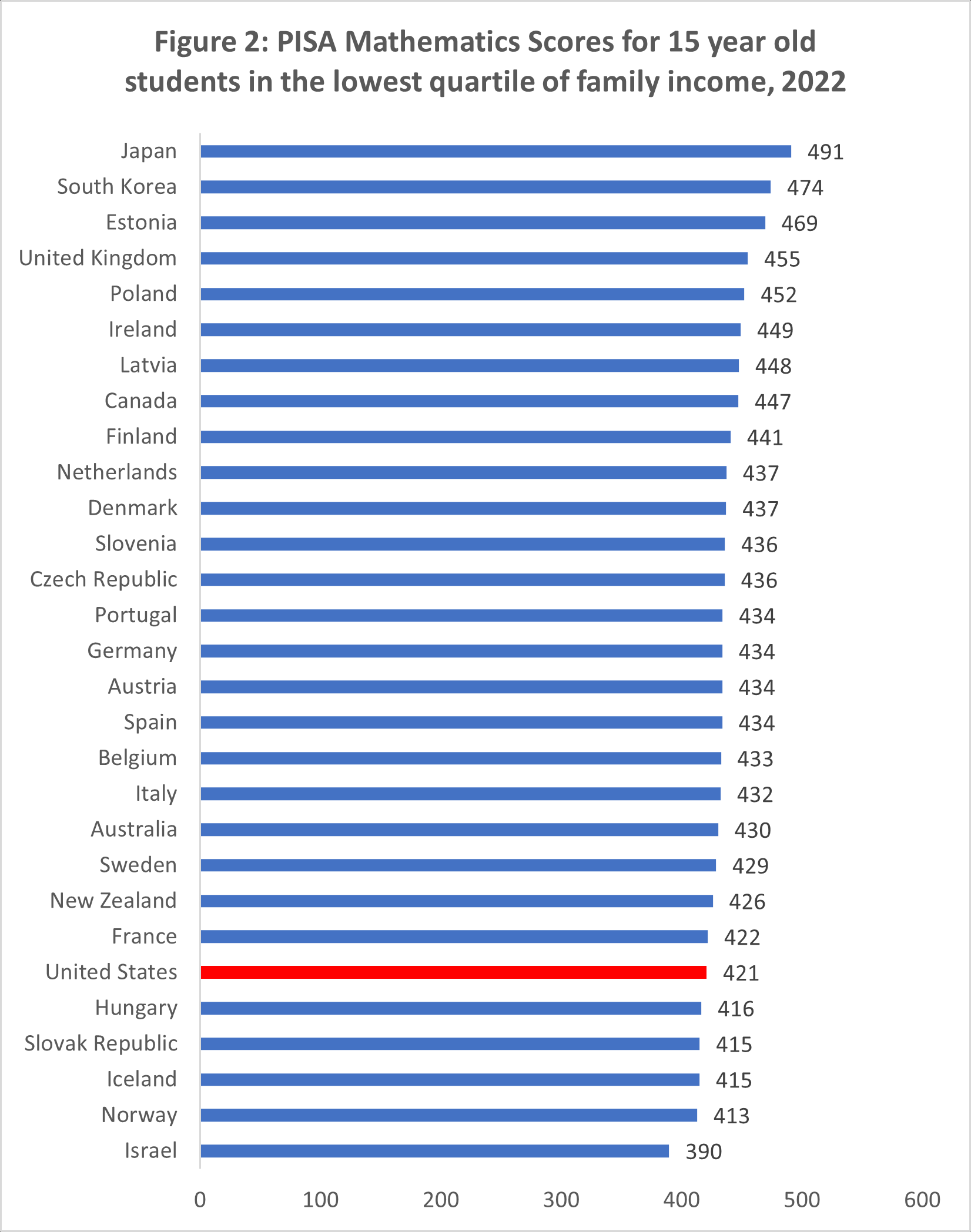
America’s poor students ranking low sadly does not surprise. What may be surprising is the fact that the poorest students in Japan scored 491 in 2022, which was higher than the average American student in 2018. Despite the 2022 test reflecting the impact of the COVID-19 pandemic and despite Japan spending approximately 40% less per pupil than the average in the United States, poor Japanese students outscored the average American student from 2018.
The United States has a costly, inefficient and relatively extractive system of public education. If you are curious about who the extractive elites benefiting from the status quo might be, simply observe who fights to preserve the system. We can’t be sure why American schools are so extractive and ineffective. Combining ZIP code assignment with regulatory capture and layering on a Rube Goldberg machine of state and federal regulation appears deeply suboptimal.
Several weeks ago, we looked at American racial achievement gaps in math and reading from an international perspective using data from the Program for International Student Assessment, an international test that every three years measures reading, mathematics and science literacy of 15-year-olds.
In 2012, the PISA exam included subgroup specifically for Florida. Let’s take a look:
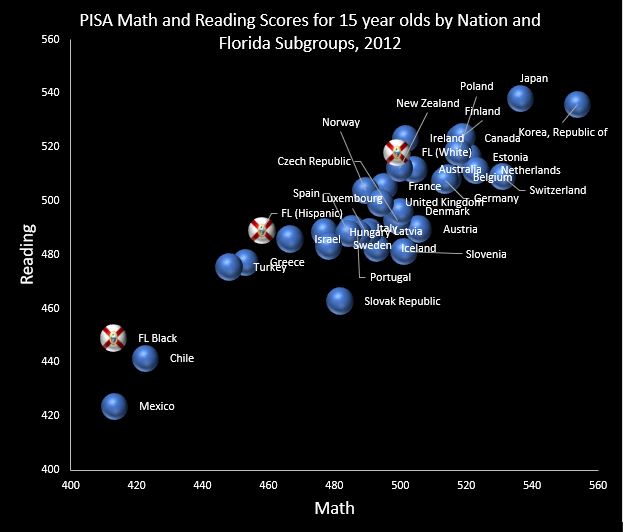
So, a couple of notes. This PISA data is from 2012. The National Center for Education Statistics shows that Florida’s white, black and Hispanic students all saw very large academic gains since the 1990s. We have reason to fear, therefore, that if the PISA exam had been given in, say, 1998, the results would have looked very frightening indeed. As it is, the results didn’t look so great in 2012.
Florida’s black students land in the vicinity of students in Chile and Mexico. Chile and Mexico spend only a fraction of what is spent per pupil in the United States and must contend with much larger student poverty challenges. Florida’s Hispanics scored higher, but still performed similar to students in Greece and Turkey, lower-spending countries.
The Third International Mathematics and Science Study exam from 2015 allows us to take a similar look at Florida subgroup achievement in international context. PISA and TIMSS test a different grouping of countries (with quite a bit of overlap) and test somewhat different things. Nevertheless, TIMSS also included Florida subgroups.
Here are the results for mathematics for nations and Florida racial/ethnic subgroups on eighth-grade math.
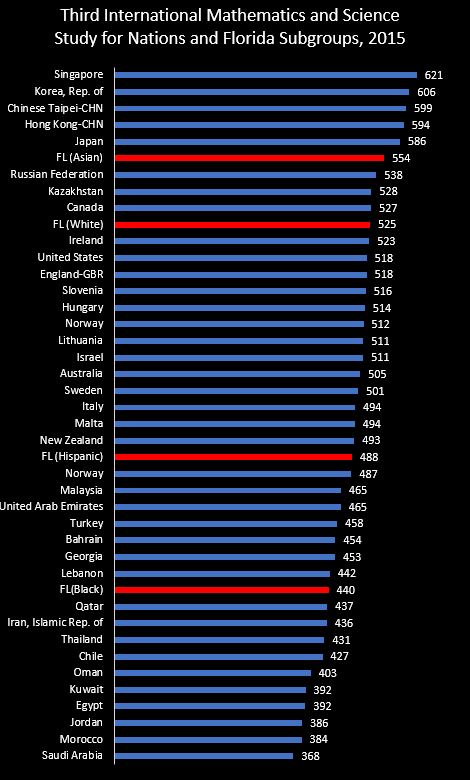
As was the case in the PISA data, American black students achieved similarly to students in nations that spend only a fraction of what American schools spend per pupil, and with more severe poverty challenges. Florida’s Hispanic students score higher but also find themselves outscored by countries such as Malta, Slovenia and Kazakhstan, which don’t begin to match American levels of spending. Florida’s Asian and Anglo students didn’t conquer the globe but had scores that were comfortably European if not Asian.
Make what you will of this information, but in my opinion, we have miles yet to go.

