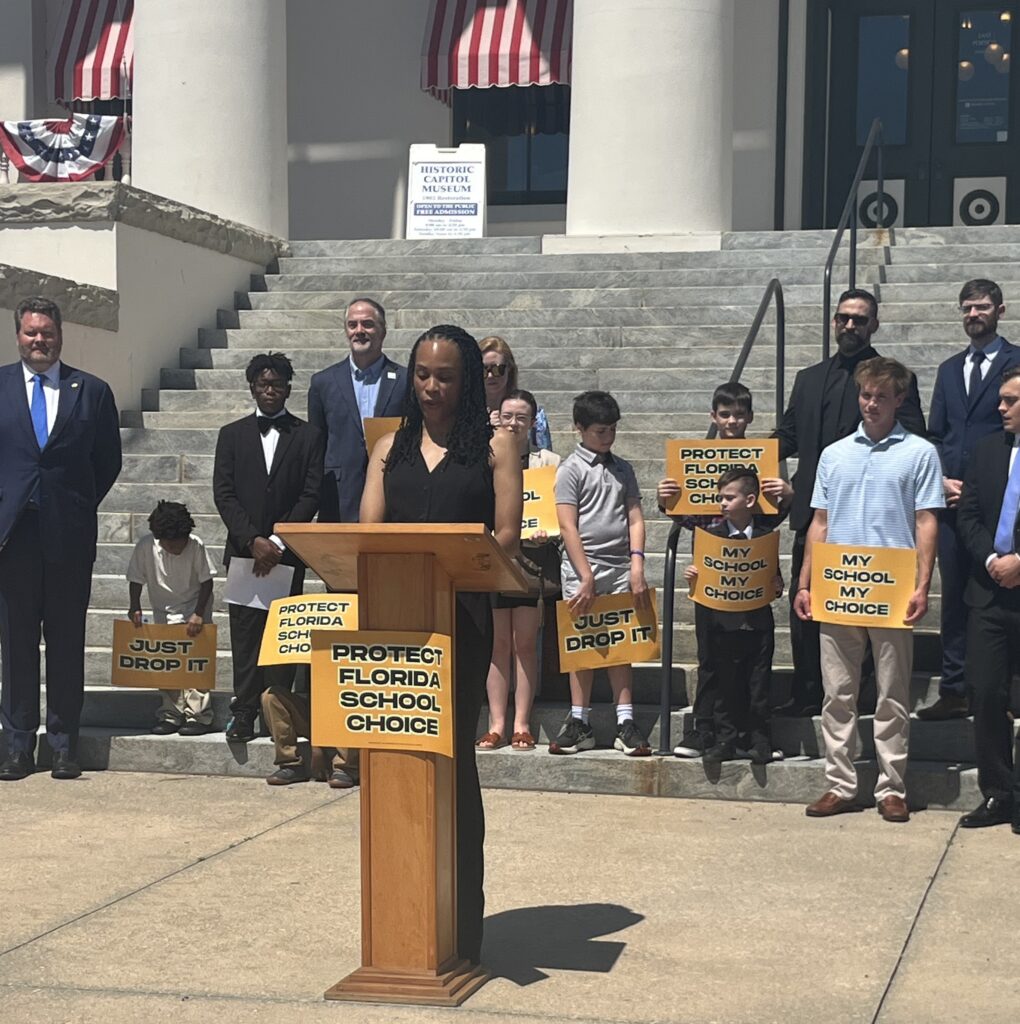
PINELLAS PARK, Fla. — Surrounded by students in crisp school uniforms, a group of educators, faith leaders, and families urged Florida’s teachers union to drop a lawsuit that seeks to end the nation’s largest K-12 education choice programs.
“I am not anti-public school. Public schools work for many children. But they don’t work for every child, including my sons,” said Leslie Coker, a stay-at-home mom whose two school-age sons have radically different unique abilities and who have benefited from the learning options the programs provide. The scholarships made it possible for a single-income household like hers to afford to send one child to a hybrid school and homeschool the other son full time. Both boys are thriving in learning environments that best fit their individual needs.
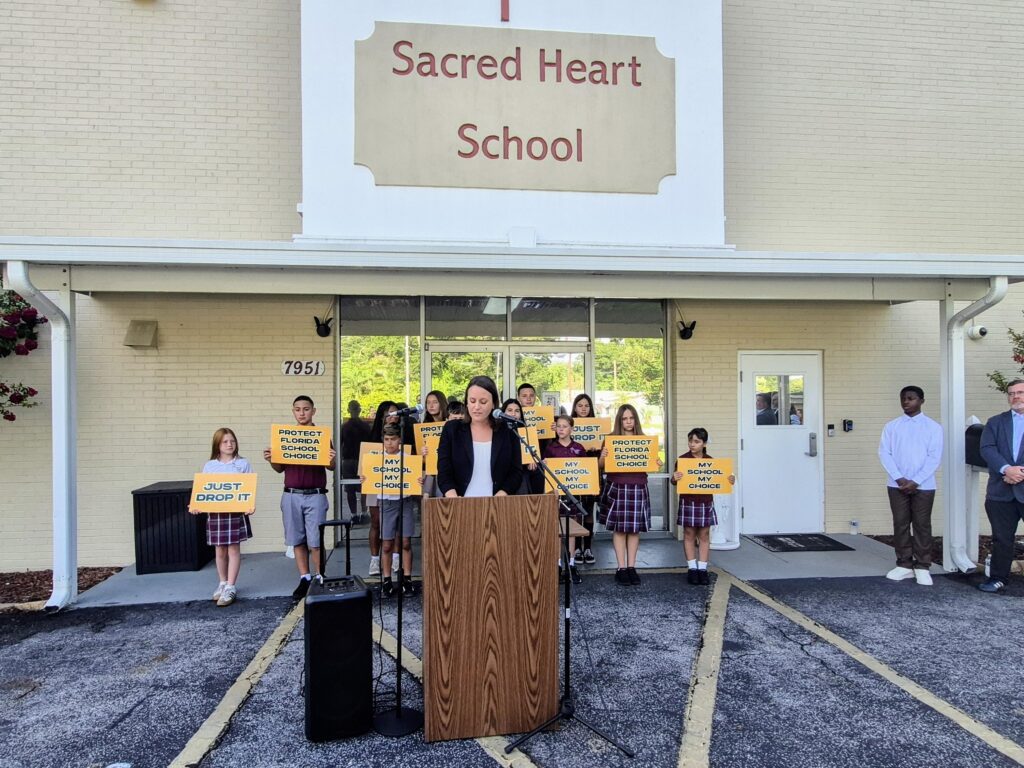
“For me, this lawsuit is not political. It is personal. If it succeeds, the impact will hit my family hard, as well as many others," the Bradenton area mom said. We are living proof that education choice is working in Florida. I urge the teachers union to respect our choices and drop the lawsuit.”
Mrs. Coker made her plea on Wednesday at a news conference at Sacred Heart Catholic School, which serves more than 200 students in preschool through eighth grade. Florida Catholic schools have increased their enrollments over the past decade in contrast to their counterparts in other states, which have seen declines. They credit Florida’s robust state scholarship programs, which have made the Sunshine State the national leader in empowering parents to choose the best learning options for their children.

“Ultimately, this debate comes down to one simple question: Who is best equipped to make educational decisions for these children? A bureaucrat sitting in an office hundreds of miles away? Or the parents who know, love, raise and sacrifice for that child every single day?” said Christopher Pastura, schools superintendent for the Diocese of St. Petersburg. He called the lawsuit “misguided and wrong” and urged the union to withdraw it.
“We cannot go backward,” he said.
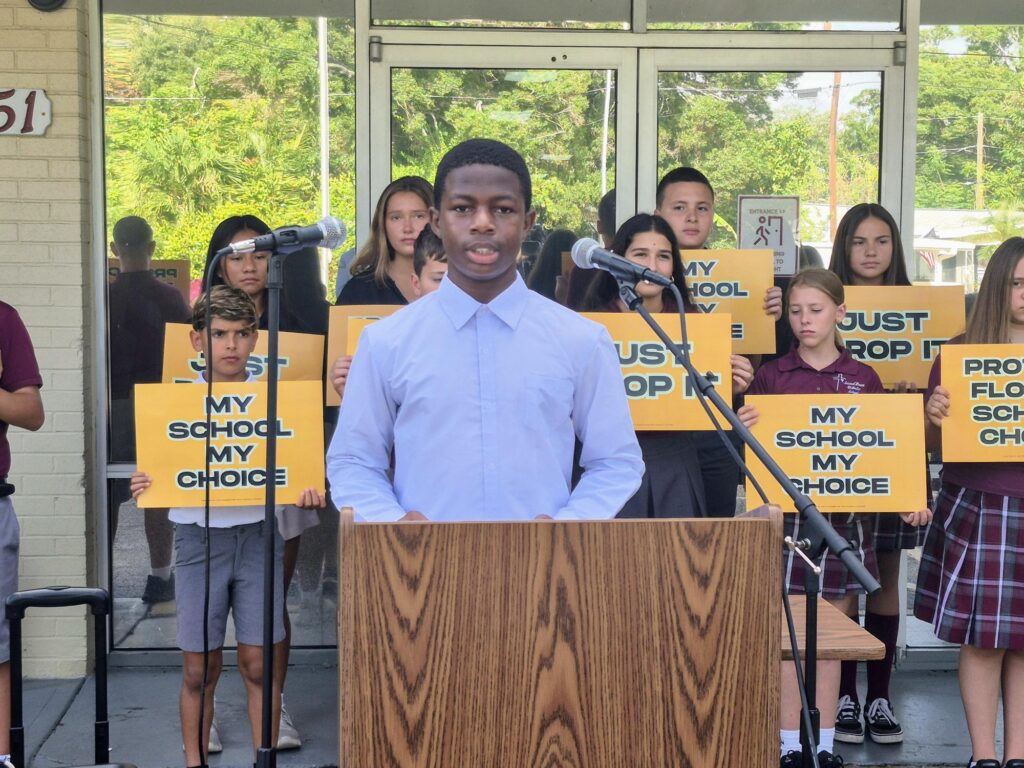
Supporters began speaking out within weeks after the Florida Education Association and others sued the state on May 5 over its three-decade-old private school scholarship and charter school programs. The latest figures from the Florida Department of Education show that 1 million Florida K-12 students are now educated outside of district schools. A news conference, organized by former Gov. Jeb Bush’s Foundation for Florida’s Future, was held May 14 outside the Old State Capitol in Tallahassee. Step Up For Students, which manages virtually all the state’s K-12 scholarship programs, organized Wednesday’s event.
James Hartman, executive director for IDEA Public Schools in the Tampa Bay area, noted that Florida charter schools, which the law established in 1996, now serve nearly 400,000 students on more than 700 campuses.
“Charter schools are not opposed to public education,” he said. “Charter schools are part of public education.”
Hartman said he hopes that as the lawsuit makes its way through the courts, the focus can stay where it belongs — on students.
For the low-income families who live in the part of Tampa served by Faith Action Ministry Alliance (FAMA), the scholarship programs are not a luxury but a lifeline.
Students who attend the FAMA-owned Grant Park Christian Academy share what they learn at home, said the Rev. Alfred Johnson. That elevates the educational level of an entire community.
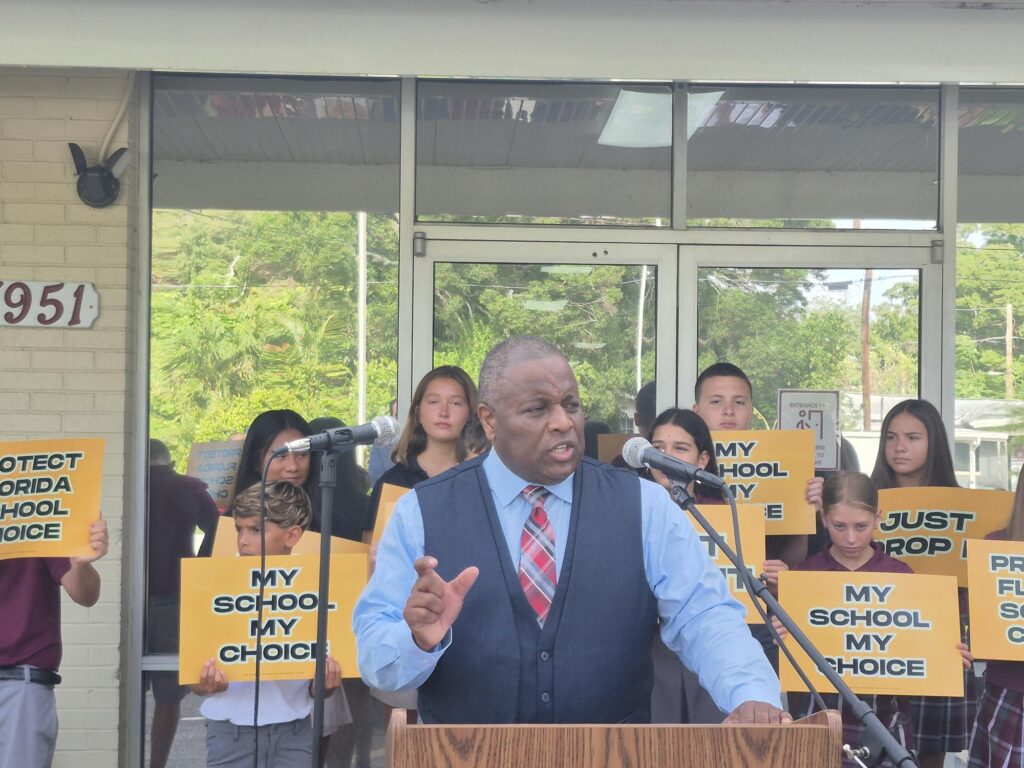
“I remember one mother telling us through tears, ‘My children are learning things at school that we didn’t even know in our home. They’re bringing it back home — and it’s changing our family.’”
Johnson said county commissioners tell him that more programs like his are needed to help those living in low-income communities.
“So how can we say we want to save neighborhoods while simultaneously attacking the very programs helping to save them?” he said. “I urge the teachers union to abandon this lawsuit — so that we do not abandon our children.”
TALLAHASSEE, Fla. — Parents, students, and education leaders who gathered at the Florida Capitol on Thursday had a message for the Florida Education Association, the teachers union that filed a lawsuit to end K-12 education choice scholarship programs used by nearly 540,000 children, as well as all charter schools.
Just drop it.
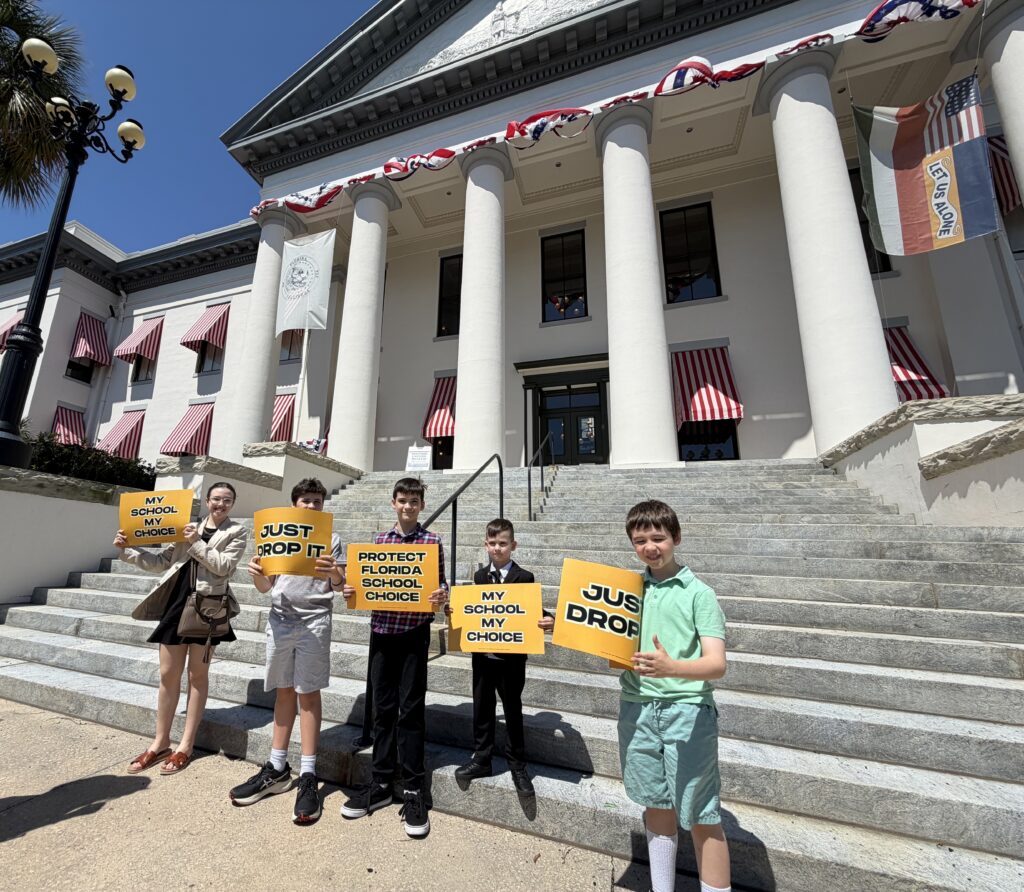
That was just one of the messages on the signs that supporters held up as they stood on the steps of the Old State Capitol building, as advocates proclaimed how education choice scholarships changed lives for the better. “My School My Choice” and “Protect Florida School Choice” could also be seen on the bright yellow signs. Former Gov. Jeb Bush’s Foundation for Florida’s Future organized the news conference. Bush launched the private school choice movement in 1999, right after he became governor.
“The scholarships are VERY important to me,” said Kiteka Walker, whose son, Rashad, is in seventh grade at Dixon School for Arts & Sciences in Pensacola. After attending previous schools and homeschooling Rashad, he asked to return to school. She sent him to Dixon because it was the right fit, offering Rashad opportunities to participate in student government, the robotics team, and other enriching activities. The Florida Family Empowerment Scholarship he received made it affordable for him to attend the private school while his two younger brothers attended a private elementary school. If the lawsuit succeeds in eliminating the scholarships, Walker said she would have to homeschool him again because she could not afford private school for three children.
“Parents choose where we send our children to daycare, we choose where to go to college. Why can’t we do the same with K-12 schools?”
Rashad Walker, who traveled to the event with his family, shared how he is thriving at the school his mother chose for him.
“Dixon has been the perfect fit for me. It has a lot of culture and provides a bunch of opportunities in band, art, singing, technology, and media,” he said.
Rashad, who also participates in robotics and serves on the student council, said the school encourages him to try new things, like playing a piano that had been gathering dust at home for years.
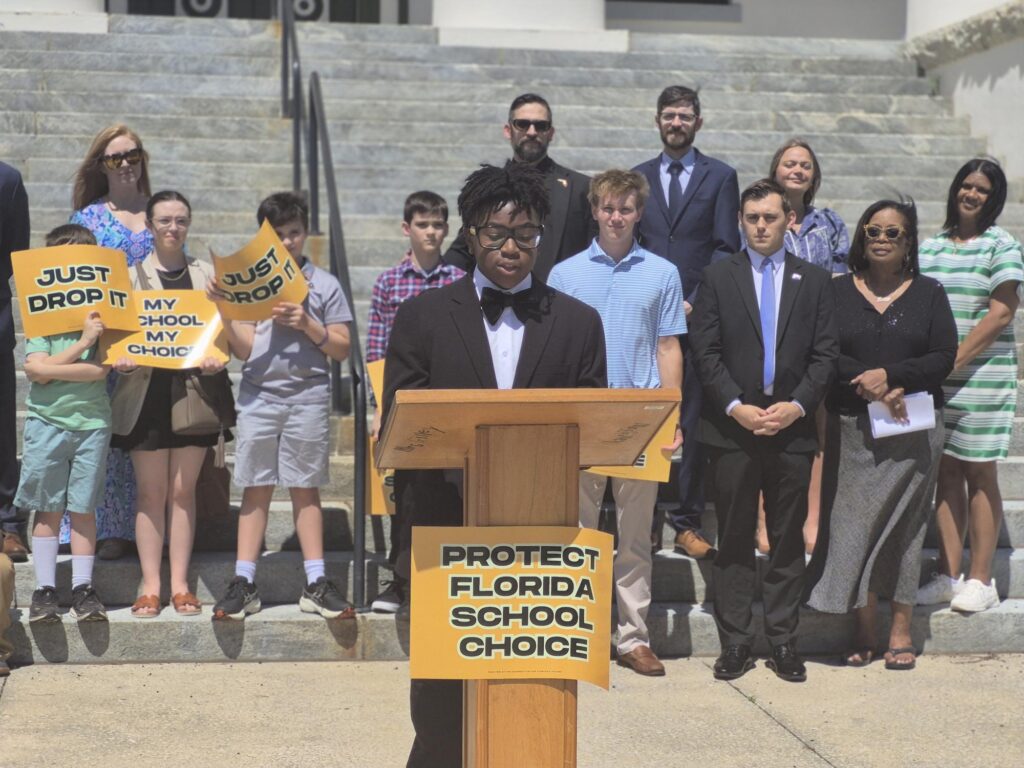
“Dixon inspired me to teach myself to play the piano. I practice every day on that piano at home. No more dust,” he said.
Last fall, when he was hospitalized for three weeks following knee surgery, Rashad created craft kits called DUCK bags that help kids combat boredom. He sold the kits at business fairs and is making some to donate to children’s hospitals.
None of that would have happened if it weren’t for Dixon, he said. And Dixon wouldn’t have happened if it weren’t for the scholarship.
“That’s why I don’t understand this lawsuit,” Rashad said. “Why get rid of something that is life-changing for other people? That helps them achieve better things in life?”
Rita Brown can see proof that education choice changes lives every day at Brownsville Preparatory Institute in Tallahassee, a private school she founded more than 20 years ago.
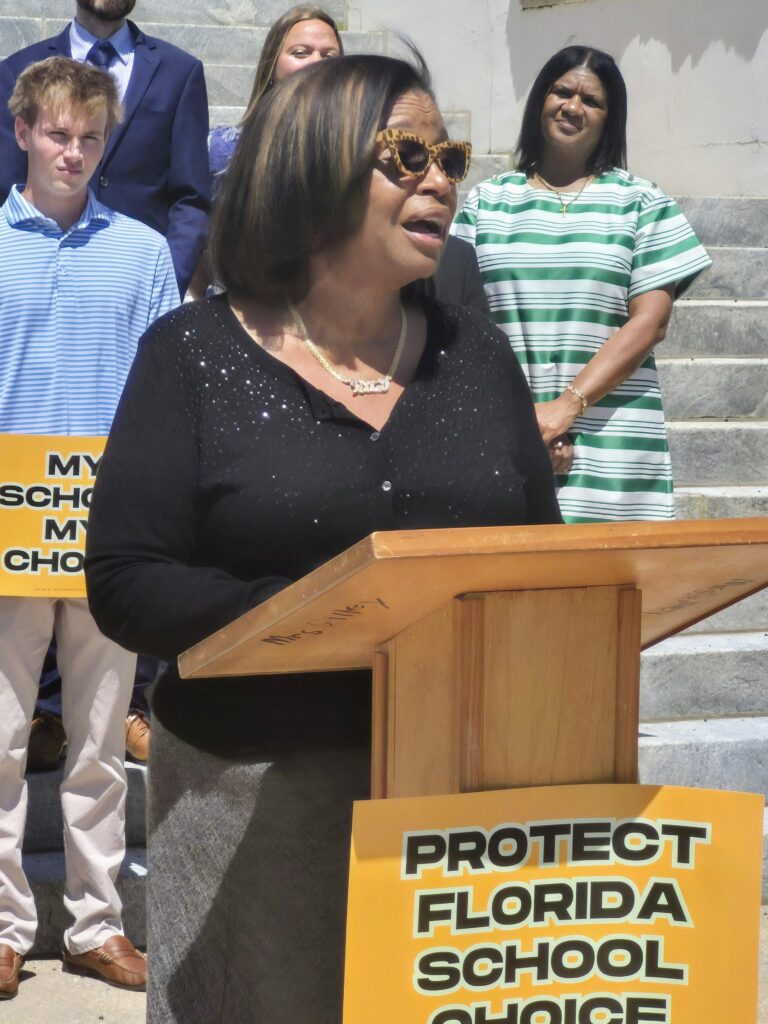
The school began as a pre-kindergarten and now serves 95 students through third grade. Brownsville is in a low-income community. Most parents can’t afford private education after their 4-year-olds complete the state-subsidized pre-kindergarten program.
The scholarships, Brown said, changed that.
It allowed her to add grades. Today, Brownsville students typically learn to read at age 3 and are adding, subtracting, writing, and learning cursive.
“We are the best school in our neighborhood,” she said. “Florida’s education choice scholarships have been a vital part of that.”
If the teachers union wins in court, Brown said, the school would lose most of its school-age children.
“That K-3 program would probably die. It would be devastating for our parents. We have all these students doing amazing things, but they would be forced to go to schools that don’t meet their needs. “
She called the lawsuit “frivolous” and “an attempt to turn back the clock.” But Florida is too embedded in education choice to return to a bygone era.
“At the end of the day, we need to be collaborative in educating all students,” Brown said.
The event inspired a lawmaker to attend to voice his opposition to the lawsuit.
State Sen. Jonathan Martin, R-Fort Myers, said empowering parents to choose the best options for their children does not take away resources from other students and makes America “the light on the hill that Ronald Reagan talked about.”
Florida’s robust scholarship programs have led the way and “will continue to make sure our light stays the brightest, not just in this country but around the world.”
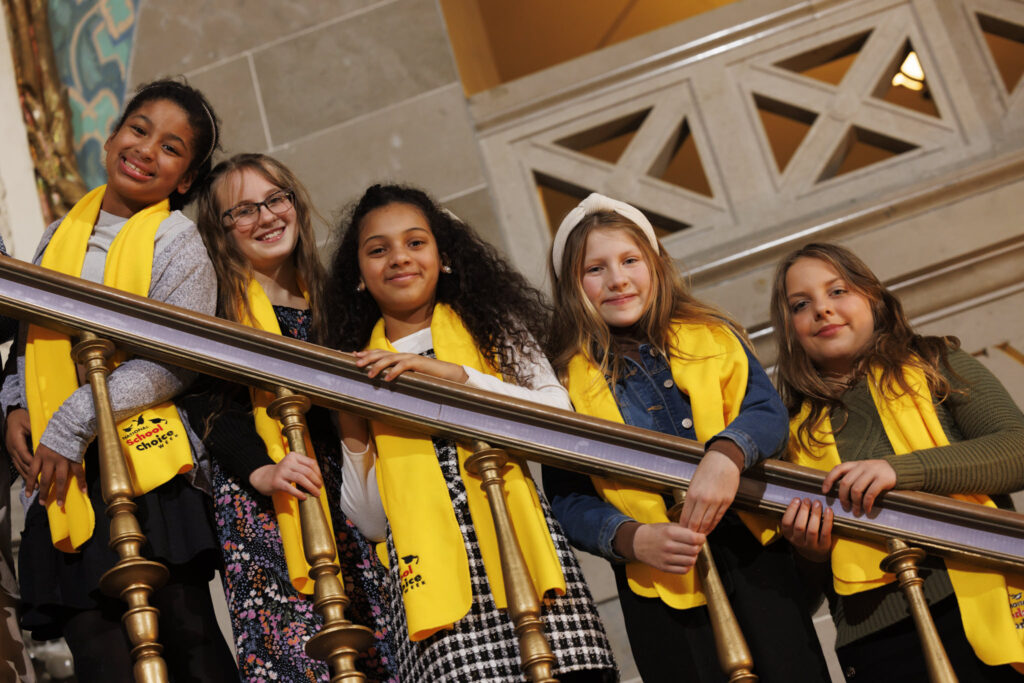
The time has come when we officially recognize National School Choice Week. However, we at Step Up For Students like to say that every week is National School Choice Week.
We are proud that Florida is the national leader in empowering parents to choose the best educational fit for their children. More than half of the state's K12 students used some form of education choice in the 2023-24 school year, according to the Florida Department of Education.

Parents’ ability to direct their children’s education has always been important, but even more so in the past 100 years, when the U.S. Supreme Court ruling in Pierce v. Society of Sisters (1925) gave parents the right to choose between public and private options.
“The child is not a mere creature of the state,” Justice James C. McReynolds wrote in the unanimous decision that the government cannot compel children to attend only public schools.
Catholic schools, which were the target of the law the high court struck down, cheered.
Fittingly, Catholic Schools Week, which we also recognize, is running concurrently this year with National School Choice Week. With its robust statewide choice scholarships, Florida is also a national leader in Catholic school enrollment growth.
National School Choice Week is a non-partisan celebration that encompasses all forms of choice: Traditional district schools, public magnet schools and charter schools, virtual schools, private schools, both religious and secular, microschools, home education and customized learning powered by education savings accounts that can include a mix of public and private programs.
Events are happening across the nation, from capitol rallies to school choice fairs to students in signature yellow scarves performing the official National School Choice Week dance in their classrooms or homes.
Throughout the week, NextSteps will share stories of students and families who have benefited from Florida’s many educational options. You will meet a young hockey player whose Personalized Education Program scholarship has allowed him to travel with his team to compete in international tournaments while keeping up with his schoolwork and educational goals. Ron Matus, Step Up’s director of research & special projects, will share his memories of a former student who was among the state’s first recipients of Florida Opportunity Scholarships pioneered by former Gov. Jeb Bush. A couple of years in a Catholic school were enough to put him on a path to a better life.
We will also bring you a story by a Tampa Bay FOX affiliate of a single parent who was able to send her son, who struggled in other schools with his autism, to a school where he is thriving, with dreams of going to college.
We will cap off the week at the festivities Thursday in Tallahassee, where Step Up representatives will have information about the Feb. 1 season open for 2026-27 scholarship applications.
Even if you aren’t at the rally, you can still learn about the scholarships and apply at www.stepupforstudents.org.
We can’t wait until next week. And the week after. And the week after that.
Because we serve Florida, where choice is the norm for all public education.
By Ron Matus and Dava Cherry
Florida’s choice-driven education system is the most dynamic and diverse in America, but it’s facing new tests. This year, 41,000 Florida students were awarded school choice scholarships but never used them.
We wanted to know why, so we surveyed their parents.
The 2,739 who responded had a lot to tell us. Not only about supply-side challenges, but about the extent to which families are migrating between different types of schools, and their expectations for finding just the right ones.
As education choice takes root across America, we thought other states could learn from these parents, which is why we boiled their responses down into a new report, “Going With Plan B.”
We saw three main takeaways:
A third of the respondents (34.7%) said there were no available seats at the school they wanted. This, even though the number of Florida private schools has grown 31% over the past 10 years. Meanwhile, a fifth of the respondents (19.7%) said the scholarship amount wasn’t enough to cover tuition and fees.
Even without scholarships, a third of the respondents (36.5%) switched school types (like going from a traditional public school to a charter school). And between their child’s prior school and the school they ended up in, more experienced a positive rather negative shift in satisfaction (20.4% to 10.5%). We didn’t see that coming.
Two thirds of the respondents said they’d apply for the scholarships again, including 63% of those who switched school types, and 55.5% of those who were satisfied after doing so.
Things got better, it seems, but not better enough.
Perhaps as choice has grown, so too have parents’ expectations.
See the full report here.
Dava Cherry is the former director of enterprise data and research at Step Up For Students, and a former public school teacher.

"War, huh, yeah
What is it good for?
Absolutely nothing"
— Edwinn Starr, "War"
The District of Columbia Public School system has a troubled history with special education. In reviewing a U.S. Commission on Civil Rights study on the subject, footnote 4 on page 7 led to a data source in which DCPS stood out like a very sore thumb: disputes between families and the district over special education: In 2018-19, DCPS had a rate of special education due process complaints filed which stood at more than eight times the national average per 10,000 students with disabilities served:

This led me to wonder what more recent data, and to wonder about how the states of Arizona and Florida would compare to DC in that more recent information. A web of policy diffusion between the states of Arizona and Florida resulting in both states eventually adopting robust formula funded education savings account programs for students with disabilities. The process began in Florida in 1999, when Florida Senate President John McKay passed and Gov. Jeb Bush signed what became a statewide voucher program for students with disabilities. Under the federal IDEA legislation, parents had the right to sue school districts for failure to provide a free and appropriate education (FAPE) for a district-financed private school placement. The practical difficulties of financing such a suit, however, left it as an avenue mostly accessible to well-to-do families. Districts have long contended that they do not receive enough funding for special education.
The McKay Scholarship program turned both of these unfortunate facts on their heads: you no longer needed to file a lawsuit to access private schools. Moreover, McKay Scholarship-participating families were entitled only to the funding that districts have spent decades describing as inadequate. Access to private education for students with disabilities was delightfully democratized and a financial win-win developed for families and districts. Tens of thousands of special needs students participated in the program, and it spent many years as the largest school choice scholarship program in the country.
Over in Arizona, our education freedom Scooby-gang was determined to emulate Florida’s success. In 2005, Arizona lawmakers passed, and Gov. Janet Napolitano signed a voucher program for children with disabilities. The Arizona school district industrial lobbying complex sued the program, and in 2009 the Arizona Supreme Court struck it down as violating the Blaine Amendment in Arizona’s Constitution. The Arizona Blaine Amendment forbade aid to “private or religious schools.” Dan Lips had proposed an account-based choice program in a paper for the Goldwater Institute, and the lightbulb moment happened: an account-based program with the option not to spend money at private and religious schools would be meaningfully different than a voucher program as pertaining to constitutional issues, among other advantages. Firing up our school choice Mystery Machine, we passed the first ESA program in 2011 and survived court challenges. Our compatriots in Florida became the second state to pass an ESA program for students with disabilities in 2015, and the ESA and McKay programs were eventually merged into a single ESA program.
How could this help DCPS and their never-ending cycle of special education conflict? Below is that more recent special education conflict data I referred to, and the rate of various conflict measures per 10,000 students with disabilities are displayed for Arizona, DCPS and Florida.

DCPS should not wait on the federal Olympians to look down from their perch on Capitol Hill to impose such a peace settlement on DCPS and the families it is constantly at war with. DCPS should settle this peace themselves as fast as possible by creating a robust ESA program for students with disabilities. You may say I’m a dreamer, but I’m not the only one. Someday DCPS will join us in this humane and beneficial policy and give peace a chance.
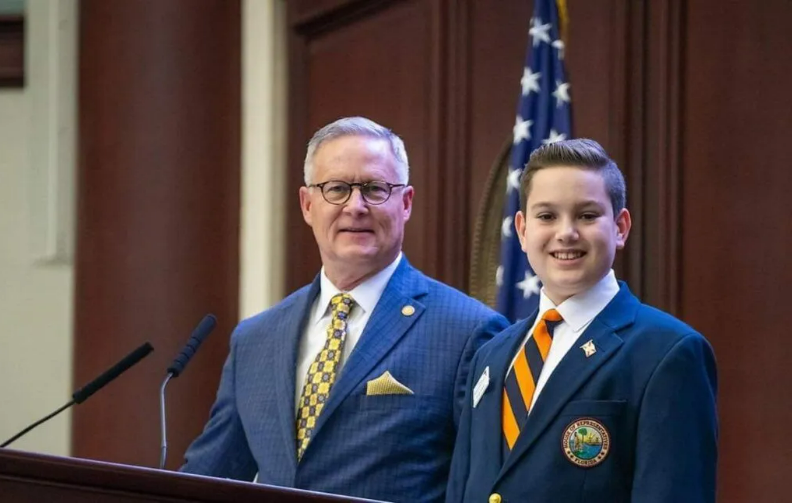
Cooper Campen, right, met House Speaker Pro Tempore Chuck Clemons, R-Newberry, while serving as a student page during this year's legislative session. Cooper and his younger brother, Alexander, receive education savings accounts as part of the state's Personalized Education Program.
More students would be able to use scholarships at hybrid schools, scholarship programs for students with disabilities would grow more quickly to meet demand, and religious virtual schools could become eligible to participate in scholarship programs under a bill passed during Florida’s 2024 legislative session.
Provisions in HB 1403, by Rep. Josie Tomkow, R-Polk City, and Sen. Corey Simon, R-Tallahassee, would:
The bill will be sent to Gov. Ron DeSantis for his signature.
The bill’s bipartisan passage drew praise from the Foundation for Florida’s Future, the nonprofit education organization founded by former Florida Gov. Jeb Bush.
“As Florida’s parental choice landscape continues to expand, we look forward to working with Gov. DeSantis, the legislature and the Department of Education to ensure Florida remains the national leader in parental choice,” the foundation said in a statement on its website.
Editor's note: This story is published in celebration of National School Choice Week, which runs Jan. 21-27.
In the early 1980s, a young educator and pastor named Frederic Pinkney received a vision of a school where all children got the attention they needed to succeed.
Years later, in 1996, he left his Duval County district classroom to co-found Joshua Christian Academy and make that vision a reality in Jacksonville. The school’s journey from scrappy start-up to enduring community institution in the northwest corner of Florida’s largest city traces the 25-year arc of education choice in the Sunshine State, which reached new highs this school year thanks to the largest-ever expansion of educational options in America’s history.
Joshua Christian Academy opened its doors three years before Jeb Bush became Florida’s 43rd governor and led the charge for school choice scholarships in the Sunshine State, which was then called the nation’s most ambitious program.
“People paid for their children to go,” Pinkney recalled.
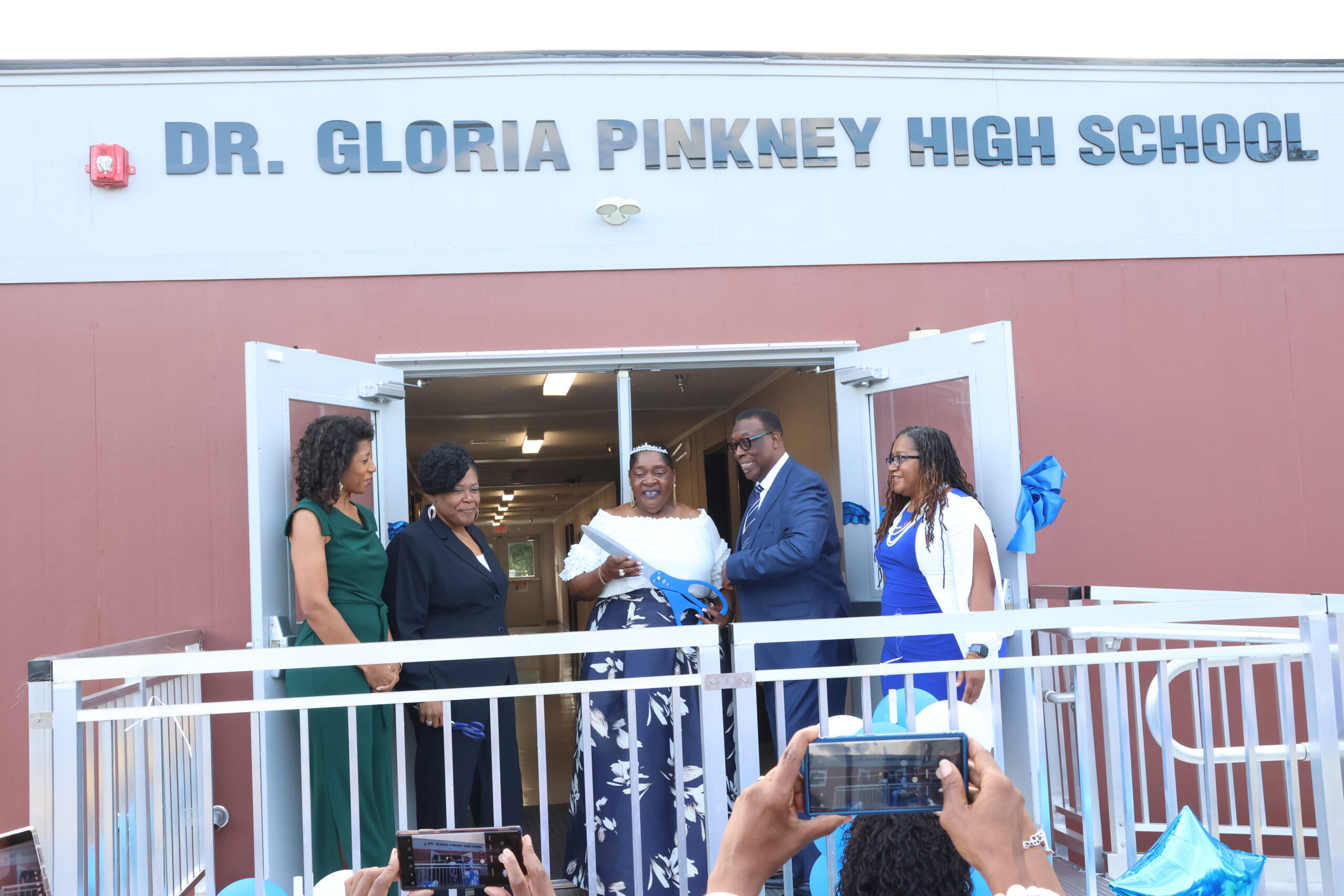
School leaders celebrate at a ribbon cutting for Joshua Christian Academy's new building, named for co-founder Dr. Gloria Pinkney. Photos courtesy of Joshua Christian Academy
The community was hungry for options. As a public-school teacher, Pinkney enjoyed helping students learn, but he also saw plenty who were struggling.
“I saw some kids were slipping through the cracks,” he said. He saw kids being passed along to the next grade without mastering the skills necessary to be promoted. He also saw kids, especially Black boys, disciplined more harshly than white kids for the same infractions.
He said he knew there had to be a better way.
Before the school officially opened, Pinkney served as the sole employee. That included getting an occupancy certificate from city hall, where staff kept saying no.
“For three months, I went to city hall every day, four or five times a week,” before a director signed off on the request. “I never backed down.”
With approvals finally in hand, Pinkney opened the school with six students. His wife, Gloria, a 19-year elementary school educator, left her job and helped her husband run the school. Church members volunteered for non-instructional tasks. Pinkney’s sister made lunches for the children. The Pinkneys' daughter, Lisa Harris, also played a key role.
 In the early years when there was no state funding source, Joshua Christian Academy experienced uneven growth and at one point had to eliminate the upper grades due to low enrollment. (Those grades were later restored as younger students got promoted.) However, the school managed to grow its elementary school enrollment as word spread about the school’s high academic standards, smaller class sizes and commitment to personalized education. With the state legislature’s passage of the Florida Tax Credit Scholarship Program in 2001 and later the Family Empowerment Scholarship Program in 2019, enrollment began to increase rapidly.
Last year’s passage of HB 1 provided the rocket fuel that sent enrollment to 400.
“It turned night into day,” he said. “It changed the culture.” He said the school’s phone rings constantly with calls from parents who want to send their kids there.
“It’s probably ringing right now,” he said.
 Such growth has allowed the Joshua Christian Academy, home of the Eagles, to offer a comprehensive athletics program and provide transportation to and from school with its fleet of seven shuttle vans and three traditional school buses. Pinkney said some students live at least 20 miles away, though the average distance is about 10. Three years ago, Joshua Christian Academy graduating class members received more than $1 million in higher education scholarships, a point of pride for Pinkney.
He credits this achievement to his daughter, Lisa Harris, who is now the school’s executive director and has taken over the school’s day-to-day operations as Pinkney stepped back to work with the church.
Pinkney is also quick to credit his wife, whose many years of experience as an educator helped provide a foundation of excellence from the beginning. In November, Joshua Christian Academy cut the ribbon on a new building to house the upper grades. Its name: “Dr. Gloria Pinkney High School.”
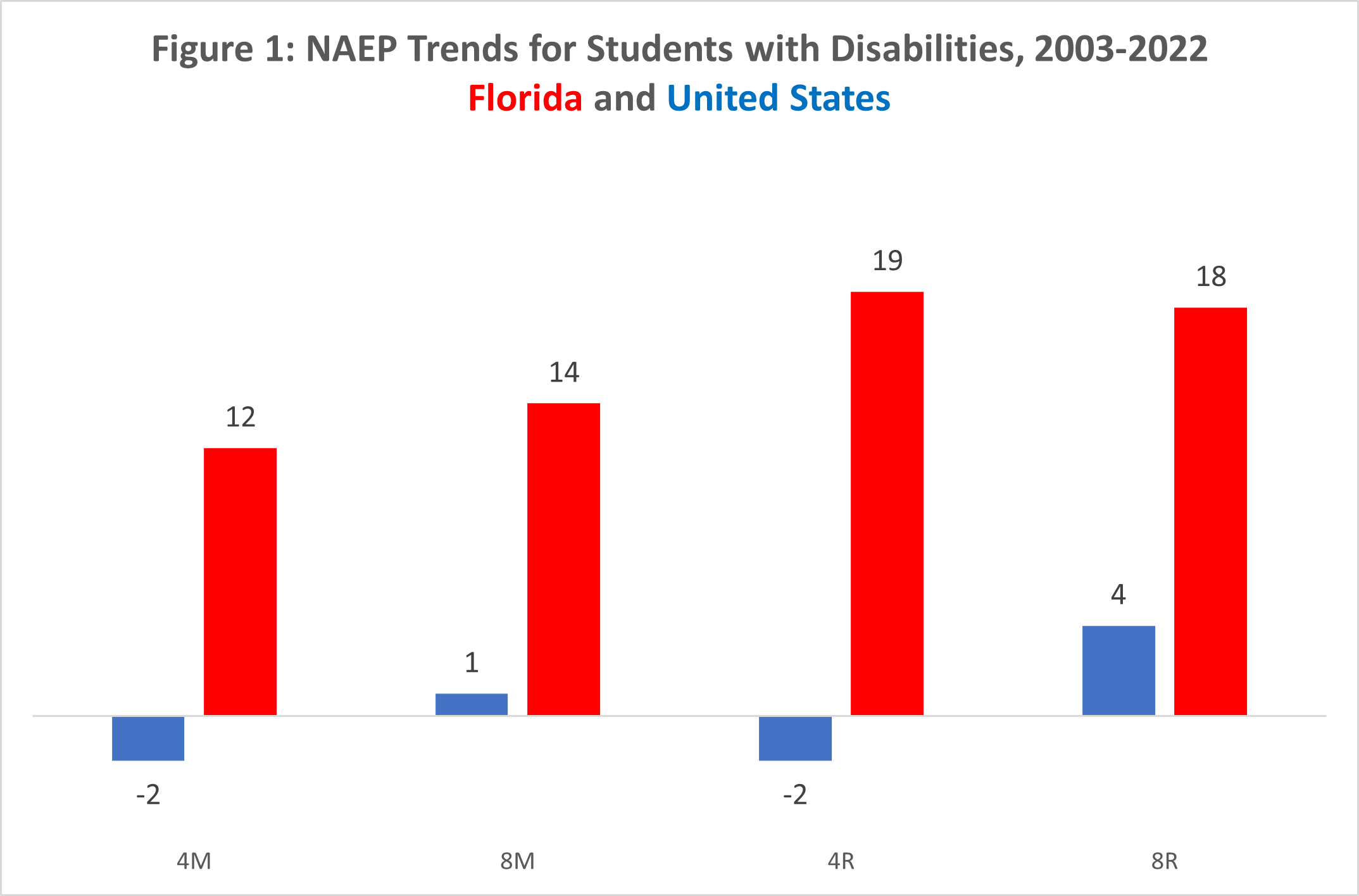
If you take the Nation’s Report Card data back as far as it will go to capture all 50 states (2003) and up until the most recent exams (2022), the trends for students with disabilities look like the chart above. For the United States across four exams you get a net 1-point increase. Let’s call that the midpoint between “spinning your wheels” and “playing in your food” spectrum. Meanwhile Florida made a net 63 points of progress, a grade level or more on each of the exams. A suite of reforms seems to have helped drive this progress.
Florida Gov. Jeb Bush’s reforms started in 1999 and included the creation of the nation’s first private choice program for students with disabilities. You can examine Figure 1 above and ponder whether the continual predictions of doom made by choice opponents seem the
least bit credible. Florida lawmakers created a separate education savings accounts, or ESA program, for students with unique abilities before consolidating the programs. Florida’s students with disabilities have had more choice access for a longer period of time than students in any other state.
Florida’s policies with a plausible connection to academic progress for students with unique abilities don’t end with choice. Florida pioneered the grading of schools A-F. Crucially, the Florida formula double weights the academic gains of the bottom 25% of students on the previous year’s state standardized exams.
 Editor’s note: This article appeared Tuesday on postandcourier.com.
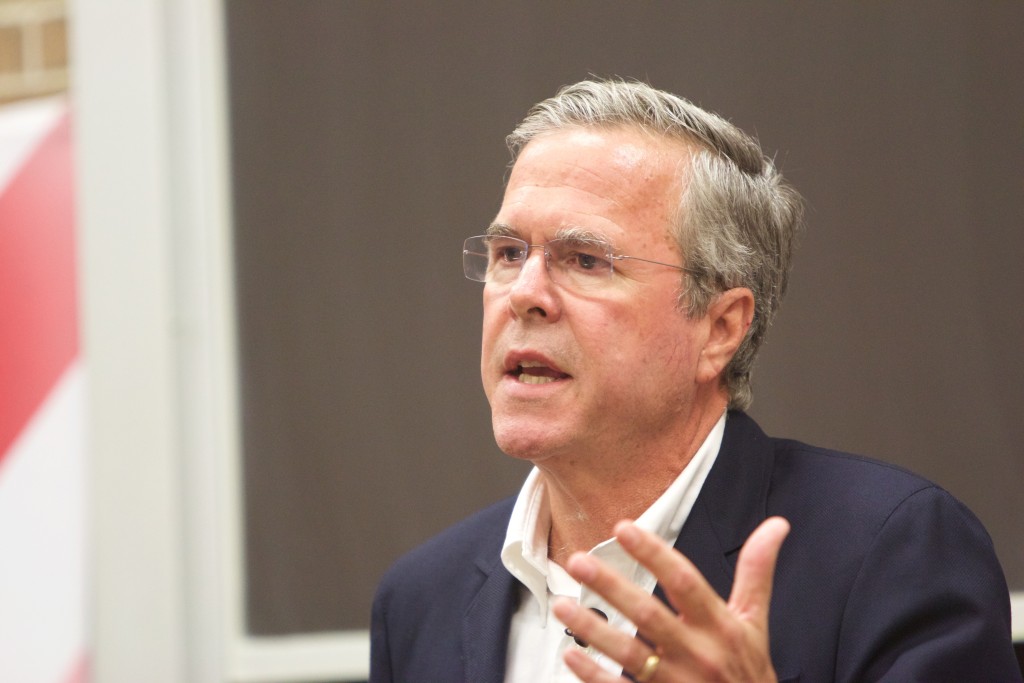
Former Florida Gov. Jeb Bush gave Republicans in the South Carolina House a pro-school-choice pep talk ahead of a public hearing on legislation that would give parents money for private tuition.
Bush, who signed Florida’s first school choice law nearly 25 years ago, encouraged the House GOP Caucus to charge ahead with efforts to give parents taxpayer-funded choices in both public and private schools.
“I want to maybe give you a sense of what the future looks like,” Bush told the caucus during an April 4 luncheon that was open to the media.
“The world gets better when parents make more choices,” he added. “There are lessons on the way to make sure it’s done right, but the idea parents know best for their kids is irrefutable in my mind.”
Chairman of the nonprofit ExcelinEd, Bush said he was in South Carolina this week before Easter as an evangelist for school choice.
It was a pitch that seemed to preach to the choir.
Republicans in the House have been pushing for private school choice for nearly two decades. After years of dividing the GOP, legislation helping parents pay for private school almost reached Gov. Henry McMaster’s desk last year. It failed at the end of the session with Republicans in the House and Senate unable to agree on student testing.
To continue reading, click here.
 In the Legislature: A new bill submitted to the state House of Representatives would allow districts to put cameras in classrooms. HB 985, would require video cameras to be placed in certain public and charter school classrooms. Teachers in the classrooms with cameras would have to wear microphones during the school day, according to the bill. WKMG. A state senator has introduced legislation that would raise the state's compulsory age for school attendance. The proposed legislation, SB 992, would raise the cap by two years from 16 to 18. If enacted, the bill would take effect on July 1. WFLA. Another bill filed recently in the Florida House would limit diversity efforts and expand the powers of university boards and alter course offerings. HB 999 proposes leaving all faculty hiring to boards of trustees and removing majors or minors in subjects like critical race theory and gender studies. It would also prohibit spending on activities that promote diversity, equity and inclusion and create new general education requirements. Tampa Bay Times. State lawmakers have been given two vastly different cost estimates as they consider HB1, which would expand school vouchers and offer education savings accounts to all school-aged children in the state. The bill's sponsor put the number at $209.6 million, but the Florida Policy Institute says the measure could add billions to the state budget. Tampa Bay Times. South Florida Sun-Sentinel.
Around the state: The school board in Lee is considering a phased rebuild of Fort Myers Beach Elementary, students at universities statewide participated in walkouts regarding various issues and the school board in Alachua approved a new policy for homeless students. Here are details about those stories and other developments from the state's districts, private schools and colleges and universities:
Lee: The majority of the Lee County school board appeared to be leaning toward a phased rebuild of Fort Myers Beach Elementary, which was severely damaged during Hurricane Ian. During the board's meeting on Wednesday, three options were presented, which ranged in cost. They include sending students to other schools and restoring the campus, a phased rebuild and a portable campus with the option to rebuild. Ft. Myers News-Press.
Volusia: Local businesses have donated items such as model jet engines and hotel stays to Volusia County schools through the adopt-a-school program. Now, the hospitality industry is on a mission to find adopters for the last nine of 67 traditional public schools — most of which are in West Volusia. The Daytona Beach News-Journal.
Alachua: The school board in Alachua approved a new policy that waives school fees for students experiencing homelessness or who are unable to pay. The new Waiver of School Fees policy establishes prohibitions on school fees for students who qualify for free lunch of breakfast, a student whose family is experiencing a severe loss or does not have the ability to pay due to any reason Superintendent Shane Andrew deems appropriate. WUFT.
Target list: Gov. Ron DeSantis' list of 14 incumbent board members around the state he is targeting to defeat in the 2024 election include Nadia Combs and Jessica Vaughn in Hillsborough county and Laura Hine and Eileen Long in Pinellas county. Tampa Bay Times.
Book reversal: A book about late MLB legend Roberto Clemente that was removed from public schools in Florida's Duval County pending a review over its references to racism and discrimination has been approved for student use. NBC News. Axios.
University and college news: A public art display celebrating diversity will not travel to State College of Florida Manatee-Sarasota after college officials requested the omission of several pieces. The concern, according to a college spokesperson, was that several images could offend viewers. The organizer canceled the scheduled exhibit. WUSF. Inside Higher Ed. Members of University of Florida's Bateman case study competition presented their campaign to Greater Gainesville Young Professionals. Students are teaching people how to identify credible news by sharing their experiences with misinformation. WCJB. A Florida nonprofit in a new lawsuit is seeking the call logs and texts of one of six trustees recently installed by Gov. Ron DeSantis to the state's most progressive higher education institution. New College of Florida made headlines in recent weeks after an overhaul of the liberal arts university's leadership. Miami Herald. The State University System Board of Governors signed off on making Richard Corcoran the interim president of New College of Florida, and will take the helm on Monday. WUSF. Hundreds of University of South Florida students participated in a walkout to protest Gov. Ron DeSantis' education policies. Tampa Bay Times. At University of Florida, a protest was held called "Stand for Freedom." Gainesville Sun. In Tallahassee, Florida State University students also protested. Tallahassee Democrat. Meanwhile, students at six Florida universities staged a walkout protesting school officials sending transgender students health information to the state. In January, Gov. Ron DeSantis sent state universities a survey requesting the number and ages of students who sought gender dysphoria treatment, including sex reassignment surgery and hormone prescriptions. WMFE. NPR.
Opinions on schools: Former Florida Gov. Jeb Bush joined Students Over Systems host Ginny Gentles to talk about the history of Florida's flourishing education options. Ginny Gentles and former Gov. Jeb Bush, reimaginED.

