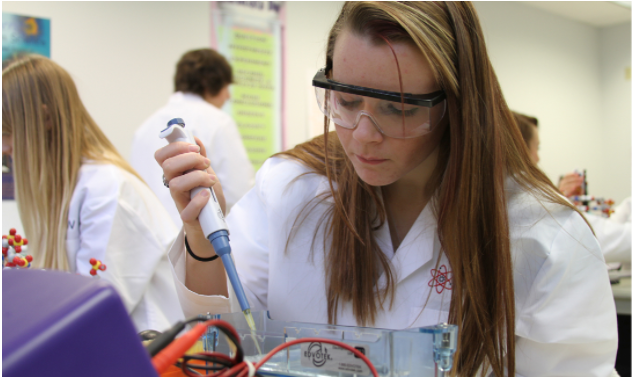
Orlando Science School in Orlando, one of nearly 700 charter schools in Florida, focuses on science, technology, engineering and mathematics and is ‘home base’ for more than 1,000 Central Florida students representing diverse cultural and economic backgrounds.
The charter school movement in Florida started with a single school in Miami in 1996. Now it’s Florida’s most popular school choice option, with nearly 700 charter schools serving 330,000 students.
At the quarter century mark, Florida’s charter school sector continues to generate new fans among parents, including … me. ????
Here’s 25 reasons why, in no particular order …
1. T. Willard Fair. If movements are judged by the company they keep, then it’s worth noting charter schools are backed by a who’s who of icons. Trail blazing and fiercely independent, Fair, the head of the Urban League of Greater Miami, co-founded that first charter school with …
2. Jeb Bush. Expanding parental choice and learning options, including charter schools, was/is vital to Gov. Bush’s vision. The Republican governor got a little help from …
3. Lawton Chiles, his Democratic predecessor. “Walkin’ Lawton” signed the charter school bill into law in May 1996, after it passed the Legislature with huge bipartisan support.
4. Rosa Parks. No direct Florida tie. But if you find anybody still clinging to “charter schools are a right-wing thing,” please let them know the First Lady of Civil Rights tried to start one.
5. Barack Obama. He liked charter schools so much, he vowed to double federal funding for them.
6. Bill Clinton. A “mistake,” he said in Orlando, for districts to keep fighting charters.
7. Rainbow coalition. Florida charter school students are 50% low-income, 63% Black or Hispanic.
8. Survey says. Parents of color are especially appreciative.
9. National model. Laws governing Florida charters are among the best in America. The best part is Florida charters are especially …
10. Accountable. The pitch from Matt Ladner: Parents don’t play.
11. Healthy competition. The best available evidence shows charters don’t hurt traditional public schools, probably help them, and probably help more as their numbers grow.
12. Let 1,000 flowers bloom. Here, here, here, here, here, here …
13. Black minds matter. Here’s but one good example.
14. Teacher power. Last I checked, Florida charters employed 14,000 teachers, more than nine states have teachers. (Hopefully we’ll have current data soon.) They appreciate the freedom.
15. They’re everywhere. If you’re near this gem of a charter in flyover country, don’t veer off U.S. 98 until you get a soft-shell crab sandwich.
16. Better outcomes. Students in Florida charters typically outperform district students on state and national tests. As but one example, see this chart showing NAEP results for low-income Black and Hispanic students.
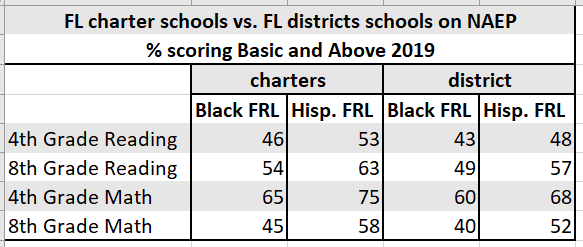 17. Better yet. Charter school students in Florida are more likely than their district peers to graduate from high school, persist in college and earn more money.
18. Better grades. 74% of Florida charter schools earned As or Bs from the state. 61% of traditional public schools did.
19. Better rankings. Seven of the Top 30 high schools in Florida are charters, according to U.S. News.
20. Academica. Five of those seven are managed by Academica, the best charter org you’ve never heard of (but a key part of the cool story that is choice-rich Miami-Dade.)
21. Science! Charters like this one are killing it.
22. Rigor. Even in the pandemic.
23. Bang for the buck. Florida taxpayers spend 69 cents on the dollar on charter students versus district students. And for those district schools, there’s …
24. No drain. According to fresh research from a charter skeptic.
25. Rising tide. Charters are a big part of the big picture in Florida, which is more choice, better outcomes.
Icing on top …
My kid. My oldest began attending a charter school last fall. He’s thrilled he had options.
So are his parents. ????
 Alabama: The state files documents to dismiss the Southern Poverty Law Center's suit against the new school choice program (Al.com).
Florida: A new private school specializing in special needs education will open in Sarasota, with the state's McKay scholarship program funding the $11,000 to $17,000 a year tuition (Bradenton Herald). After five years of declining enrollment, Catholic schools in Palm Beach County are seeing a rebound in student enrollment (Sun-Sentinel).
Indiana: Former Secretary of State Condoleezza Rice speaks at a church in Indianapolis and calls for more options for students (Indianapolis Star).
Kentucky: With nearly 10,000 students, the Catholic Diocese of Covington would be the third largest school district in northern Kentucky. The diocese would like to see a tax-credit scholarship program for low-income students (Cincinnati.com).
Louisiana: The Department of Justice's lawsuit to block the voucher program is based on the enrollment of 570 of the 8,000 voucher students located in 22 districts under federal desegregation orders (Education Week, Washington Times, The Advocate). Gov. Bobby Jindal aired television ads slamming the anti-voucher lawsuit (Associated Press).
Maine: Three charter schools in the state claim success with their special needs student population (MPBN).
Mississippi: The state's new charter school board will operate on 3 percent of the revenue collected from authorized charters but the board has no charter schools yet and the state didn't appropriate a starting budget (Clarion Ledger, Fordham Institute).
North Carolina: The Charlotte area sees strong growth in charter school enrollment and has piqued the interest of more charter school operators (Charlotte Observer). Minority Democrats in the state legislature took a bold step supporting school choice, says Robert Danos, a former spokesman for the 11th District GOP (Blue Ridge Now). (more…)
Washington: The new Charter School Commission is attracting candidates from across the state and beyond, including Liz Finne, a lawyer and director of the Center for Education Reform at the Washington Policy Center. The governor and other leaders expect to choose nine volunteers by March 6 (Associated Press). A coalition of educators and community groups filed a legal challenge that questions the constitutionality of Washington's new charter schools law (Associated Press). More from Education Week.
Colorado: With more than 80,000 students enrolled in 190 charter schools, charter leaders try to clear up misconceptions about the school choice option (Reporter-Herald). Douglas County's Choice Scholarship Program does not violate the state Constitution, rules an appeals court. The outcome could have wide-ranging implications for whether vouchers can be used statewide (Associated Press).
Alabama: Legislators approve tax credit scholarships for students attending failing public schools (Associated Press). More about the "legislative bombshell'' that Republicans called historic and Democrats said was a sleazy "bait and switch,'' at AL.com. And the site offers a primer on the Alabama Accountability Act.
Idaho: Khan Academy will provide math, physics and history classes in 47 public, private and charter schools this fall, making Idaho the nation's first proving ground for statewide implementation of the free online educational content and teaching model (Associated Press).
Michigan: A report measuring charter school performance statewide calls the Eastern Michigan University-authorized schools the second worst system in the state. EMU says the report doesn't take into account that the schools serve some of the state's toughest communities (Ann Arbor.com)

Fair
In an effort aimed at boosting black student achievement, a new group is forming in Florida to develop a cadre of black entrepreneurs and executives to lead high-quality schools, including charter and private schools.
Black Floridians C.A.R.E. – which stands for Choice Advocates Reforming Education - is chaired by T. Willard Fair, a former chair of the state Board of Education and longtime leader of the Urban League of Greater Miami.
“It’s important because we believe that the rest of the battle for effectiveness and equality (in education) rests with us,” Fair told redefinED. “Why should I expect whites and Cubans to care about black children in Liberty City? It’s not their children.”
Fair said more black leaders in education - principals, owners, board members, chief executives - would galvanize support in the black community generally. But it’s especially critical for establishing deeper roots for school choice, he said.
“When you have a movement that comes out of the adults in the community, then it does not die,” said Fair, who co-founded Florida's first charter school in 1996 with former Gov. Jeb Bush. “Then the community says, ‘We have ownership of this.’ “
The group’s executive director is Isha James. She too has strong ties to school choice efforts, including stints at the Black Alliance for Educational Options, the National Association of Charter School Authorizers and Partners for Developing Futures, a social investment fund for people of color who want to open charter schools.
“Students who see people in power that look like them, they have higher aspirations,” James said. “I can’t continue to tell a child that he can be the principal of a school if the only thing he sees that’s ever looked like him is a janitor.”
Black Floridians C.A.R.E. will develop a leadership pipeline through training academies and mentoring programs, then serve as a conduit between black professionals and private, charter and district schools. James said primary recruitment efforts will be aimed not at educators, but at people with backgrounds in finance, law and business. (more…)
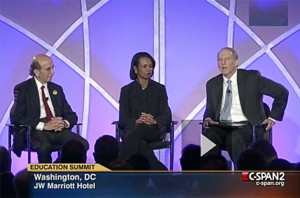 At Jeb Bush’s National Summit on Education Reform in Washington, D.C. last week, two prominent education reformers from the center-left and the center-right joined to make a remarkable statement about parental choice. Asked from the audience to name their “No. 1 idea” to improve public education, former New York City school chancellor Joel Klein and former U.S. Secretary of State Condoleezza Rice answered with a remarkably united voice.
Their three minutes of extemporaneous remarks are well worth your time, and are available through C-SPAN.org here.
In brief, Klein spoke of the way various types of learning options, including charter schools, have helped spur improvements in New Orleans and Harlem: “About a third of the kids in Harlem in the third grade are in charter schools. What’s amazing is the Harlem District went up, and this is apples to apples, went up dramatically from when we started this intensive choice process there to now. … Not only did the charter schools outperform almost everybody, but the public schools … actually moved up significantly themselves.”
Rice spoke to how competitive pressures have produced a “catalytic” effect in higher education, and noted that only wealthier families tend to have choice in a K-12 system where pupil assignment is determined only by geography: “So the only people stuck in neighborhood schools are poor people, and that’s the height of inequality. And that’s why I’ve called it a civil rights issue.”
The lineup for this week’s Jeb Bush education conference is further evidence that a growing centrist coalition has emerged to move the ball on education reform and school choice.
This is the Foundation for Excellence in Education’s fifth national summit, and it grows in both stature and bipartisanship every year. Two years ago, it made headlines when President Obama’s education secretary, Arne Duncan, was announced as a keynote speaker. This year, Duncan’s speaking again. So is John Podesta, the former Clinton chief of staff who heads the left-leaning Center for American Progress; and Gloria Romero, the former Democratic California state senator who authored the original parent trigger bill; and, on various panels, other Democrats like North Carolina Gov. Bev Perdue and Virginia State Delegate Algie Howell.
So, on the one hand, it’s no longer so notable that more and more liberals and progressives and Democrats are part of this constellation. On the other hand, holy smokes! Clearly, they’re not on the same page with Jeb Bush and fellow conservatives on every education issue. But the strength of the arguments in favor of ed reform and school choice, and the leadership of folks like Bush and Obama, have galvanized people from all across the political spectrum to have respectful, thoughtful discussions about our schools and our kids in ways that just weren’t possible 10 or 15 years ago.
I don’t know how long this will last, but the 2012 elections have at least produced a renewed call in Congress for a bipartisan solution to the deficit crisis. I suspect this is a rare opportunity in education, and reformers of all stripes would be wise to recognize it as such, and to do what they can to extend it. One way to foster that political cooperation is to make the public better aware that all this is happening – that Republicans and Democrats have actually found common ground on more than a few planks of ed policy. (more…)
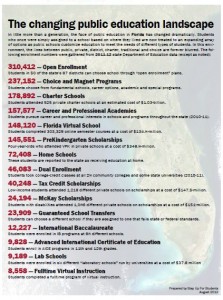 Though we know little about the parents who long have chosen their school through where they decide to live (or to pretend to live), Florida keeps count of those who no longer want their neighborhood school. And here's some data to chew on: In a state known for its breadth of learning options, that number last school year reached 1.2 million.
In other words, using a conservative approach with new 2011-12 enrollment records, 43 of every 100 students in Florida public education opted for something other than their zoned school.
This number is produced largely from state Department of Education surveys required of the 67 school districts and reflects, not surprisingly, surging growth for choice options. Though total public school enrollment grew by only 1 percent last year, reaching 2.7 million, charters grew by almost 16 percent, online by 21 percent, private scholarships for poor children by 17 percent. (See an enrollment compilation of 2011-12 options here.)
Granted, Florida is not like most other states in this regard. A combination of educational, budgetary and political factors, including the gubernatorial tenure of Jeb Bush, has put the Sunshine State on an accelerated path of parental empowerment. That said, it is a diverse, highly populous state with national political significance, and this kind of transformation is central to the new definition of public education.
The national education debate is still absorbed by adults who grew up with a pupil assignment plan built almost entirely on geography. Many of them went to the same schools as their parents and even their grandparents, and it’s natural they would define public education that way. That may help explain why parent activists or groups such as the PTA continue to oblige the teacher unions that pressure them to resist laws giving parents more options. The union message – that traditional public schools are endangered – plays to the parents’ natural fears.
That’s why these numbers are worthy of pause. (more…)
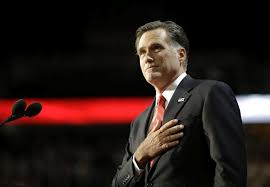 Choice at the RNC: Mitt Romney drops a line about school choice in his big speech, while Jeb Bush and Condoleezza Rice say more (redefinED). A former voucher student from Florida joins Jeb Bush on stage, saying in an interview later, "Because I had choice in my education, I was granted a better life (redefinED). (Image from minnesota.publicradio.org)
Louisiana: A statewide teachers union accuses the Black Alliance for Educational Options and other school choice groups of supporting a pro-KKK educational curriculum. (Choice Media)
Washington: The political landscape around charter schools has changed as voters get ready to vote on a charter measure for the fourth time. (Seattle Times)
Florida: A powerful lawmaker and school choice supporter is puzzled by charter schools that want to set up in one of the school districts in his legislative district. (St. Augustine Record)
Ohio: Hundreds of special needs students are benefiting from a voucher program. (Cincinnati.com) (more…)
It’s one thing to hear school choice stalwart Jeb Bush or a think tank researcher state the obvious about school choice in Florida – that it’s now a fundamental part of the education landscape. It’s quite another to hear it from the likes of Alberto Carvalho, the well-respected superintendent of the Miami-Dade school district.
A news video shows him saying this to a reporter after a recent education summit (his remarks start at about the 4:30 mark):
Change is going to accelerate. And you need to learn about what the change is, impose your own change just to survive. We are now working in an educational environment that is driven by choice. I believe that is a good thing. We need to actually be engaged in that choice movement. So if you do not ride that wave, you will succumb to it. I choose not to.
It would be noteworthy if any big-district superintendent in Florida – where school choice is both nearly mainstream and perpetually hot button - spoke as refreshingly as Carvalho. But it’s especially significant coming from the Miami-Dade schools chief because 1) no district in Florida has made bigger gains with its students over the past decade, and 2) among the state’s biggest districts, it has among the highest concentrations of enrollment in magnet schools, career academies, charter schools and in private schools via tax credit scholarships.
In other words, the parents in Miami-Dade are seeking out school choice options more than most; the proliferation of options hasn’t hurt student achievement; and the superintendent, rather than feeling besieged, is being proactive.
It would be wrong to suggest Carvalho is alone. Other school leaders in Florida have positively responded to change; sometimes, it even makes headlines. “We have never had to compete before,” Walt Griffin, the new superintendent in Seminole County, Fla., said in a recent story about expanded learning options – public options – in that district. “People who home-school or send their children to private or charter school might not know what we have to offer.”
Without a doubt, there are myriad areas where superintendents and school choice supporters disagree (just like there are plenty of areas where supporters themselves butt heads.) But Carvalho’s comments acknowledge that expanded parental choice is a dynamic that isn’t going away. Indeed, when hundreds of thousands of Florida parents have collectively selected magnet schools, career academies, charter schools, vouchers, virtual schools, etc., how can it? The most pressing debate is how the players involved, including school districts, can continue to expand options in the most efficient and effective ways.
Maybe I'm reading too much into a sound bite, but I think Carvalho’s comments also suggest he doesn’t see the “either/or” that has seeped into so much of the school choice debate. At its core, despite the boilerplate story line, this is really just about giving parents more options.
(Image from asiapac.com.au)
 Idaho: State education offficials approve the American Heritage Charter School, which will emphasize American history, patriotism, money management and free market economics. (Idaho Statesman)
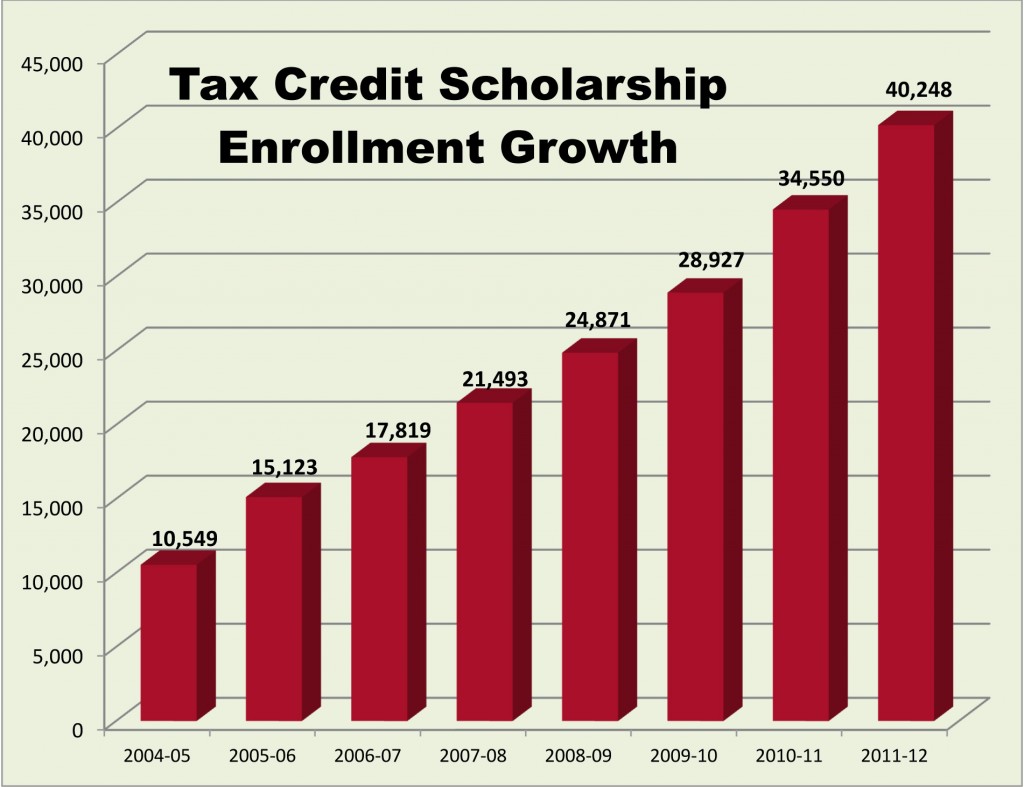
Florida: Demand continues to surge for the state's tax credit scholarship program, as the chart at left shows. (Tampa Bay Times' Gradebook blog). The number of charter school teachers in the state tops 10,000, more than double the number from five years ago (redefinED).
Mississippi: Former Florida Gov. Jeb Bush encourages Mississippi officials to follow Sunshine State education reforms, including vouchers and charter schools. (Associated Press)
Washington: A parents group forms to fight a ballot initiative to bring charter schools to the state. (The News Tribune)
Georgia: Debate heats up over a proposed constitutional amendment that would allow the state to authorize and fund charter schools. (Atlanta Journal Constitution)
Louisiana: The ACLU threatens to sue a charter school for policies banning pregnant girls from classrooms and requiring girls suspected of being pregnant to submit to a pregnancy test. (Associated Press)
Maine: Applications are withdrawn for two proposed on-line charter schools, but the groups behind them say they'll be back next year. (Kennebec Journal)
Utah: State education officials discuss additional financial and academic accountability measures for charter schools. (Salt Lake Tribune)
New York: State education officials will consider seven new charter schools in Queens, including one with a Chinese-based curriculum and mandatory martial arts training. (New York Daily News)
California: A former charter school administrator, fired after allegedly ordering his staff to cheat on standardized tests, is paid $245,000 in a settlement. (Los Angeles Times)