We're trying something new today: an occasional report card that offers a quick analysis of education reform news from around the country. Who gets a satisfactory? Who's in need of improvement? Read on.
The Huffington Post is a fair news outlet when it comes to offering a broad range of view on education reform. But sometimes it voluntarily repeats the same bizarre or weak criticisms of school choice. Joy Resmovits' most recent article on the DOJ suit against Louisiana vouchers gives added weight to bizarre, one-off criticisms while not giving enough weight to the evidence supporting vouchers.
Joy reports the "evidence on the value of vouchers is limited." I'm not sure how she means to use the word "limited." Results are "limited" in the sense that vouchers themselves are generally only available to a small group of highly disadvantaged students who then receive a relatively small scholarship to attend private schools. The value is usually around half the amount spent on a district public school. Even then, 11 of the 12 of the random assignment studies on the value of vouchers shows positive results for students using them.
 In another instance, Joy references a private school which teaches that the Loch Ness monster is evidence in favor of the Young Earth Creationist theory. It's a point of criticism Joy has raised in at least three other articles on vouchers, but it really doesn't deserve the weight and attention she gives it. The use of the Loch Ness monster is so weird even other creationists make fun of it.
Using a rare and off-the-wall case in a private school to criticize an entire voucher system would be like me criticizing public education because a single district banned a lesbian girl from wearing a tuxedo for her senior portrait, or because a district has a high school named after one of the Ku Klux Klan founders, or because a district banned a book from the library - or any number of other examples of bad and/or discriminatory behavior in our nation's schools.
From Patricia Levesque, executive director of the Foundation for Excellence in Education, in the Shreveport Times (H/T to EdFly Blog and Jay P. Greene's Blog):
The rhetoric surrounding parental choice often becomes apocalyptic in tone, despite very clear evidence that it improves public schools. Much of the Louisiana discussion has focused on the issue of accountability. Louisiana's statute provides for student testing and includes strong mechanisms to remove under performing schools. This is a higher standard of accountability for private schools than the standard that applies to school districts in Louisiana, and across the nation. The bottom-up approach created by empowering parents to vote with their feet if their child's school is not meeting their needs represents the ultimate form of accountability. No amount of regulatory compliance can hope to match a system of decentralized parental choice. Compliance models focus on school and grade level average results, while empowered parents focus on the particular needs of their child. Full op-ed here.
 Idaho: State education offficials approve the American Heritage Charter School, which will emphasize American history, patriotism, money management and free market economics. (Idaho Statesman)
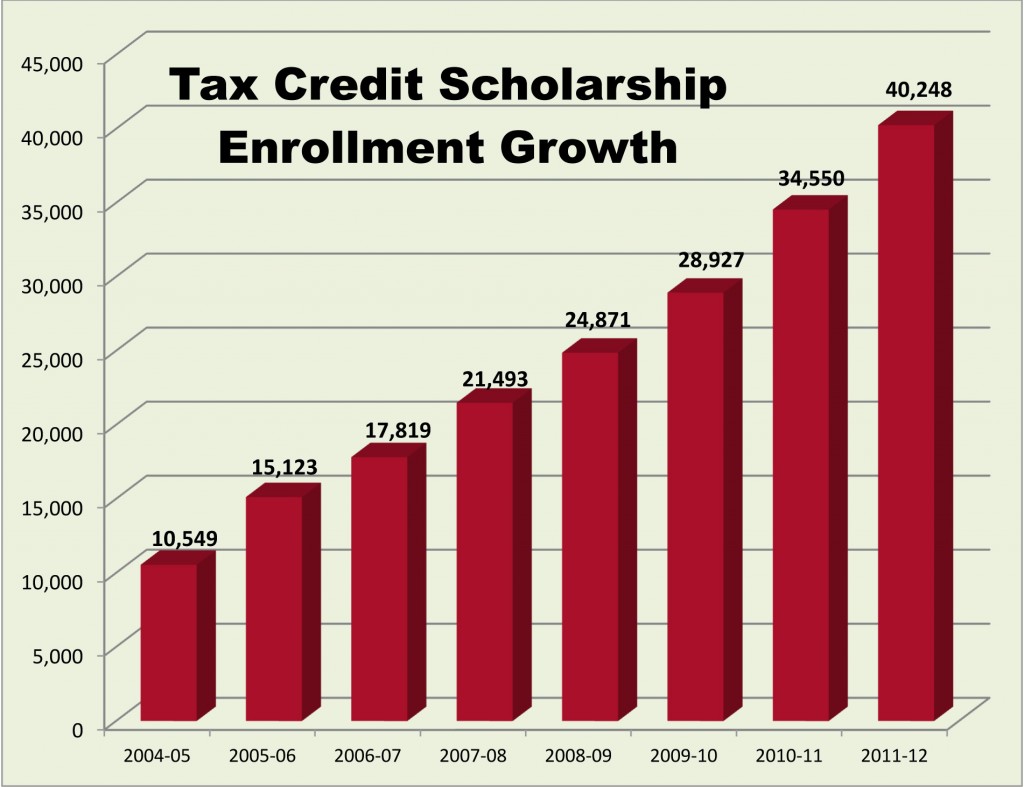
Florida: Demand continues to surge for the state's tax credit scholarship program, as the chart at left shows. (Tampa Bay Times' Gradebook blog). The number of charter school teachers in the state tops 10,000, more than double the number from five years ago (redefinED).
Mississippi: Former Florida Gov. Jeb Bush encourages Mississippi officials to follow Sunshine State education reforms, including vouchers and charter schools. (Associated Press)
Washington: A parents group forms to fight a ballot initiative to bring charter schools to the state. (The News Tribune)
Georgia: Debate heats up over a proposed constitutional amendment that would allow the state to authorize and fund charter schools. (Atlanta Journal Constitution)
Louisiana: The ACLU threatens to sue a charter school for policies banning pregnant girls from classrooms and requiring girls suspected of being pregnant to submit to a pregnancy test. (Associated Press)
Maine: Applications are withdrawn for two proposed on-line charter schools, but the groups behind them say they'll be back next year. (Kennebec Journal)
Utah: State education officials discuss additional financial and academic accountability measures for charter schools. (Salt Lake Tribune)
New York: State education officials will consider seven new charter schools in Queens, including one with a Chinese-based curriculum and mandatory martial arts training. (New York Daily News)
California: A former charter school administrator, fired after allegedly ordering his staff to cheat on standardized tests, is paid $245,000 in a settlement. (Los Angeles Times)
 It’s rare to find strong school choice advocates on local school boards. But in Florida, another such advocate has emerged as a viable candidate in one of the state’s biggest school districts.
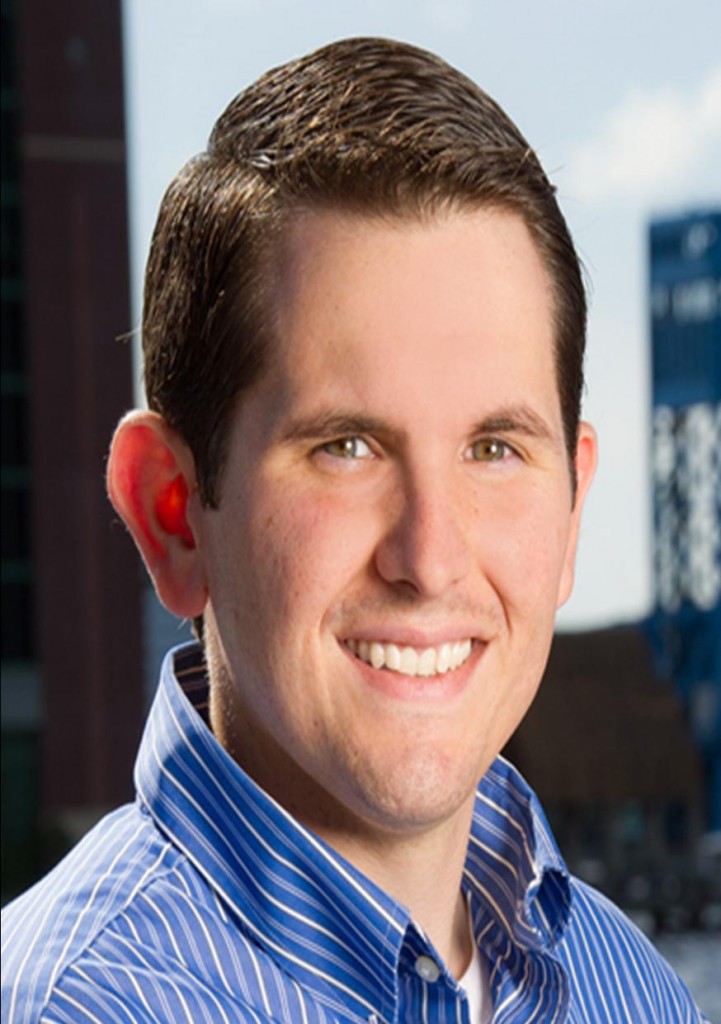
Jason Fischer, 29, is one of six candidates running for the District 7 seat in Duval County, which is the county that corresponds with the city of Jacksonville. As we’ve noted before, Duval has been particularly unfriendly territory when it comes to charter schools, vouchers and tax credit scholarships. So it’s worth noting that not only is Fischer openly supportive of expanded school choice, including private options, but he’s no ordinary contender by other measures. Last month, Gov. Jeb Bush endorsed him. And yesterday, with less than three weeks to go before the Aug. 14 primary, three speaker-designates for the Florida House of Representatives did the same.
Like Glen Gilzean, a school board member and candidate in Pinellas County, Fla. who we’ve also written about (and who also snagged an endorsement from Bush), Fischer defies the caricature of the school choice supporter who wants to tear down traditional public schools. His platform is by no means limited to school choice; it includes, among other things, more focus on teacher quality and performance pay. But Fischer doesn’t shy from the potential benefits that come when more learning options are available to more kids.
“If the government has a good functioning school in an area, and people want to send their kids there, that’s fine,” Fischer told redefinED in a phone interview this week. “My goal isn’t to undercut public education. It’s to make sure parents have the widest opportunities available.”
“I think the choices will improve the quality of education of their child primarily,” he continued. “But secondarily, it will force the public school education system to improve its service level … so everyone benefits.”
Duval has struggled even more than most Florida urban districts to improve test scores for low-income students, and the School Board and one of the county’s key education advocacy groups have resisted more learning options for these students. But Fischer suggests that expanded choice can be part of the solution. (more…)
Editor’s note: Today, we introduce a new feature (even if we’re not sure the name will last) - an occasional compilation of bite-sized nuggets about school choice and education reform that are worth noting but may not be worth a post by themselves.
More anti-Muslim bigotry in school choice debates
It’s nearly impossible to go a month without hearing another example of anti-Muslim bigotry in a school choice debate.
The latest example: Louisiana state Rep. Valarie Hodges, who now says she wishes she had not voted for Gov. Bobby Jindal’s voucher bill because she fears it will promote Islam. “There are a thousand Muslim schools that have sprung up recently,” she said. “I do not support using public funds for teaching Islam anywhere here in Louisiana.”
The lawmaker’s comments echo Muslim bashing in school choice debates in Kansas, Alabama, Tennessee and other places in the past few months alone. Sadly, religious bigotry has long been a part of the school choice narrative. To repeat what we wrote in April:
The courts have ruled that vouchers and tax credit scholarships are constitutional. We live in a religiously diverse society and this pluralism is a source of pride and strength. We can’t pick and choose which religions are acceptable and unacceptable for school choice. And we should not tarnish whole groups of people because of the horrible actions of a few individuals. In the end, expanded school choice will serve the public good. It will increase the likelihood that more kids, whatever their religion, become the productive citizens we all want them to be.
Jeb Bush endorses pro-choice school board candidate
Jeb Bush doesn’t endorse local candidates often. But last week, he decided to back a Tampa Bay-area school board member who openly supports expanded school choice, including vouchers and tax credit scholarships.
Glen Gilzean, 30, is running against four other candidates to keep the Pinellas County School Board seat that Gov. Rick Scott appointed him to in January. The district in play includes much of the city of St. Petersburg and has more black voters than any other.
I don’t know how much Bush’s endorsement will help Gilzean. He's a black Republican in a district that leans Democratic (even if school board races in Florida are officially nonpartisan). But I do know this: Black students in Pinellas struggle more than black students in every major urban school district in Florida, and frustrated black residents are increasingly open to school choice alternatives. (more…)
Pennsylvania: A budget deal expands the state's existing tax credit scholarship program and creates a new one aimed at helping students in struggling schools. (Philadelphia Inquirer)
 Washington: Bill Gates chips in $1 million for a ballot initiative to bring charter schools to one of the last states without any. (Associated Press) It appears supporters gathered enough signatures to get the initiative on the ballot. (Associated Press)
Florida: Former Gov. Jeb Bush endorses a local school board member who openly supports vouchers, tax credit scholarships and other forms of expanded school choice. (Tampa Bay Times) The incoming state House speaker also backs the board member. (Tampa Bay Times)
New Jersey: The state-appointed superintendent in Newark overrules a local advisory board and moves ahead with plans to lease empty buildings to charter schools. (NJ Spotlight)
Louisiana: State Superintendent John White continues to face criticism for his handling of a questionable private school that is seeking to participate in the state's new voucher program. (New Orleans Times Picayune) A state lawmaker now says she regrets voting for the program because she fears it will promote Islam. (Huffington Post)
California: The teachers union at Green Dot charter schools pushes for performance pay and evaluations tied to test scores. (Contra Costa Times)
Tennessee: A charter school operator vows to appeal to the state after a local school board rejects its plan to open charter schools in wealthy West Nashville. (The Tennessean)
Oklahoma: Online learning is growing more popular in Oklahoma, with supporters seeing it as an equalizer between districts that are big and small, rural and urban. (Tulsa World)
(Image from businessweek.com)
 A chain of Catholic, college-prep high schools that has demonstrated success with low-income students is eyeing two Florida cities for a possible expansion. Tampa and Miami are near the top of the list for the Chicago-based Cristo Rey Network, group president Rob Birdsell told redefinED. The reasons: A good job pool. The availability of tax credit scholarships. A need for more high-quality options for low-income kids. And maybe even some nudging from former Florida Gov. Jeb Bush.
“We very much want to get to Florida,” Birdsell said in a phone interview. “Gov. Bush is a friend of Cristo Rey (and) he is persistent.”
Lauded by education reformers and others for innovative work with Hispanic and African American students (see if you can get through this “60 Minutes” piece without crying), Cristo Rey now operates 24 Catholic high schools in 17 states and the District of Columbia. Its students typically come in two grade levels behind. But 84 percent of those who graduate enroll in college.
The students pay more than half of the $12,000 average tuition through a corporate work study program that gives them real-world experience at banks, hospitals, law firms and other partners. Accessing Florida’s tax credit scholarship program – worth $4,335 per student this fall – would fill out most of the remaining gap. That would take pressure off both the families and the network’s fundraisers. (more…)
 Nobody invoked Ronald Reagan this week and demanded that somebody (Randi Weingarten? President Obama? The local school board?) “tear down this wall,” but two school choice champions got close. Step Up for Students President Doug Tuthill used the Berlin Wall analogy yesterday in a redefinED post about the big-picture trends in ed reform. And in a beautiful coincidence, Robert Enlow, president and CEO of the Friedman Foundation for Educational Choice, did so today in an op-ed for CNN.
Wrote Enlow: “Just like the millions of East Germans who demanded freedom, we know that there are millions of parents that want to be removed from a system that uses a zip code to determine where their children must attend school.” He concluded, “Vouchers should be made available to children no matter if they are poor, disabled, from the middle class or from a family of 10, or from a rural, suburban or urban area. There should be no restrictions on who gets to choose, just like there were no restrictions on who could escape tyranny once the Berlin Wall fell.”
Also by coincidence, one of the nation’s biggest pollinators for school choice, Jeb Bush, delivered an ed reform speech in Colorado this week. He didn’t explicitly urge anyone to tear down any walls, either, but according to Education News Colorado he did implore the audience of 1,700 to “join reformers to make school choice both public and private the norm in our country."
Hmmm. Anyone else see speech potential here? Tampa. August. Fired-up delegates shouting "Tear down this wall!" as millions watch ...

