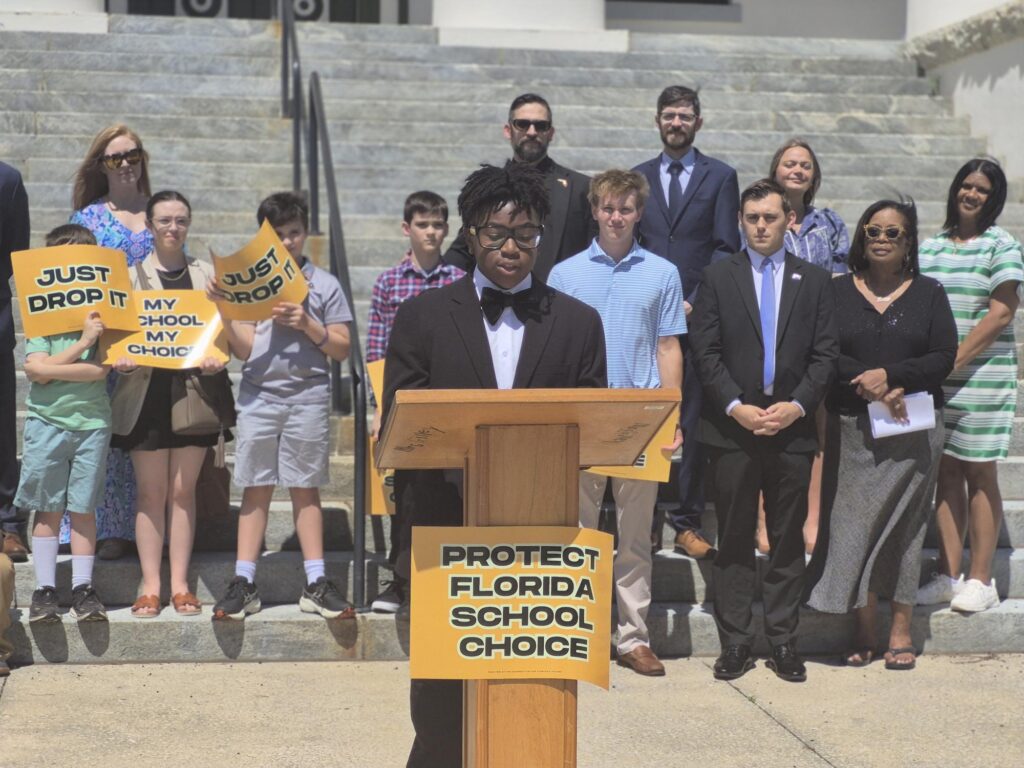
Nine days after the state teachers union sued to strip Florida families of the right to choose their children’s education, the pushback began when supporters of state K-12 scholarships and charter schools gathered in Tallahassee on the steps of Old State Capitol to protest.
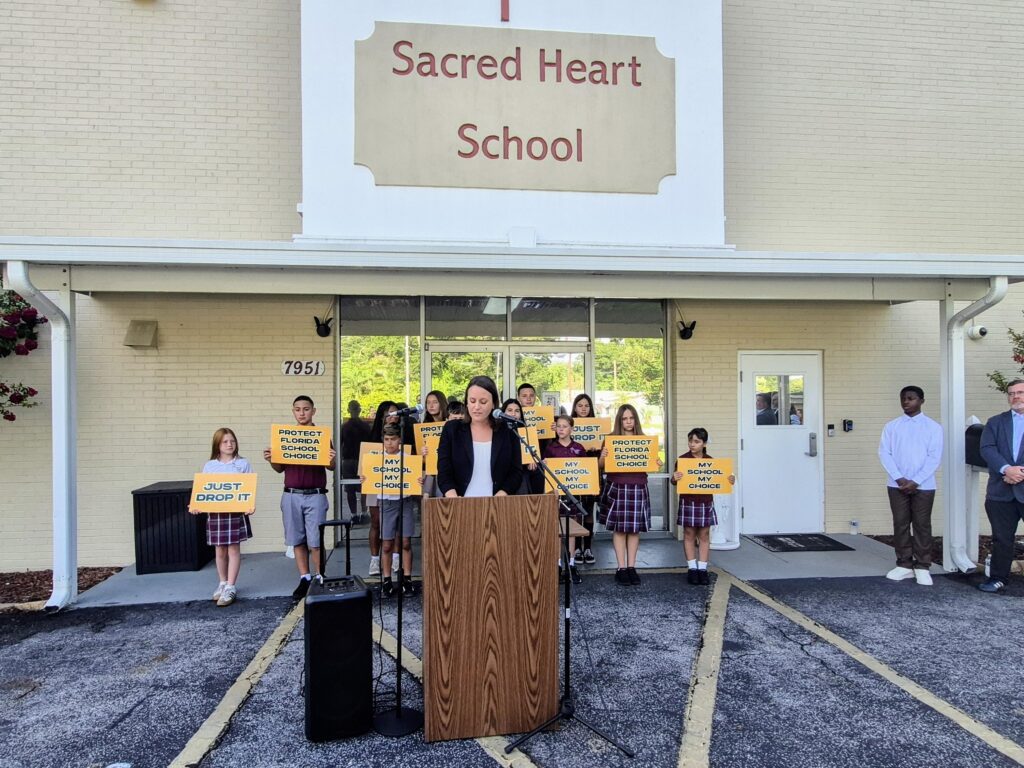
Two weeks later, choice supporters stood outside Sacred Heart Catholic School in the Tampa Bay area holding signs with the slogans, “My Child, My Choice” and “Just Drop It.”
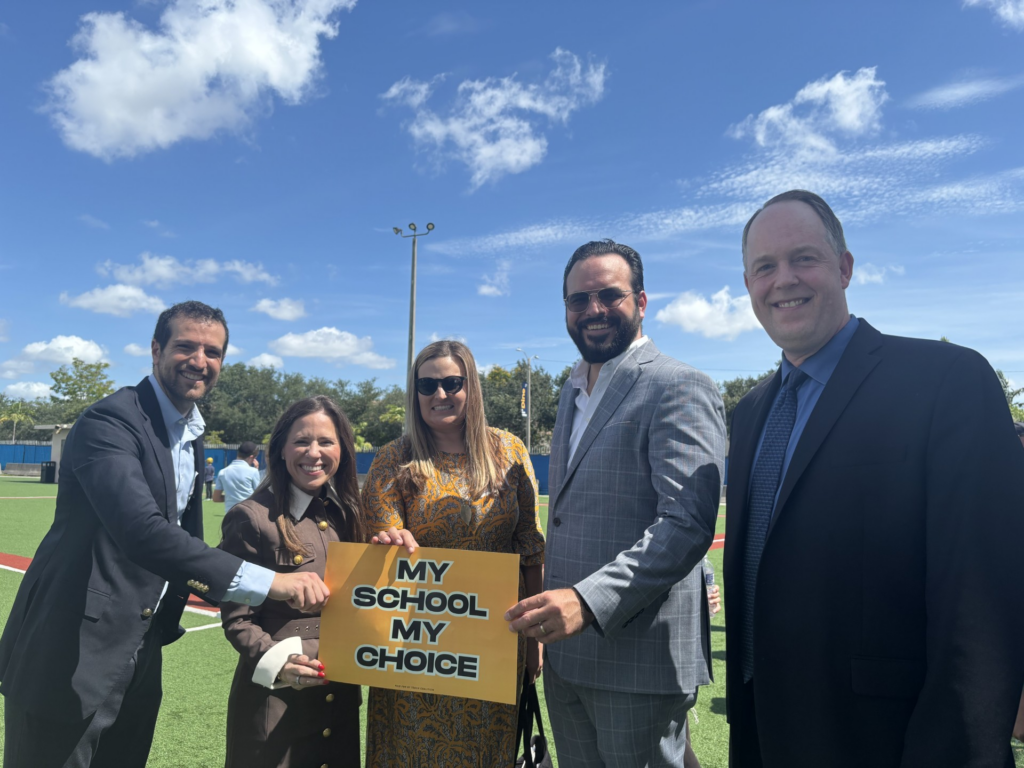
This week, the protests got louder. Students, parents, charter, and private school leaders stood outside Lubavitch Educational Center, the state’s largest Jewish day school, on Thursday and pledged to defend the decades-old policies and programs that have empowered families to choose the best educational fit for their children from a rapidly growing number of options.
“It’s not easy to pay private school tuition,” said Ailyn Weisleder, whose three sons are thriving at a Jewish day school. “But universal school choice has made that possible for our family. It gave us, and thousands of other families across Florida, the ability to choose the education that fits our children, not just the school assigned to us by a ZIP code.”
Audrey Maman Bensoussan said her family can’t afford to give her four children a Jewish education without the scholarships. She said the school feels like “a second home” to her children.

“If this lawsuit succeeds, it will not hurt politicians or special interests. It will hurt families like mine. It will hurt children like mine. It will take opportunities away from parents who simply want the freedom to choose the school that best meets their children's needs.”
Yonah Schwartz, 11, said at the news conference that if the lawsuit succeeds, then he won’t be able to afford to transfer to a school that better suits his learning needs.
“Not every kid learns the same way,” he said. “For me, changing schools means getting the chance to learn in a place that’s a better fit for me.”
The lawsuit, filed May 5, asks a judge to eliminate the state’s education choice scholarship programs based on the Florida Constitution, which says the state “shall make adequate provision for a uniform, efficient, safe, secure, and high-quality system of free public schools.” The lawsuit also seeks to end state funding of charter schools.
Faith leaders, charter school and private school leaders, as well as former Florida Gov. Jeb Bush’s Foundation for Florida’s Future, have supported the news conferences. Step Up For Students, the nation’s largest education choice scholarship funding organization, led the Tampa Bay area event. Teach Florida, a nonprofit school choice advocacy organization for Jewish education, organized and led the Miami event.
“The lawsuit brought by the Florida Education Association threatens everything these programs have made possible,” said Melissa Glaser, Teach Florida’s executive director. “This is about protecting families, protecting opportunity, and protecting a parent’s fundamental right to choose the best educational path for their child.”
She said more than $130 million annually in state scholarship funding helps ensure that Jewish children throughout Florida receive “the education they deserve — in schools that reflect their values and strengthen our communities.”
Their comments echo those made at the previous news conferences, where families described how scholarships had changed their lives. A charter school leader also spoke about how tuition-free charter schools ( which, like district schools, are public) have benefited students, including many from low-income households. Faith leaders also described how their schools uplift communities and welcome students with special needs.
Jim Rigg, superintendent of schools for the Archdiocese of Miami, said the lawsuit could damage “a thriving educational ecosystem in South Florida that attracts people from all over the world.” That includes the 37,000 students who attend Catholic schools in the diocese’s three counties. He said each school is accredited, gives standardized tests, complies with applicable state requirements, and employs highly qualified and certified teachers.
“But at its heart, the issue is not about institutions. It’s about children and families. Everyone wins with meaningful school choice, ultimately making our state the ideal place to raise and educate a child.”
A new state law has replaced Florida’s patchwork of local zoning rules that had prevented some small private schools from opening, paving the way for robust school choice options to expand.
Gov. Ron DeSantis signed Senate Bill 182 on April 20. In addition to a broad swath of education changes, from a cursive writing mandate to a teacher mentoring program, it includes a provision that exempts private schools with 150 or fewer students from applying for costly rezoning and land use changes when operating in commercial or mixed-use zones and in nontraditional buildings, provided they meet fire safety standards or similar checks.
The new law takes effect on July 1. It benefits private schools of all sizes by expanding legislation passed in 2024 that allowed them to operate in houses of worship, museums, theaters, colleges, and former schools or day care centers without needing these changes.
SB 182 also lets them build new facilities on these properties or on land owned by Florida College System schools and state universities without zoning changes.
The new law covers faith-based and secular schools, with Jewish education leaders leading the push for its passage. According to the Florida Department of Education, 15,679 students are enrolled in 85 Jewish schools across the state.
Demand for Jewish day schools has soared as families primarily from the Northeast move to Florida because of its robust education choice scholarship programs. The migration has meant fewer available seats for those seeking schools that provide academic and Judaic instruction.
Teach Florida, a division of the Teach Coalition, which advocates for Jewish nonpublic schools and parents, praised the law as “a transformational moment” for all Florida families.
“Today, Florida confirmed its commitment to students by removing one of the biggest barriers standing between Florida families and the education they want for their children,” said Melissa Glaser, executive director of Teach Florida. “For too long, local zoning restrictions have prevented schools from opening where demand is greatest. This law will help more schools grow, create more classroom seats, and ensure that more students can access the education they deserve.”
Last year, the group published a report on regulations governing the opening of private schools across South Florida. It concluded that local zoning restrictions were a major barrier to opening a new school, due to a patchwork of local laws that limit where schools can open, allow public schools to open in the same areas where private schools are prohibited, impose extra requirements on new private schools such as costly traffic studies regardless of school size, nebulous standards for “compatibility” and “scale,” and arbitrary requirements for lot size, fence height, building sharing and more.
As a result, the typical time to obtain zoning approval for a new school in South Florida was 12 to 18 months, and the process cost more than $150,000 in legal, architectural, and study fees.
“All nonpublic schools should receive the same protections and flexibilities as public schools,” the report said.
For microschools that register as private schools, the law exempts them from fire code complications that limit them to a maximum of five students.

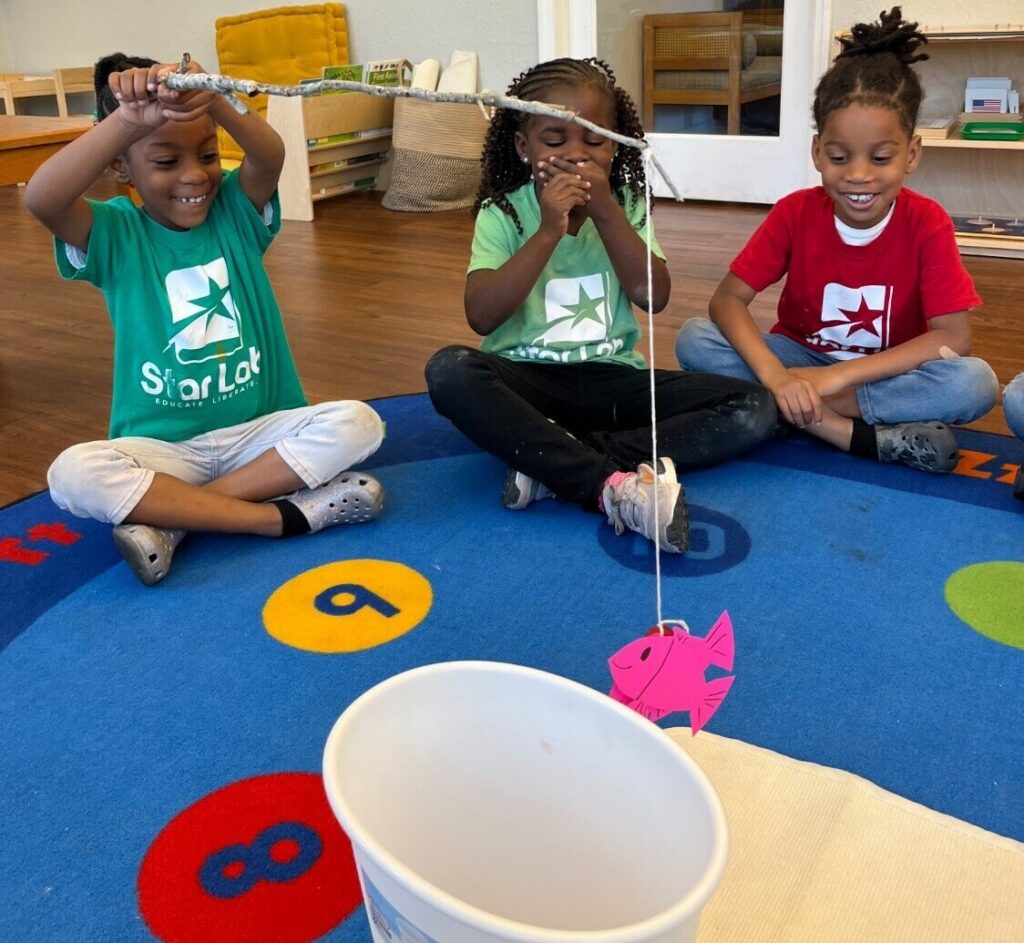
Alison Rini, the founder of Star Lab in Sarasota, could serve only five students during her first year due to fire codes that would require her to spend $97,000 on a sprinkler system for the rec center of a public housing complex where Star Lab operated. A local philanthropy stepped forward to help the housing authority pay for the system, but many founders are not as fortunate.
“The new law is a major win for diverse educational options,” Rini said. “The zoning process is incredibly burdensome.” In addition to the sprinkler system, Rini said she spent $10,000 to apply for a minor conditional use permit to use a one-story building less than 3,000 square feet that had previously housed a day center. The whole process took nearly two years and cost a total of $130,000.
“All of that time and money could have gone into our students and our curriculum; it was so frustrating,” Rini said.
Rini said she had to invest all the time and money with no guarantee of success. However, she said the planning commission easily approved her proposal when she was finally able to present it after 22 months of preparation.
After the vote, Rini said the chairperson commented, “I don’t know why this had to be so hard for her. I’m from Europe, and we have schools in apartment complexes all the time. This is a very compatible use.”
Danny Aqua, projects director for Teach Florida, recently told EdChoice the law adopts common sense fire code reform by 1) requiring fire officials to recognize alternative fire safety methods that are already in the code, and 2) treating similar facilities like day cares and churches as existing schools when applying the fire code.
“The goal is not to reduce safety, but to ensure that regulations designed for large, traditional schools are applied more appropriately to smaller educational environments,” he said.
TAMPA, Fla. – Shuli Goldenberg didn’t need to see Tampa Torah Academy to know it would be just right for her now 12-year-old son, Yanky. After talking on the phone with a rabbi who co-founded the school, she was sure it was “perfection.”
Still, she had persuaded her husband, Yisroel Aron, to move 1,200 miles from the Catskills in upstate New York; to leave family behind; to start life anew in the Sunshine State – all for a school they’d never seen.
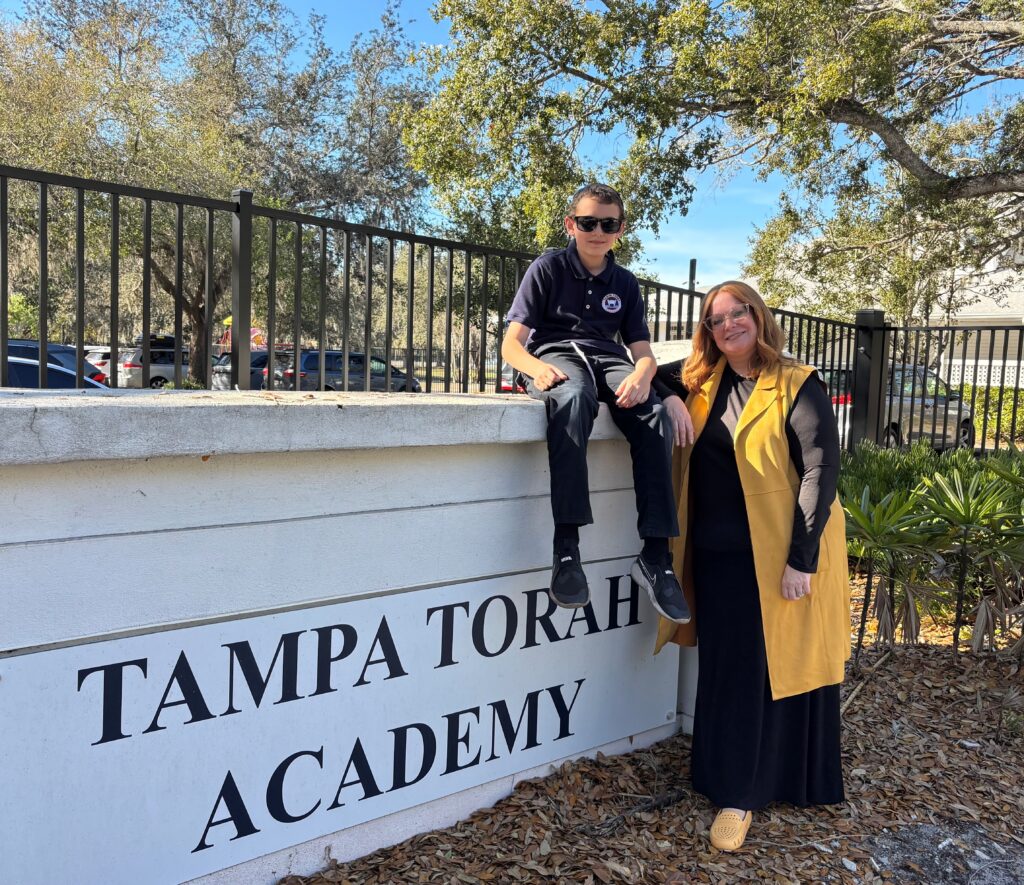
So, when she finally got to see it in person, a few days after the family moved down …
“I stood there with tears in my eyes thinking, ‘I’m home,’ ” Mrs. Goldenberg said. “It was like magic. It was exactly the school I wanted and exactly the school I knew my son would thrive in.”
The Goldenbergs are yet another example of a family drawn to Florida by educational opportunity (see others here, here, and here).
In their case, they represent what is likely the biggest group of “school choice transplants.” Hundreds if not thousands of Jewish families have moved to Florida in recent years, motivated at least in part by booming Jewish schools and the universal availability of state school choice scholarships.
The result: Between 2007-08 and 2022-23, the number of students in Florida’s Jewish schools grew 58%, to 13,379, and the number of Jewish day schools and yeshivas nearly doubled, from 40 to 74.
The Destination Florida pipeline is especially strong from New York to South Florida. But there are growing pockets of Jewish schools emerging in other parts of Florida too, like Tampa.
The why is obvious, said Rabbi Ariel Wohlfarth, co-founder of Tampa Torah Academy.
“School vouchers, no income tax, nice weather; why would you be any place else?” he said.
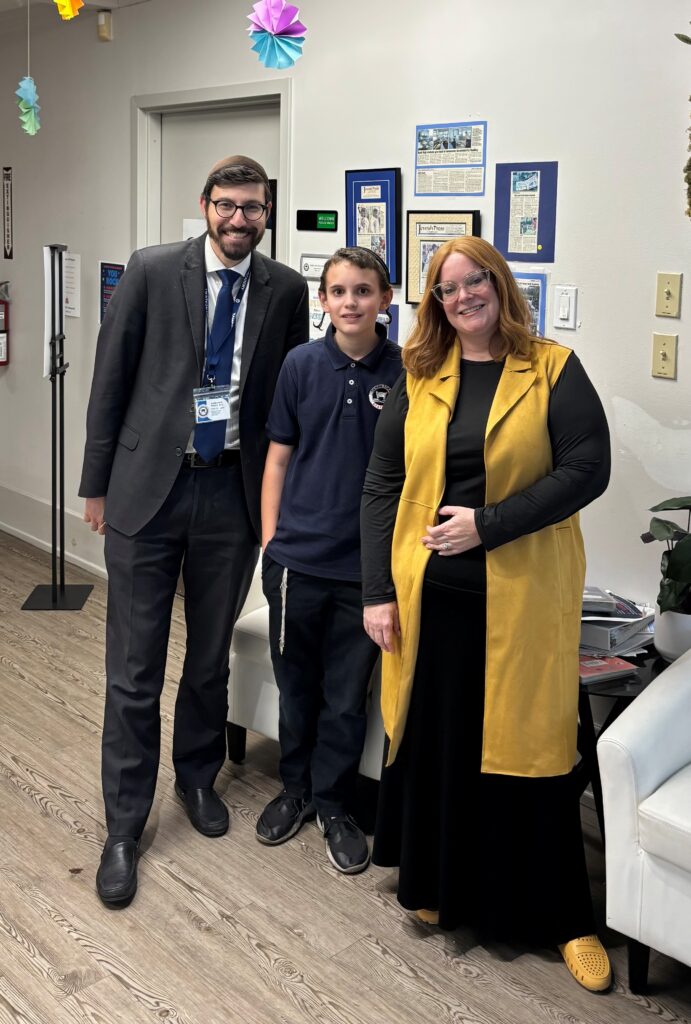
Tampa Torah Academy occupies a former preschool in a polished suburb. The school and its dormer windows and wraparound porch are framed by stately oaks and towering palms, next to a pond with a fountain whose streams arc outward in a circle, like the petals of a giant aquatic flower. An aerial view is the first thing people see when they visit the school website, along with the words, “Experience the Warmth of a Jewish Connection.”
Tampa Torah Academy opened in 2022 with 10 families, eight of whom relocated from New York. In the three years since, it’s tripled in size, from 33 students in grades K-7 to nearly 100 in K-12.
Every student uses a choice scholarship, which averages $8,000 or $10,000 a year, depending on the scholarship type. As of 2023, they’re available to every student in the state.
In New York, Yanky attended Jewish schools before Mrs. Goldenberg pulled him after a bullying incident.
She tried to homeschool him, but it wasn’t easy. She worried he wasn’t proficient enough in some subjects, like math, because of her own academic shortcomings, and that he wasn’t hanging out enough with other kids.
There were a few other Jewish schools in the area. But they were too expensive, too far away, or too big. Yanky, she said, “would have been lost and miserable.”
Thankfully, in the summer of 2022, Mrs. Goldenberg said, a miracle happened.
As word spread about a wave of Orthodox Jewish people leaving New York for schools in Florida, Mrs. Goldenberg got a fundraising pitch for Tampa Torah Academy. She donated, then called, then had a long conversation with one of the co-founders, Rabbi Yirmiyahu Rubenstein.
She was amazed by what she heard. The school promised solid instruction in both secular and religious studies; small class sizes; and teachers who would know each student’s strengths and weaknesses and adjust accordingly.
Everything “was like perfection,” Mrs. Goldenberg said. “I hung up the phone, I went across the house to my husband, and I said, ‘We’re moving to Tampa.’ “
Mr. Goldenberg is a retired businessman who worked in real estate. Mrs. Goldenberg is a former English teacher. Both had familiarity with Florida, having lived near Miami before things, for them, got too congested and hectic.
Neither knew the Tampa Bay area. But seven months after the call with Rabbi Rubenstein, they settled in Wimauma, a suburb 30 miles south of Tampa where a Jewish community is growing and former pastures are sprouting subdivisions.
“I thought Florida had flamingos, but we have cows next door,” Mrs. Goldenberg said.
Odds are high that more out-of-state families will be joining the Goldenbergs soon.
Tampa Torah Academy has room for 170 students – and it’s actively informing families in other states about what’s available in sunny Florida. Families in New York, New Jersey, and California, all states without private school choice programs, are among them.
As one indicator of the interest level, Rabbi Wohlfarth pointed to a recent, online “community fair” that connected Jewish communities nationwide to Jewish families interested in moving. Nearly 150 families visited the Tampa booth; more than 30 indicated serious interest.
The choice scholarships, Rabbi Wohlfarth said, are a powerful draw.
Jewish families are generally familiar with private school choice programs, “but they don’t know the amounts,” Rabbi Wohlfarth continued. When they hear what Florida provides, their ears perk up, he said. “They’re like, ‘I didn’t realize it was that much.’ “
Even without the scholarships, tuition at Tampa Torah Academy was more reasonable than similar schools up North, Mrs. Goldenberg said. The scholarship made it better still.
Without it, she said, paying for the school “would have been an enormous amount of stress.”
Tampa Torah Academy provides Yanky everything he needs to be successful, she said. It’s strong in both general academic subjects, what Orthodox families call “English,” and Jewish religious studies, often called “Judaics.”
“I wanted him to have both. That’s very important,” Mrs. Goldenberg said. “At Tampa Torah Academy, they also have a high school division now, so they can prepare to send the kids to the best colleges.”
Yanky said he’s happy with his new school and state. For top Florida amenities, he listed 1) “It’s not cold,” 2) theme parks, 3) Top Golf.
Mrs. Goldenberg said the only downside is the family’s two older children – a son and a daughter and their four grandchildren – are still in New York.
Otherwise? The people of Tampa Bay are “lovely,” she said, and the pace of life just right: “not as rush-y” as South Florida but more energizing than the Catskills. “There’s always something to do,” she said.
The cherry on top is the school, and the tight-knit community that revolves around it.
“Oh my God I love it. I feel like all of us are thriving,” she said. Meanwhile, friends up North are “buried under 27 inches of snow.”
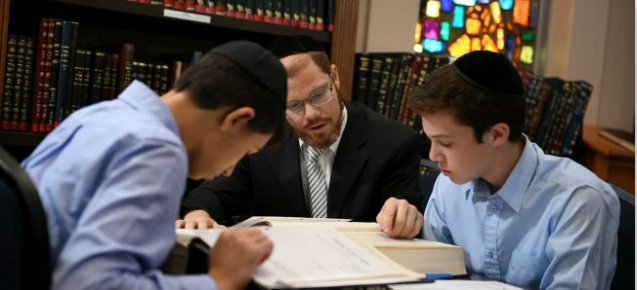
Students from junior pre-K through high school at Yeshiva Toras Chaim Toras Emes in North Miami Beach, Florida, receive education in Limudei Kodesh in conjunction with a rigorous secular studies program that focuses on building strong minds and strong characters in a warm, welcoming learning environment. Lessons are tailored to each student’s unique learning style and needs.
Editor’s note: This article appeared Tuesday on ou.org, the website of the Orthodox Union. You can read a story about Jewish day schools and education choice from reimaginED senior writer Lisa Buie here.
Leaders from six Jewish day schools in South Florida recently convened to discuss the historic school choice expansion that Gov. Ron DeSantis signed into law on March 27. The new law expands scholarships to all K-12 students in the state and will give approximately $8,000 per student.
This could bring as much as $40 million of new funds into Jewish day schools, which will help alleviate South Florida families who are struggling with the private school tuition crisis. One concern shared by many parents is that the influx of these funds will cause schools to raise tuition by $8,000, which would negate the affordability factor.
To address this issue, representatives from Jewish day schools met in a small focus group with staff members and the executive committee from Teach Florida, a project of the Orthodox Union, the nation’s largest Orthodox Jewish umbrella organization. The schools strongly affirmed that affordability is a critical component of their educational mission and will remain a key focus for them moving forward.
“Affordability is an important value of our schools,” says Teach Florida Engagement Director Melissa Glaser. “They don’t intend to take the state funds and then turn around and increase tuition by an equivalent amount. The schools recognize the value of affordability, and their goal is to support families receiving much-needed relief funds toward tuition, while providing a quality education to their students.”
Rabbi Bernstein of Toras Emes agrees, and says, “Over the last decade, we raised tuition very minimally as we value affordable education for our families. This year, before learning of the school choice bill, we made the decision to raise tuition due to incredible hiring challenges and inflationary costs.”
He adds, “We fully support the fact that school choice funds are intended as a relief for parents and will not be viewed as extra entitlement for the school.”
To continue reading, click here.
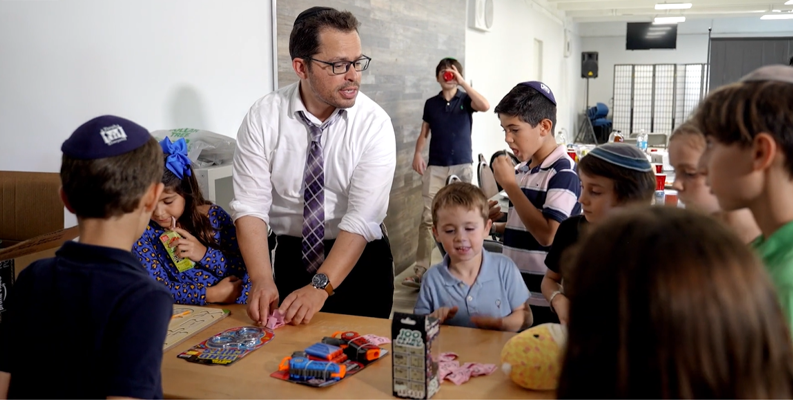
Educator and entrepreneur Rabbi Isaac Melnick, with support from The Drexel Fund, will open a new elementary school that is an outgrowth of more than two decades of strong secular and Jewish education leadership.
Rabbi Isaac Melnick thinks learning should be fun. As a young teacher in a Hebrew dual-language charter school in South Florida, he ran a lively after-school program that taught Torah to students who wanted to receive Judaic instruction. He called the program Torah 4 Everyone. He also ran Camp Cooluna, a summer camp that offered water slides, crafts and costumes alongside instruction in Jewish scriptures.
When the after-school program was forced to go all virtual during the pandemic, Melnick didn’t miss a beat. He started Jewish American Zoom, which offered Judaic teaching in an atmosphere of entertainment, wacky competitions and prizes that included Amazon gift cards and massive Hershey’s Kisses.
The program, which Melnick called JAZ, was such a hit that some kids lamented it only operated Monday through Thursday.
Now, with more than a decade of experience launching and managing extra-curricular programs, Melnick wants to open a full-fledged Jewish day school. Shorashim Academy is slated to open for the 2023-24 school year in the Hallandale, Florida area.
He’s garnered support from The Drexel Fund, a national philanthropic nonprofit that aids entrepreneurs who want to start private schools that offer greater access to underserved populations and have the potential for replication.
Melnick was recently accepted into the organization’s Founders Program, which is providing him with a year’s salary as well as an opportunity to obtain seed money for startup costs. The fellowship program also offers training on such topics as school governance and budgeting.
As a fellow, Melnick will visit high-performing schools across the country and work with mentors who will help him develop a business plan for the new school.
Melnick and his school were a natural fit for the program according to Eric Oglesbee, director of Drexel’s founder’s program and a Drexel alum who founded River Montessori High School in Indiana.
“At the Drexel Fund, we are attracted to entrepreneurs with a clear and compelling vision for serving underserved populations in their local communities,” Oglesbee said. “Additionally, we are focused on supporting the development of financially sustainable, replicable models that from first principles are likely to produce outstanding academic results and deep character formation.”
What makes Melnick’s vision compelling, Oglesbee said, is his passion paired with his expertise and connections.
“We felt what he needed from us was the opportunity to have an entire year where he could devote 100 percent of his energies toward opening Shorashim Academy and to engage in a customized learning plan with a cohort of other first-time school founders to help him have a strong launch into a sustainable school,” Oglesbee said.
One unique feature of Shorashim Academy is that it will cater to a Jewish population that is more casually observant than those who attend the rapidly growing surrounding day schools in South Florida, which are primarily Orthodox.
“They may celebrate major holidays like Yom Kippur and Passover,” Melnick said. “They may have special meals and traditions and observe some form of Shabbat and occasionally visit the synagogue,” but their lives look more like the surrounding secular culture.
Melnick explained his target families fall into two groups: low-income families for whom a private education is financially unthinkable and middle-income families for whom private school might be possible but would require extreme sacrifices that would force them to forgo vacations and other aspects of a typical middle-class lifestyle.
“These are people who otherwise would not send their children to Jewish day schools,” he said.
Despite the challenges, members of the Orthodox community are required to provide their kids with a Jewish education regardless of the cost.
“I would sell my house,” said Melnick, a husband and father of four who is Orthodox. “Not all families are willing to do that.”
Melnick says Shorashim Academy is needed because Jewish students who don’t attend Jewish schools are at risk of losing their connections to their Jewish identity and Israeli heritage when they become adults. He’s seen that happen to former students from the non-religious Hebrew language charter school who attended his after-school Judaic program.
“Some of these kids are in their 20s, and they are struggling with it,” he said.
That’s why he believes an immersion program is critical. The academy’s name – Shorashim, from the Hebrew word for roots – reflects its purpose.
The school will initially be open to about 30 first and second graders. More grades will be added each year until the school serves students in preschool through 12th grade.
Upper grades are part of the long-range plan, which Melnick expects will take 12 to 15 years to implement.
Each day will begin and end with prayer. Two periods will focus on religious instruction, including fostering of an awareness and appreciation of Israeli culture, with the rest used for academics. Melnick hopes to offer evening Judaic classes for parents.
To make the school accessible to students regardless of income, Melnick plans to accept state K-12 education choice scholarships. He said the Florida Legislature’s recent expansion of state scholarship programs has placed private education within financial reach of more families.
As an example, Melnick explained that a family of six like his can qualify with a household income of up to $148,600. (Step Up For Students, which hosts this blog, manages state K-12 scholarship programs. You can find out more about scholarship programs and the latest eligibility rules here.)
“We’re very grateful for the scholarship program,” he said. “I’m very impressed with how powerful these scholarships are.”
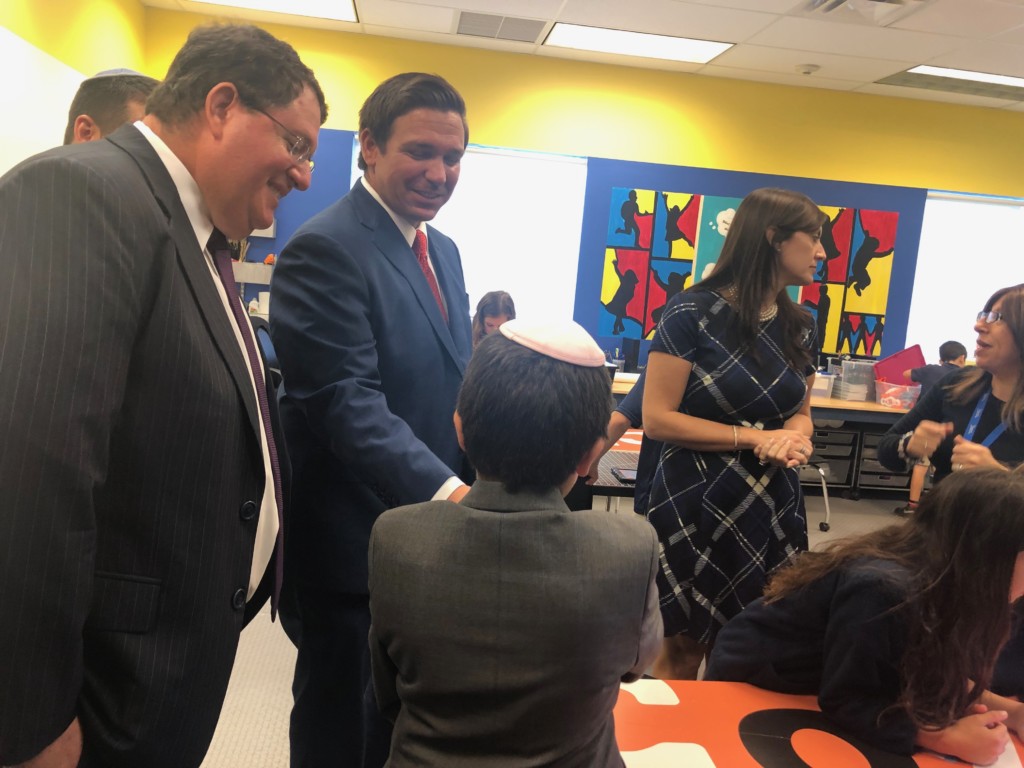
Governor-elect DeSantis greets a child at Brauser Maimonides Academy, flanked by Representative Randy Fine and Lt. Governor-elect Jennette Nunez
In his first trip to South Florida since winning the election, Governor-elect Ron DeSantis visited a Jewish Day school Monday where he spoke about the importance of expanding educational options and enhancing security specifically at such schools.
DeSantis visited Brauser Maimonides Academy, a Jewish Day school in Fort Lauderdale, where 80 students use the Florida Tax Credit Scholarship for low-income students. Step Up For Students, which helps administer the scholarship, publishes this blog.
“For his first trip to be focused on visiting a Jewish day school, talking about security and expanding school choice says an enormous amount about what his priorities will be when he gets sworn in,” said Rep. Randy Fine, R-Palm Bay, who attended the event.
Fine, who sponsored legislation in 2017 that provided security funding for Jewish day schools, said DeSantis highlighted security at the Orthodox school Monday. Gov. Rick Scott asked legislators last month to increase security funding for Jewish Day schools from $2 million to $4 million. This past spring, the Florida Legislature approved $2 million in security funding for 46 Jewish day schools.
Rabbi Yoni Fein, head of school for Brauser, said he was encouraged by the governor-elect’s visit. Fein said security is his own top priority, specifically “with the rise of anti-Semitism and the number of incidents that have happened on school properties.”
The number of anti-Semitic incidents in the United States grew by 57 percent in 2017, according to the Anti-Defamation League.
“There is a lot more we need to do to ensure we have the highest security possible,” he said.
At a roundtable discussion, DeSantis emphasized how scholarship programs such as the Florida Tax Credit Scholarship and Gardiner Scholarship for students with special needs are working and how there are many families who want the same choice, according to Mimi Jankovits, executive director of Teach Florida.
“Florida has the weather, low taxes and hopefully under the DeSantis administration we will build the best school system in the country,” Jankovits said.
House and Senate leaders released their $83 billion budget Friday.
The spending plan, which lawmakers are expected to debate during the final day of an extended legislative session, would allocate $654,491 to fund security at Jewish day schools in Florida after a rash of anti-Semitic threats throughout the country.
There have been bomb threats at 167 Jewish community centers in 38 states since the beginning of the year.
Rep. Randy Fine, R-Palm Bay filed HB 3653, which initially would have set aside $1.5 million to enhance security at Jewish day schools. Over the weeks of session, that amount was lowered.
The Florida House of Representatives lowered the funding for security to $254,491.
By contrast, the Senate budget allocated $500,000 for Jewish day schools, at the behest of Sen. Lauren Book, D-Plantation.
Addressing the Florida House PreK-12 Appropriations Subcommittee in March, Fine said Jewish students are afraid to come to school, with some even dropping out because of the security threats.
There are 55 Jewish day schools in the state of Florida, which serve nearly 10,000 students, according to Fine.
Several parents previously expressed concern to the Hebrew Academy of Tampa Bay about enrolling their children in the school, worrying they would be targeted because they are Jewish.
Rep. Randy Fine
Citing a rash of anti-semitic threats, the Florida House PreK-12 Appropriations Subcommittee unanimously approved a measure setting aside $1.5 million to enhance security at all Jewish day schools in Florida.
Rep. Randy Fine, R-Palm Bay, said since the beginning of the year there has been a dramatic rise in anti-Semitism. He said there had been 154 bomb threats reported at Jewish schools around the country, and 17 reported in Florida.
Appropriations documents show the measure, HB 3653, would benefit students in preschool through high school. Florida has 35 Jewish day schools in nine counties.
Fine mentioned there were no such schools in his district, but he felt the issue had statewide importance.
“We have a situation that Jewish students are very afraid and beginning to drop out of the schools,” Fine said. “It would put in security precautions so students and parents will feel safe having students attend these schools.”
Rep. Jennifer Sullivan, R-Mount Dora, asked what security measures would be put in place with the funding. (more…)
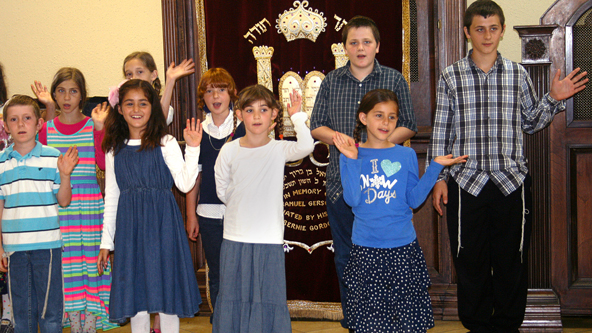
Students at the Hebrew Academy of Tampa Bay rehearse for their final performance of the school year. The Jewish day school is among a growing number turning to public aid for support.
Finances were always a struggle for the Hebrew Academy of Tampa Bay, a small Jewish day school in Florida. But when the economy tanked a few years ago, the struggle turned into a fight for survival.
“We had to go out and find those dollars,’’ said Sulha Dubrowski, the school’s founder and director. A Homeland Security grant paid for a new gate and door locks. The state’s Voluntary Prekindergarten Program, which supplements tuition for 4-year-olds, helped fill preschool seats.
Sulha Dubrowski
Three years ago, the academy discovered Florida Tax Credit Scholarships, a state program that uses tax-credited corporate contributions to help low-income children attend private schools. Now, 18 of the academy’s 35 students use the scholarships to pay half of the school’s $8,500 average annual tuition.
The scholarships, Dubrowski said, “helped us keep our doors open.’’
Saving Jewish day schools like the academy is the primary mission of the newly-formed Jewish Leadership Coalition, a nonpartisan advocacy group based in South Florida that includes rabbinical and lay leaders, educators and the Orthodox Union, which represents Orthodox congregations across the country.
Florida currently has about 35 Jewish day schools, but it’s getting harder every day for many to remain open, said coalition director Elliot S. Schreiber.
“Jewish day schools are hurting financially and are faced with the painful decision whether to continue providing general and Jewish education services to the community,’’ he said. “The result has been exorbitant tuition costs for low- and middle-income families with the community at large having to come up with huge sums to keep Jewish day schools in operation. It is unsustainable.’’ (more…)
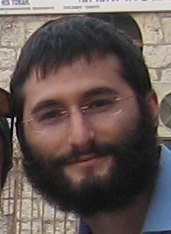
Rabbi Dubrowski
As a Rabbi in training, I had the opportunity to travel and live in countries around the world, such as Argentina, France, Israel and Ukraine. What I saw was greater emphasis on preparing the youth to succeed in life. Kids were being given the skills necessary to grow and become successful adults who can find work and support themselves and their future families. In the U.S., we are definitely falling short of this goal.
As the most prosperous country in recent history, we owe a great deal of our success to free markets and the excellence that competition breeds. The ability to choose where you live, work and play has forced the marketplace to create products catered to our society.
Education should be no different. The more options we have for schooling our children, the more focused schools will be on providing the best experience possible. This means supporting a successful public and private school system, so parents can find the right environment and system that caters to their individual child's needs.
The reality is many children have been removed from this marketplace by the cost of tuition at private schools. Even with scholarships available, it is still too costly for many of our middle-income families, thereby excluding them from making the right choices for their children.
Floridians are truly fortunate that our state has seen this challenge and acted to overcome it. (more…)

