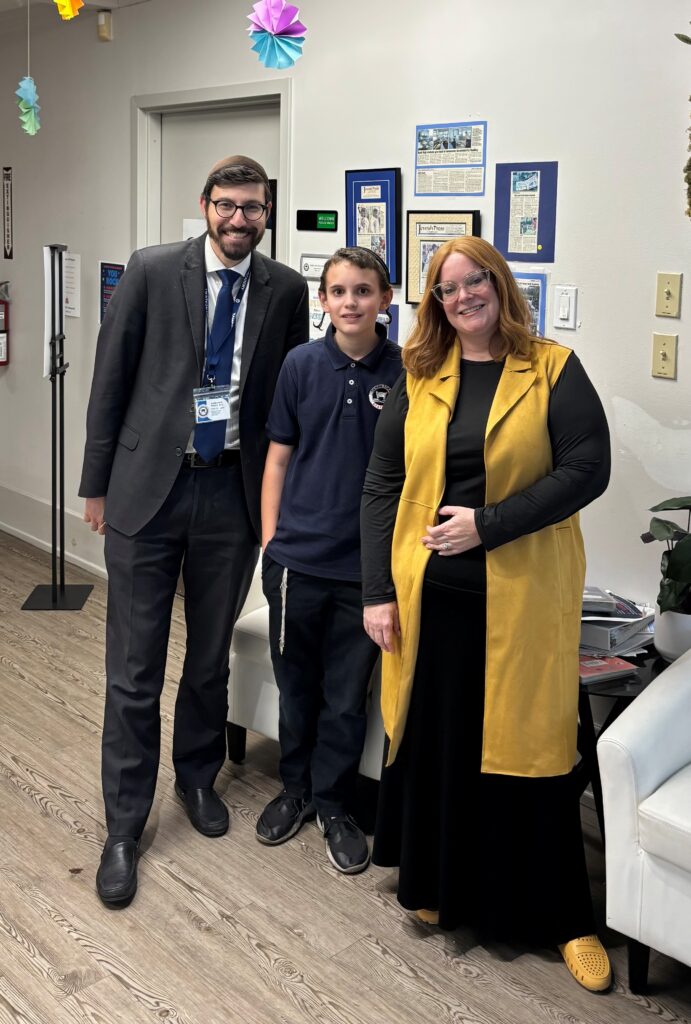
TAMPA, Fla. – Shuli Goldenberg didn’t need to see Tampa Torah Academy to know it would be just right for her now 12-year-old son, Yanky. After talking on the phone with a rabbi who co-founded the school, she was sure it was “perfection.”
Still, she had persuaded her husband, Yisroel Aron, to move 1,200 miles from the Catskills in upstate New York; to leave family behind; to start life anew in the Sunshine State – all for a school they’d never seen.
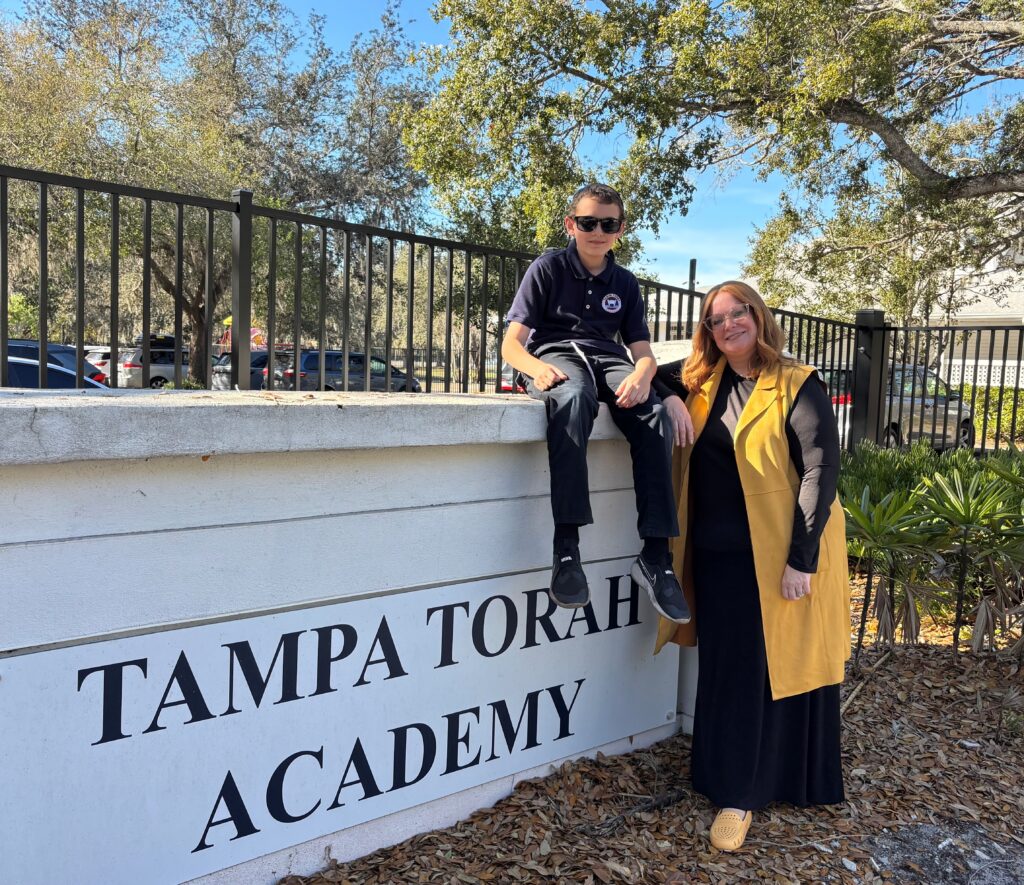
So, when she finally got to see it in person, a few days after the family moved down …
“I stood there with tears in my eyes thinking, ‘I’m home,’ ” Mrs. Goldenberg said. “It was like magic. It was exactly the school I wanted and exactly the school I knew my son would thrive in.”
The Goldenbergs are yet another example of a family drawn to Florida by educational opportunity (see others here, here, and here).
In their case, they represent what is likely the biggest group of “school choice transplants.” Hundreds if not thousands of Jewish families have moved to Florida in recent years, motivated at least in part by booming Jewish schools and the universal availability of state school choice scholarships.
The result: Between 2007-08 and 2022-23, the number of students in Florida’s Jewish schools grew 58%, to 13,379, and the number of Jewish day schools and yeshivas nearly doubled, from 40 to 74.
The Destination Florida pipeline is especially strong from New York to South Florida. But there are growing pockets of Jewish schools emerging in other parts of Florida too, like Tampa.
The why is obvious, said Rabbi Ariel Wohlfarth, co-founder of Tampa Torah Academy.
“School vouchers, no income tax, nice weather; why would you be any place else?” he said.
Tampa Torah Academy occupies a former preschool in a polished suburb. The school and its dormer windows and wraparound porch are framed by stately oaks and towering palms, next to a pond with a fountain whose streams arc outward in a circle, like the petals of a giant aquatic flower. An aerial view is the first thing people see when they visit the school website, along with the words, “Experience the Warmth of a Jewish Connection.”
Tampa Torah Academy opened in 2022 with 10 families, eight of whom relocated from New York. In the three years since, it’s tripled in size, from 33 students in grades K-7 to nearly 100 in K-12.
Every student uses a choice scholarship, which averages $8,000 or $10,000 a year, depending on the scholarship type. As of 2023, they’re available to every student in the state.
In New York, Yanky attended Jewish schools before Mrs. Goldenberg pulled him after a bullying incident.
She tried to homeschool him, but it wasn’t easy. She worried he wasn’t proficient enough in some subjects, like math, because of her own academic shortcomings, and that he wasn’t hanging out enough with other kids.
There were a few other Jewish schools in the area. But they were too expensive, too far away, or too big. Yanky, she said, “would have been lost and miserable.”
Thankfully, in the summer of 2022, Mrs. Goldenberg said, a miracle happened.
As word spread about a wave of Orthodox Jewish people leaving New York for schools in Florida, Mrs. Goldenberg got a fundraising pitch for Tampa Torah Academy. She donated, then called, then had a long conversation with one of the co-founders, Rabbi Yirmiyahu Rubenstein.
She was amazed by what she heard. The school promised solid instruction in both secular and religious studies; small class sizes; and teachers who would know each student’s strengths and weaknesses and adjust accordingly.
Everything “was like perfection,” Mrs. Goldenberg said. “I hung up the phone, I went across the house to my husband, and I said, ‘We’re moving to Tampa.’ “
Mr. Goldenberg is a retired businessman who worked in real estate. Mrs. Goldenberg is a former English teacher. Both had familiarity with Florida, having lived near Miami before things, for them, got too congested and hectic.
Neither knew the Tampa Bay area. But seven months after the call with Rabbi Rubenstein, they settled in Wimauma, a suburb 30 miles south of Tampa where a Jewish community is growing and former pastures are sprouting subdivisions.
“I thought Florida had flamingos, but we have cows next door,” Mrs. Goldenberg said.
Odds are high that more out-of-state families will be joining the Goldenbergs soon.
Tampa Torah Academy has room for 170 students – and it’s actively informing families in other states about what’s available in sunny Florida. Families in New York, New Jersey, and California, all states without private school choice programs, are among them.
As one indicator of the interest level, Rabbi Wohlfarth pointed to a recent, online “community fair” that connected Jewish communities nationwide to Jewish families interested in moving. Nearly 150 families visited the Tampa booth; more than 30 indicated serious interest.
The choice scholarships, Rabbi Wohlfarth said, are a powerful draw.
Jewish families are generally familiar with private school choice programs, “but they don’t know the amounts,” Rabbi Wohlfarth continued. When they hear what Florida provides, their ears perk up, he said. “They’re like, ‘I didn’t realize it was that much.’ “
Even without the scholarships, tuition at Tampa Torah Academy was more reasonable than similar schools up North, Mrs. Goldenberg said. The scholarship made it better still.
Without it, she said, paying for the school “would have been an enormous amount of stress.”
Tampa Torah Academy provides Yanky everything he needs to be successful, she said. It’s strong in both general academic subjects, what Orthodox families call “English,” and Jewish religious studies, often called “Judaics.”
“I wanted him to have both. That’s very important,” Mrs. Goldenberg said. “At Tampa Torah Academy, they also have a high school division now, so they can prepare to send the kids to the best colleges.”
Yanky said he’s happy with his new school and state. For top Florida amenities, he listed 1) “It’s not cold,” 2) theme parks, 3) Top Golf.
Mrs. Goldenberg said the only downside is the family’s two older children – a son and a daughter and their four grandchildren – are still in New York.
Otherwise? The people of Tampa Bay are “lovely,” she said, and the pace of life just right: “not as rush-y” as South Florida but more energizing than the Catskills. “There’s always something to do,” she said.
The cherry on top is the school, and the tight-knit community that revolves around it.
“Oh my God I love it. I feel like all of us are thriving,” she said. Meanwhile, friends up North are “buried under 27 inches of snow.”
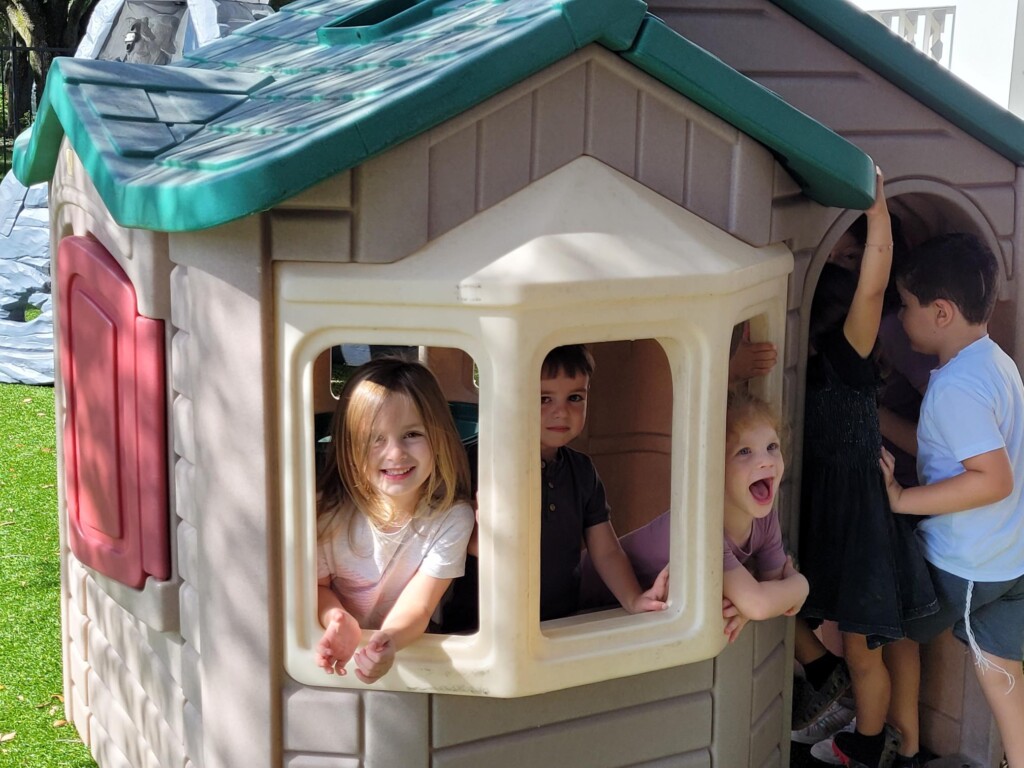
Students enjoy recess at Tampa Torah Academy.
TAMPA, Fla. — With 16 dormer windows that peek out from all sides of the roof and a wrap-around porch, the building looks more like a place to relax than study. Shaded by a canopy of oaks, the only noise comes from chirping birds and water spraying from a fountain in a nearby pond.
“It’s very quiet out here,” said Rabbi Ariel Wohlfarth, one of two deans at Tampa Torah Academy, which opened two years ago in a building that once housed a day care center and community clubhouse for a leafy suburb of Tampa.
But through the front door was a buzz of activity. During a recent visit, kindergarten students seated at two tables worked on crayon  drawings of their families. In another, a teacher prompted third graders to examine the text of “Charlotte’s Web” for clues about the characters. In a third room, older boys listen to a rabbi explain the importance of Israeli kings’ reigns as historical markers. Nearby, older girls learn the origin story of the prophet Samuel.
The school, whose mission is to offer an authentically Orthodox Jewish education, is one of only four Jewish day schools in the Tampa Bay area. Jewish day schools are booming in South Florida, and the greater Tampa Bay area is also seeing a resurgence after years of decline.
A report released this year by Teach Coalition and Step Up For Students showed that the number of Jewish schools in Florida nearly doubled over the past 15 years, boosted by parents using state school choice scholarships and the migration of families from New York.
The report attributes much of the enrollment decline in the Tampa Bay region to the 2010 closing of Pinellas County’s only Jewish day school. A casualty of the Great Recession, Pinellas County Jewish Day School could not secure enough operational funding from donors affected by stock market woes. At the same time, many families hit by the recession could no longer afford tuition, so enrollment dropped from more than 200 to 140.
The closing left the state’s second-largest Jewish population with few options: Hillel Academy in Tampa, which offers a track for Orthodox students but is also open to non-Jewish students, and Hebrew Academy of Tampa, a Montessori school for students in preschool through eighth grade. A charter Hebrew language school offered a Judaic after-school program but closed in 2013 after one year.
Eventually, the dearth of choices prompted parents seeking an Orthodox education for their children to contact Yeshivas Chofetz Chaim, also known as the Rabbinical Seminary of America. Based in Queens, New York, the organization starts Orthodox Jewish day schools across the United States. The organization had established successful schools in Orlando and Boca Raton.
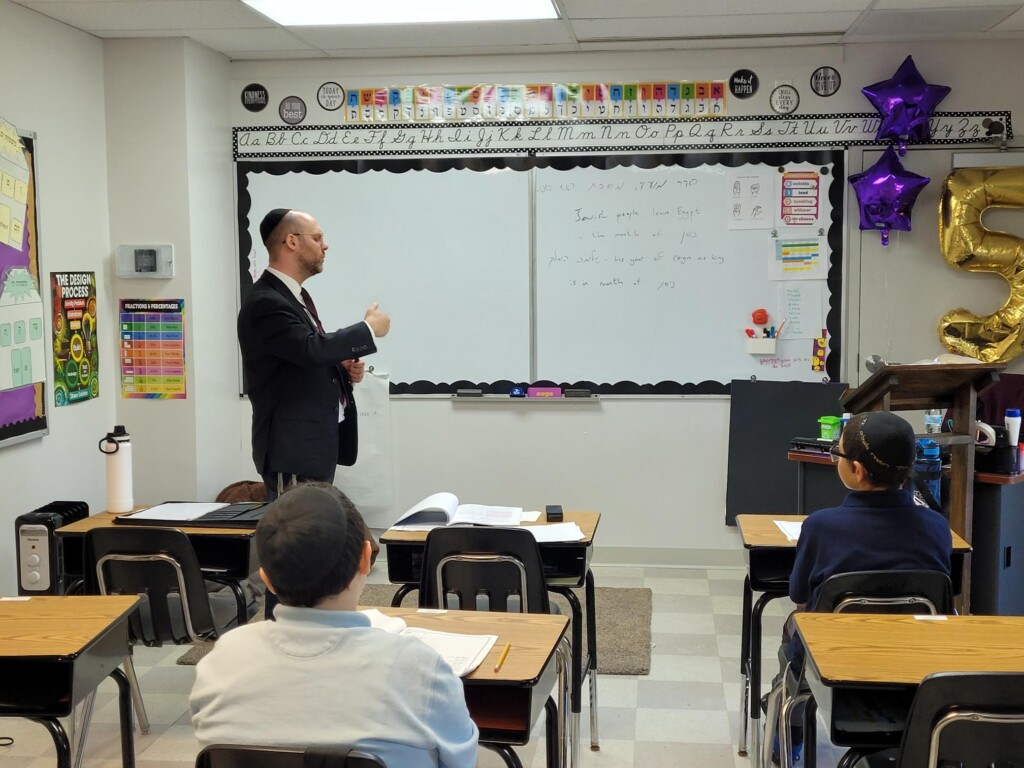
A boys' Torah class learns about Jewish history.
“In most communities, there’s usually a Jewish day school that creates an environment that is completely Jewish,” said Rabbi Jeremy Rubenstein, who along with Wohlfarth is co-dean of Tampa Torah Academy. “And parents were looking for that, and it didn't exist in Tampa.”
So, in 2022, Rubenstein, his wife, their kids, and eight other families moved to the Tampa Bay area to start an Orthodox school. A property search revealed the 10,000-square-foot building in a Tampa suburb that a day care center had recently vacated. After extensive renovations, they opened the school to 33 students in preschool through seventh grade. The wives of those who moved to Florida comprised most of the school staff. Two years later, school leaders added an eighth grade.
Tampa Torah Academy now has 80 students from more than 30 families. Some live within 15 to 20 minutes of the school, but most live closer to Tampa’s core. Some even come from Clearwater, a 36-mile trip that can expand to a two-hour drive during rush hour. Others drive up from Sun City Center in the southernmost part of the county, which is 40 miles from the school.
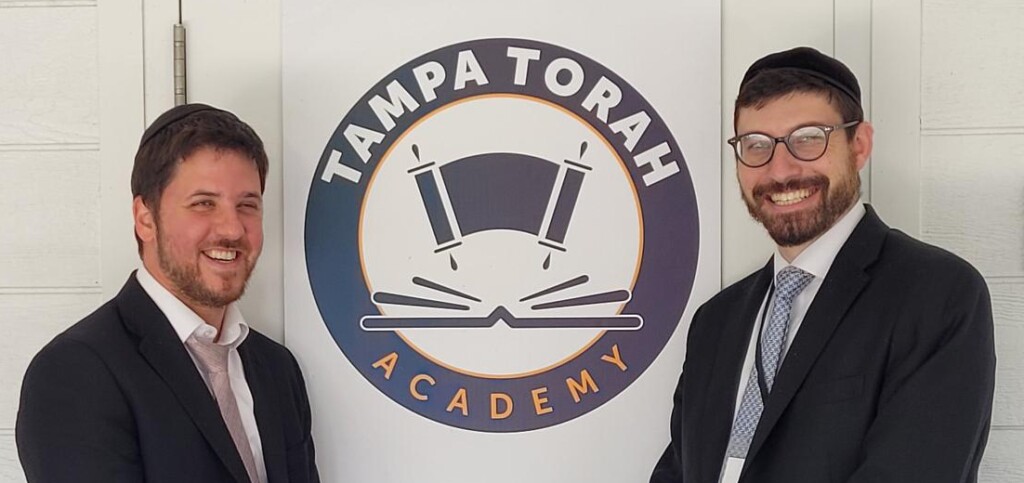
Rabbi Jeremy Rubenstein, left, and Rabbi Ariel Wohlfarth are the deans of Tampa Torah Academy.
Leaders contracted with a busing service this year to provide transportation.
“We have students coming from all different, all sorts of places,” Rubenstein said.
This year, leaders expanded again, with high school programs for boys and girls. The boys are meeting at a Tampa Kollel and the girls at Tampa Torah Academy. Like the other Jewish schools, Tampa Torah Academy accepts Florida’s school choice scholarships.
“Switching our kids from public schools to TTA was one of the best decisions we made,” parent Danny Betesh said in a school video. “We love the fact that our kids came to TTA because of how warm it is, how they know everyone. They know the staff; they know the kids from all the grades…they feel like a family.”
Local Jewish leader Jeffrey Berger welcomes the expansion of education opportunities for Jewish families and says the uptick in school growth is expected as Jewish families move in from other states.
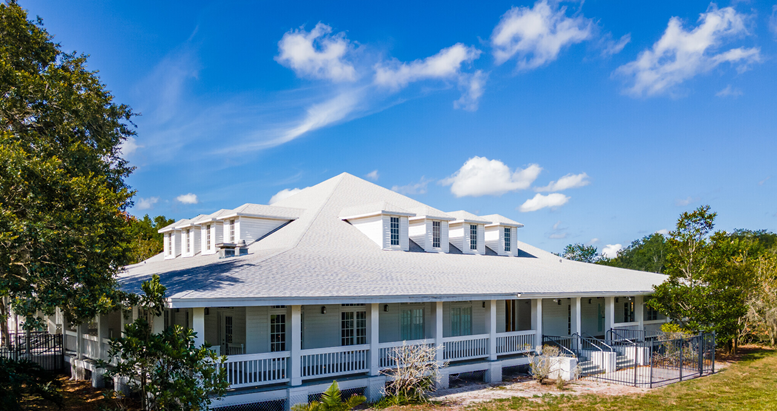
Tampa Torah Academy
Before Tampa Torah Academy opened, “we had a gap in certain segments of the community,” said Berger, a retired real estate attorney and president of the Tampa Jewish Community Centers & Federation. “There was a need for their brand of Orthodox Judaic religious institution.”
He said Hillel Academy, which opened in 1970, plans to open a high school next year. Tamim Academy of Pinellas, which opened this year at the Chabad of Pinellas, also fills a void that existed for too long in that area.
Berger said he was excited to see 100 people turn out at a recent open house for Tampa Torah Academy. He believes families will continue to be drawn to the area for its warm climate and lower cost of living than its northern neighbors.
“The availability of scholarship money has certainly made all private schools more affordable, and I think Jewish day schools are a part of that,” he said. “Affordability is a big issue for a lot of people across the board, including those who want their children to have a Jewish education.”
The number of Jewish schools in Florida nearly doubled over the past 15 years, boosted by parents using state school choice scholarships and the migration of families from New York, according to a new report from Teach Coalition and Step Up For Students.
Student enrollment between 2007-08 and 2022-23 rose 58 percent, from 8,492 to 13,379, while the number of Jewish day schools and yeshivas grew from 40 to 74, the report shows.
Over the same span, the percentage of Jewish school students using choice scholarships increased from 10 to 60 percent.
 The growth of Jewish schools in Florida is historic and unmatched anywhere else in America. The analysis is also likely to understate the trend lines, given it does not cover the 2023-24 school year, the first year every student in Florida became eligible for a choice scholarship. (The data for 2023-24 is not yet available.)
On a cautionary note, the report also points to increasingly pressing issues that could limit future growth – and not just for Jewish schools.
The vast majority of newer Jewish schools are on the smaller side, with fewer than 175 students. That’s not a function of parental preference, the report suggests, but the result of challenges schools face in navigating restrictive local zoning laws to find adequate and affordable facilities.
“With Florida’s existing Jewish schools at or near full capacity, more effort is needed to source suitably sized school buildings,” said Danny Aqua, director of special projects at Teach Coalition. “Without legislative and regulatory action to reduce the hurdles to opening new schools, the lack of school building space may throttle growth in Florida’s Jewish day schools.”
Full report here.

The headline: Families who enrolled their children at a new Jewish day school in South Florida were forced to temporarily seek other options after local zoning and permitting issues delayed the school’s opening.
Behind the headline: A new law granting universal K-12 scholarship eligibility to all Florida families has created record demand. More families are leaving states like New York, slowing growth in Jewish schools there and fueling a boom in 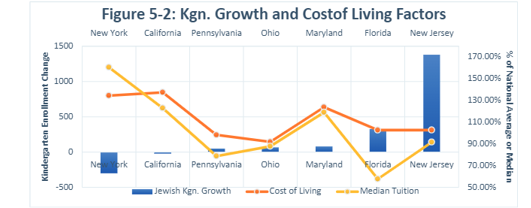 demand for Jewish schools in Florida.
Between the lines: Bet Midrash Ohr Ha-Chayim Ho-Kadosh had planned to open the K-8 private school last month on the first four floors of the Home Tower, an 18-story building in the South Florida city of Hollywood. But first, officials had to seek a special land use exception from the city officials. A charter school next door used to occupy the same space in the Home Tower that Bet Midrash plans to use, which would make it seem like a slam dunk.
Not so fast: City planners recommended approval of the special exception, but with conditions. Those included updating a traffic study, getting a road access permit from the Florida Department of Transportation, busing all students, and staggering pickup and drop-off times with the neighboring charter school. Bet Midrash agreed to all of it.
Yes, but: Despite the staff recommendation and a federal law preventing local governments from placing undue land-use burdens on religious institutions, the city Planning and Development Board voted it down 5-2. The reason? Concerns about traffic congestion. The board also said school leaders failed to provide a complete traffic study, which the planners said was okay if they submitted an updated one.
Big picture: A law passed in 2022 reined in local government rules that blocked new charter schools. It allowed charter schools to skip certain land use hurdles if they were housed in churches, museums, libraries, colleges or universities, community service centers, theaters, cinemas, or if the proposed location had recently housed another school or child care center as long as the sites met health, safety and welfare standards.
If Bet Midrash were a charter school, these changes would have helped it get a local government green light.Why it matters: Despite skyrocketing demand, private school founders still face many barriers to getting their doors open. Finding a suitable location and being able to afford it is formidable, says Eric Oglesbee, director of the Drexel Fund, a national nonprofit that supports new schools in underserved areas. That’s especially true for first timers without deep pockets or pre-existing local government relationships.
“Single founders are often bootstrapping their way to opening a school. They don’t have connections to have conversations (with local officials) ahead of time,” he says. “You can rack up thousands of dollars on a prospective site…and find that it falls through.”
What’s next: Bet Midrash is expected to appeal the planning board’s denial to the Hollywood City Commission, which could hear the matter as early as Sept. 20. Meanwhile, the school remains closed while it works out unrelated health and safety permitting issues with local officials.
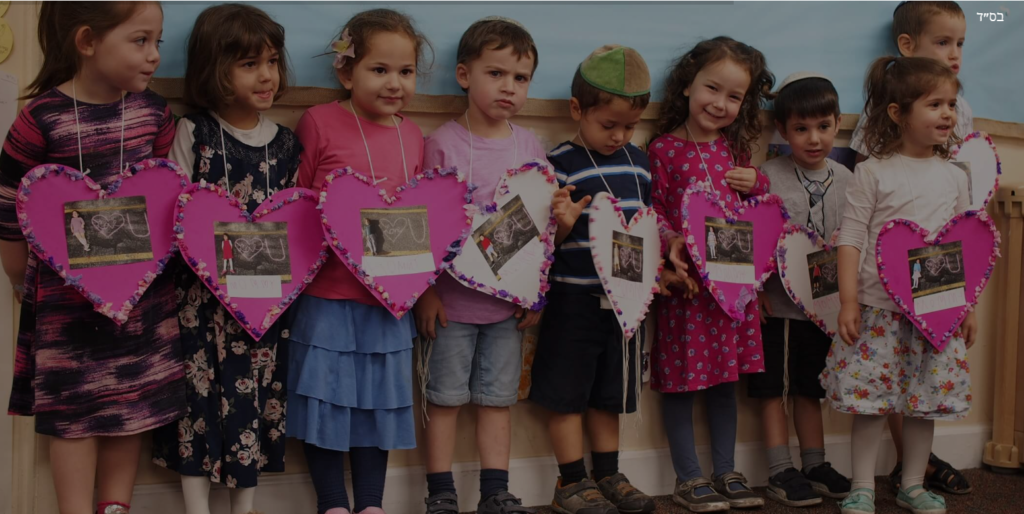
Hebrew Academy Community School in North Broward County, Florida, began the last academic year at near maximum capacity thanks to an influx of new families, many from out of state.
Allan Jacob, a North Miami Beach nephrologist and chairman and CEO of Physicians Dialysis, wrote last week for the Wall Street Journal about the decision of many New York Orthodox Jews to relocate to Florida:
So why did Rabbi Yisrael Taussig leave Brooklyn to start a community in Wimauma? Malka Taussig, his wife, says the answer is simple: Unlike Brooklyn, Florida offers well-paid jobs, cheap housing, affordable education and the hope of a brighter future. Many of the rabbi’s followers have joined him in Florida, as have others who originally were not his followers but want to live in a community where they feel comfortable and can thrive.
Florida’s school choice programs play a prominent role in the decision of many families to relocate.
Life for Orthodox Jews is not easy in New York, where taxes are high for a school system that does not meet their preferences and where they therefore bear the double burden of school taxes and private school tuition. Taxes, housing and education are all much more affordable in Florida.
Jacob notes:
That’s why many young families up north are enticed by Florida’s robust menu of state-supported private-school scholarships, worth on average of about $7,500 a year, as well as expanded benefits for children with a wide range of disabilities. These programs make private school tuition far more affordable in Florida than in New York and New Jersey. Legislation recently signed by Gov. Ron DeSantis has made even more families eligible for these options, further fueling the migration.
A similar trend appears to be occurring between California and Arizona. Again, the outflow comes from a high tax/cost state that provides no assistance to families seeking private education to a lower cost/taxed state which does.
Jason Bedrick, Ed Choice’s director of policy and a member of Arizona’s Orthodox community notes, “The rate at which Orthodox Jewish families are moving to Arizona, particularly to the Phoenix metro, is staggering. Much, though not all, of the migration is coming from Los Angeles.”
The question in my mind is not why so many Orthodox Jews are moving, but rather, why so few?
I’m guessing it won’t be long until other religious communities follow their lead. The COVID-19 pandemic has a great many of us reassessing life, creating a great deal of demand for housing.
Many states have taken bold action to give families more control over the education of their children, and religious or not, that is an important advantage in the competition for talent and industry.
Florida's public charter schools and tax credit scholarships have a few things in common. Both are growing by at least ten thousand students a year. And both are facing new legal hurdles, or in the case of the scholarships, an outright constitutional challenge.
Daniel Woodring, a former general counsel in the state Department of Education whose clients now include both charter schools and tax credit scholarship parents, says that's no coincidence. This school year, Florida's charter schools grew to enroll more than 250,000 students - about one of every 11 children attending the state's public schools.
Speaking on Saturday to a global gathering of education reform researchers and practitioners in South Florida, Woodring said that growth helps explain why some charter organizations now have to fight legal battles or overcome new roadblocks in the same Florida school districts that approved them a few years earlier, and why even charter schools with solid track records are having trouble opening new schools.
"Their concern is very simple," he said of districts subjecting charters to new levels of scrutiny. "It's competition. It's economics."
National. Uncommon Schools wins the 2013 Broad Prize for outstanding charter school network (Education Week). U.S. Education Secretary Arne Duncan praises charter schools for recent improvements but criticizes some for excluding high rates of students through disciplinary actions (Education Week). Tax credit scholarship programs are boosting Jewish day schools and yeshivas nationwide (The Jewish Press).
 Washington: A coalition led by the state teachers union files a lawsuit challenging the constitutionality of the state's new charter school law (Seattle Times). The state's three biggest districts take different approaches to the new charter law, with Spokane most aggressively embracing it (Associated Press).
Virginia: The Norfolk school district considers converting a fifth of its schools into charters (Virginian-Pilot).
Louisiana: Only one of 117 private schools participating in the state's school choice voucher program is found to be in violation of financial rules (New Orleans Times Picayune). The state's fledgling "course choice" program continues to grow, with 1,500 students enrolled so far (New Orleans Times Picayune).
Mississippi: Charter school supporters consider the possibility of luring a high performing charter network like KIPP (Jackson Clarion Ledger). The process for starting a charter school in Mississippi is a grueling one (Jackson Clarion Ledger). One parent offers a testimonial about the power of the Nashville Prep charter school (Jackson Clarion Ledger).
Wisconsin: Gov. Scott Walker says he'll use test scores, graduation rates and other measures to determine the effectiveness of the newly expanded school choice voucher program (Green Bay Press Gazette). More from the Wisconsin State Journal. The statewide expansion involves a couple of twists on Walker's part, including a veto of language that could have been used to circumvent the caps (Education Week). Private schools consider whether to participate (Milwaukee Journal Sentinel). Critics say private schools that accept vouchers are shortchanging students with disabilities (Wisconsin Watch). (more…)
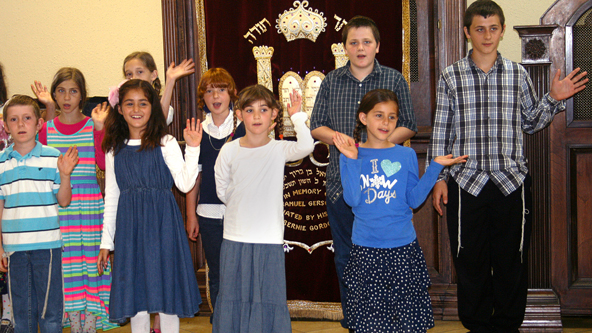
Students at the Hebrew Academy of Tampa Bay rehearse for their final performance of the school year. The Jewish day school is among a growing number turning to public aid for support.
Finances were always a struggle for the Hebrew Academy of Tampa Bay, a small Jewish day school in Florida. But when the economy tanked a few years ago, the struggle turned into a fight for survival.
“We had to go out and find those dollars,’’ said Sulha Dubrowski, the school’s founder and director. A Homeland Security grant paid for a new gate and door locks. The state’s Voluntary Prekindergarten Program, which supplements tuition for 4-year-olds, helped fill preschool seats.
Sulha Dubrowski
Three years ago, the academy discovered Florida Tax Credit Scholarships, a state program that uses tax-credited corporate contributions to help low-income children attend private schools. Now, 18 of the academy’s 35 students use the scholarships to pay half of the school’s $8,500 average annual tuition.
The scholarships, Dubrowski said, “helped us keep our doors open.’’
Saving Jewish day schools like the academy is the primary mission of the newly-formed Jewish Leadership Coalition, a nonpartisan advocacy group based in South Florida that includes rabbinical and lay leaders, educators and the Orthodox Union, which represents Orthodox congregations across the country.
Florida currently has about 35 Jewish day schools, but it’s getting harder every day for many to remain open, said coalition director Elliot S. Schreiber.
“Jewish day schools are hurting financially and are faced with the painful decision whether to continue providing general and Jewish education services to the community,’’ he said. “The result has been exorbitant tuition costs for low- and middle-income families with the community at large having to come up with huge sums to keep Jewish day schools in operation. It is unsustainable.’’ (more…)
Tax hike: Seminole County schools Superintendent Walt Griffin says his district needs another 1-mill tax on county property to pay for a slew of school improvements. Orlando Sentinel.
 Digital divide: Over the next few years, computers will play an even bigger role in public education. StateImpact Florida.
Summer lunch: And breakfast at more than a dozen South Florida schools that will keep their kitchens open to serve needy children. Miami Herald.
Jewish schools: A coalition of Jewish leaders is advocating for policies that help ease the financial burden on private school parents. SaintPetersBlog.
Overage students: Superintendent Nikolai Vitti will ask board members to OK a plan that increases the number of schools offering classes to overage students. Florida Times-Union.
Teacher turnover: In Florida, four out of 10 new teachers leave their jobs within the first five years. In Duval County, it's about five out of 10, according to a recent study. Florida Times-Union.
Lessons learned: Manatee County schools suffered the brunt of lax accounting and archaic budgeting software, but a citizens advisory group stands behind the new superintendent. Bradenton Herald. Manatee school board member and budget committee chairwoman Julie Aranibar looks back on troubled year. StateImpact Florida.
Gifted students: More than 10 percent of Miami-Dade County's students are labeled gifted students. Miami Herald. Although school districts test children for free to determine if they are gifted students, many parents turn to outside psychologists, instead. Miami Herald.
Education shift: Five retiring teachers reflect on the changing landscape in public education. Ledger.
Portables: Broward looks to spend millions to get rid of 1,180 portable classrooms older than 20 years. Sun-Sentinel.
Arrested: Royal Palm Beach High assistant principal arrested in prostitution sting. Palm Beach Post.
Scholarships: Four Hillsborough County seniors win Red Pittman Scholarship. Tampa Tribune.
Budget cuts: The Pembroke Pines Charter System projects a $2.4 million budget shortfall for the 2013-14 school year and has no money for contracted raises for 330 teachers. Sun-Sentinel. Manatee officials say they'll work to get kilns running again at Manatee High. Bradenton Herald.
FCAT: South Florida’s students perform as well or better than last year in most every field tested, but schools and teachers likely to be judged more harshly as Florida moves toward more rigorous standards. Miami Herald. And students aren't making the kind of gains they should be, educators say. Tampa Tribune. Education Commissioner Tony Bennett calls the results unacceptable and suggests the state has lost focus on reading and math. Tampa Bay Times. More from Orlando Sentinel, Sarasota Herald-Tribune and Palm Beach Post.
BP and schools: Volusia County school district official says the BP oil spill had a clear impact on state revenue, decreasing state dollars that could have gone toward education funding. Daytona Beach News-Journal.
Grads: Service, technology and international pursuits are on the minds of Hillsborough's seniors. Tampa Tribune. A contest glitch results in car giveaways for two Hillsborough seniors. Tampa Tribune. 211 seniors are the first graduates of Weeki Wachee High. Tampa Bay Times.
Bullying: New law gives school districts the right to discipline students for cyberbullying outside school, if the student’s school life is impacted. Florida Times-Union.
Tolerance: Parents start a petition after a principal criticizes their son for wearing makeup to school. Tampa Bay Times.
Charter schools: Large charter organizations draw criticism for impact on public education. St. Augustine Record.
Texas: The State Board of Education votes to urge lawmakers to reject school vouchers - or any other mechanisms that reduce funding to public schools (Texas Tribune). Orthodox Jews, Catholics and leaders of other religious groups joined forces with private school advocates to rally for tax credit scholarships(The Yeshiva World News).
California: L.A. mayoral candidate Wendy Greuel, who wants to be the "education-reform mayor,'' supports parent trigger and other reform measures (Los Angeles Times). More from the Huffington Post.
Colorado: The Senate approves a bill that adds $1 million for charter school construction (Associated Press).
Washington, D.C.: Former students and faculty of Sidwell Friends, the elite private school that has educated children of presidents and members of Congress, want to open a charter school - and have Sidwell's support (The Washington Post). A report by the Walton Family Foundation shows the District's charter schools received about $13,000 less in per-student funding in 2011-12 than traditional public schools (Washington Examiner).
Pennsylvania: Philadelphia is the latest city to rally for school choice with more than 200 parents, educators and other charter supporters demanding district officials allow the expansion of at least 20 charter schools (NewsWorks). Also, the city's Mayor Michael Nutter asks the governor to approve more funding for city schools, including reimbursing districts for dollars spent on charter schools (NewsWorks).
Florida: Facing a tuition crisis, Jewish day school educators and religious leaders lobby Tallahassee for expanded school choice (Lubavitch.com). Lawmakers are trying to give district schools some of the same flexibility as charters, but still within union agreements (redefinED). This charter school almost didn't happen - and now it's one of the leading science schools in the state (redefinED).
Louisiana: New Orleans school officials consider an enrollment plan that, eventually, will allow some charters to hold seats for students who fit the school's mission - like a military academy. Opponents worry it will lead to cherry-picking high-achievers (The Lens). State Rep. Katrina Jackson has proposed a bill to allow public school students to recite the Lord's Prayer and Pledge of Allegiance (KATC). Former Secretary of State Condoleezza Rice touts Gov. Bobby Jindal's efforts to reform Louisiana's schools (The Times-Picayune). (more…)

