Embracing technology and launching new schools haven't fueled the kind of innovation that will actually lead to meaningful improvements in the education system as a whole — at least not on their own, a new article published this week by the World Economic Forum argues.
Michael Barber, the chief education adviser at Pearson UK, and Joel Klein, the former chief of New York City public schools, outline a "playbook" for transforming school systems. The two authors, the chair and vice-chair of the forum's Global Agenda Council on Education, look at systemic education reform from a global perspective, drawing on case studies from around the world.
They write:
[G]ood ideas are not enough. ... So the central question is perhaps not the extent of innovation, but its quality and speed from idea to impact. Innovation is happening, but too little of it is focused at the heart of learning and when it does it spreads too slowly.
Investments in technology have largely automated existing pedagogies or delivered school efficiency savings outside of the core of learning and teaching. Where new school providers have entered systems, the innovation is often more about school marketing than reimaging the learning model. This prompts the question of how to spark the right type of innovation in education.
The authors suggest education leaders and policymakers should think about the whole system, and set clear goals — like achieving 85 percent literacy, or increasing the amount of time schools devote to instruction (as Chile did during a wave of reforms that began in the '90s). Then, they should give educators the means, and the freedom, to meet them. (more…)
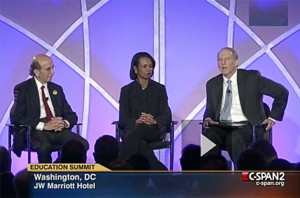 At Jeb Bush’s National Summit on Education Reform in Washington, D.C. last week, two prominent education reformers from the center-left and the center-right joined to make a remarkable statement about parental choice. Asked from the audience to name their “No. 1 idea” to improve public education, former New York City school chancellor Joel Klein and former U.S. Secretary of State Condoleezza Rice answered with a remarkably united voice.
Their three minutes of extemporaneous remarks are well worth your time, and are available through C-SPAN.org here.
In brief, Klein spoke of the way various types of learning options, including charter schools, have helped spur improvements in New Orleans and Harlem: “About a third of the kids in Harlem in the third grade are in charter schools. What’s amazing is the Harlem District went up, and this is apples to apples, went up dramatically from when we started this intensive choice process there to now. … Not only did the charter schools outperform almost everybody, but the public schools … actually moved up significantly themselves.”
Rice spoke to how competitive pressures have produced a “catalytic” effect in higher education, and noted that only wealthier families tend to have choice in a K-12 system where pupil assignment is determined only by geography: “So the only people stuck in neighborhood schools are poor people, and that’s the height of inequality. And that’s why I’ve called it a civil rights issue.”
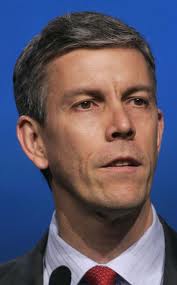 The next few years are critical for education reform, with the implementation of higher standards likely to put tremendous pressure on political leaders to abandon course, U.S. Education Secretary Arne Duncan said Wednesday.
“The idea of implementing higher standards, the adoption in 46 states of higher standards, is clearly a huge step in the right direction. (But) that’s the easy part,” Duncan, referring to Common Core standards, said at a national education summit organized by Jeb Bush’s Foundation for Excellence in Education. “Will our political leaders have the courage when test scores drop 20, 30, 40, 50 percent? … Will they have the courage not to backpedal and dummy down standards like political leaders did under No Child Left Behind?”
Despite the challenges, Duncan said he was optimistic that state and local leaders would rise to meet them, and in bipartisan fashion. He pointed to recent reforms as proof.
“I’m actually extraordinarily hopeful,” he said in response to a question from moderator Andy Rotherham. “When I look at what states did, local legislative leaders, chief state officers, what they have done over the past couple of years, no one predicted that would happen. No one predicted that 46 states would adopt higher standards. No one predicted that three dozen states have taken teacher evaluations and principal support to a very different level. No one predicted that we would have 44 states working on the next generation of assessments. Frankly, we’ve had almost no rollback. And honestly, if a couple states choose to roll back, that would not be the end of the world.”
Duncan was a keynote speaker at the fifth annual summit, which drew about 800 participants from nearly every state. He made a pitch for continued investment in early childhood education and stressed teacher quality and teacher equity. He said the fact that not a single district has methodically moved to align its best teachers with its most struggling students is a sign of how far reformers have yet to go. (more…)
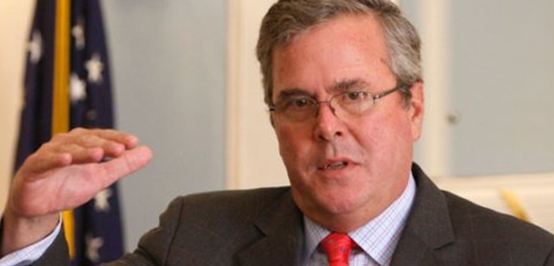 Jeb Bush may or may not seek the presidency in 2016, but those who dismiss his education foundation as a political prop are simply out of touch. What the Foundation for Excellence in Education is showing once again, with its fifth annual national summit, is that it is creating a sense of urgency and national purpose around our most fundamental commitment to each new generation.
 Editor's note: blog stars is an occasional roundup of good reads from other ed blogs.
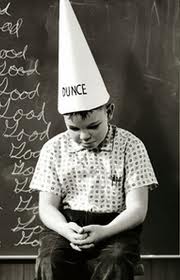
The EdFly Blog: Frivolous litigation earns dunce cap
As for Florida dumbing down education, as is alleged in the lawsuit, the state ranks first in the country in the percent of 2011 graduates who took an AP exam, sixth in the percent of graduates passing at least one AP exam, and fourth in improving the passing percentage since 2001.
An in-depth analysis by ProPublica last year praised Florida as being a leader in giving low-income students the same access to AP classes as affluent kids.
And while the state’s NAEP scores took a dip in 2011, it ranks second nationally in gains on the national assessments dating back to the 1990s.
In fact, by any measure, the state’s education system is light years ahead of the system that was in operation when Mills helped run Tallahassee. And the biggest beneficiaries have been the students who were routinely ignored back then. Full post here.
Sara Mead's Policy Notebook: This is why our current education debate is toxic
Richard Rothstein's American Prospect investigation into the details of Joel Klein's childhood (no, I'm not kidding here) is really not worth reading, but it unfortunately exemplifies two of the most toxic aspects of the current education reform conversation (fwiw it also contains some interesting information about the history of post-war public housing in NYC):
Personality over policy: The point of Rothstein's very long article seems to be that Joel Klein's education policy views are invalid because his childhood was less poor than it has sometimes been represented as being. At a surface level, this is idiotic. Whether Klein grew up in abject poverty or simply in circumstances much more humble than the financial and political status to which he has risen has absolutely nothing to do with whether the education policies he proposes work. Nor did Klein or anyone else ever claim himself as the sole data point for the power good teachers and schools can have on kids' lives. There's, um, actual research on this. (more…)
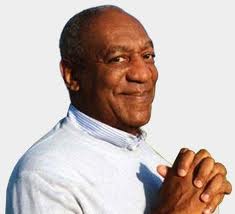 Bill Cosby has joined the board of directors of StudentsFirst, the education reform group founded by Michelle Rhee.
In a statement emailed to StudentsFirst supporters a few minutes ago, Cosby, a school choice supporter, wrote: "Enough is enough. I've seen the statistics on where American students rank in the world. I've heard the stories of children being sent off to schools that are nothing more than dropout factories, and our youth end up back out on the street uneducated and unprepared for life. I refuse to sit back and watch this happen. That's why I'm joining the board of StudentsFirst and will be working alongside you and StudentsFirst members across the nation to put children's needs first."
According to Education Week, StudentsFirst named other board members today, including Connie Chung, Joel Klein, Roland Martin and Jalen Rose.
Diane Ravitch called Cosby's move "the worst news of the day."
"This is a coup for her (Michelle Rhee) in her efforts to demean our nation’s teachers and promote the privatization of American public education," she wrote on her blog. "He is clearly uninformed about what she is doing. If you know how to contact him, do so. This is not in character for him."
 Ideologues tend to exaggerate political debate, but Louisiana school superintendent John White reminded us Tuesday that rational policy is the key to integrating vouchers into a robust public education system. The accountability that White introduced, and the Board of Elementary and Secondary Education (BESE) adopted, represents a thoughtful balance of testing, regulation and market forces that ultimately will require vouchers to prove their value.
That's a formula for how private learning options will become mainstream.
Lawmakers have shown themselves to be particularly inept at writing policy framework for vouchers so, in expanding the New Orleans voucher program to the rest of the state, the Louisiana Legislature punted accountability to the bureaucrats. That left White, a former Teach For America administrator and New York City schools executive under chancellor Joel Klein, with a task that requires careful calibration in a volatile environment. (As if to reinforce the rhetorical excess, one BESE board member on Tuesday assured his colleagues they were about to bite into the forbidden fruit of Eden and could be assured that “evil is going to arise.”)
What makes accountability so difficult is that there is still no clear blueprint. Every state with a voucher or tax credit scholarship has a different iteration, and the loudest voices are usually at the extremes – the voucher critics who demand the private schools be held to precisely the same standard as a public school and the voucher advocates who argue that no regulation is necessary because the market will force schools to respond. So the chore is to find the right balance, one with academic and financial oversight that taps into the accountability that follows from a parent who can walk out the door. This is made all the more challenging by the fact that, in most states, the students who receive the scholarship or voucher represent a minority of the enrollment in the private school.
White navigated the academic maze this way: 1) Every voucher student takes the state test; 2) The results of every test are reported on a statewide basis; 3) Any school with at least 40 students taking the test is held accountable; 4) Those schools will be evaluated on a scale similar to that of public schools. If they fail three out of any four years, their students will be given priority to attend other schools. Furthermore, the failing school will not be allowed to take new students and could be dropped from the program.
The rule has been criticized because the accountability portion is projected to capture only about a fourth of the participating schools in the first school year and schools will not be banned after one failing year. But the small number of schools with at least 40 tested students is the very nature of this school landscape. The 5,600 Louisiana students who receive vouchers this fall will not generally be attending schools where every student receives public support. Instead, they will go to private schools with mostly private-paying students, and you can’t reliably measure a school’s fitness based on two or three or a dozen student test scores.
That said, there is nothing sacrosanct about the lines that are drawn in this new Louisiana accountability rule, and they will no doubt be amended and improved over the years. But the rule is a commendable start and one, similar to the approach in Indiana, that makes an important statement about private learning options. They are part of, not in competition with, the public education system, and they need to be properly held to account.
As a former U.S. Commerce Department Foreign Service officer, as well as someone who worked extensively in international trade and economic policy earlier in my career, I was especially interested to read the Council on Foreign Relations new report, "U.S. Education Reform and National Security." The council’s task force was chaired by former Secretary of State Condoleeza Rice and former New York City schools chief Joel Klein. For anyone who spends time thinking about international competitiveness and security issues, the important link to a successful education system is readily apparent. But for many, education remains a domestic issue separate from foreign activities.
For us education policy wonks, most of the data is not new or surprising. An exception for me: the fact that now 75 percent of U. S. citizens between 17-24 are not qualified for military service because they are physically unfit, have criminal records or have inadequate levels of education. Among recent high school graduates who are eligible to apply, 30 percent score too low on the Armed Services Vocational Aptitude Battery to be recruited. The achievement gap is alive and well in the military also: African American applicants are twice as likely to test ineligible as white applicants.
The report quotes from a U.S. military report that found in a staff of 250 at an intelligence headquarters in Iraq, “only 4-5 personnel were capable analysts with an aptitude to put pieces together to form a conclusion.” This included both officers and enlisted personnel. Suddenly, it becomes more plausible to understand how a military unit in Afghanistan thought burning Korans would be a good way to dispose of them! Unfortunately, data raising questions about the critical thinking and educational background of some in the officer corps correlates with the huge numbers of seemingly strong high school graduates that require remediation in college.
Rather than a long litany of recommendations, the report makes only three. And one of them is to restructure education to provide students with good choices. The task force wants parents to have a wider range of options and wants to see a system that encourages and supports innovation. (more…)
Outgoing New York schools chancellor Joel Klein is right to identify that low-income families deserve to have the best educational options available to them, but he frames the argument for school choice in a way that stops short of advocating for equal opportunities for our most disadvantaged families.
In the Wall Street Journal today, Klein reflects on his tenure running the nation's largest school system and explains how his embrace of charter schools was especially controversial in a district where, he wrote, "bureaucrats, unions and politicians had their way." He writes, "the debate shouldn't be about whether a school is a traditional or charter public school. It should be about whether it's high-performing, period."
Allow us to take his argument a step further, in two ways. First, charter is not the only alternative for underprivileged children. Second, we should take special care when labeling any school as high- or low-performing, because the variation within schools is typically greater than between schools. An International Baccalaureate school is high-performing based on standardized test performance and many other measures, but is not necessarily the best fit for all students. (more…)

