Dozens of Florida schools — many of them online schools — initially rated "incomplete" by the state Department of Education now have official A-F grades.
As noted by the Orlando Sentinel, school grades recently became final after the deadline for appeals passed.
Of the 114 schools that received incomplete ratings when the state released preliminary grades in July, 76 now have letter grades. The grades are based on student performance on the Florida Standards Assessment, along with other factors such as learning gains.
A significant number of the newly graded schools are virtual education operations that were rated incomplete because fewer than 95 percent of their students took all their state assessments.
Among statewide providers, Florida Virtual School received a B for its full-time high school program and a C for its full-time K-8. K12 Inc. received a B.
Both K12 and FLVS came fairly close to meeting the 95 percent threshold, with roughly 90 percent of their students tested.
A third provider, Edgenuity, still has an incomplete. Updated state records show just 62 percent of its students took all their required tests.
Individual students choose schools for reasons that are often deeply personal. But their schools are all measured and judged by common standards.
The students who stay in virtual charter schools for the long haul tend to see better results. But the model is uniquely suited to students who are dealing with instability.
Untangling these contradictions made for one of the most interesting debates at this year's National Charter Schools Conference.
In studies and media reports, the performance of virtual charter schools looks pretty bad. Why that is, and what to do about it, are murkier questions with implications for how school systems should operate under the new definition of public education.
"This tension between personalized instruction and a one-size fits-all measurement is not going to go away," Mary Gifford, a senior vice president at K12 Inc., one of the nation's largest and most prominent online learning companies, said during a discussion of what's next for virtual charter schools.
Students opt for online charters for a variety of reasons. Some are looking for a stopgap while their parents find a better school. Some are traveling athletes, or long-term medical patients, or rural children with few other options. More than a third are behind on credits when they enroll, and many change schools frequently, but Gifford said those who stick around three years or more tend to show the best academic results. (Of course, it also stands to reason that students who struggle with online charter schools may be more likely to leave quickly). (more…)
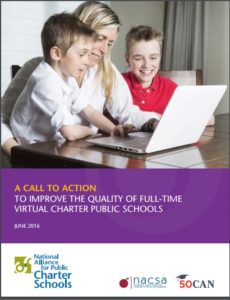
A new report calls for states to subject virtual charter schools to greater scrutiny.
States need to overhaul the way they fund and regulate online charter schools and rein in "large-scale underperformance," a new report argues.
The argument isn't coming from the usual anti-charter school suspects. The report was released this morning by the National Alliance for Public Charter Schools, the National Association of Charter School Authorizers, and the pro-charter advocacy group 50CAN (aka the 50-State Campaign for Achievement Now).
The three groups say they support full-time virtual schooling, and that the model can be beneficial for some students. But the report says recent research has found negative effects so significant and widespread that "[t]he breadth of underperformance by full-time virtual charter schools convinces us that states need to change the policy framework within which these schools can operate."
"If traditional public schools were producing such results, we would rightly be outraged," the report adds. "We should not feel any different just because these are charter schools."
Online learning companies and some allied advocacy groups have disputed some of the most widely cited studies of virtual charters' effectiveness, pointing out that virtual charters often serve disadvantaged students who change schools frequently, making their performance hard to gauge.
The report addresses this argument, noting that in a study by Stanford University's Center for Research on Education Outcomes, the "mobility" rates of virtual charter students and their comparison groups in traditional public schools are similar. Other observers have concluded the negative findings are simply too strong to explain away. (more…)
 Charter schools: K12 Inc., a company that operates two charter schools in South Florida, accuses the board chairman of those schools of possibly breaking ethics laws by writing checks to a nonprofit organization he runs and its chief administrative officer. Sun-Sentinel. The Washington Post recounts the story of the relationship between Jeb Bush and an African-American charter school he helped start in Miami in 1996.
Testing optional: Even though a majority of respondents in Florida and nationally support regular school testing, a growing number of parents think they should be able to opt out, according to a St. Leo University Polling Institute survey. Gradebook. The Pasco County school system is asking teachers and principals for their thoughts on quarterly tests. Gradebook.
School recess: Osceola County parents are petitioning to require daily recess for elementary students. News13.
Teacher shortage: Lee County schools have a shortage of teachers and qualified substitutes, and teachers are no longer permitted to take off work for professional training. Fort Myers News-Press.
Administrators retiring: Two top administrators in the Marion County school system are retiring. Ocala Star-Banner. (more…)
Company officials are questioning the state's accountability framework for virtual providers.
Florida’s public school accountability system could be on the verge of snaring one of the nation’s largest online education providers.
K12 Inc. is expected to get an initial “incomplete” when letter grades for Florida public school are released this month. But it’s still possible the final grade, whenever it is released, could be unflattering – with serious consequences for K12’s operation in Florida.
The state awarded K12 a D last year, and the company’s appeal was stymied in part because of data conflicts with school districts. If the company receives a D or an F in the next three years, it could be forced to sever its ties with nearly 50 school districts, its five virtual charter schools, and new virtual charters expected to open next year.
That would be the first time a digital learning provider faces that penalty since lawmakers first created a new system of "approved providers" and district-managed virtual instruction programs.
Representatives for K12 and the schools it helps manage in Florida say it's hard to predict what its grade will be, or whether it will receive one for the current school year. The main reason, the company says, is that it has struggled to obtain student information from the districts where it operates virtual instruction programs.
But company officials are also questioning the state's accountability framework for virtual providers, which grades those providers based on combined results for independently run virtual charter schools and school district programs, over which they have less control.
The state Department of Education has indicated it would give the company a grade of incomplete, at least for now, while officials try to sort out issues with data reported by 17 districts that have contracted with K12. It is not clear when a final grade may be out.
To understand K12’s situation, a little history is in order.
Florida’s virtual education system took a turn in 2008, when a new law required school districts to create new virtual instruction programs. The revised law allowed districts to supplement local virtual programs by hiring outside providers like K12, which currently contracts with 48 districts. It also required districts to offer at least three different options, which often included locally run franchises of Florida Virtual School, the state’s publicly run provider.
In 2011, Florida law authorized virtual charter schools. Their boards can hire companies like K12, or other state-approved providers, to manage their schools.
Under the current grading system, the state can issue grades to virtual charters. It also issues grades to providers, which for grading purposes combine their virtual charters and district instruction programs together. (more…)
Charter schools: A Florida House subcommittee looks at having the state Department of Education review charter applications before they go to the districts for approval. redefinED. More from The Buzz. Lawmakers also talk about possible legislation looking at allowing charter schools access to underutilized district buildings. Herald/Times. The draft bill may help ease the way for out-of-state charter groups that want to open high-performing schools in Florida. Tampa Bay Times.
 Digital learning: Miami-Dade County school district plans to roll out 100,000 laptops and tablets to students by August 2015. Miami Herald. K12 Inc. focuses on expanding and using technology-based learning programs from pre-kindergarten through college on a global basis. Businessweek.
Homeschooling: Palm Beach County homeschoolers participate in National Geographic Bee. Sun Sentinel.
School construction: Agriculture Commissioner Adam Putnam will launch a statewide awareness campaign next week to create a new revenue source for construction and renovations at schools, colleges and universities. The Buzz.
Petition: Civil rights groups target Florida with a petition drive and grassroots movement to overturn the state's race-based educational achievement goals. Reuters.
Common Core: Cursive writing could survive in Florida schools after all, thanks to newly implemented education standards. Sun Sentinel. Students in Hillsborough County schools will field test the multi-state Partnership for Assessment of Readiness for College and Careers test this year, despite state leaders rejecting the exam. StateImpact Florida.
Extended day: A new state report finds that a majority of selected schools that added an extra hour of reading instruction in 2012-13 showed improvement. Tampa Bay Times.
Teachers: The Education Foundation - Champions for Learning names its 25 Teachers of Distinction in Collier County. Naples Daily News. State funding helps Polk public schools and USF put on a two-day training program to entice minority and male college students to become local elementary teachers. The Ledger.

