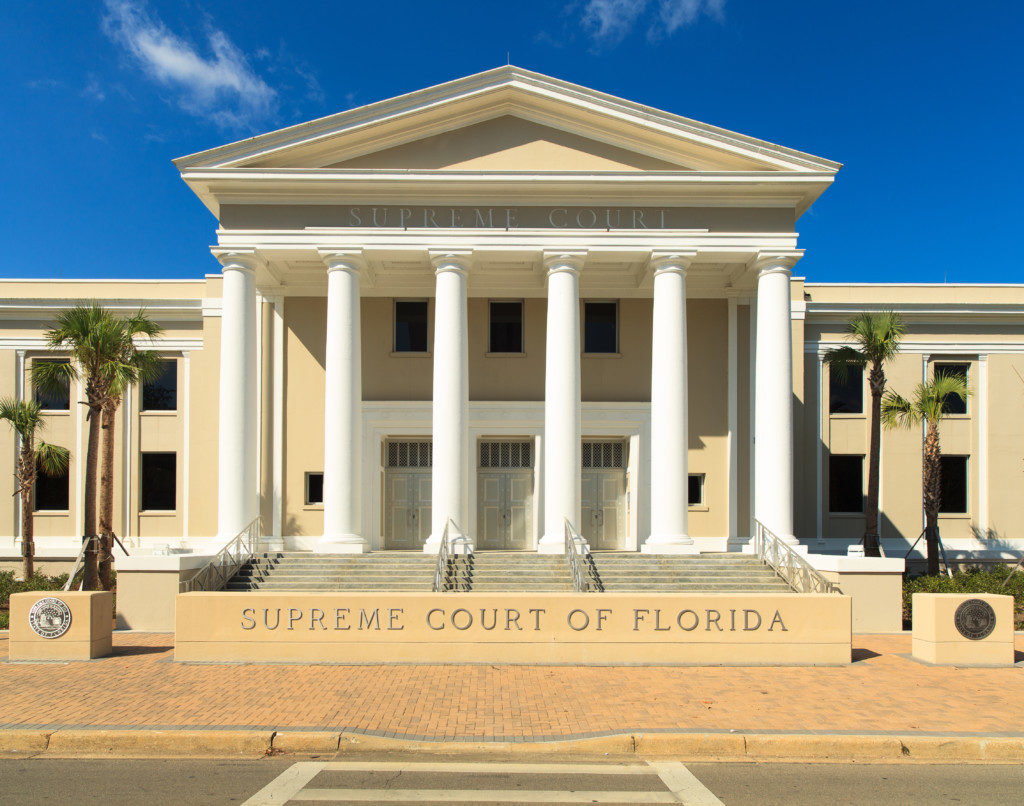
On June 7, 2005, opposing sides met for the final time to argue before the Florida Supreme Court over the constitutionality of the state’s first voucher program, the Opportunity Scholarship. Supporters of the program for low-income students had won several important victories, forcing opponents to abandon all but one remaining argument -- that the voucher violated Florida’s “Blaine Amendment.”
Florida’s Blaine Amendment, Article 1, Section 3 of Florida’s constitution, is one of the most restrictive in the country. It reads:
“No revenue of the state or any political subdivision or agency thereof shall ever be taken from the public treasury directly or indirectly in aid of any church, sect, or religious denomination or in aid of any sectarian institution.”
Just seven months earlier the First District Court of Appeal issued an “en banc” decision, with eight of the justices declaring the program violated Article 1, Section 3.*
A ruling by Florida’s Supreme Court on the matter could have sent the case to the U.S. Supreme Court to resolve, once and for all, how state Blaine Amendments could be applied to restrict or support state-funded scholarships to attend religious schools. But the Florida Supreme Court ducked the issue altogether. In a stunning move, the Court reversed course and resurrected two arguments it had rejected just four years before.
The U.S. Supreme court isn’t expected to resolve the lingering questions over state Blaine Amendments until 2020.
Florida’s First District Court of Appeal had the last word on the matter, but despite claiming a “clear meaning” and “unambiguous history” of Florida’s no aid clause, the court’s decision left gaping holes and many unanswered questions.
Lawyers defending the voucher program argued the scholarship did not violate the Florida Constitution because the benefit was to the student and the general public, and not intended to aid religious organization. In fact, the entire program was neutral with respect to religion because the vouchers were issued to parents who could use them at any private religious or non-religious school of their choosing.
Furthermore, the Opportunity Scholarship forbid private schools from selecting students on a religious basis and stated that scholarship students could not be compelled to pray, attend worship or even take religious courses.
Supporters noted several state programs benefiting Florida residents were provided at religious or religiously-affiliated institutions. Programs included Florida Bright Futures Scholarship, John McKay Scholarships, Florida Private Student Assistance Grant Program and eight other scholarship programs, along with the 23 private religious colleges accepting them. Supporters pointed to direct financial support for religiously-affiliated colleges, including $8.9 million in 2002 for libraries at Bethune-Cookman, Edward Waters College and Florida Memorial College.
Attorney General Robert Butterworth pointed to other direct appropriations, such a rent paid to churches used as polling places and subsidized pre-K at religious preschools.
Butterworth even noted that state funds provided subsidized medical care at religiously affiliated hospitals such as St. Mary’s in West Palm Beach or Baptist Medical Center in Jacksonville.
A direct taxpayer subsidy to a sick patient to attend any hospital, religious or non-religious, of their choosing, should not be treated any differently under the law that a scholarship to attend a religious or non-religious school, the Attorney General argued.
The appellate court majority responded to these arguments with deafening silence, with no mention of the McKay Scholarship, the state’s only other K-12 voucher program funded by direct appropriations at the time. The ruling was narrowly tailored to only one single K-12 scholarship program.
Even Judge Wolf, who concurred in part, criticized the majorities incoherent constitutional interpretation stating,
“In order to avoid catastrophic and absurd results which would occur if this inflexible approach was applied to areas other than public schools, the majority is forced to argue that the opinion is limited to public school funding and article 1, section 3 may not apply to other areas receiving public funding.”
The court would not only fail to grapple with these important constitutional questions, it would end up ignoring Florida’s own legal precedent on the matter.
Coming Thursday: Florida has a long history of court cases that upheld the constitutionality of providing aid to religious institutions.
*Seven justices ruled the OSP should be struck down entirely for violating the state’s “Blaine Amendment.” Just one justice ruled the OSP should be partially struck down by requiring religious schools to be excluded from the program. Five justices ruled the program should be upheld.
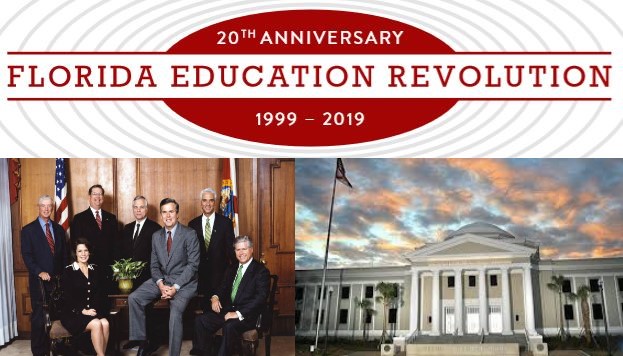
Gov. Bush's "A+ Plan" for accountability faced a long road of legal battles as soon as it began 20 years ago.
Editor’s note: March 2 marked the 20th anniversary of the legislative session in which Florida Gov. Jeb Bush launched a number of K-12 reforms that transformed education throughout the state. With the start of the 2019 legislative session earlier this month, redefinED embarked upon a series of articles that examine aspects of Bush’s K-12 education revolution and how it continues to reverberate. Today’s piece is the second of two retrospectives that chronicle the plan’s legislative roller coaster ride. You can read Part I here.
The critics strike back
With vouchers deemed constitutional by the First District Court of Appeal and with an appeal rejected by a 4-1 vote by the Florida Supreme Court, state leaders not only began to improve the A+ Plan; they birthed an entirely new scholarship program.
In the summer of 2001, Florida created the Florida Corporate Income Tax Scholarship, later renamed the Florida Tax Credit Scholarship, for low-income students. The prior year, the state had created the McKay Scholarship for students with special needs. Both programs swelled in size immediately, dwarfing the embattled school voucher, the Opportunity Scholarship Program (OSP). McKay served 8,000 students with special needs in 2002, while more than 55,000 low-income students applied for 15,000 corporate tax scholarships in its first year.[1]
The Florida Tax Credit Scholarship would eventually grow to become the largest private school scholarship program in the nation, serving 100,512 students in the 2018-19 school year. (The program is administered by non-profits such as Step Up For Students, which hosts this blog.)
The state also revised the A+ Plan’s accountability system in December 2001. Previously, schools were evaluated only on fourth-grade reading, fifth-grade math, and both tests in eighth and 10th grades. New rules based school grades on both math and reading tests in all grades between third and 10th. The new grading scale also gave a substantial weight to learning gains, with bonus points for significant gains for low-income students.
With the new rules in place, more schools received “F” grades, and enrollment in the OSP soared to 557 students in the next school year. Enrollment peaked at 788 students in 2004-05.
After a year away from the courtroom, the lawsuit resumed in the Leon County Circuit Court under a new judge, Kevin Davey, in the summer of 2002. Voucher opponents now argued the programs violated Florida’s “Blaine Amendment,” a constitutional ban on direct or indirect aid to religious institutions.
Voucher supporters were eager to argue the case as the U.S. Supreme Court just two weeks prior to the hearing had ruled an Ohio voucher program did not violate the U.S. Constitution’s “Establishment Clause.”
On Aug. 5, Judge Davey issued his ruling. “The language utilized in this provision is clear and unambiguous,” he wrote regarding Article I, Section 3 of the state constitution. Known as the “No Aid” clause, it bans “direct and indirect” aid to any church, or sect, or sectarian institution.[2]
School choice supporters appealed, claiming the ruling also threatened other religiously affiliated organizations such as several non-profit hospitals operating in the state.
The First District Court of Appeal would uphold the ruling 8-5 on Nov. 12, 2004. Scholarship supporters appealed to the Florida Supreme Court, knowing a loss could still be appealed to the U.S. Supreme Court.
Lawyers for both sides argued on the “No Aid” clause before the Supreme Court on June 7 2005. Lawyers representing parents argued the aid was to the student, not the school, as U.S. Supreme Court had reasoned in its 2002 Zelman decision.
On Jan. 5, 2006 the Florida Supreme Court in a 5-2 vote ruled the voucher program was unconstitutional, but for entirely different reasons than anyone expected.
The OSP "diverts public dollars into separate private systems parallel to and in competition with the free public schools that are the sole means set out in the Constitution for the state to provide for the education of Florida's children,” wrote the majority in a decision that completely contradicted its own ruling five years earlier.
Back in 2001, Justices Charles Wells, Harry Lee Anstead, Barbara Pariente and Fred Lewis voted 4-1 (against Peggy Quince) to decline jurisdiction on the case, which allowed the Circuit Court of Appeal decision to stand. That ruling found nothing within Article IX Section 1 of the state constitution prohibited vouchers or any other educational alternative created by the Legislature.
But with all other avenues of ruling the program unconstitutional now defeated or in jeopardy of being appealed to the U.S. Supreme Court, the Florida court suddenly reversed course. Not comfortable with its own ruling, the court invented its own definition of “uniformity” and declared vouchers “inevitably harmed” public schools without examining a single piece of evidence.
Clark Neily, a lawyer representing scholarship parents, condemned the decision as “among the most incoherent, self-contradictory and ends-oriented court decisions in recent memory.”
Chief Financial Officer Tom Gallagher agreed, called the ruling “a results-oriented decision.”
But Steve Gey, a law professor at Florida State University, believed the ruling “adhered closely to the text of the Constitution.”[3] Gey had co-authored a friend of the court brief in March 2005 entirely on the “No Aid” clause in support of the teachers union’s lawsuit.
Many legal critics, including the Harvard Law Review, would criticize the ruling.
While legal experts debated its merits, the impact of the ruling hit families the hardest.
Barbara Cruz used the scholarship to send her daughter to La Progresiva Presbyterian School in Miami. Her daughter would graduate using the scholarship, but Cruz still described the court ruling as, “so, so bad.”[4]
Many others were in limbo.
“I think [the ruling is] going to hurt a lot of students and their parents who can’t afford it, and they are forced to go to these public schools,” said Bobby Evans, whose daughter, Kiara, attended St Paul’s Catholic School in Jacksonville on the scholarship for the sixth and seventh grades. Kiara would finish out the year on the scholarship, but whether she could remain at St Paul’s remained unknown.[5]
School choice supporters worried the ruling might be used to target other programs.
“One of the attorneys for the plaintiff made it very plain,” said Sen. John McKay, sponsor of the state’s McKay Scholarship. “If they succeeded with this case, they will be going after children with disabilities next.”
Opponents celebrated.
“I think this spells the end of this diversion of public monies to private education programs in Florida,” said Ronald Meyer, the lawyer representing the teachers union in the case.
When asked about challenging the tax credit scholarship or McKay Scholarship, Meyer told Education Week, “The significance of this travels well beyond the state of Florida.” He hinted that the ruling could help overturn vouchers in other states as well.[6] A few months later, Meyer would deny that the teachers union had any interest in challenging either scholarship program.[7]
Bush promised to save the program.
In mid-February, Gov. Bush stood before a rally of thousands of parents and students, most of them black, wearing t-shirts stating “Save Our Students,” and promised to get a constitutional amendment passed to rescue the voucher program.
“This is a fundamental right, this is a civil right, this is American as apple pie,” Bush said to a cheering crowd.[8]
Bush and Senate President Tom Lee moved to pass a constitutional amendment that would save the OSP and protect other private scholarship programs. The amendment would need to pass the Senate and the House by three-fifths votes before being approved by voters in November 2006.
Those efforts collapsed when Sen. Majority Leader Alex Villalobos, Sen. Nancy Argenziano, Sen. Dennis Jones, and Sen. Evelyn Lynn joined Democrats to oppose the amendment. Bush came up one vote shy of the three-fifths threshold. Villalobos would be stripped of his power as a result.[9] Today, Villalobos works for the legal firm headed by Ronald Meyer, the teachers union’s lead counsel.
Bush and Sen. Lee brushed off the defeat and moved to a new plan, passing a bill to allow the remaining OSP students to transfer to the tax credit scholarship program.[10] Tensions were high with just a few days left in the session. Democrats’ best hope for defeating the bill was to stall. Senate Democratic Leader Les Miller demanded the full text of bills be read aloud, a parliamentary trick that brought the legislative process to a grinding halt.[11] The House eventually ran out of time to vote on the bill.[12]
The OSP’s private scholarship was finally dead.
The end
Although the legal case that ended the OSP, known as Bush v. Holmes, faced considerable criticism from legal experts at the time, scholarship supporters worried that copycat lawsuits would upend voucher programs around the country.
But the case was never successfully duplicated. And despite threats from the teachers’ union, the case even failed to overturn significantly larger scholarship programs in Florida. At the time of the Holmes ruling, the tax credit scholarship enrolled more than 14,000 low-income students in private school, while the McKay Scholarship enrolled more than 15,000 children with special needs. Combined, both programs cost $136 million that year.[13]
The Opportunity Scholarship’s private option ended in 2005-06 with 734 students. During the program’s seven-year lifespan, the state spent a mere $11.2 million for 2,848 scholarships. Ninety-five percent of the students on the program were black or Hispanic, and 70 percent participated in the free or reduced-price federal lunch program.
None of the worries conjured by critics, including Sen. Betty Hozendorf’s claim the scholarship was a “lynching of the civil rights movement,” ever proved true.
The Opportunity Scholarship Program continues today, though students may only choose to attend another public school. Enrollment and the students who are eligible fluctuate annually. OSP enrollment peaked with 4,424 students attending new public schools in 2011-12 and had a low of 1,280 in 2008-09. In 2017-18, the latest data available, the program served 3,074 students.
Despite its small size, the OSP started a massive fight over how to educate Florida’s students. Today, its history is half-forgotten and half-confused, but its legacy reshaped Florida’s educational landscape forever.
[1] Balona, Denise-Marie. “Tax Vouchers Trigger Rush; More than 15,000 Kids Received Private-School Scholarship From Corporate Taxes; Many Children Are On Waiting List,” Orlando Sentinel, March 21, 2003.
[2] Flannery, Mary Ellen and Kimberly Miller. “Judge Rejects School Vouchers,” Palm Beach Post, August 6, 2002.
[3] Matus, Ron and Steve Bousquet. “Court throws out vouchers,” St Petersburg Times, January 6, 2006.
[4] Matus, Ron and Steve Bousquet. “Court throws out vouchers,” St Petersburg Times, January 6, 2006.
[5] Mitchell, Tia. “Student’s life in limbo with end of vouchers; the Florida Supreme Court ruled Opportunity Scholarships violated the state Constitution,” Florida Times-Union, January 9, 2006.
[6] Richard, Alan. “Florida Supreme Court Finds State Voucher Program Unconstitutional,” Education Week, January 6, 2006. https://www.edweek.org/ew/articles/2006/01/05/18voucher_web2.h25.html (accessed 3.25.19)
[7] Klas, Mary Elen, “Senate moves to keep vouchers; The state Senate advanced a proposal to fix the constitutional weakness of Florida’s first voucher program. It comes up for a vote today,” Miami Herald, May 3, 2006.
[8] Follick, Joe. “Thousands rally to push lawmakers on vouchers,” Sarasota Herald-Tribune, February 16, 2006.
[9] Cotterell, Bill. “Party-switching votes doom tuition vouchers,” Tallahassee Democrat, May 2, 2006.
[10] Klas, Mary Elen, “Senate moves to keep vouchers; The state Senate advanced a proposal to fix the constitutional weakness of Florida’s first voucher program. It comes up for a vote today,” Miami Herald, May 3, 2006.
[11] Kennedy, John. “Democrats try to stall revival of vouchers,” Orlando Sentinel, May 4, 2006.
[12] Kaczor, Bill. “Bush’s Prized School Voucher Plan Looks to Be Out of Time; House Has No Plans to Vote On Program,” Sun Sentinel, May 6, 2006.
[13] Stockfish, Jerome and Marilyn Brown. “Court Rejects School Vouchers,” Tampa Tribune, January 6, 2006.
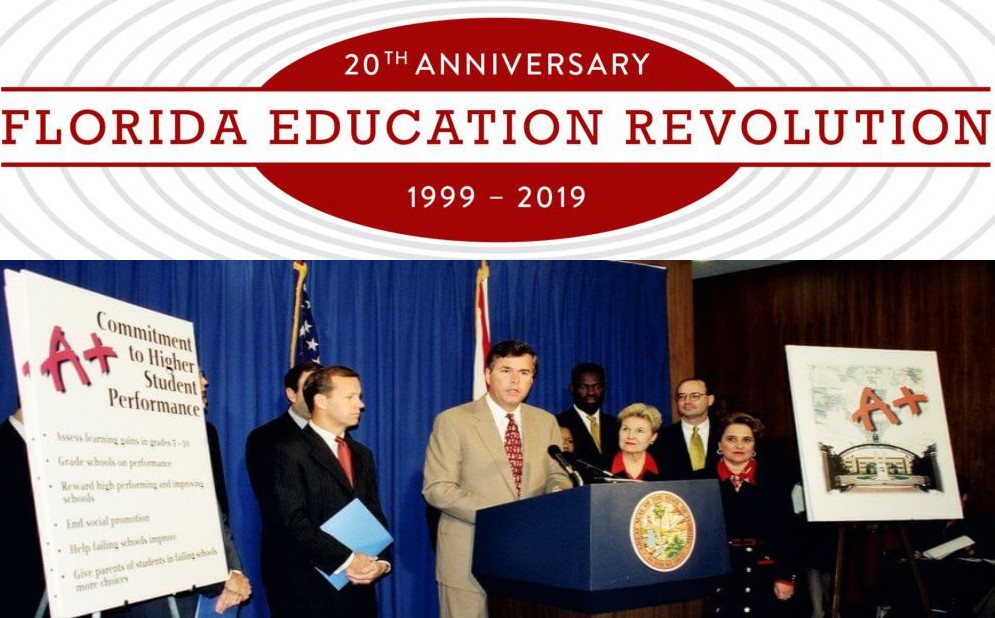
Gov. Bush's "A+ Plan" for accountability faced a long road of legal battles as soon as it began 20 years ago
Editor’s note: March 2 marked the 20th anniversary of the legislative session in which Florida Gov. Jeb Bush launched a number of K-12 reforms that transformed education throughout the state. With the start of the 2019 legislative session earlier this month, redefinED embarked upon a series of articles that examine aspects of Bush’s K-12 education revolution and how it continues to reverberate. Today’s piece is the first of two retrospectives that chronicle the plan’s legislative roller coaster ride. Part II is available here.
OPPORTUNITY AWAITS
In January 1999, Gov. Jeb Bush’s recently announced “A+ Plan” was generating bipartisan praise. Democrats, school district leaders, and even the teachers union said positive things about letter grades for schools, annual testing, and increased accountability.
“The only negative is the voucher piece,” said Florida Education Association spokesman David Clark.[1]
That “voucher piece,” the Opportunity Scholarship Program (OSP), never served more than 57 students during its first three years, and never more than 788 students in any year. But as the first statewide voucher program in nearly a half-century, it also became the most controversial educational program in Florida’s history. Despite the tiny size, the stakes were huge. Supporters and opponents alike spent millions to sway public opinion while the nation watched a titanic legal battle rage for nearly seven years to decide the fate of the little scholarship program.
The program as initially envisioned had critics and opponents at every level.
“It’s a great plan – except for the opportunity scholarship,” said Connie Milito, a lobbyist for Hillsborough County.[2]
“I can’t complain if Bush is supporting Democrat proposals,” said Senate Minority Leader Buddy Dyer from Orlando, who supported everything in the A+ Plan except the opportunity scholarship.[3]
Private schools remained skeptical, too. The Miami Herald surveyed 300 schools in South Florida in 1999 and found only three willing to participate. A follow-up survey would find only 50 the next year. Private schools seemed to think the law came with too many strings attached.
Eligible students would come from public schools receiving two “F” grades within a four-year window. Private schools would get between $3,400 and $3,800 and couldn’t charge more to cover tuition. Schools could not use academic or religious admission requirements, and oversubscribed schools required a lottery to admit scholarship students. Students also could not be compelled to attend religious classes or prayer.
“I think the only schools that are going to take these students are schools that are badly under-enrolled or schools that are already low-performing,” Sherry Ryan, the owner of Vista School in Coral Springs, told the Herald.[4]
Sister Mary Caplice, the superintendent for the Diocese of Pensacola-Tallahassee, was a little more optimistic. “There continue to be things that we have to work out, but there’s room for negotiation in the law,” she told the Herald.[5]
Newspapers were split, too.
The Orlando Sentinel complained the voucher program would “ultimately steal money from public schools and punish public schools for conditions over which they have no control.”[6]
But the Florida Times-Union in Jacksonville editorialized in favor of the voucher program, though it called the concept “embarrassingly modest” when compared to Ted Forstmann’s and John Walton’s $100 million Children’s Scholarship Fund.[7]
By mid-March 1999 supporters had raised $1.3 million to help push for vouchers, while the Florida Education Association, the state's teacher union, had already spent more than $1 million on an advertisement campaign to derail vouchers in the Legislature.[8]
GETTING STARTED
On March 26, 1999, the House passed the “A + Plan” 71-49, with seven Republicans breaking ranks to vote “no” while seven Democrats voted in favor
“This is the day that will go down in the annals of Florida history as the day we abandoned the public schools and the day that we abandoned, more importantly, our children,” complained then-Rep. Debbie Wasserman Schultz.[9]
Rep. John Cosgrove of Miami called the program “a grand theft of public education dollars,” while House Democratic Leader Lesley Miller of Tampa worried the voucher would become “a fast track toward resegregation.”[10]
Passage in the Senate would take a bit longer, passing 25-15 on April 30, 1999. Critics fumed again.
“Vouchers are the 20th-century equivalent of ‘Let them eat cake’,” said Latha Krishnaiyer, president of the Florida PTA.[11]
“Vouchers in this bill are the lynchings of the civil-rights movement,” claimed Sen. Betty Hozendorf of Jacksonville.[12]
Jeb Bush would sign the A + plan into law on June 21.
Students at two elementary schools, Spencer Bibbs and A.A. Dixon Elementary, in Escambia County were the first to be eligible for the Opportunity Scholarship. That first year just 57 students attended one of four Catholic Schools and one Montessori school.
THE LAWSUIT
"This will kill public education, and we're not going to let it happen," Leon Russell, chairman of the Florida Chapter of the NAACP, said after the voucher passed the Senate. "We'll go to court. We'll fight on every battlefield there is."[13]
The day after Bush signed the bill, opponents sued as promised. Opponents included school board members, Citizens’ Coalition for Public Schools, the Florida Chapter of the NAACP, a teacher, and parents of three students in Escambia County. Opponents claimed the voucher program violated three sections of the Florida Constitution and the U.S. Constitution.
The lawsuit would last nearly seven years and result in a contentious ruling that was widely criticized by legal scholars at the time.
While the lawsuit continued, opponents ran a public relations campaign under a group calling itself “Citizens Committee for Public Information on School Vouchers.” With backing from mystery donors, the group spent $75,000 on full- and quarter- page ads in several newspapers around the state, ran the website www.stopvouchers.org, and encouraged visitors to call a toll-free number, “1-877-901-OUCH,” to learn more.[14]
Lawyers for both sides met to discuss the case in Leon County Circuit Court under Judge Ralph Smith on Feb. 24, 2000. Smith’s remarks spelled immediate trouble for the voucher program.
“All children aren’t entitled to a private education,” he said. Smith even seemed to blame struggling students for public school failures when he remarked, ”The students who have been at the school and who may be the reason that the school has failed are now going to get a private education.”
In early March, lawyers from the Institute for Justice (IJ) representing scholarship parents moved to have Judge Smith removed from the case, noting his son was engaged to the daughter of Jack Carbone, deputy chief of staff for the Florida Education Association. Carbone and his daughter denied the engagement, and Judge Smith remained on the case. Smith’s son and Carbone’s daughter later wed on Oct. 9, 2000. The First District Court of Appeal later removed Judge Smith from the case on Sept. 4, 2001.
But back on March 14, 2000, without hearing any evidence, Judge Smith ruled the program unconstitutional under Article IX, Section 1 of the Florida Constitution. Smith reasoned that because the constitution mandated that funding free public schools was a “paramount duty,” it was “in effect a prohibition on the Legislature to provide a K-12 public education in any other way.”
“The ruling sent teachers unions and other voucher foes to their fax machines declaring victory,” wrote Miami Herald reporters Lesley Clark and Analsia Nazareno.[15]
But Dermita Merkman, the mother of a 5-year old daughter on the scholarship, took the judge’s remarks personally. “I’m just wondering how this is unconstitutional, us wanting a better education for our kids?” she told the Miami Herald.[16]
Lawyers representing scholarship parents appealed the decision.
Supporters remained hopeful. John Kirtley, now chairman of Step Up For Students, which runs four scholarship programs and hosts this blog, donated $500,000 to the Children’s Scholarship Fund to provide grants to inner-city private schools willing to accept students from the Opportunity Scholarship Fund.[17] Billionaire Ted Forstmann offered to pick up the $185,000 tuition tab for the 52 students remaining on the scholarship program.[18]
Both donations came within a week of Judge Smith’s ruling.
By the end of May, the number of schools willing to participate in the scholarship program jumped nearly fourfold to 101 private schools across the state.[19] However, the number of eligible students did not expand, as many public schools saw sufficient improvement on the writing portion of the state test.
While scholarship opponents breathed a sigh of relief, Gov. Bush touted the results as proof that competition worked. Indeed, multiple studies over the next few years showed that the threat of a voucher alone was enough to modestly improve the lowest performing schools in the state.
However, a research paper in 2013 would later reveal that at least some of the improvement was due to schools gaming the system by reclassifying the lowest-scoring students as “limited-English proficiency,” which exempted the scores from the school’s letter-grade evaluation.
On Oct. 3, 2000, a unanimous decision by the District Court of Appeal reversed Judge Smith.[20] “Article IX does not unalterably hitch the requirement to make adequate provision for education to a single, specified engine, that being the public school system,” wrote the justices.
Opponents appealed to the Florida Supreme Court, but on April 24, 2001, the court declined to hear the case on a 4-1 vote, thereby upholding the Court of Appeal’s decision. The voucher program was constitutional.[21] For now.
SOURCES
[1] Silva, Mark and Daniel de Vise. “Bush Plan For Schools Draws Praise,” Miami Herald, January 26, 1999.
[2] Talev, Margaret and Marilyn Brown. “Bush unvels lesson plan for schools,” Tampa Tribune, January 26, 1999.
[3] Ibid.
[4] De Vise, Daniel. “Voucher Plan Finds Limited Support 24 Private Schools Willing to Commit,” Miami Herald, January 30, 2000.
[5] Ibid.
[6] Editorial. “Opportunity For Whom?, There Are Plenty of Things Wrong With an Education Plan Zipping Through the Florida House of Representatives,” Orlando Sentinel, March 7, 1999.
[7] Editorial. “Education Help for the need,” Florida Times-Union, March 5, 1999.
[8] Pedreira, David. “Pro-voucher group not short on cash,” Tampa Tribune, March 12, 1999.
[9] Saunders, Jim. “House gives Bush big win,” Florida Times-Union, March 26, 1999.
[10] Kaczor, Bill. “House passes school voucher bill in partisan vote,” Associated Press, March 26, 1999.
[11] Kleindienst, Linda. “Florida became the first state to approve vouchers to attend private schools. Critics vow to fight in court,” Orlando Sentinel, May 1, 1999.
[12] Ibid.
[13] Ibid.
[14] Nazareno, Analisa. “Tuition voucher foes launch pricey campaign to sway public opinion,” Miami Herald, February 16, 2000.
[15] Clark, Lesley and Analisa Nazareno. “School voucher program ruled unconstitutional Gov. Bush’s private tuition benefit diverts public money, judge decides,” Miami Herald, March 15, 2000.
[16] Ibid.
[17] Hegarty, Steven. “With money and fight, Kirtley pushes for school choice,” St. Petersburg Times, May 21, 2000.
[18] Clark, Lesley. “Billionaire offers to pay way for voucher students,” Miami Herald, March 18, 2000.
[19] Mark, David. “School Choice Group Raises $2 Million,” Tallahassee Democrat, April 21, 2000.
[20] Hagarty, Steven. “Appeal court finds school voucher law constitutional,” St Petersburg Times, October 4, 2000.
[21] O’Connor, Lona. “All Sides Welcome Voucher Decision,” Sun-Sentinel, April 26, 2001.
COMING UP: The court’s ruling paved the way for scholarship expansion throughout the state, but also saw a doubling down of voucher opponents. A surprise Supreme Court decision ensued. Read Part II here.
Today we are trying something new: annotating an article from a different blog, using Genius. Click on the highlighted portions below to read our comments on the article. You may need to have pop up blockers turned off to view the content. We these offer comments to correct the record. The original post can be read here.
By Casey Quinlan
Policy reporter at Think Progress
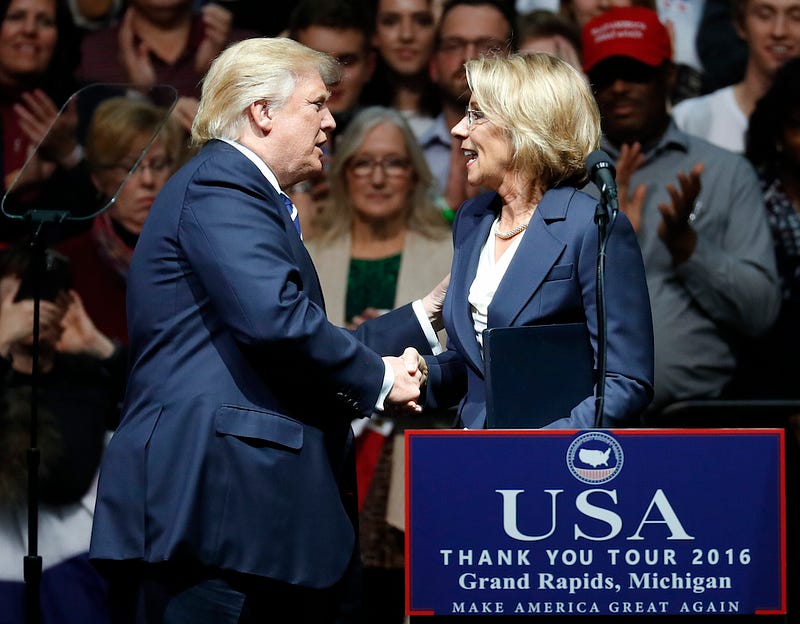
President-elect Donald Trump shakes hands with his pick for Education Secretary Betsy DeVos during a rally, in Grand Rapids, Mich., Friday, Dec. 9, 2016 CREDIT: Paul Sancya
On Monday, Massachusetts Sen. Elizabeth Warren wrote a scathing letter to President-elect Donald Trump’s pick for education secretary, Betsy DeVos, questioning whether she had the expertise to run the department. Among Warren’s many criticisms of DeVos’ record — her unknown views on many aspects of higher education and civil rights issues, for example — Warren also mentioned the “racially charged history” of voucher programs.
Warren wrote:
After Brown v. Board of Education and the court-ordered segregation of public schools, many Southern states established voucher schemes to allow white students to leave the education system and take taxpayer dollars with them, decimating the budgets of the public school districts. Today’s voucher schemes can be just as harmful to public school district budgets, because they often leave school districts with less funding to teach the most disadvantaged students, while funneling private dollars to unaccountable private schools that are not held to the same academic or civil rights standards as public schools.” (more…)
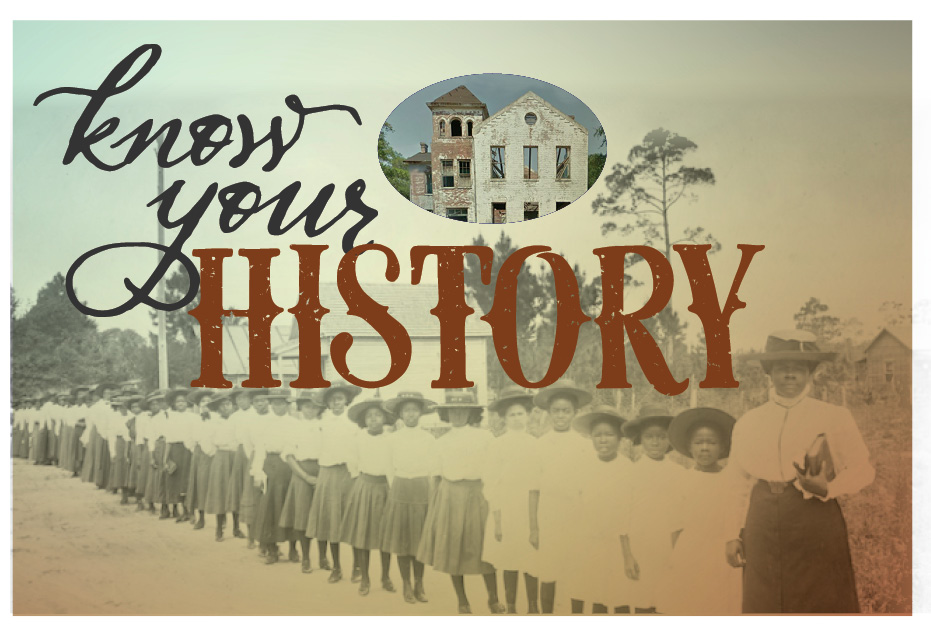
William N. Sheats was, in many ways, the father of Florida's public school system. He was also an ardent racist who declared war on a racially integrated private school in North Florida, which he referred to as a "nest of vile fanatics" in an episode that subjected the state to national ridicule.
But perhaps the most fascinating — and troubling — aspect of this complicated figure is this: By the standards of his time, he was a moderate.
Several times during his long run as the leader of Florida's public education system, he faced threats to his political career because, in the view of his opponents, he wasn't racist enough.
Sheats was Florida's first elected education superintendent, serving from 1893 to 1904, and again 1913 until his death in 1922. He worked to modernize Florida's uniform system of public schools and helped draft the first statewide curriculum. He reformed teacher training and certification, requiring educators to pass exams to prove subject-area mastery. He worked to ensure more public high schools were accredited, and helped pass the state's compulsory-attendance law in 1919. During his tenure, Florida had one of the best-funded public school systems among southern states and had more accredited high schools per capita than any other state in the region.
But Sheats was also a racist. He once declared access to education would "make the vast number of idle, absolutely worthless negroes industrious and self-supporting." (more…)
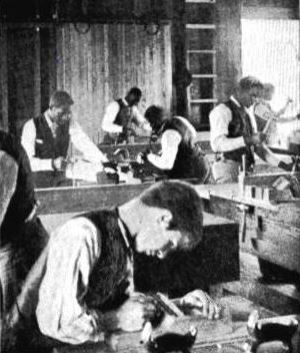
Black and white students in industrial class at the Orange Park school, 1898. Clay County Archives.
"We do not refuse anyone on account of race," Orange Park Normal and Industrial School principal Amos W. Farnham wrote to William N. Sheats in the spring of 1894.
In a letter to Sheats, Florida's top education official, Farnham described a faith-based institution in Clay County that was racially integrated 60 years before Brown v. Board of Education. Black and white students went to chapel, ate meals and learned together. Boys at the school, he wrote, "play baseball, 'shinney,' marbles and other games together."
Those words would soon spell trouble for the school, its students and its teachers.
Sheats, who would later be hailed as the "father of Florida's public school system," was an unrepentant segregationist and racist who launched an 18-year campaign to destroy the upstart school. His staunch opposition to racial integration fueled a decades-long crackdown on dozens of schools — many of them private institutions run by religious aid societies. It also inspired laws that subjected Florida to national ridicule and dashed hopes of racial progress after Reconstruction.
Known as the Sheats Law, a Florida statute barring black and white children from being taught in the same school was struck down in court, 120 years ago next month.
A school with a mission
Orange Park Normal and Industrial School was founded by the American Missionary Association (AMA), a protestant abolitionist society, with a mission to educate the children of freed black slaves.
The school took its name from the surrounding town, an enclave of northern transplants just south of Jacksonville on the banks of the St. Johns River. It first opened its doors to 26 students, including 16 boarders, in October 1891. By the fall of 1892, its enrollment swelled to 116 students.
The school provided a primary education for grades 1-8 as well as teacher training, vocational training and college preparatory coursework for older students in grades 9-12. In addition to typical courses of the day such as grammar, rhetoric, mathematics and calisthenics, the school also taught music, stenography, typing, agriculture, botany, horticulture, wood-working and printing. (more…)
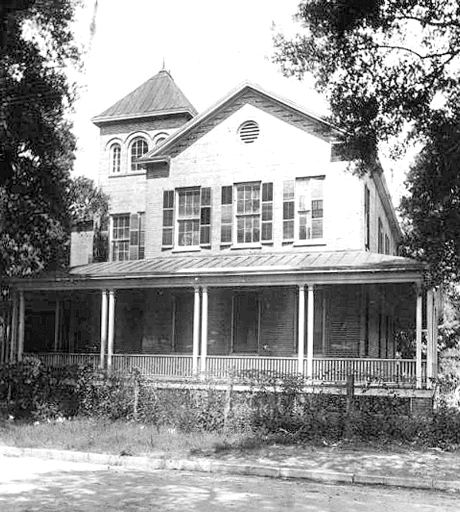
St. Benedict The Moor School, St. Augustine, Fla. Source: Wikimedia Commons.
A century ago, three Catholic sisters in St. Augustine, Fla. were arrested for something the state Legislature had recently made a crime: Teaching black children at what, in the parlance of the time, was known as a "negro school."
The ensuing trial propelled a 266-year-old French Catholic order and America's youngest Catholic Bishop into the middle one of the wildest and most racially charged gubernatorial campaigns in Florida history. A hundred years ago today, the white sisters won their legal battle, vindicating the rights of private institutions like the Saint Benedict the Moor School that fought to create educational opportunities for black children in the era of Jim Crow segregation.
Black parents' demand for quality education didn't begin with Brown v. Board, but hundreds of years before, in chains and in secret. But near the turn of the twentieth century, as Jim Crow laws reversed the progress made under post-Civil War reconstruction, public institutions intended to uplift freed blacks became increasingly inadequate and unequal. Black parents often turned to their own churches or to missionary aid societies, like the Sisters of St. Joseph, to educate their children.
The story of the three white Catholic sisters has been examined over the years by multiple scholars, whose work informs this post. And while details in the historical record are at times murky and ambiguous, the episode sheds light on the countless struggles across the South to educate black children who were pushed to the margins by oppressive public institutions.
* * *
Founded in 1650 in Le Puy-en-Velay, a rural mountain town in southern France, the Sisters of St. Joseph took up a mission to serve, educate and care for the poor and disadvantaged. For the next 200 years, the sisters pursued their mission throughout France until they were invited to Florida by Bishop Augustin Verot after the end of the U.S. Civil War.
Verot, a native of Le Puy, recruited eight sisters for a new mission: To educate newly freed slaves and their children.
The sisters established Florida's first Catholic school for black students in 1867 along St. George Street in St. Augustine. They would go on to establish schools in Key West and in Ybor City. With the financial backing of a wealthy heiress, Saint Katharine Drexel, the Sisters of St. Joseph opened St. Benedict the Moor School in 1898.
The Sisters of St. Joseph, along with other religious groups like the Protestant American Missionary Association, educated black students in private and public schools in Florida for several decades. But then the legislature lashed out against their efforts. "An Act Prohibiting White Persons from Teaching Negroes in Negro Schools" unanimously passed through both chambers without debate, and was signed into law on June 7, 1913. (more…)
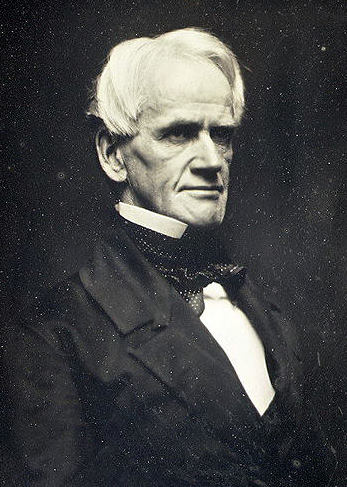
Horace Mann (Source: Wikimedia Commons)
The first-ever state supreme court ruling finding charter schools unconstitutional continues to stir debate all over the country, and has inspired some choice opponents to raise questions about other charter school laws, including the nation's oldest.
While there is little reason to think the Washington State Supreme Court's legal reasoning could spread to many other states, it is the latest illustration of how an idealized past that never was continues to create barriers to a 21st-Century education system.
Opponents try to cast a romantic vision of free, universal public education as a foil against school choice, relying on a mythical conception of "common schools" that has rarely squared with reality.
Getting American common schools to serve all students required more than a century of political turmoil, countless lawsuits and no shortage of attempts — from Dust Bowl-era California farm towns to the Freedom Schools launched by the Civil Rights Movement — to create separate educational opportunities for religious and ethnic minorities who were excluded from, or under-served by, traditional public school systems.
In many ways, the fight for inclusion and equity continue to this day.
“[P]eople too frequently forget that those schools were at different times not open to blacks, religious minorities, or, until the 1970s, students with special needs and disabilities,” Andrew Rotherham and Richard Whitmire wrote in a recent piece for The 74.
Common schools were first popularized in the mid-1830s by Massachusetts education reformer Horace Mann. The idea spread through out the U.S. over the next few decades during a time when anxiety over waves of immigrants, many of them from Ireland and other predominately Catholic countries. (more…)

