A bill to make Louisiana the 19th state allowing parents to direct public education funding to learning options of their choice awaits a signature by a supportive governor.
Right now, 17 states, most recently Georgia, have some sort of education savings account in place, and an 18th, Oklahoma, offers parents an individual tax credit.
In addition to its eye-catching name, Louisiana Giving All True Opportunity to Rise (LA GATOR) scholarship program would eventually be open to all students and has some features that are worth highlighting.
Voucher transition: Starting in the 2025-26 school year, GATOR scholarships would replace the state’s existing voucher program for low-income students, known as School Scholarships for Educational Excellence. Students using the existing vouchers would receive priority in the application process for GATOR scholarships, and receive the same level of funding as they did under the voucher program.
Phasing in options: The state Department of Education would be required to open applications by March 1, 2025. But scholarships in the first year would be reserved for students who plan to use their scholarship funds for a single provider (most likely a private school). Applications for families who plan to use the program to pay multiple service providers would open March 1, 2026.
Public school participation: The bill underlines the possibility that school districts and charter schools could offer classes or other services to scholarship students. It says: “Each public school governing authority may adopt a policy authorizing the acceptance of account funds for providing services covered as qualified education expenses to a participating student who is enrolled part-time in a school under its jurisdiction or who takes individual courses provided by such a school without being enrolled in the school.”
Elastic clause: The bill would allow parents to access specifically authorized expense categories, such as school tuition or curriculum, as well as “Any other educational expenses approved by the state board.” This creates an avenue for the state to approve innovative education offerings that meet the spirit of the law but not the letter.
User reviews: Like similar programs in other states, the Louisiana measure contemplates an online platform where parents can browse education services they pay for with scholarships funds. It would require Louisiana’s platform to “allow parents to publicly rate, review, and share information about participating schools and service providers.”
Autonomy protection: The legislation includes multiple provisions designed to reassure schools and service providers that participating in the scholarship program will not invite increased government regulation. It would direct the state Board of Elementary and Secondary Education to set rules “in a way that maximizes school and provider participation.” It also stipulates that schools and providers “shall be given maximum freedom to provide for the educational needs of participating students without governmental control.”
Louisiana Gov. Jeff Landry pushed hard for the LA GATOR program and touted its passage in a news release, so his signature is likely. The key remaining question is how much funding lawmakers will set aside for scholarships in the program’s first year.
Under the timelines laid out in the legislation, scholarship applications would debut at the height of carnival season, three days before Mardi Gras. Laissez les bons temps rouler!
As school vouchers spread across Louisiana in the 2012-13 school year, they put private schools within reach of black and Hispanic students who couldn't afford them before. As a result, they helped reduce segregation in the state's schools, a new study has found.
The report, one of four released Monday looking at different aspects of vouchers in Louisiana, is the first of its kind to examine the rollout of a new private-school choice program across an entire state.
The Louisiana Scholarship Program allows low-income students to transfer out of schools rated C, D or F by the state accountability system. The vast majority of participants — including 80 percent of the 1,741 students examined in the study — are black.
Researchers (Anna Egalite of North Carolina State University, Jonathan Mills of Tulane University, and Patrick Wolf of the University of Arkansas) compared the racial makeup of public and private schools to their surrounding area.* They then looked at how that makeup changed when students started using vouchers the year the program expanded statewide.
They found the "vast majority" (82 percent) of students who changed schools using vouchers reduced segregation in their former public schools. However, only 45 percent of voucher-related transfers reduced segregation in the private schools where students wound up.
Taken together, the researchers found a net gain for racial integration.
Since the positive effect of student transfers on better integrating the public schools they left is much larger than the negative effect of student transfers on reducing integration in the private schools that receive them, the net effect of the [Louisiana Scholarship Program] on school-level racial integration across both school sectors is positive.
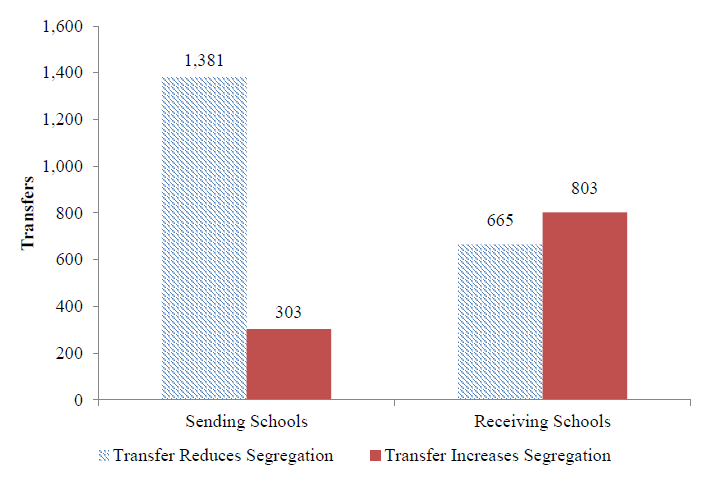
Louisiana vouchers helped reduce segregation in new public schools, a new study has found..

Hage
Vouchers, here. Charters, there. Virtual, over there. Politically, school choice sectors have been islands. But there are signs the movement is building bridges to advance common goals.
Florida's lead here surfaced at this week’s American Federation for Children summit, during a panel discussion on just that topic. In the Sunshine State, charter schools and supporters of vouchers and tax credit scholarships have teamed up to advance legislation, said panelist Jon Hage, founder and CEO of Florida-based Charter Schools USA.
“We realized it was time to join forces,” Hage said. “We felt we were sort of the Army, and they were the Navy … What we’re trying to do is have a common Department of Defense.”
The Florida school choice coalition doesn’t stop at two sectors. Through a group formed in 2010 – the Florida Alliance for Choices in Education – it includes online providers, home-schoolers and district school choice options like magnet schools. In the middle of this year’s legislative session, the group held a rally that, for the first time, brought parents together from across the spectrum.
Panelists suggested the benefits of a united front included strength in numbers, a more focused message and crossover appeal.
In response to a question from moderator Nina Rees, CEO of the National Alliance for Public Charter Schools, Hage said some Democratic lawmakers in Florida were more willing to support charter bills this year because they had supported tax credit scholarships in the past. Plus, the coalition offered a tighter, more compelling argument – one that emphasized school choice options even more and better deflected the usual criticisms. (more…)
by Kenneth Campbell

Campbell
This week, NBC’s Education Nation is visiting New Orleans on its national tour to get a first-hand look at education challenges and opportunities being faced by local regions. On a national scale, Louisiana, more particularly New Orleans, has long been considered a hotbed for education reform. But this week’s visit is another chance to zero in on the many changes that have taken place and the progress that has been made as part of the massive reform movement that has emerged. Long before the state took on a national profile, the Black Alliance for Educational Options (BAEO) was at the forefront of the education reform movement in Louisiana - advocating on behalf of parents and students and fighting for expanded educational options across the state.
It’s no secret that in the last few years, Louisiana has adopted a number of education reforms centered on school choice and teacher accountability, among other key issues. Just last year, Gov. Bobby Jindal signed into law one of the most advanced and comprehensive education reform bills in the nation. BAEO has been on the ground for more than a decade to help bring these reforms to life.
Early on, we waged a battle against the status quo and promoted the belief that students must come first in all efforts to improve education in Louisiana. We provided a voice for Black children from low-income and working-class families and demanded they have an equal opportunity to compete and succeed. We have seen parents asking for help to rescue their children from failing schools and we have seen the passage and implementation of a comprehensive scholarship “voucher” program that allowed thousands of Louisiana children to trade their destitute educational environments for private schools that gave them hope and a greater chance to achieve. Along the way, we’ve helped parents fight for “choice” and “options,” as well as navigate the system and better leverage the options that are available to them today.
And while there is much more work to be done, we are proud today to see Louisiana has come a long way because of education reform. Today, many of the parents we met early on are reaping the benefits of their hard work and commitment to advocating for their children. Even more, we see those parents feeling empowered, standing up and volunteering to be a voice, not only for their children, but for all of the children who deserve access to a high-quality education. (more…)

