On Wednesday, U.S. Sen. Marco Rubio, R-Fla., introduced a bill that would create a federal tax credit scholarship program for low-income students. Today he offers his thoughts about it in an op-ed for the Tampa Bay Times. Here's an excerpt:

Sen. Rubio
Unfortunately, hundreds of thousands of schoolchildren in our country are not as fortunate as I was. These children are being failed by our nation's broken public school system, and they and their parents deserve the freedom and flexibility of school choice. There is perhaps no greater symbol of failure in our education system and our society than the worried faces of parents sending their kids off to a failing school because they don't have the liberty to choose a better, safer school.
While some students may be lucky enough to attend high-quality public charter schools in their areas, a private school education has become unattainable for the majority of low-income and middle-class families. It's too difficult for parents in today's economic environment to incur the financial burden of paying tuition at a private school, forcing parents to bypass better and safer education options.
Further, because of our nation's fiscal crisis, private schools may not be able to distribute a high number of institutionally funded scholarships to children. The result is a large number of students and families yearning for the opportunity of gaining a better education at a high-performing private school that will adequately prepare them to compete in a 21st century global economy.
To ensure that more American children receive that opportunity, I have introduced the Educational Opportunities Act, to create a new federal tax credit for individuals and corporations to help families pay for expanded educational opportunities. Full op-ed here.
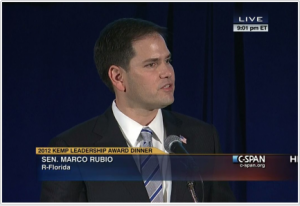 U.S. Sen. Marco Rubio, R-Fla., devoted a substantial portion of a major speech this week to education reform, saying public schools are a “disaster” for millions of disadvantaged American kids and pointing to parental school choice as a critical piece in uplifting the middle class.
More charter schools and more career and technical academies are among the changes necessary to ensure that people have the skills needed for the middle-class jobs of the future, Rubio, a Republican from Miami, said at the Jack Kemp Foundation’s Leadership Award Dinner (C-SPAN video here). He also proposed creation of a corporate federal tax credit to provide scholarships to low-income students who want to attend private schools.
“The bottom line is we are trying to prepare 21st century students using a 20th century education model,” Rubio said, according to a transcript of his remarks. “Now is the time to be creative, innovative and daring in reforming the way we provide our people the skills they need to make it to the middle class.”
Rubio is a longtime school choice supporter. But his latest remarks on the subject are noteworthy given the timing and context. In the aftermath of Mitt Romney’s loss, Republicans are re-branding their image to better appeal to middle-class voters – and Rubio squarely framed school choice as a vehicle for equal opportunity and upward mobility. Rubio’s points also dovetail with arguments long made by choice groups such as the Florida-based Hispanic Council for Reform and Educational Options. Minority voters are increasingly warming to vouchers, tax credit scholarships and other forms of expanded school choice, and polls suggest they may likewise warm to politicians who embrace such options.
In another section of his speech, Rubio mitigated his harsh assessment of failing schools, acknowledging the tough job schools face and offering sympathy for those in the trenches: “But perhaps the most effective thing we in government can do about societal breakdown is acknowledge the impact it is having. Ask any of the amazing teachers we are blessed to have here in America. I have four of them in my own family. They are on the frontlines of this problem. They will be the first to tell you that every single day, kids bring their home experience in to the classrooms. Every day, they see firsthand how kids living in dysfunctional homes are going to really struggle to make it. As a people, we cannot build a vibrant and broad-based middle class if we do not solve this problem.”
Here is the main section of the speech that touched on education: (more…)

