A new report argues supporters of private school choice can learn from public charter schools and should look for ways to "break down the walls" between the two sectors.
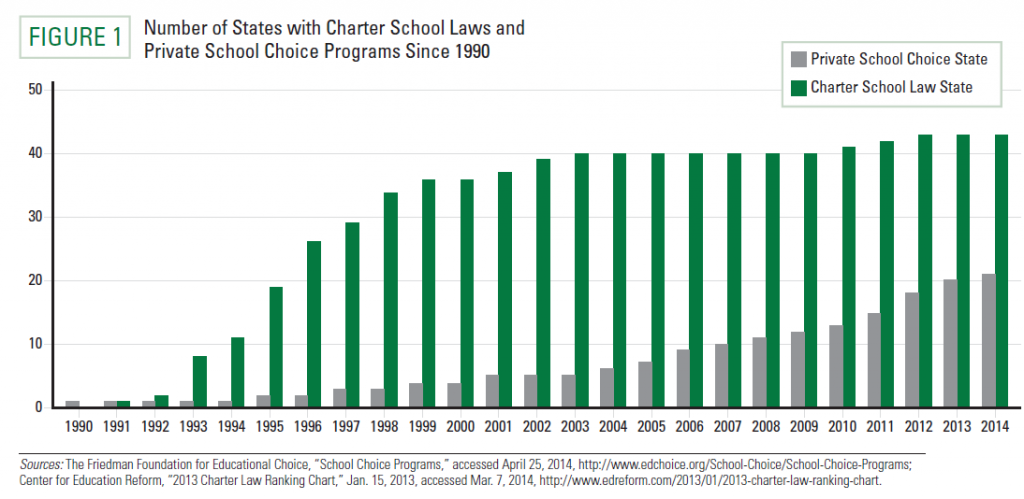
While most states have authorized charter schools for more than a decade, private school choice programs are starting to become more widespread. Chart from the Friedman Foundation's report.
Private school choice programs serve only a few hundred thousand students nationally, a fraction of the 2.3 million enrolled in charters. But more states have created tax credit scholarship and voucher programs in recent years, and existing programs, including the tax credit and McKay scholarships in Florida, are growing.
A report released this morning by the Friedman Foundation for Educational Choice argues that as private school choice programs grow and proliferate, they can draw a few lessons from the charter sector about how to create more quality options for students.
Report author Andy Smarick - a consultant at Bellwether Education Partners who's among the leading proponents of a "three-sector approach" to education reform - writes that private schools could learn from charters' use of networks and incubators to improve their operations. He also advocates for a charter-style approach to accountability, in which participating schools get screened by authorizers — agencies that hold them to performance-based contracts in exchange for more freedom to operate.
That idea may prove controversial among private schools that have traditionally not seen as much regulation as their publicly funded counterparts. But as states debate how they will regulate private school choice programs, Smarick writes that authorizers would be in a position to fine tune their judgement calls about how private schools are evaluated. For example: Should they be publicly accountable for the performance of all their students, or just the performance of students who receive tuition subsidies through tax credit or voucher programs?
"The contractual relationship, if implemented properly, will also be more nuanced - rendering fairer judgments and respecting the unique characteristics of private schools - than, say, a single letter grade for a school that would be generated via a state’s accountability system," he writes.
Other insights from the charter sector are more straightforward, such as the use of incubators and networks. (more…)
by Allison Hertog
Mississippi recently became the first state in the nation to adopt a public and private school choice program in which state and federal monies are provided directly to schools which parents choose. Aimed at students with dyslexia, it's also the second special needs school choice program in the country designed for children with a single type of disability. (Ohio’s Autism Scholarship Program enacted in 2003 was the first.)
What makes this new program interesting is that it may be a starting point for other state legislatures where special needs voucher bills have failed due to concerns about parent accountability – Wisconsin comes to mind – or where special needs voucher laws have come under increased scrutiny due to reports of private school abuse of public money – Florida comes to mind.
Mississippi’s program morphed from a dyslexia screening and treatment bill (supported by a governor who struggled with the learning disorder) into a school choice measure during the proverbial sausage-making legislative process. It’s not as carefully or as broadly designed as it could have been. It also appears there’s currently only one school in the state which is specialized enough to meet the exceedingly specific criteria to participate. But nonetheless, it succeeds in incentivizing the growth of more highly-accountable school options for parents. (more…)
Some of us at redefinED will be at the American Federation for Children summit tomorrow and Friday, where there will be lots of discussion about school choice and education reform. As good a time as any, we thought, to offer a snapshot of where Florida stands. Check out these numbers, which Doug Tuthill, the president of Step Up for Students and a redefinED host, shared last week with business leaders at a Leadership Florida event:
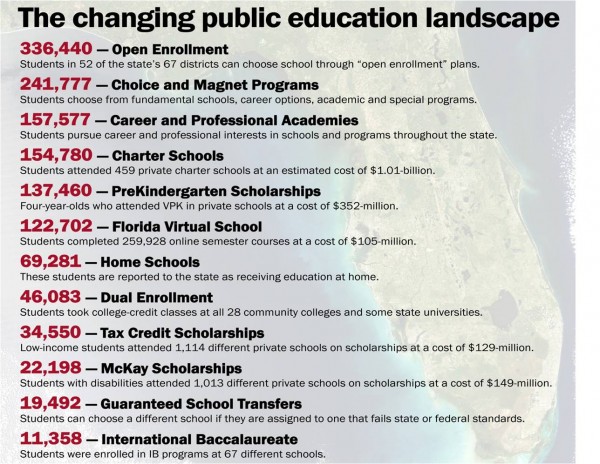
The numbers (carefully compiled by Jon East, vice president for policy & public affairs at Step Up) are from 2010-11 and we know in many cases the current figures are even higher. Charter school enrollment, for example, topped 175,000 this year, and the tax credit scholarship program serves more than 39,000 students. Altogether, the numbers underscore two things we emphasize at redefinED: School choice - the kind that allows parents to go beyond their neighborhood school - is becoming mainstream in Florida. And the lines between "public" and "private" are more blurred here than in any other state.
The AFC conference agenda includes Louisiana Gov. Bobby Jindal, New Jersey Gov. Chris Christie, Newark Mayor Cory Booker and an all-star line up of choice experts and advocates. We're hoping to have a little time to update you on what's going on with blog posts and tweets. For the latter, follow us at @redefinEDonline.
 Editor's note: We're going to try something new today - "blog stars," an occasional round-up of material from other blogs that we think is worth spotlighting. Some of the most illuminating commentary/analysis about education issues nowadays is found not in traditional media like newspapers, but in the blogosphere. As with everything else we do, we'll emphasize posts that touch on school choice, parental choice and common ground in education reform. Here goes:
Dropout Nation: Embrace the Power of Families
The move today by Louisiana’s legislature to approve the expansion of the state’s voucher program can only be seen as a success for children in that state. The centerpiece of Gov. Bobby Jindal’s school reform efforts, the proposal — which would transform the program from one that just serves 3,000 students in New Orleans — will likely help as many as 300,000 more children get out of the Bayou State’s failure mills and dropout factories.
But the passage of the plan, along with one that would allow for the opening of more charter schools, is another reminder of the important shift that is happening, not only within Louisiana’s public education system, but throughout American public education as a whole. Families once relegated to the sidelines are taking more-powerful roles in shaping education decisions decision-making. It’s past time for this to happen. It is absolutely immoral and unacceptable to deny families, especially those from the poor and minority households, the ability to reshape education for their kids and keep them out of the worst education in this nation has to offer.
As Dropout Nation has reported over the past few years, more families are realizing that they can no longer assume that their children will fare well in just any school. Thanks to the work of the school reform movement — including the work of standards and accountability advocates and civil rights-based reformers in advancing the array of measures that would eventually come together in the No Child Left Behind Act — parents know more about the abysmal quality of teaching and curricula endemic in both the worst urban districts and mediocre counterparts in suburbia. And this data, along with the first wave of school choice efforts that started in the early 1990s with Milwaukee’s school voucher program and the first charter schools opened in Minnesota, have allowed families, especially those from low-income backgrounds, to realize that they don’t have to take anything that is given by traditional districts. Full post here.
Choice Words: 10 years after Zelman, challenges still loom for voucher advocates
Ten years after the U.S. Supreme Court upheld the constitutionality of the Cleveland voucher program, state judges are still sending conflicting signals about the viability of private school choice. The latest setback for choice proponents took place last week in Oklahoma, where a Tulsa County judge ruled that a voucher for students with special needs violated the state’s constitutional prohibition of public money for sectarian institutions. (more…)

