For its first hearing of the year, the Florida House's Education Committee heard from leaders of several out-of-state charter school networks. The theme, according to Mike Bileca, R-Miami and chair of the committee, was "schools that have taken excellence and scaled."
Florida education officials have pushed for years to bring more nationally well-regarded charter schools to the state. Bileca has long supported those efforts.
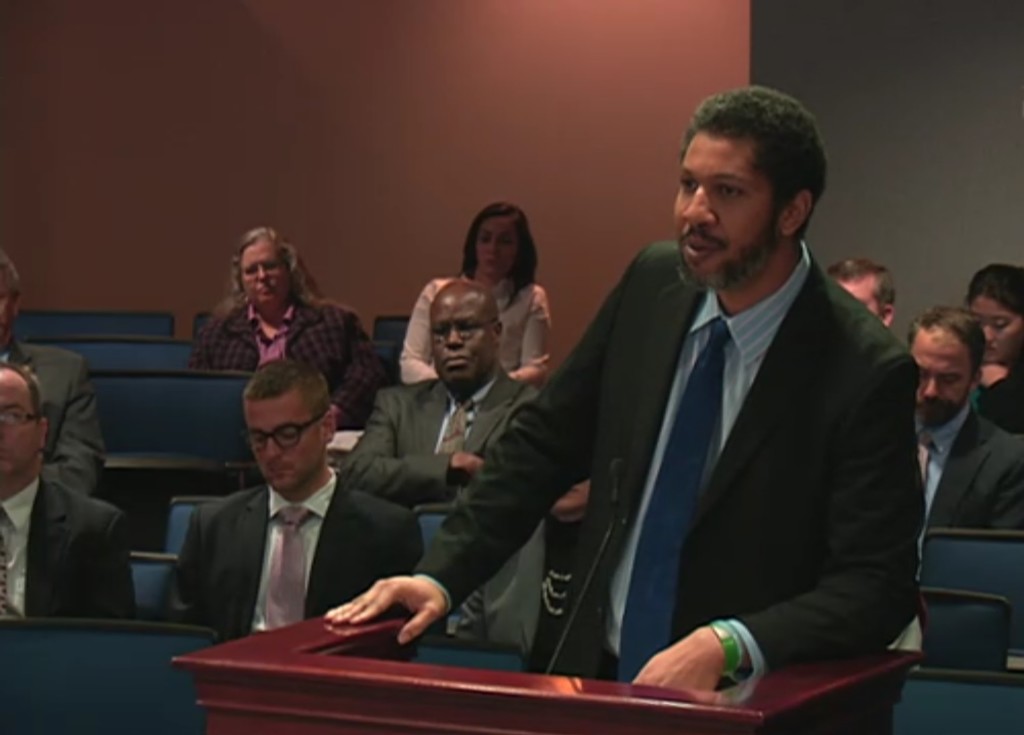
KIPP Foundation executive Quentin Vance addresses the Florida House Education Committee.
Quentin Vance, an executive at the KIPP Foundation, pushed back against the idea that there's "a trade-off between charter schools and public schools, and this is a competition." His organization, one of the largest charter operators in the country, has started a network of schools in Jacksonville, and is now in the early stages of a formal collaboration with the Duval County school district there.
An excerpt from his comments is below, lightly edited for length and clarity.
Nationally, what we've seen in growing schools in so many different cities across the country is that when there is increased choice for kids, where families can become consumers and the only metric of deciding where they want to go to school is what's going to be best for their kids it creates an environment in which everyone gets better.
(more…)
Older students with special needs could use Florida's McKay Scholarships to pay for transition programs intended to prepare them for jobs, under legislation backed unanimously by a state House panel on Tuesday.
Bileca
HB 837, by Rep. Michael Bileca, R-Miami, would allow children between the ages of 17 and 22 to use the vouchers for "transition-to-work" programs.
A growing number of private schools that accept McKay scholarships have started post-graduate programs designed to prepare recent graduates for the workforce.
This year, lawmakers have filed multiple bills, including some expected to pass this week, aimed at expanding college and job-training programs for special needs students who finish high school. (more…)
Bileca
The Florida House this morning unanimously approved legislation that would expand access to the state's newest parental choice program for children with special needs.
The legislation would allow children with muscular dystrophy and a broader range of students with autism to use Personal Learning Scholarship Accounts, a cutting-edge program created last year.
The legislation would also open the program to three- and four-year-olds, expand the services that can be paid for with the accounts, increase oversight for the nonprofit organizations that administer the program, and allow them to collect administrative fees.
The largest such organization is Step Up For Students, which co-hosts this blog and employs the author of this post.
Last year, Florida became the second state in the country to create an education savings account program, which allows parents of special needs children to use state education funding to pay for a range of education-related services, from private school tuition to therapies and textbooks.
Rep. Mike Bileca, R-Miami, backed the creation of the program last year, and helped shepherd this year's bill, which no legislator has voted against. He said he's been hearing from parents who have begun using the accounts.
"It's been nothing short of life-changing," he said before the bill passed 114-0. "Of all things that I've done personally on education in this chamber, there's been nothing more powerful for me than being able to talk with these parents and hear their stories."
After rejecting a handful of proposed amendments, the Florida House is now ready to take a final vote on its charter school legislation. But one of the most interesting proposals on the floor today was one that was not adopted.
Rep. Michael Bileca, R-Miami, proposed an amendment that would have given school districts more flexibility under state building regulations. He pulled the proposal, citing concerns that it wasn't germane to the charter school bill.
But it's part of a larger thrust among lawmakers trying to navigate tensions between charter schools and school districts. Charter schools do not have to comply with all the state's regulations for school facilities, but they still have to comply with building codes. Districts have asked for some of the flexibility enjoyed by charter schools, and state panels have discussed the issue when they grappled with plans to address long-range capital funding needs.
"It's strongly supported and was done at the urging of our school districts, many of them in the state," Bileca said of his proposal, which would have given school district more flexibility in the ways they design their parking lots and build interior walls.
It's not clear what will become of that idea, but there are other ideas still in play that fit with a similar theme. Charter schools also enjoy more flexibility under class-size requirements in the state constitution. Their financial penalties for failing to comply with the class-size rules are based on the school-wide average.
The budget conference announced today includes an education funding bill (HB 5101) that would extend the same flexibility to school districts. That proposal, however, remains controversial. It was one of the reasons cited by Democrats for votes against the bill earlier this month. Rep. Joe Saunders, D-Orlando, cited the measure as part of a "slow attrition" of the constitutional provision.
"I feel very strongly that when the voters passed the class-size amendment in 2002, we got clear directive. We got clear directive that our class sizes should stay small," he said.
The idea has been proposed before. It advanced last session but did not pass. Supporters note the penalty calculations are not enshrined in the constitution, and that changes could save the school system money. Regardless of how the idea fares in the next two weeks, it's part of a larger theme to keep an eye on as lawmakers resolve their differences over charter school legislation and facilities funding.
A bill that would accelerate the growth of Florida's tax-credit scholarship program could be headed for a vote on the House floor.
Rep. Michael Bileca
The House Choice and Innovation Subcommittee approved the measure on a party-line vote Tuesday, after approving changes that would raise limits on the program's growth and voting down a proposal to require that scholarship students take the same standardized tests as their public school peers.
After the changes approved Tuesday, the program could grow to about $401 million next school year, raising the cap for that year by about $43.6 million. That would allow as many as 76,680 students to receive scholarships. (The program is administered by Step Up For Students, which co-hosts this blog.)
The hearing was packed with parents, teachers, students, political activists and clergy members on both sides of the school choice debate. Students weighed in on both sides, including Artayia Wesley, an eighth-grader who said she has used a scholarship to attend St. Andrew Catholic School in Orlando since she was in fourth grade.
"Before, I was academically challenged," she said. "I wasn't the best student in the class, grade-wise. But as I went to St. Andrew, now I'm an A-B student and working to be on the honor roll."
Democrats on the committee, who opposed the bill, said they wanted the state to measure for scholarship students's academic progress with the same standardized tests taken by public-school students. Rep. Shevrin Jones, D-West Park, introduced an amendment to create that requirement. It failed on a party-line vote after setting off a debate about how schools should be held accountable.
Representatives of the Florida Education Association and Florida PTA said they supported Jones' proposal.
Florida lawmakers are working on proposals that would allow parents of children with developmental disabilities to put state education funding to use beyond the traditional public school system – and even beyond private, virtual or other school choice options.
Rep. Bileca
The proposals being considered in the House and Senate resemble the “education savings accounts” that have started getting attention around the country, but they would be available only to certain children with special needs.
Parents of children with conditions like autism, spina bifida or cerebral palsy would be able to use “personalized accounts for learning” to cover expenses like therapy, private tutors or a specialized curriculum. Under a bill already filed in the Senate, they could also use the funds to start saving for college.
While the McKay Scholarship program can allow disabled students to attend public or private schools of their choice, disabled children's needs often extend beyond the “in-school component" of their education, House Choice and Innovation Subcommittee Chairman Mike Bileca, R-Miami, said during a hearing on the proposal Tuesday.
“For some students, a full day at school may not meet their education needs, and the parents have the most valuable perspective and insight into what their children need,” he said.
Ashli McCall, one of two parents who testified in favor of the proposals, told the committee she is the mother of a 15-year-old with Asperger syndrome. She said her son would be stymied by a “total sensory overload” in a traditional public school setting. She said he responds best to one-on-one instruction at home, but could benefit from having more access to therapists.
“If we had had the funding to support the needs of my child at an earlier age, we may have had more success in his academic achievements,” she said. “He struggles with so many issues which interfere with his learning that his academic process has been hindered.” (more…)
Rep. Trujillo is a co-sponsor of the House parent trigger bill
The parent trigger bill is back in the Florida Legislature this year and, judging by the spirited 8-5 party line vote it got in its first committee stop Thursday, perhaps as contentious as ever. But unlike last year, some Florida parents and child advocates not only voiced support, but drove to Tallahassee to tell lawmakers in person.
Former Marion County teacher Karen Francis-Winston trekked 200 miles from Ocala with her daughter to testify in favor of the bill sponsored by Republican Reps. Michael Bileca and Carlos Trujillo.
Pastor Alfred Johnson came from Tampa,where he said he serves a low-income community.
“I don’t understand what’s the matter with empowering parents to make a recommendation,’’ he told the Choice & Innovation Subcommittee. “We’re doing nothing but recognizing they have a voice, a say in the process.’’
House Bill 867, with an identical version filed by Sen. Kelli Stargel, R-Lakeland, allows parents with children in an F-rated school to petition the school district to consider a turnaround plan that could include bringing in a charter school operator. The petition would need signatures from a majority of parents. (more…)
 Editor's note: Another year, another legislative session, another stack of school-choice bills in Florida. Here's a roundup of choice legislation that lawmakers will consider in the annual session that begins today.
Career Academies:
SB 1076 by Sen. John Legg, R-Lutz. Expands the "Career and Professional Education Act (CAPE)," revising requirements for high school graduation and accelerated high school graduation, and allowing students to earn and substitute certain industry certifications for certain course credits. Also requires districts to make digital materials available to students and to use the Postsecondary Industry Certification Funding List in determining annual performance funding distributions to school districts and Florida College System institutions, etc.
Charter Schools:
HB 373 by Rep. Joe Saunders, D-Orlando. Provides that a contract for a charter school employee or service provider may not extend beyond the school’s charter contract, and that the employee or service provider is not entitled to compensation after the school’s closure. (Identical to SB 780 by Sen. Geraldine Thompson, D-Orlando.)
HB 453 by Rep. Victor Torres, D-Orlando. Requires the compensation and salary schedules for charter school employees to be based on school district schedules. (Identical to SB 784- Charter Schools by Sen. Geraldine Thompson, D-Orlando.)
SB 744 by Sen. David Simmons, R-Altamonte Springs. Requires charter school applications to demonstrate the applicant is financially qualified to open and maintain a high-quality charter school, requires the charter to set forth detailed reporting of the financial operations of the school to ensure employees are not paid unreasonable compensation, and requires that the term of the charter must provide for cancellation of the charter if the school becomes insolvent, fails to provide a quality education, or does not comply with applicable law. The bill also clarifies that a charter school system shall be designated a LEA solely for the purpose of receiving federal funds if certain criteria are met.
SB 828 by Sen. Rene Garcia, R-Hialeah. Grants school districts the ad valorem tax exemption given to charter schools, and restricts the use of capital outlay funds for property improvements if the property is exempt from ad valorem taxes. It restricts charter schools or technical career centers having financial problems from certain activities, and grants flexibility to high-performing school choice districts.
HB 1001 by Rep. Karen Castor Dentel, D-Maitland. Prohibits charter schools from requiring, soliciting, or accepting certain student information before student's enrollment or attendance. Also requires charter schools to submit attendance plans to the school district for students enrolled in school; provide funding to the school district in event of student transfers; and report to the school district certain student enrollment and wait-list information.
SB 1092 by Sen. Geraldine Thompson, D-Orlando. Requires charter school to submit attendance information for each student to the school district, and requires the charter school to provide a prorated portion of per-student funding to the school district if a student transfers to another public school in the school district before the last day of the school year.
SB 1164 by Sen. Kelli Stargel, R-Lakeland. Revises the eligibility criteria for extracurricular activities to include students in charter schools, and revises the criteria for bylaws, policies, or guidelines adopted by the Florida High School Athletic Association. (Compare to HB 1279 by Rep. Larry Metz, R-Groveland.) (more…)
Some members of the Florida House Choice & Innovation Subcommittee grew up attending public schools and, later, went to work for them.
Others sent their children to parochial schools and charter schools while at least one representative home-schooled his kids.
In all, 13 members of the new subcommittee said they have had first-hand experience with an array of educational options – perhaps a good sign for a group that will help shape Florida’s growing school choice movement.
During the first official meeting Tuesday in Tallahassee, members introduced themselves and listened as state education leaders explained how school choice works and what options are available.
Here’s what members revealed about their educational background:
Rep. Michael Bileca
Florida House Speaker Will Weatherford announced committee assignments today (hat tip: News Service of Florida.) Here is who will serve as chairs and vice chairs of the education committees, including the new subcommittee on school choice and innovation:
Education Committee: Chair, Marlene O'Toole, R-Lady Lake. Vice Chair, Elizabeth Porter, R-Lake City.
Education Appropriations Subcommittee: Chair, Erik Fresen, R-Miami. Vice Chair, Marlene O'Toole, R-Lady Lake.
Choice and Innovation Subcommittee: Chair, Michael Bileca, R-West Miami. Vice Chair, George Moraitis, R-Fort Lauderdale.
K-12 Subcommittee: Chair, Janet Adkins, R-Fernandina Beach. Vice Chair, Ronald Renuart, R-Ponte Vedra Beach.
Higher Education and Workforce Subcommittee: Chair, Jeanette Nunez, R-Miami. Vice Chair, Jason Brodeur, R-Sanford.
To see all members by committee, click here.

