Brickman
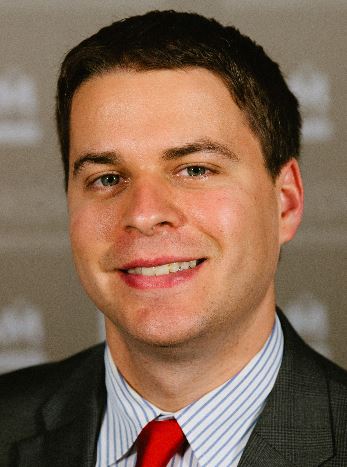
Imagine if parents could pick and choose individual courses for their children, from an endless array of different providers, in the same way they now pick and choose other products online. Michael Brickman, the national policy analyst for the Fordham Institute, says that world may not too far in the future, thanks to a budding parental choice trend folks are calling “course choice.”
“Ideally parents and students can sit down at the computer and "shop" online for courses,” Brickman said during a live chat Wednesday with redefinED. “This is so commonplace and mundane when we go on sites like Amazon.com and add items from different sellers from around the world to our virtual shopping cart. Hopefully through (course choice), education can catch up to the rest of the world in this regard.”
A handful of states are moving ahead with course choice, including Louisiana and Wisconsin, where Brickman served as a policy advisor in Gov. Scott Walker’s office before joining Fordham. Florida is among those taking a close look. Brickman recently authored a policy brief that gives education officials a primer on course choice and the challenges ahead.
Course choice is complementary to parental choice options such as charter schools and vouchers, he said during the chat. But it can spur those options to innovate even more.
“I love traditional school choice and think it's nowhere near obsolete as of now,” he said in response to a question. “But one of the frustrating things about these reforms is how similar the schools look to one another. The point of additional flexibility is to INNOVATE. Some charter and private models are off and running with this but many are still lining up 30 desks in each room, putting a teacher in front of the class for 7 hours a day, etc.”
You can read the entirety of the chat in the transcript below.
Brickman
Things are changing so fast with parental choice, charter schools and vouchers are starting to look old school. Before you know it, a lot more parents won’t just be choosing schools for their children, they’ll be choosing individual courses.
It’s called course choice. And to help us all get a better handle on it, we’re having a live chat next week with Michael Brickman, national policy director for the Fordham Institute. Brickman authored an excellent primer on course choice that Fordham released last week.
The chat is open to anyone with a fair question. It’s in writing, so we’ll type in questions, you’ll type in questions and our guest will type in answers as fast as his fingers can fly.
To participate, just come back to the blog on Wednesday, May 28. We’ll start promptly at 11 a.m. Just click in to the live chat program, which you’ll find here on the blog.
In the meantime, if you have questions that you’d like to send in advance, you can leave them here in the comments section, email them to rmatus@sufs.org, tweet them to @redefinEDonline and/or post them on our facebook page. See you then!
Don’t look now, but a bigger, faster and potentially more far-reaching wave of educational choice is rolling in as we're still grappling with basic questions about vouchers, tax credit scholarships and charter schools. Lucky for us, a new guide from the Fordham Institute offers a heads up on the complications with “course choice” so its promise can be fully realized.
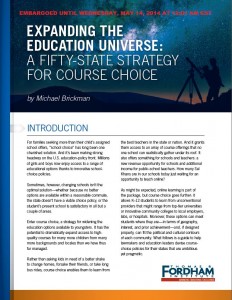
Released today and authored by Michael Brickman, Fordham’s national policy director, “Expanding the Education Universe: A Fifty-State Strategy for Course Choice” arrives as school choice begins to give way to educational choice on a more fundamental level.
“Rather than asking kids in need of a better shake to change homes, forsake their friends, or take long bus rides, course choice enables them to learn from the best teachers in the state or nation,” Brickman writes. “And it grants them access to an array of course offerings that no one school can realistically gather under its roof.”
To some extent, course choice is already happening. Students in many places can take dual enrollment courses. Florida offers a vast course menu through Florida Virtual School. Louisiana adopted a course choice program two years ago. It’s just a matter of time before other states and/or school districts seize the day in a bigger way, and some, like Florida, are already taking a closer look.
The bottom line: students will increasingly be able to choose a course here and a course there, from an exploding number of providers. That will increasingly be true no matter what school they’re in.
That’s the upside. The downside? All kind of prickly questions have to be tangled with, from funding and access to eligibility and accountability. Brickman offers a rundown of five big ones, with potential directions, complications, tensions and tradeoffs. For example:
Who can be a provider: “Parents and kids will naturally want the widest possible range. Districts, however, will tend to favor tighter limits, whether out of concern for quality control or to minimize competition with their own offerings. States will also have to balance the desire to serve more children with the political headache that inevitably comes when ‘controversial’ course providers are included. Or they may leave such decisions to districts or entrust them to third parties.”
Who pays them: “Does the child’s school district pay the cost? Does the state? The parents? Who decides what price is reasonable? How many kids can take how many such courses? Who controls this money? Who generates it?”
Then there’s this fun one: “What if Molly takes all but one or two of her courses from course providers? Is she still a student of Madison High School? Does it still confer her diploma? Is it still the school’s job to determine whether she has truly fulfilled state or district graduation requirements? If not the school, then who?”
And some thought school choice was complicated. 🙂

