The story: With less than a week to go before the U.S. Supreme Court hears arguments about the constitutionality of religious charter schools, supporters and opponents are making wildly different predictions about the possible effects.
 Supporters, who include advocates for religious education, are framing a win for their side as a victory for religious freedom and a logical extension of recent rulings that affirmed faith-based schools’ right to participate in publicly funded programs.
“This is a way of getting new choice options in the context of performance accountability,” said Andy Smarick, a senior fellow at the Manhattan Institute, during a recent debate about religious charter schools sponsored by the American Enterprise Institute. “A small number of religious organizations might apply to run charter schools, and I think that’s wonderful and not going to change the world.”
The Manhattan Institute is among the organizations weighing in on the side of religious charter schools.
Opponents, which include the National Alliance for Public Charter Schools, are sounding the alarm over what they say could cripple a movement that began more than 30 years ago to launch innovative new public schools.
The other side: The National Alliance for Public Charter Schools warned that a ruling allowing religious charter schools could carry “catastrophic consequences” for the nation’s existing charter schools.
For religious charter schools to exist, they argue, the high court would have to redefine charter schools as private. That would overturn laws in 46 states, plus Washington, D.C., and Puerto Rico, that define charters as public and thus threaten their ability to be funded under the same per-pupil formulas as school districts.
Yes, and: Charter supporters also point out the potential for ripple effects, such as charter schools losing facilities funding, questions about teacher participation in state benefit programs, or more drastically, calls to halt the approval of new schools or even funding of existing ones.
“This could lead to the destruction of chartering or limiting of chartering,” said Kathleen Porter-MaGee, a managing partner at Leadership Roundtable, an organization that brings together laity and clergy to support the Catholic church.
Instead of extending charters to religious groups, she encouraged a doubling down on private K-12 scholarship programs, which are now established in 29 states, with Texas poised to become the 30th.
Expanding scholarship programs for private education would let faith-based schools maintain instructional and employment practices that align with their beliefs, free from government interference, while allowing them to serve families who would not have access without private funding.
Catch up: The legal and political battle rocketed to the Supreme Court shortly after two Catholic dioceses won approval from Oklahoma’s statewide virtual charter review board in 2023 to open St. Isidore of Seville Catholic School, an online charter school that would include the same Catholic teachings as the church’s in-person schools.
The fight pitted Republicans against one another, with the current Oklahoma attorney general taking a position opposite his GOP predecessor and filing a lawsuit. It also divided the charter school movement, with national groups forcefully opposing a legal argument that could redefine their status as public entities and some charter schools arguing they would welcome the change.
While Oklahoma has a refundable tax credit that pays up to $7,500 per child for private school tuition, the program was not available until January 2024, about six months after St. Isidore applied for charter school authorization.
Possible upsides of a win for St. Isidore:
“Catholic schools have been doing things on the cheap for far too long,” Smarick said. “This is the opportunity to say you can remain private for as long as you want…but if you think you can do more for your mission in the charter school context, you can.”
Possible downsides:
Charter groups preparing: In case the court rules in favor of St. Isidore, advocates of established charters are working on model legislation that would allow states to maintain funding. A finding that says charter schools are not state actors also raises many questions, such as whether the ministerial exception, a legal doctrine that shields religious organizations from non-discrimination laws in the hiring of staff with ministerial duties, would apply to faith-based schools.
“No one knows what the court is going to say,” Smarick said. “State legislatures need to step up fast and answer these questions.”
Tune in: The U.S. Supreme Court has scheduled oral arguments in the case for 10 a.m. April 30. Audio will be livestreamed.
 Aaron Churchill, Ohio research director for the Thomas B. Fordham Institute, has released a new report on charter schools in his state for the institute.
Broadly speaking Churchill praises an effort that began in 2015 to tighten up accountability for authorizers, advocates for funding and other efforts to expand “quality” charters, and calls for funding equalization between brick-and-mortar district and charter schools.
Churchill writes: "Ohio can’t afford to slip back into the dark ages of lax accountability and anything-goes in the charter sector. Lawmakers need to maintain the commitment to accountability for sponsors and schools to ensure that student achievement remains a priority and that the performance of the sector continues its upward trend."
This bit of text in the study got your humble author’s attention: "Through much-needed reforms, state lawmakers have reinvented Ohio’s charter school sector. The Buckeye State is no longer the “wild west” of charter schools, as dozens of low-performing schools have closed, and more than forty sponsors have departed."
Out in Arizona, we take the “wild west” term as a badge of honor, given our remarkable results and the unfortunate stagnation of much of the rest of the charter movement. I don’t live in Ohio, and thus will offer no opinion on any of Chu’s recommendations. I will however offer a different perspective.
Let’s start with exhibit A, the Brookings charter school access map from 2014-15.
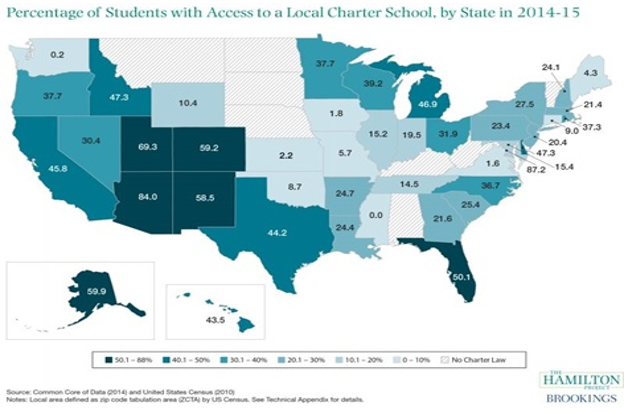
The map shows the percentage of students in each state with one or more charter schools operating in their ZIP code. Even before the 2015 reforms that Chu noted led to 100 Ohio charter schools eventually closing, the state’s charter school sector operated in fewer than one-third of all Ohio ZIP codes.
This was according to the initial design of the Ohio charter statute. Until a recent change in statute supported by both Fordham and yours truly effectively prevented charter schools outside urban areas.
The Stanford Educational Opportunity Project has compiled academic achievement data on schools from around the nation by linking state exams. This chart shows the average rate of academic growth by school for Ohio charter schools, 2008-2018.
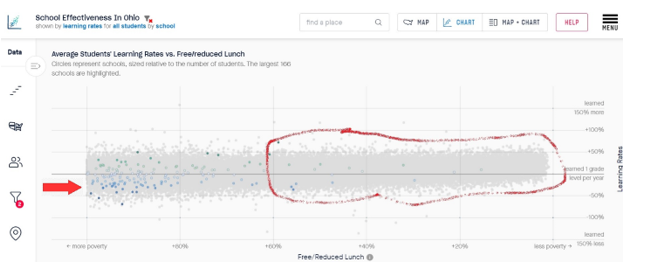 Figure 1: Average Academic Growth Rates for Ohio Charter Schools, 2008-2018 (Source: Stanford Educational Opportunity Project)
Two things to note: First, the circle. Ohio has very few charter schools with either median or low levels of student poverty. The lack of schools in the red circle constitutes further confirmation of the heavily geographically segregated nature of Ohio’s charter school sector seen in the Brookings map.
Second, note the red arrow. Ohio had a large number of high-poverty charter schools with low levels of average academic growth (blue dots below the “learned 1 grade level per year” line. This is disturbing. It means the already large achievement gaps grew in these schools over time.
Finally, take note of the blue-to-green dot ratio: High grow schools do not outnumber schools with low levels of growth.
Now, let’s compare Ohio’s geographically segregated charter sector to the nation’s most geographically inclusive charter sector in Arizona. As shown in the Brookings map, 84% of Arizona students had one or more charter schools operating in their ZIP code.
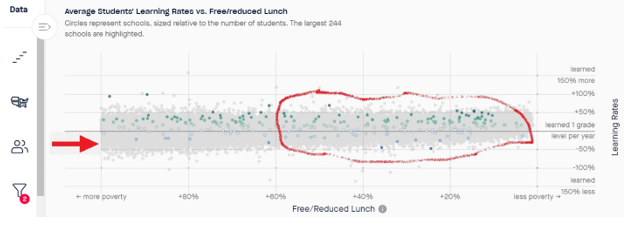
Figure 2: Average Academic Growth Rates for Arizona Charter Schools, 2008-2018 (Source: Stanford Educational Opportunity Project)
Look again in the red circle. Lots of charter schools and lots of charter schools with high levels of academic growth.
Next, let’s examine the high poverty area of the chart near the red arrow: very few low-growth schools.
Finally, notice the total ratio of green-colored schools to blue-colored schools in the entire chart. Arizona has high growth schools across the entire sector, relatively few low-growth schools.
Data from the National Alliance for Public Charter Schools reveal that Arizona has a larger absolute number of urban charter schools than Ohio. How did the state avoid a large number of low-growth schools-urban or otherwise? Closures, but largely not of the administrative variety.
The Arizona State Board for Charter Schools listed 106 charter school closures between 2010 and 2014 and the reasons for the closures, a few more than the 100 closed in Ohio since 2015. The board describes a wide variety of reasons for closures including lack of enrollment, loss of a facility, merger with another charter, etc. The explanations are broad enough to require interpretation, but approximately 16 of the school closures involve a clear administrative action by the board to either close or merge.
Arizona charter schools that closed between 2000 and 2013 had an average tenure of operation of four years and an average of 62 students enrolled in the final year of operation for closed Arizona charters. Arizona law grants 15-year charters, but the competitive environment in Arizona closes charters early and often.
Why does Ohio have so many low-growth charter schools? I believe that this map from the Fordham Institute explains much of the difference between Ohio and Arizona:
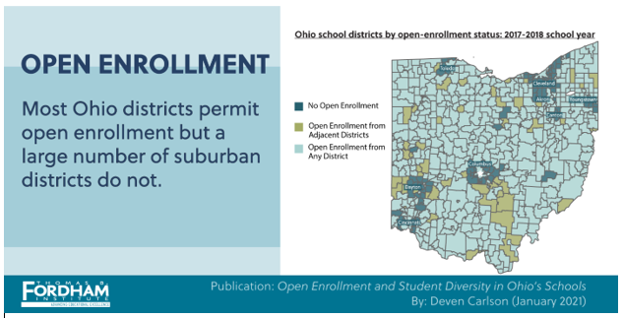
Notice that not every suburban district in Ohio participates in open enrollment. Notice also the sickly, green-colored districts that only participate in open enrollment with adjacent districts. One can’t help but wonder just which students they might be trying to avoid.
My theory is as follows. Low-growth urban charter schools survived in Ohio but quickly closed in Arizona because Arizona students have lots of other options. Nearly all Arizona school districts participate in open enrollment. This includes relatively affluent districts like Scottdale Unified, which brings in over one-quarter of its total enrollment from outside the district’s boundaries.
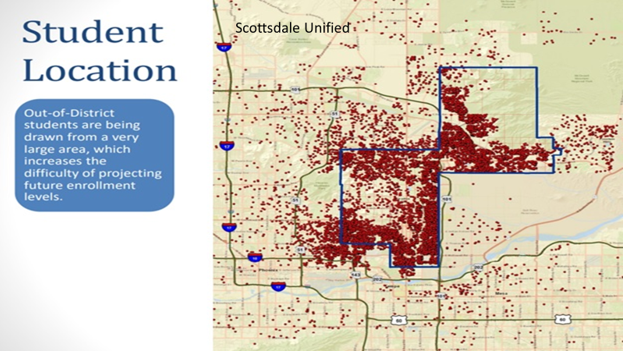
Scottsdale Unified enrolls approximately 20,000 students, with 4,500 students coming to the district through open enrollment. The 9,000 students who live within the boundaries of Scottsdale Unified who attend schools in charters, other districts, private schools, etc., doubtlessly play a large role in making open-enrollment opportunities available. Suburban districts in Arizona prefer to participate in open enrollment rather than close campuses.
Arizona’s suburban charter schools opened suburban districts to open enrollment, leading to closure of low-demand charter schools. This virtuous cycle does not have the chance of occurring in charter sectors constrained exclusively to urban areas.
Wisely, Ohio lawmakers recently expanded choice options by removing geographic restrictions on charters and expanding private choice options. The limitations of Ohio’s charter sector thus seem to owe more to poor central planning than to “wild west” liberality.
Author and podcast host Steven Berlin wrote: “The strange and beautiful truth about the adjacent possible is that its boundaries grow as you explore them. Each new combination opens up the possibility of new combinations.”
Arizona’s experience shows that choice programs, far from being siloed, interact with each other out in the field. Allowing families and teachers to shape the K-12 space is a much better idea than leaving it to state officials and is the best solution to the elimination of low-performing schools of any sort: more options.
Embracing liberality takes humility and wisdom, but without it, choice sectors quickly hit a low ceiling in serving the interests of the poor.
Ohio’s charter failure, by my way of thinking lies in central planning. The goal ought not be to replace bad central planning with better central planning. Rather, the goal should be to create a fully inclusive and demand-driven system of education that allows educators and families to act as the hands of a potter at a wheel, molding the K-12 space over time to create the types of schools educators want to run – and that families want to support.
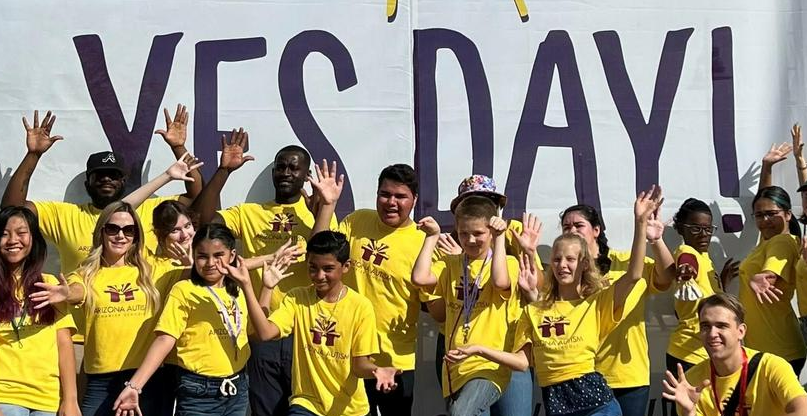
Arizona Autism Charter School in Phoenix is the first and only tuition-free, public charter school in the state focused on the educational needs of children with autism. Serving families on two campuses, the school has been recognized nationally for excellence and innovation, winning the prestigious Yass Prize in 2022.
Editor’s note: This commentary from Nina Rees, president & CEO of the National Alliance for Public Charter Schools, appeared Sunday on the74million.org to mark Teacher Appreciation Week, which coincides this year with National Charter Schools Week.
Remember the teacher who made a difference in your life? For me, that was Mrs. Campbell, my AP French teacher.
As an immigrant for whom English was not a first language, Mrs. Campbell offered me a chance to excel while my other classes were more daunting. Her class was also where I felt most at ease and supported. Mrs. Campbell found ways to shine a positive light on me in this large, rural high school, and when it came time to apply to college, she was the advocate who reached out to the admissions office to ensure my application got serious consideration.
Today, more than 35 years (yikes!) after I sat in her classroom, Mrs. Campbell continues to inspire me. I’ve dedicated my career to improving education policy. I wake up every day working to make public education better, not just for students and families, but for teachers like Mrs. Campbell who know that offering options helps all families.
I’m thrilled that National Charter Schools Week coincides with Teacher Appreciation Week this year, because charter schools are powered by teachers and other visionary educators who make a huge difference in the lives of more than 3.7 million students — two-thirds of whom are from low-income, Black, or Latino communities.
Teacher quality is the single biggest in-school factor in determining student success. There’s lots of fluffy talk about how important teachers are, but most of the time they are treated like identical cogs in a wheel. Charter schools do it differently.
Public charters offer an environment that encourages teachers to flourish, treats them like professionals and rewards their excellence through competitive pay and advancement opportunities. This allows them to chart their own course, whether it’s dedicating themselves to the classroom, moving into leadership roles or opening their own schools.
Charter schools also rely on teachers’ judgment about what works for students and what doesn’t, providing the flexibility to adapt curriculum and instruction as needed.
One of the key reasons charter schools were created was to give educators the freedom to test new ways of teaching. It’s also one of the reasons the late Albert Shanker, leader of the American Federation of Teachers, supported charter schools. Even Randi Weingarten, president of the AFT, is a charter school founder.
Today, the sector boasts more than 206,000 teachers — and the National Alliance of Public Charter Schools is especially proud that these educators reflect the diversity of the students they teach. The most recently available data (2020-21 school year) show that 69.3% of charter school students were children of color, compared with 53.4% of district students.
To continue reading, click here.

Pennsylvania Cyber Charter School, headquartered in Midland, Pennsylvania, is one of the largest and most successful online public schools in the nation, offering personalized instruction for students in kindergarten through 12th grade.
Editor’s note: This analysis of school choice trends in 2002 appeared Monday on theanswertampa.com.
More parents overwhelmingly chose school choice in 2022 after expressing frustration with lockdown policies, school boards and mandates. As more state legislators look to expand school choice policies in 2023, Florida is seen as a model to follow, according to several reports and polls taken throughout the year.
In 2022, the majority of parents surveyed in a major study said they wanted other options for their children’s education other than the public school districts their children were zoned to attend.
In "Never Going Back: An Analysis of Parent Sentiment on Education," the National Alliance for Public Charter Schools surveyed more than 5,000 parents to learn more about the reasons why they increasingly chose different educational options after the 2020-21 school year.
According to the survey, 93% of parents surveyed said one size doesn’t fit all in education. More than 25% said they switched the type of school their children attended; 86% said they want different options for their children to attend a school other than in the district where they are zoned or assigned to attend.
Among parents who switched schools, charter schools were a popular choice. Roughly three in four parents surveyed said they want more public charter school offerings in their area.
Nearly 90% of parents surveyed said after switching school types, they or their children experienced a positive change as a result of the switch; 57% said their children were happier.
Roughly 83% of parents said education had become a more important political issue in 2022 than it was in the past. Nearly as many, 82%, said they were willing to vote outside of their party when it comes to educational issues.
The 2022 report followed a 2021 report, “Voting with Their Feet: A State-level Analysis of Public Charter School and District Public School Enrollment Trends,” which found that at least 1.4 million students left their district schools during state lockdowns in the 2020-2021 school year. The report, which analyzed data from 42 state educational agencies, also found that nearly 240,000 new students enrolled in public charter schools during the same period.
To continue reading, click here.
Imagine School at Broward is a tuition-free public charter school in Coral Springs, Florida, one of 712 charter schools in the state serving about 360,000 students. Imagine Schools is a national non-profit network of 51 schools in seven states and the District of Columbia.
A new report from the National Alliance for Public Charter Schools reveals three key takeaways, updating its 2021 charter school enrollment report, “Voting With Their Feet.”
Titled “Changing Course: Public School Enrollment Shifts During the Pandemic,” the report is an analysis of student enrollment trends in public schools during the pandemic (2019-20 to 2021-22 school years).
The numbers show that more than 240,000 students enrolled in charter schools, a 7% increase—while district public schools lost approximately 1.5 million students—nearly a 3.5% decrease.
The report also examines population shifts and enrollment trends for white, Black, and Hispanic students and indicates an increase in white, Black, and Hispanic enrollment in public charter schools. Overall, public charter school enrollment outpaced state population shifts in the majority of the states examined.
The new report logically builds on last year’s report, which showed public schools nationwide lost nearly 1.5 million students (a decline of 3.5%) while charter schools gained 237,311 students (an increase of 7%). According to the update, those new charter school students didn’t return.
For the new report, the Alliance obtained robust and reliable subpopulation data for White, Black, and Hispanic students in 25 of the 41 states in its analysis, looking at two questions: Did enrollment increase for the subpopulation of students? And did the subpopulation’s enrollment trend outperform or underperform the state’s enrollment trend by type of public school?
A Harris Poll commissioned by the Alliance may explain why: “Eighty-nine percent of parents whose children have switched school types report that they or their child experienced a positive change as a result of the switch.”
The most likely positive experience, as explained by the poll, was that students were happier at their new school (57% of respondents).
The poll also found that 9% of parents agreed that “one size doesn’t fit all in education,” and that 86% of parents wanted options outside the district school their child is zoned to attend.
According to the latest data, Florida public charter school enrollment rose from 329,219 in 2019-20 to 341,926 in 2020-21, an increase of 3.7%. Meanwhile, enrollment in non-charter Florida public schools fell from 2,529,733 in 2019-20 to 2,449,761 in 2020-21, a 3.16% decrease.

Editor’s note: This commentary appeared Monday on nypost.com.
US public-school enrollment fell 3.5% during the two pandemic years — about 1.5 million students — while public charter school rolls jumped 7%, a new report notes. Families are voting with their feet, and if they can’t choose charters they’re leaving public education altogether.
The study commissioned by the National Alliance for Public Charter Schools covers the 39 of the 41 states with public charter schools; enrollment rose a total of 240,000 kids, though total US charter rolls are only 3.6 million.
For the 25 states with adequate racial-breakdown data, regular public schools lost 920,000 white, 140,000 Hispanic and 178,000 black students. The number of black kids in charters rose by more than 34,000, Hispanics by 96,000 and whites by about 30,000.
Many white families, presumably with more resources, apparently opted to pay for private or Catholic schools or to do home-schooling — as did some minority families. But it’s obvious that charters kept families of all races in public education.
This puts the lie to the claim that charters kill public education: Rather, they’re its salvation unless and until regular public schools shape up — if the unions and other vested interests will let them.
In New York City and state, charter schools are measurably better than nearby traditional public schools. Students in NYC charter schools that were approved by the State University of New York vastly outperformed traditional public schools on the state’s English and math exams. (That, presumably is why teacher-union allies like Bronx Assemblyman Michael Benedetto want to strip SUNY of its authority to approve charter schools.)
To continue reading, click here.
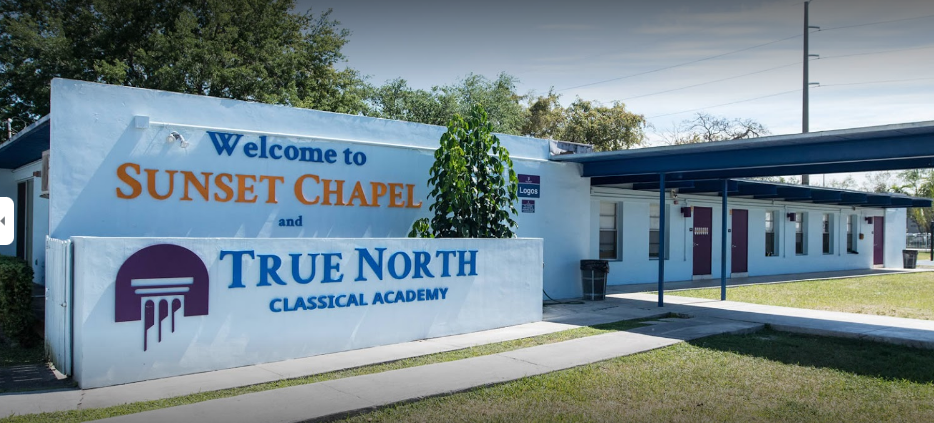
True North Classical Academy in Miami is ranked No. 14 in the state for elementary schools and No. 29 for middle schools by U.S. News & World Report. Ninety-five percent of students score at or above proficient in math and 92% score at or above proficient in reading.
Editor’s note: This post reflects the content of a news release issued by the National Alliance for Public Charter Schools.
In a new report from the National Alliance for Public Charter Schools and The Harris Poll released Wednesday, parents reveal that they want more and better school options with 93% believing that one-size education doesn’t fit all and 86% wanting options for their children other than the district-run school they are assigned to attend.
This is something Florida school choice advocates already know. In the sunshine state, enrollment in education choice programs, including charter schools, has steadily increased over the last two decades.
Enrollment in public charter schools has continually risen since their inception in 1996. The schools now serve more than 11% of the public school student population. An estimated 47% of PreK-12 students attended a school of their choice during the 2017-18 school year.
The poll gathered feedback from parents of school-age children across the U.S. and found that:
“Parents are a powerful voting bloc in our country, and those currently serving or seeking political office would do well to listen to them,” said Nina Rees, president and CEO of the National Alliance for Public Charter Schools.
“This report shows education has increased dramatically in importance as a voting issue to parents. Education has often taken a back seat as a priority issue in elections, but it appears this is no longer the case, and rightfully so.”
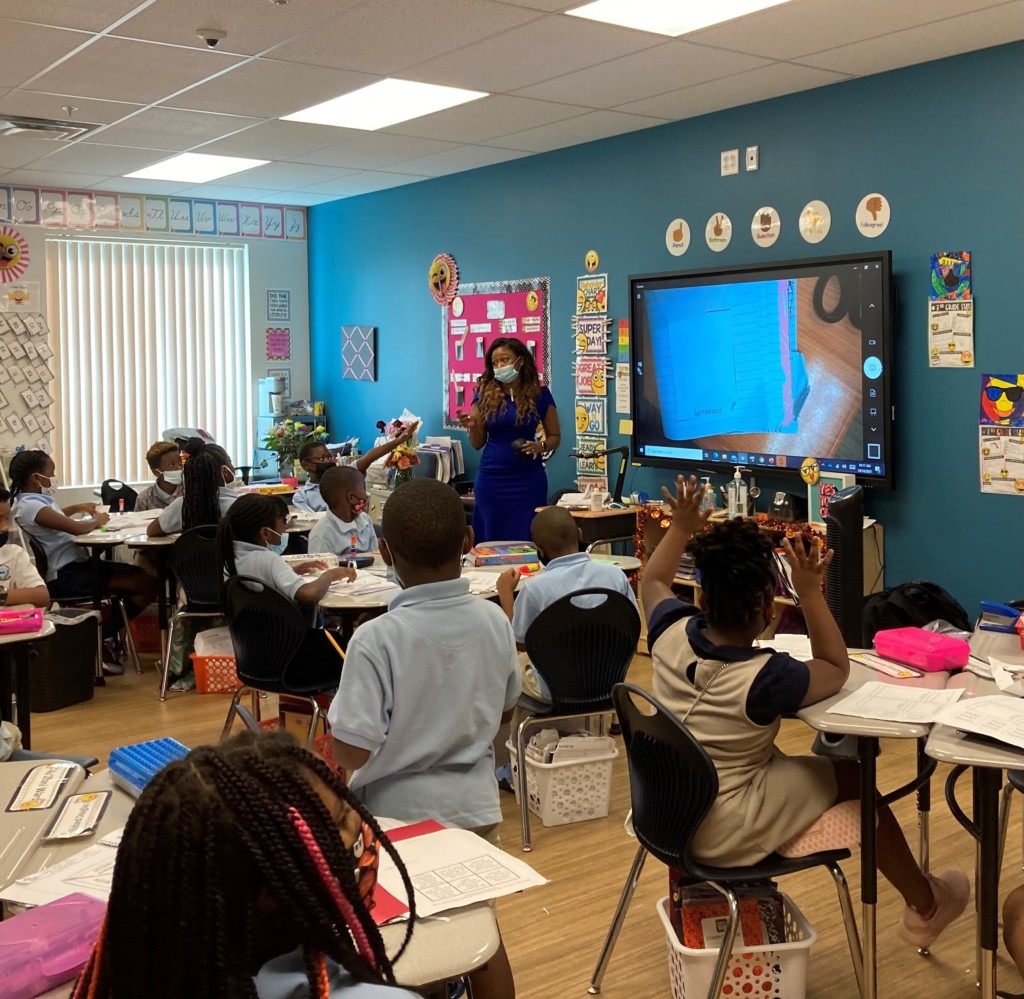
Third-grade teacher Ashley Clarke leads her class at Somerset Academy Eagle Campus in Jacksonville, Florida, which has as its focus academic excellence, leadership development, personal responsibility, community involvement and character.
Editor’s note: This commentary from Nina Rees, president and CEO of the National Alliance for Public Charter Schools, appeared today on the74million.org.
A parent-led rally today in Washington, D.C., is putting the charter school movement’s energy and passion on full display as supporters band together to fight for their schools and for every student’s right to a high-quality education.
The event is happening during National Charter Schools Week, an annual celebration of charter schools and the students, teachers, leaders, families, advocates and supporters who bring power and purpose to the movement.
This year’s National Charter Schools Week theme is Charter Schools Rising, and the evidence for their rise is everywhere. Demand for charter schools has never been higher, and support is strong in all quarters. It’s true that charter schools have faced significant challenges on the federal policy front — from threatened funding cuts to proposed Charter Schools Program rules that would limit educational opportunities — but each challenge offers the opportunity to show how formidable and united the movement is.
We have fended off funding cuts and organized a massive campaign to protect the rule changes. Last week, a bipartisan group of senators added their voices to the chorus calling on the U.S. Department of Education to back off its proposed changes to the Charter School Program. The department has also heard from governors, state school chiefs, educators and parents who know firsthand that charter schools are vital to educational opportunity and equity.
Today’s rally will keep that momentum going.
This week also offers the opportunity to honor and thank the 2022 Charter School Changemakers — some of the most inspiring advocates and community leaders in the movement — and the 2022 Champions for Charter Schools, federal and state policymakers who are blazing a path of opportunity for students across America.
To continue reading, click here.
 Editor’s note: This commentary from Nina Rees, president and CEO of the National Alliance for Public Charter Schools, appeared Tuesday on USA Today.
Schools are often regarded as the center of our society, and never has that been more true than now.
Issues of health, safety, social justice, economics and infrastructure intersect at the schoolhouse door. With so many different perspectives, who should we listen to? I say we should listen to parents.
Parents living through the COVID-19 pandemic got an unexpected crash course in navigating the complex world of K-12 education. And they are quick learners.
For many who saw their children wrestling with technology, disengaged or falling behind at home while their schools struggled to engage them in learning, there came an especially important lesson: There is another way.
By the hundreds of thousands, families made the decision last school year to enroll their children in charter schools – public schools that had the flexibility to adapt quickly during the crisis. Across the country, charter schools rapidly met children’s and families’ needs through remote learning, adapted curriculum, individual family outreach, even food and internet security.
A report by the National Alliance for Public Charter Schools found charter school enrollment increased across the country as district public school enrollment decreased. Across 42 states, charter schools gained nearly 240,000 students, a 7% increase from the previous school year to 2020-21. Other public schools, including district-run schools, lost more than 1.4 million students, a 3.3% decrease from the previous school year.
A pandemic anomaly, skeptics might say. Not so. Parents have been trying to tell us all along.
To continue reading, click here.

