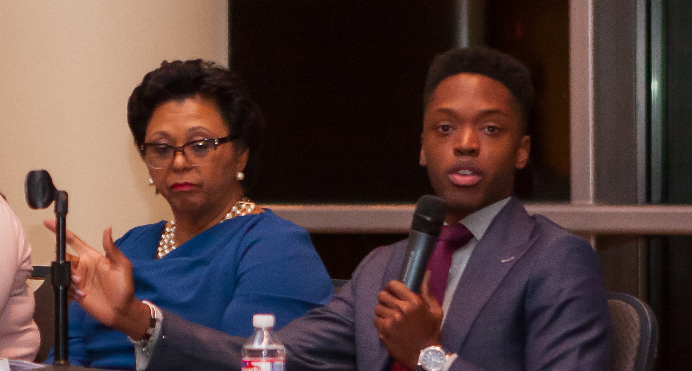
Walter Blanks, right, press secretary for the American Federation for Children, has been honing his education choice advocacy skills for several years after participating as a member of the federation’s first Future Leaders Fellowship Program.
Isabella Paez has always embraced advocacy. The whip-smart Florida 15-year-old is proud of her Cuban-American heritage and is active in school clubs that promote business ethics and social justice.
A lover of literature, her favorite book is “The Hate U Give,” the 2017 New York Times bestseller by Angie Thomas inspired by the Black Lives Matter movement.
“It offers a really cool perspective on life outside my own community and my own heritage,” said Paez, who lives in the Miami area and attends Mater Academy, a Title I college prep charter school for middle and high school students in Hialeah Gardens.
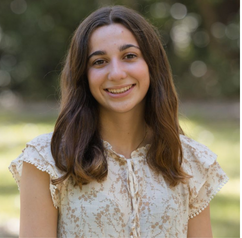
Isabella Paez
Paez, who has wanted to become an international human rights lawyer since she was in third grade, also loves studying history.
“I really enjoy learning about the past and what we learn moving forward,” she said.
Her interests and accomplishments made the Mater Academy sophomore a perfect fit for membership in the National Alliance of Public Charter Schools inaugural Rising Leaders program. The first cohort includes 10 students from across the Unites States who were chosen from among more than 100 applicants.
The charter school advocacy group founded the program to develop students’ leadership and advocacy skills with training from policy professionals. It is one of several youth advocacy groups that have been formed as national education choice groups see the value of using students to promote their message of letting families choose the best educational fit for their children.
(Step Up For Students, which hosts this blog, has an alumni network that is open to scholarship recipients who want to advocate for the program after completing high school.)
“These 10 young leaders represent our country’s future,” said Nina Rees, CEO and president of the National Alliance for Public Charter Schools. “Education by its very nature is quintessentially a student’s experience. It is only fitting that students should be the voice of education advocacy. We are grateful to be able to connect with them, teach them, and learn from them, and we can’t wait to see the change they will create in the decades to come.”
Each cohort will serve actively for one year and then mentor its successors. Students will have the opportunity to apply what they’ve learned by launching advocacy clubs in their schools to help address education issues in their communities, speaking on panels and at events to promote student voices and participating in education policy discourse.
The Rising Leaders curriculum includes training in civics, advocacy, and leadership. Guest lecturers include former U.S. Rep. Carlos Curbelo, who served two terms representing District 26 in South Florida; recipients of the 30 under 30 Changemakers Award; and senior leadership at the National Alliance for Public Charter Schools.
Membership in a student group teaches students to share their personal stories to raise awareness among families and makes a powerful case for education choice to public policy shapers.
“The whole idea at the core of the movement was to benefit students, and there weren’t any spaces for young people to talk about their experience,” said Walter Blanks Jr., press secretary for the American Federation for Children and a member of the first cohort in its Future Leaders Fellowship Program.
The alumni group began in 2018 to identify and train college students who benefited from education choice scholarships as advocates. The federation plans to start a similar group for high school scholarship students in 2023.
“AFC thought there were no better people to advocate and speak on this issue than the ones who have directly benefited from what I call ‘school choice policy boot camp,’” said Blanks, whose participation helped launch his career as an education choice advocate.
The training involves teaching members how to share their stories and how to engage with lawmakers so they can be “put in a room with the people making these policies,” Blanks said.
Members also travel and meet with national leaders such as former U.S. Education Secretary Betsy DeVos and former U.S. Secretary of State Condoleezza Rice. Blanks said hearing directly from students is a powerful weapon against opponents of education choice, who almost always are adults.
Blanks knows first-hand that this is true. He shared his personal story as a bill was under consideration before a legislative committee in his native Ohio. The next speaker, a teachers’ union representative, argued against the bill, saying education choice doesn’t work.
“The chairman said, ‘How can you say it doesn’t work after hearing Walter’s story?’” Blanks recalled.
In addition to providing powerful advocacy, the program also helps groups with succession planning by adding young voices to the mix.
“You look at the education reform space and it’s mostly made up of analysts and data wonks, but these people have been in the movement a long time,” Blanks said, noting that the first education choice program, which began in Milwaukee, is now three decades old.
Leaders at the National Alliance of Public Charter School agree.
“For the future of public education to be strengthened in a way that is sustainable and meaningful for students, it’s important to have student voices be part of future policy,” said Sindy Pierre-Noel, director of programs for the alliance.
“We have a politically and socially engaged generation that has great ideas for the future. We need these student leaders to continue their work into their adult life and continue to grow and improve the public education sector, especially charter schools, with a perspective from their lived experience.”
Paez, the Miami-area teen who recently underwent media training with the group, can’t wait to get started.
“I realize education does impact every single student, and having that choice and opportunity is super important, and that really is why I’m really excited about this program.”
She is scheduled to speak at her first gala in a few weeks.
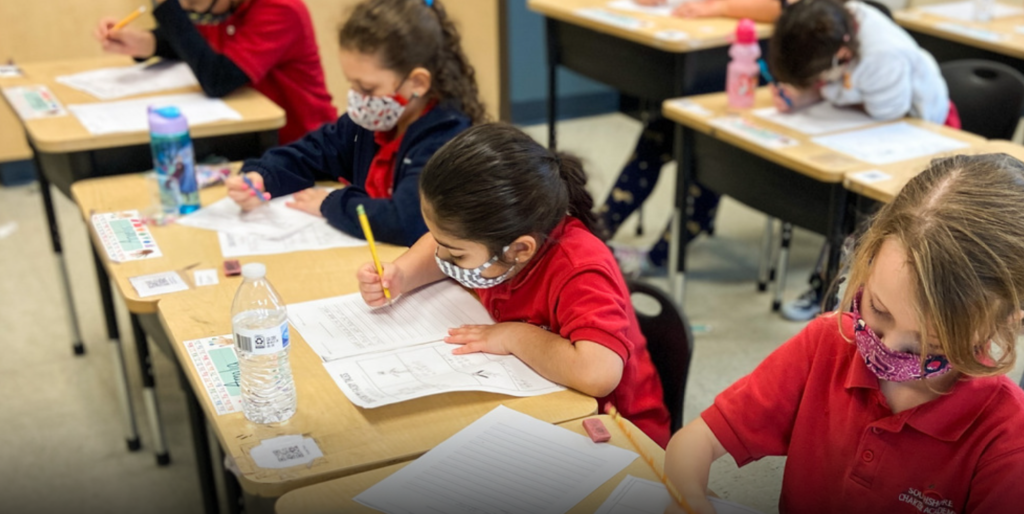
SouthShore Charter Academy is a tuition-free public charter school in Hillsborough County, Florida, for students in kindergarten through eighth grade, governed by the Florida Charter Educational Foundation. Among its features are personalized learning plans for each student with periodic assessments to determine how he or she learns best.
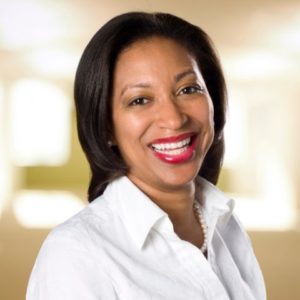
Debbie Veney
Debbie Veney already had earned a journalism degree from Howard University when the nation’s first public charter school, City Academy Charter School in St. Paul, Minnesota, opened its doors nearly 30 years ago. She enjoyed the benefits of education choice by attending a Catholic school.
“It was small and very student focused,” recalled Veney, who grew up in Washington, D.C. “It was a predominantly Black school, and it was a really interesting experience for me to be in a private school setting that was culturally affirming and academically rigorous.”
Today, Veney is senior vice president of communications for the National Alliance of Public Charter Schools, the largest nonprofit advocacy group specifically dedicated to supporting charter schools, which are funded with public dollars but are privately managed. Unlike private schools, charter schools do not charge tuition.
Based in the nation’s capital, the alliance works to educate lawmakers and thought leaders about how charter schools can meet the needs of the communities they serve by providing families with public school options.
It also advocates for legislation that will advance the charter school movement. As host of the annual National Charter Schools Conference, the alliance brings together educators, leaders, lawyers, researchers and policy experts.
Veney was the mastermind behind the organization’s recent study that showed charter schools experienced their greatest enrollment boost in six years during the 2020-21 school year, even as traditional district schools saw declines.
She had seen local stories in January about the growth of charter schools and shrinkage in district schools in different parts of the country and “was curious about whether there was really a significant pattern here or whether these were one-offs.”
The study, which covered 42 states, showed charter schools gained nearly 240,000 students – a 7% increase – from 2019-20 to 2020-21. Other public schools, including district-run schools, lost more than 1.4 million students, a 3% loss, during the same period.
“We became a very popular option for a lot of parents, and what was really interesting to me was that you could see this pattern of where there was any capacity at all, parents maximized that opportunity and grabbed as many seats as they could.”
As district campuses in many areas stayed shuttered, many charters remained open for in-person learning, prompting parents who may have been dissatisfied with their district’s remote learning program the prior spring to seek alternatives.
Though Florida kept its district campuses open, the trend of charter school growth over district schools still held.
Veney speculated that could have been because parents got “an up close and personal” look at what districts were teaching during the spring 2020 quarantine and wanted something different.
“Even with schools that didn’t close, it was as if there was this window of time where people rethought a lot of stuff,” she said. “I figured out some things that I would have never figured out if there hadn’t been a pandemic.
“I think there was a lot of word of mouth that went on. I saw parents who left ‘A’ rated schools because they wanted a different type of experience.”
Veney said the study turned up a few surprises, namely that several states reported decreases in charter school enrollment, albeit extremely modest, such 9 fewer children in Iowa and 22 fewer in Wyoming.
The largest decline was in Illinois, where charters lost 702 students, a decrease of 1.1 % over the previous year. But traditional district schools in that state lost 66,806 students, a decline of more than 3.5%.
“Some of it may have simply been a factor of students (who) graduated,” she said. “And a lot of parents didn’t enroll their children in kindergarten.”
She also pointed out that the Census reported an explosion in homeschooling, which parents who may have been unemployed or working from home decided to try.
Veney, who counts among the most significant trends she has witnessed the rise of national networks that are able deliver “amazing” results, said she foresees a new wave of parental involvement even as the pandemic panic fades into memory.
“Looking ahead, I see parents are really going to be more vocal about what they want for their kids,” she said. “I’m seeing more parents being more directive now, realizing they have the voice to do that.”
She also predicts more grassroots involvement in the charter movement as opposed to operators from distant places starting schools.
“I think we are going to see a lot more people who are from that community using their voices and becoming advocates,” she said. “I don’t think we can go back to pre-pandemic times.”
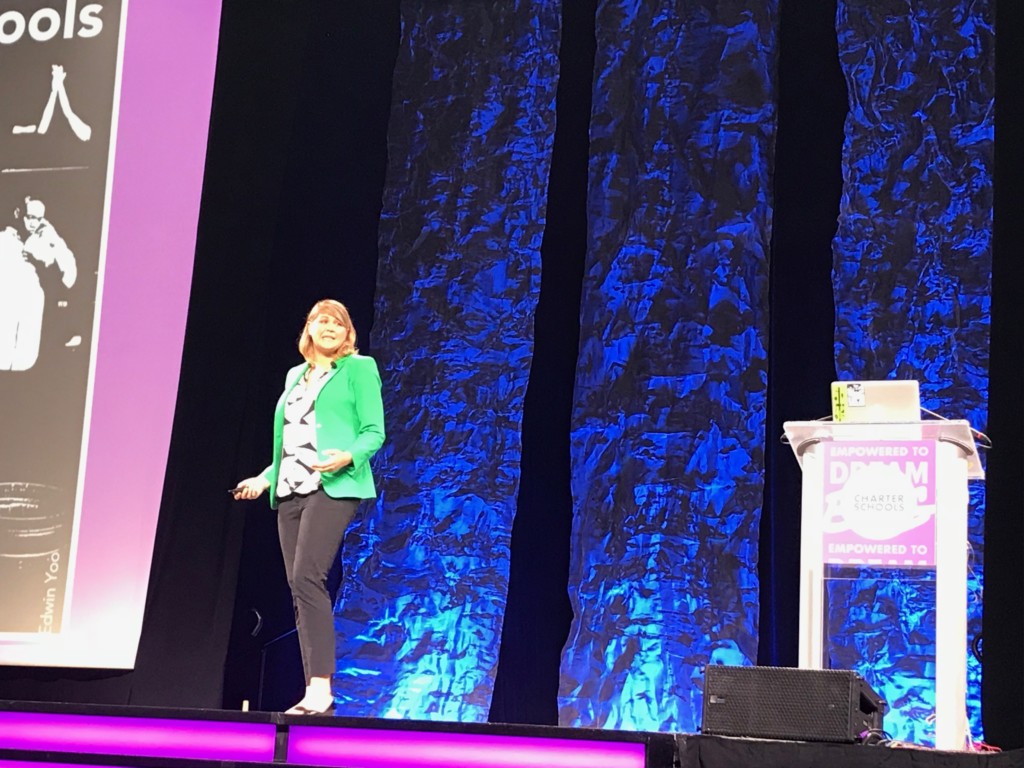
Sydney Chaffee, 2017 National Teacher of the Year, spoke about the importance of empowering students to become active and engaged citizens.
AUSTIN, Tex. - Sydney Chaffee has taught her students about apartheid in South Africa.
But students simply do not take notes and answer questions.
They probe deep questions about morality and justice.
“My students draw comparisons between South African kids’ activities and their own power and promise as young people," said Chaffee, the 2017 National Teacher of the Year. “They debate whether they would be willing to risk their lives to ensure future generations can live in a more just world.”
Chaffee, a humanities teacher at Codman Academy Charter Public School in Boston, was one of the main speakers at the closing session of the National Alliance of Public Charter Schools Wednesday. (more…)

