By Lauren May and Ron Matus
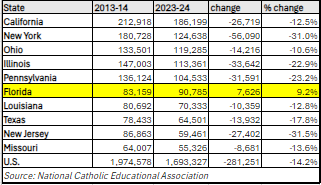
Florida continues to be a standout in Catholic school growth. But the latest national data from the National Catholic Educational Association, released Tuesday, shows other states with expansive new school choice programs are gaining steam.
In fact, Florida is no longer the only state in the Top 10 states for Catholic school enrollment to show a net gain over the past decade. This year it’s joined by Indiana. The Hoosier State is now in the plus column thanks to this year’s jump of nearly 4,000 students.
(Indiana, by the way, replaced Missouri in the Top 10. Missouri’s enrollment has been relatively stable for the past five years, but it dipped just enough for Indiana to pull ahead.)
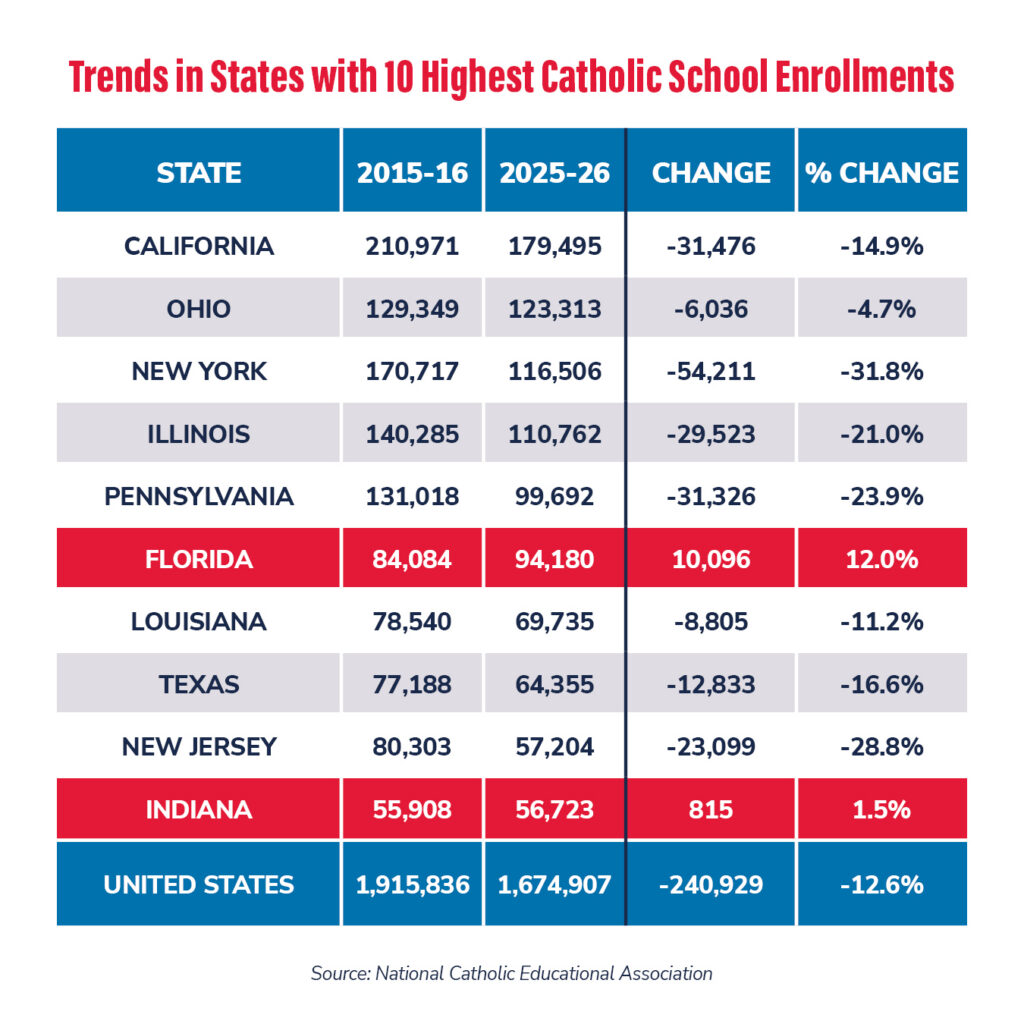
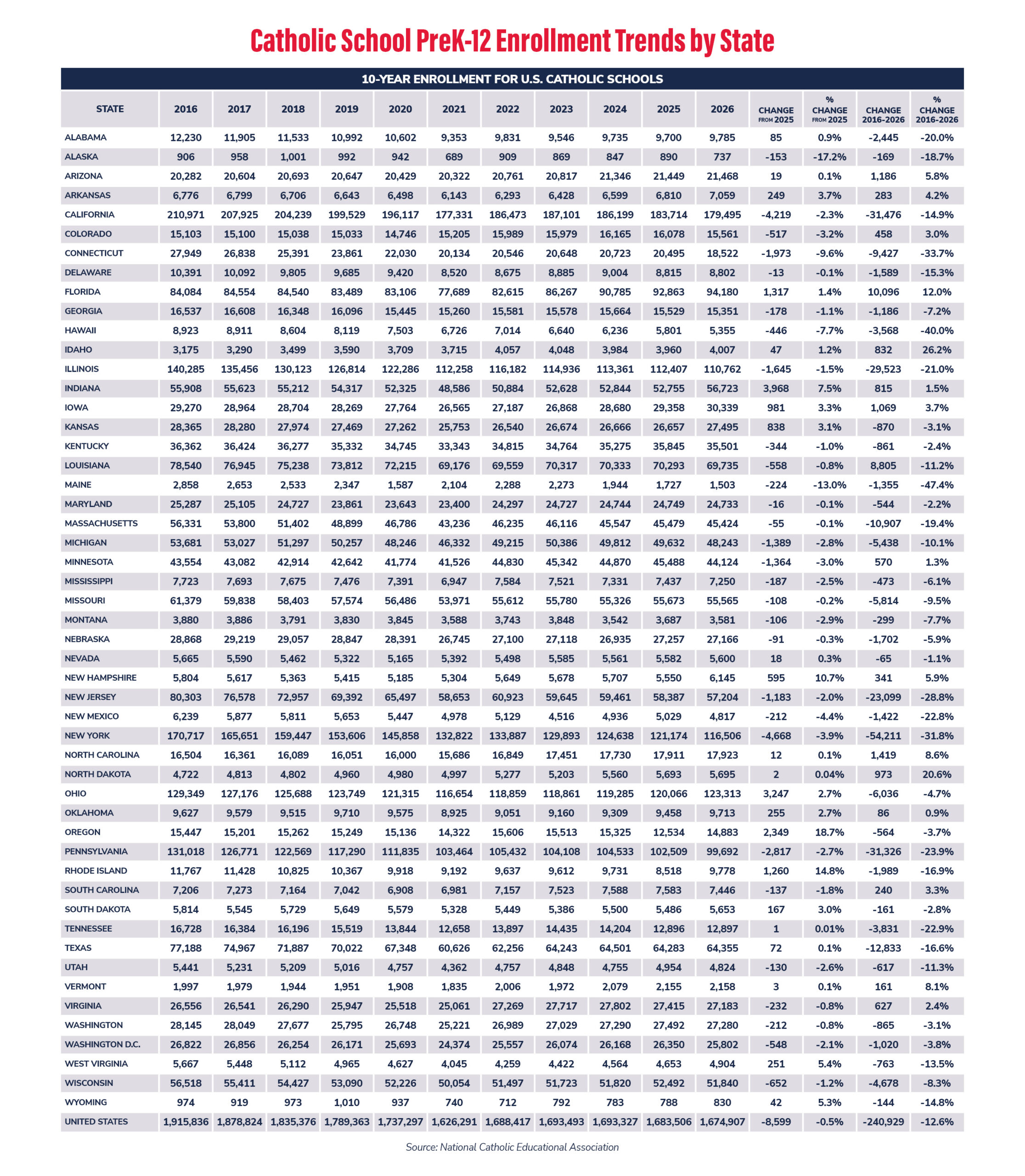
No state had a bigger one-year increase than Indiana, the new report shows. Plenty of others, though, are seeing significant growth, including Ohio, Iowa, and New Hampshire, all states with choice programs that encompass universal eligibility.
Check out the data for yourself in the chart we put together at the bottom of this post. It includes the NCEA’s year-by-year numbers for all 50 states, going back a decade.
The report isn’t just good news for individual states. Nationally, enrollment stayed pretty steady for a fifth straight year. After decades of falling numbers, that’s encouraging – and supporters of Catholic education, and education pluralism more broadly, should feel the wind at their backs.
Meanwhile, don’t forget about Florida just yet.
Catholic school enrollment down here is up 12% over the past decade, while total K-12 growth ran about 10% over that span.
The Sunshine State’s been the outlier for years, buoyed by the most robust school choice programs in America. It’s for that reason that we issued a special report, “Why Catholic Schools in Florida Are Growing: 5 Things to Know,” in 2023, and followed it up with update briefs in 2024 and 2025.
Stay tuned for the 2026 update soon.
About the authors
Lauren May is Vice President and Head of the Federal Scholarship Tax Credit Program at Step Up For Students and a former Senior Director of Advocacy at Step Up For Students. As a proud graduate of the University of Florida, she received her bachelor’s degree in special education and her master's degree in early childhood education. She then completed another master's degree in educational leadership from Saint Leo University. A former Catholic school teacher, early childhood director, and principal, she was honored with the University of Florida’s “Outstanding Young Alumni” award in 2018. As a believer
that parents are the first and best educators of their children, Lauren loves working with families across the state and beyond to ensure they can find and make use of the best educational options for their children.
Ron Matus is Director, Research & Special Projects, at Step Up For Students. He earned a bachelor's degree in history and English/creative writing from Florida State University and a master's degree in Florida Studies from the University of South Florida. He joined Step Up in 2012 after more than 20 years as an award-winning journalist, including eight years as the state education reporter for the Tampa Bay Times, the state’s biggest and most influential newspaper.
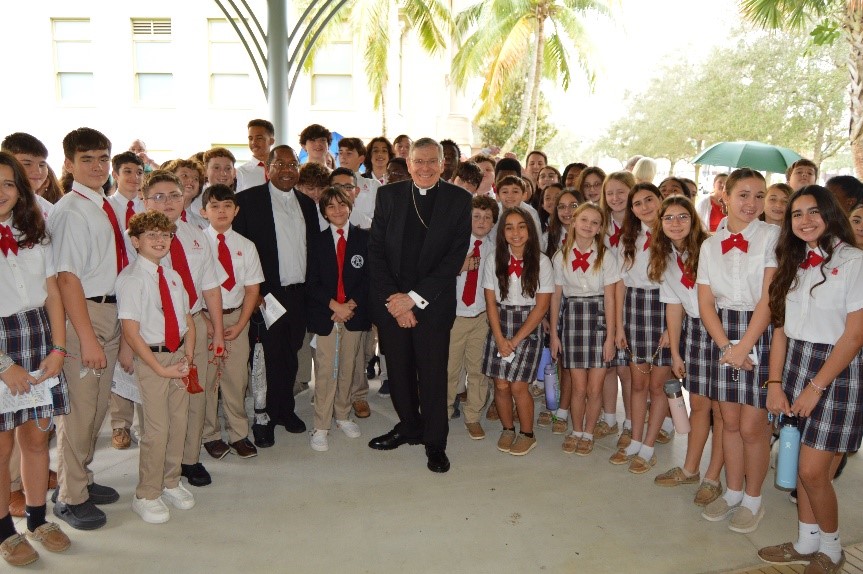
Bishop Barbarito of the Diocese of Palm Beach poses with Reverand Delvard, pastor and students from St. Ann Catholic School in West Palm Beach.
By Ron Matus and Lauren May
The latest national and state-by-state Catholic school enrollment numbers are out – and they amplify the contrast between what’s happening in Florida and most of the rest of America.
Bishop Barbarito of the Diocese of Palm Beach poses with Reverand Delvard, pastor and students from St. Ann Catholic School in West Palm Beach.
Nationally, Catholic school enrollment in PreK-12 held steady, according to the latest annual report from the National Catholic Educational Association, released Wednesday. In 2023-24, 1,693,327 students were enrolled in Catholic schools, virtually the same number as the prior year. (Officially, the 2022-23 number was 1,693,493.)
In Florida, enrollment climbed to 90,785, up 5.2% from the prior year.
The NCEA figures for Florida are slightly different than the numbers NextSteps reported in January. That report was based on enrollment figures from the Florida Conference of Catholic Bishops, which includes a broader group of preschool students in its count.
Either way, Florida continues to be an encouraging outlier.
Last August, Step Up For Students published “Why Catholic Schools In Florida Are Growing: 5 Things To Know,” which took a closer look at the Florida numbers and some of the factors behind them.
At that time, Florida was the only state in the Top 10 for Catholic school enrollment to see growth over the past decade – 4.4%. The latest figures show that’s still the case, but strong gains over the past year boost the 10-year increase to 9.2%.
Clearly, Florida’s robust education choice scholarship programs are a difference maker. But it’s also true that in the most competitive educational environment in the country, Florida Catholic schools have found even more ways to stand out to families.
A number of schools have incorporated popular programming, such as IB programs and classical curriculum while keeping Catholic teaching at the core of all that they do. At the same time, some dioceses have embraced – and relentlessly deployed – cutting-edge strategies to raise parental awareness about choice scholarships.
During scholarship application season, the Diocese of Venice, which covers southwest Florida, now sends more than 1 million texts and emails about the scholarships to Catholic families. Not coincidentally, the diocese has the biggest enrollment growth of any diocese in Florida, and all 16 of its schools now have wait lists.
Nationally, Catholic school enrollment is down 14.2% over the past decade, but there are encouraging signs here, too. After a post-COVID dip, the numbers climbed for two years before stabilizing this year. Five of the Top 10 states also showed some year-over-year growth this year. (Florida, Ohio, Pennsylvania, Louisiana, and Texas).
The good news is that there is no reason for Florida to remain the outlier given the growing number of states that have adopted major if not universal choice programs in the past three years. Catholic school supporters across the nation have a golden opportunity to help their schools further flourish and grow.
Ron Matus is Director of Research and Special Projects and Lauren May is Advocacy Director at Step Up For Students, which publishes this blog and administers education choice scholarship programs in Florida.
For more than two years, administrators at Purcell Marian High School in Cincinnati have been navigating the competing pressures of new and old.
They decided the shift to blended learning could help them meet the varying needs of an increasingly diverse student body, and help their students meet a state requirement to pass four years of high school math courses. They also knew that they couldn't knock down all the walls in their 87-year-old building or upend the traditions that had drawn students to seek a Catholic education in the first place.
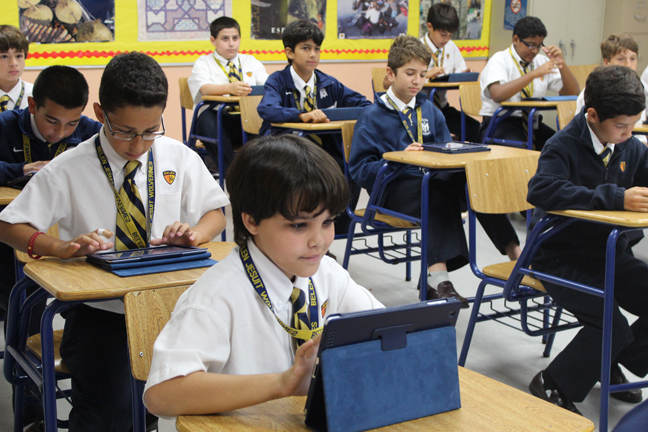
In this 2012 file photo, students at Miami's Belen Jesuit Preparatory School Pads during a Spanish class.
"We couldn't just gut the school and start over as an all-blended learning school," Jeanine Flick, the school's academic dean, told a crowded session at an Orlando conference for thousands of Catholic educators.
Instead, in 2013 the school began a gradual, subject-by-subject shift from paper textbooks to electronic ones, and from instruction led entirely by teachers to what principal Veronica Murphy described as a more "student-centered" approach, in which students work through material based on what they have mastered. It began converting one of its newer buildings into an open-plan "blended learning center."
While Catholic educators, much like their public-school counterparts, have been exploring blended learning for a few years, it's now becoming widespread, and was one of the hottest topics at the National Catholic Educational Association's annual convention last week. Sessions were often packed with teachers and administrators looking to draw lessons from schools like Purcell Marian that have already made the shift and are starting to draw lessons from it.
They've faced many of the same the same hurdles as public schools, and some unique ones. For one thing, they often lack public funding to pay for students' devices or the technology that connects them.

