 Videos have surfaced recently of starving residents of Shanghai screaming in the night a week into an incredibly misguided COVID-19 lockdown that has imprisoned Chinese citizens in their homes.
A reporter from The Economist noted that a Chinese drone flew through the area blaring a message: “Please comply with COVID restrictions. Control your soul’s desire for freedom. Do not open the window or sing.” Other videos show HAZMAT-suited soldiers beating and arresting their fellow citizens for walking outside in search of food.
Shanghai residents have made their feelings about their oppressors clear in a variety of ways.
 Decades ago, George Orwell’s account of being a British soldier in India during imperial occupation explained that he hated imperialism and his own role in it. “Feelings like these are the normal by-products of imperialism,” Orwell wrote. “Ask any Anglo-Indian official, if you can catch him off duty.”
Orwell hauntingly described the task of going through the motions and playing the role expected of him: “He wears a mask, and his face grows to fit it.”
We, of course, would never see public officials justifying entirely unconscionable policies here in the United States. Or would we?
Take a moment to read this recent news report titled, “Suburban school officials predict ‘chaos’ if Kansas lets out-of-district students transfer freely. Go ahead, click the link and read it from start to finish. I’ll wait for you to come back.
Finished already? That was fast.
Okay, so the article really jumps the shark with this quote: “We believe in neighborhood schools,” said Brett White, superintendent of Andover schools east of Wichita. “The open borders would just throw into chaos what’s an established policy.”
If you are scoring at home, the superintendent of a school district in which 75% of students are white identified as being to the east of Wichita, which is 70% non-white. In any case, Superintendent White supports “neighborhood schools,” because obviously, to do otherwise would throw an established policy into “chaos.”
One person’s “chaos” is another person’s “freedom,” but “chaos” does sound risky. Would it be best if Wichita’s families controlled their soul’s desire for freedom?
Martin Luther King Jr. was in effect asked to control his soul’s desire for freedom, and he had quite a remarkable response, written by hand in the margins of a newspaper from jail. The letter read in part:
History is the long and tragic story of the fact that privileged groups seldom give up their privileges voluntarily. Individuals may see the moral light and voluntarily give up their unjust posture; but, as Reinhold Niebuhr has reminded us, groups are more immoral than individuals. We know through painful experience that freedom is never voluntarily given by the oppressor; it must be demanded by the oppressed.
Superintendent White might want to think about taking off that mask before it gets too late.
Even as school choice has gone mainstream in Florida, the majority of its public-school students still attend zoned schools.
But many of their families are still choosing.
"As a parent, I looked at all the options, including my home-zoned school," Adam Miller, the school choice chief at the Florida Department of Education, told a state House panel this week. "If I had selected that option, I wouldn't be counted as a parent who exercised choice, but I actually did exercise choice, because I looked at all the options and decided that was the best choice for my child."
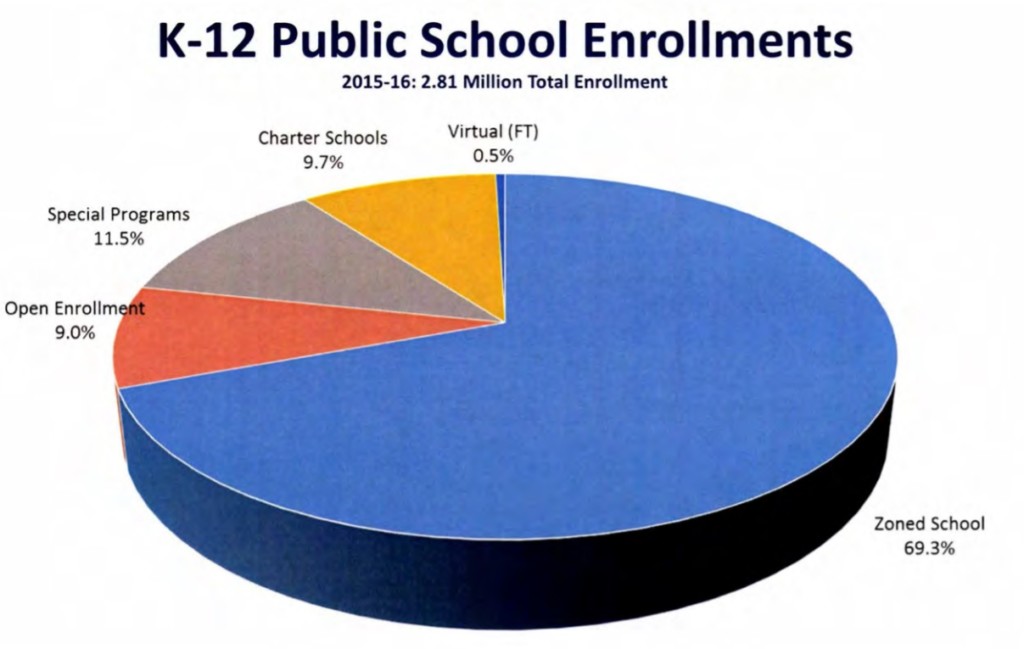
The majority of Florida's public-school students attend zoned schools, but for some of them, it's a conscious decision. Graph by Florida Department of Education
 Last year, 43 percent of Florida’s PreK-12 students attended a school other than their assigned neighborhood school. This enthusiastic embrace of school choice by parents is forcing school boards to rethink their roles and responsibilities. Should they fight to prevent parents from attending non-district schools? Or should they embrace parent empowerment and help ensure all their community’s students have access to the schools - neighborhood, magnet, charter, virtual or private - that best meet their needs?
This dilemma was on full display at a recent Palm Beach County, Fla. school board meeting. The board was reviewing what to do about three struggling charter schools when one board member, Marcia Andrews, suggested the board should do more to help these schools succeed. “We’ve got to kind of change how we do business,” she said, according to the Palm Beach Post, “so they’ll know we’ll partner with them, so they’ll be successful.”
Some of her colleagues disagreed. They argued that when parents choose charter schools they take their funding with them and that hurts the district. They also worried about the costs of helping charter schools when district budgets are already stretched tight.
This caused another board member, Frank Barbieri, to join Andrews in calling for greater collaboration and support. “I don’t want to hear about ‘we’re taking money from our kids and giving it to these kids,’ ” said Barbieri. “These are our kids. Let’s help them.”
Statistics from Florida’s tax credit scholarship program, which I help administer, support the these-are-all-our-kids position. (more…)
Rhee’s failing schools model for vouchers and tax credit scholarships misinterprets the relationship between students and schools. With rare exceptions, schools are not good or bad independent of the students they serve. Some schools are good for some students and bad for others. A state-designated “A” school can be a terrible match for a particular student, which means for that student the school is a failure.
In recent weeks, Tony Bennett, Florida’s new education commissioner, and Michelle Rhee, the CEO of StudentsFirst, offered conflicting rationales for supporting school choice. Bennett told participants at a National School Choice Week event in Tampa, Fla., that school choice is a necessary condition for equal opportunity and social justice. Low-income children should have access to the same options as the affluent, Bennett said, and this is why he supports providing low-income families with publicly-funded vouchers and scholarships to attend private schools.
StudentsFirst, on the other hand, released a state policy report card that docked Florida a few points for extending school choice to all low-income children. The group favors policies that restrict vouchers and tax credit scholarships to low-income students in state-designated “failing” schools. Within the choice movement, Rhee’s position is called the failing schools model.
Ten years ago, the failing schools model was the most favored, and it’s still popular with state legislators who see it as a politically safe compromise that allows parents to use vouchers only when their assigned district school is “failing.” But school choice, at its core, is about empowering parents to match their children to the schools that best meet their needs. Those judgments don't necessarily align with school-wide standardized test scores.
Rhee’s failing schools model misinterprets the relationship between students and schools. With rare exceptions, schools are not good or bad independent of the students they serve. Some schools are good for some students and bad for others. A state-designated “A” school can be a terrible match for a particular student, which means for that student the school is a failure. Bennett’s approach assumes the relationship between a student and a school is what succeeds or fails, which is why he thinks all parents should be empowered to access the schools that work best for their children.
The failing schools model also tends to inappropriately pit public versus private schools by implying private schools are better, which is not true. (more…)
The headline said it with absolute authority: “Parents, teachers say 'no' to Tony Bennett.” The story relayed criticism from the usual quarters about Florida’s new education commissioner. It quoted a local parents group that’s stomping mad about standardized testing . It quoted a teachers union president who doesn’t like vouchers and charter schools.
 More open-minded folks were quoted too. But the headline still reflected a widespread perception - that the masses of Florida parents and teachers don’t like where Florida schools are headed. It’s a conclusion drilled in deep by media coverage even as test scores and grad rates improve and growing numbers of parents embrace new learning options. And it’s why my holiday wish is for those parents, in whatever choice sector they’re in, to become better organized.
I won’t dispute that teachers unions and the usual parent groups represent a lot of people, or that in some cases they have legitimate concerns. But they don’t speak for all, and their views aren’t shared by all. The number of charter school students now tops 200,000 and there are more than 50,000 in private schools via tax credit scholarships – just to name two of Florida’s many alternatives. (The scholarship program is administered by Step Up For Students, which co-hosts this blog.) Those numbers are rising by double-digit percentages every year. They’re also contributing to a bigger picture in which 1.3 million students in Florida, about 40 percent of the total, are now enrolled in schools other than their assigned neighborhood school.
I‘m sure those parents have diverse views about education reform and school choice. And I suspect those views are often not in synch with those who get all the ink. Becoming better organized is the best way to get ink, too. Along the way, it will nudge news coverage into better reflecting the more complex – and frankly, from a news perspective – more fascinating realities on the ground.
That’s starting to happen. Parents for Charter Schools, for example, a group with roots in the Florida Consortium of Public Charter Schools, is becoming more visible. But there’s so far to go. I’d like to see parents who benefit from school choice options quickly respond to negative stories, whether it’s to dispel misinformation or to admit something’s amiss. I’d love it if reporters felt compelled to call them for a quote about say, the new ed commissioner, or that new bill that could impact their kids.
I know that’s easier said than done. Low-income parents, in particular, don’t have the time or resources or political connections to mobilize like their more affluent counterparts across town. But the reality is this: if choice parents don’t find ways to speak up, parent groups with conflicting agendas will speak for them. Just like they’ve done for years.

Georgia's first compulsory school attendance law was passed in 1916. Photo from georgiainfo.galileo.usg.edu.
For the last 150 years, we have assumed “public education” meant publicly funded education, but in this new age of customized teaching and learning this definition is too narrow. Today, it’s more useful and accurate to define public education as all learning options that satisfy mandatory school attendance laws, including those that don’t receive public funding, such as private schools and home-schooling.
Education - especially public education - has taken many forms in the United States over the last 300 years. According to Pulitzer Prize winning education historian Lawrence A. Cremin, in the 1700s education encompassed institutions “that had a part in shaping human character - families and churches, schools and colleges, newspapers, voluntary associations, and … laws”, while public education referred to formal instruction in public settings outside the home.
Public teaching became increasingly common in the latter half of the 18th century, and by the early 19th century most communities had at least one free school open to all white children. These free schools, which operated independently much like today’s charter schools, became known as common or public schools. They combined with religious schools receiving public funding to educate the poor to comprise public education. As Cremin notes, in 1813, most New Yorkers saw publicly-funded religious schools “as public or common schools.”
Over the next few decades, public funding for religious schools - most notably Catholic schools - became more contentious and rare. By the mid-1800s, free public schools and public education had become synonymous. Schools not receiving public funds were called private schools, even though they provided public instruction outside the home.
The birth of public education as we know it today occurred during the 1840s and ‘50s. (more…)
 Students at six high-poverty schools in Memphis returned to class this month as the focus of an education reform project that's worthy of national attention. The schools are the first cluster in the “Achievement School District,” a Race To The Top-fueled vision headed by Chris Barbic, founder of the acclaimed YES Prep charter schools in Houston.
The district’s near-term goal – lifting schools in the bottom 5 percent statewide to the top 25 percent within five years – is as ambitious as YES Prep’s target of getting every graduate into a four-year college. Its big-picture goal is even more so: Showing the world that lessons learned from the highest-performing charter schools can turn around the lowest-performing traditional schools.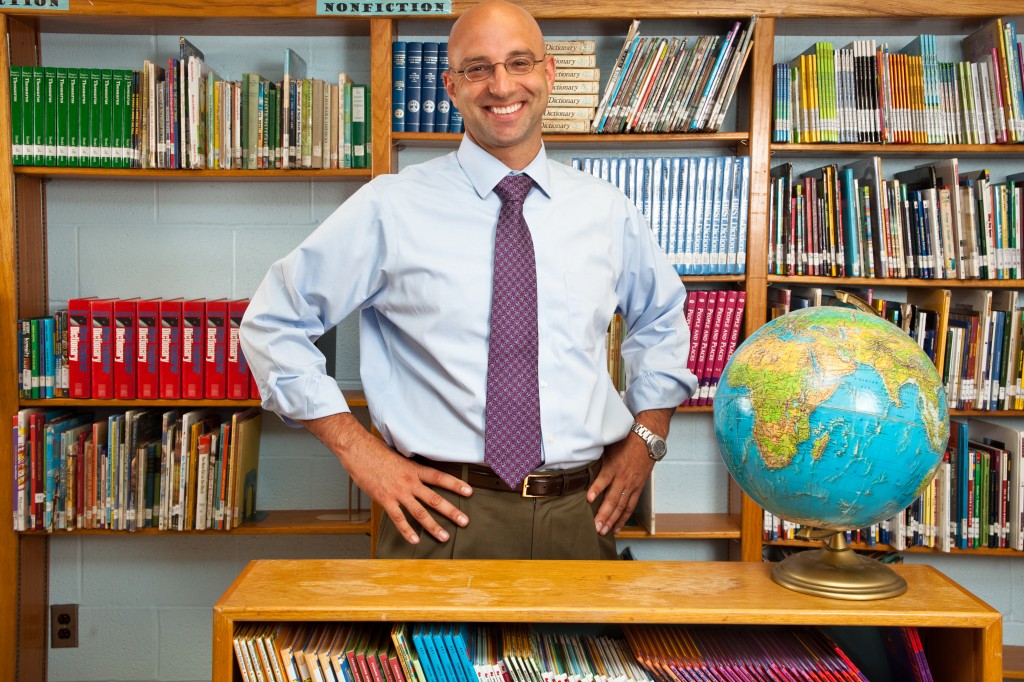
Barbic calls it Charter School 3.0.
“There’s an opportunity here to say, look, we’re not creating the charter school that’s going to be across the street from the public school and slowly bleed it to death. What we’re saying is, this is the neighborhood school,” Barbic said in the redefinED podcast below (the phone interview was conducted during the first week of school). “To me this is Charter School Version 3.0. – which is, you don’t get to pick the kids; the kids don’t get to pick you. If we really believe this works, we’re going to phase you in and you’re now the neighborhood school. And you got to work with all the kids … whatever kids show up with, you have to serve those kids.”
“If we can pull that off,” Barbic continued, “it’s going to make a huge statement that will hopefully accelerate things like this in your backyard and other places around the country.”
Schools like YES Prep and KIPP share many characteristics – high expectations, high-energy teachers, longer school days, more flexibility at the school and classroom level. And yet, despite a solid body of evidence that they’re making a big difference for low-income kids, they remain fairly rare. Barbic said that’s in part because it’s only been in the past three to five years that they’ve learned to replicate more rapidly. But now, folks inside traditional school systems are beginning to appreciate the benefits.
“You’re seeing things in Denver and things in Houston where there’s efforts being made by the district to try and take the practices of the best charters, the best charter organizations, and try to apply them in a larger system,” he said. “And I think what’s happening in New Orleans with the Recovery School District, what we’re hopefully going to be able to achieve here, is an opportunity to say, ‘Look, this works. And it works at scale, in a neighborhood school environment.’ ”
On a related note, Barbic talks about ASD's parent outreach efforts - which are extraordinary compared to traditional public schools. When teachers showed up for school in early July, buses took them to the communities where their students live. “We hit all the apartment complexes. We banged on doors,” he said. “We met (the parents) and we invited them to come out to a community picnic that we were having later that week.”
The response: “Cautious optimism.”
“They’ve met us halfway,” Barbic said. “Now it’s on us to perform and get some results.”
 From redefinED host Doug Tuthill: Today we begin a new feature at redefinED – an ongoing dialogue between myself (that's me pictured on the right) and John Wilson, who writes the Unleashed blog at Education Week. For the last 25 years, I’ve been one of Wilson’s biggest fans. I worked hard for John when he ran for president of the National Education Association in the late 1980s (we lost), and I’ve always respected the sincerity and dignity with which he conducts himself. John is a passionate and intelligent advocate for children, teachers and public education - and he’s a gentlemen. So I was thrilled when John accepted my invitation to dialogue with me on redefinED about how best to improve public education. I’m looking forward to learning from John, and I’m hoping our exchanges will inject some more civility into our public discourse. Our first installment is below.
Doug Tuthill: John, I was pleased to read your endorsement of customization on your blog recently. For readers who missed it, you wrote, “our citizens want choice. Parents want to choose the school that best fits their children. Let's not stifle this customization, but embrace it.” But I was especially intrigued when you wrote that we need to “stop the fragmentation and welcome charter schools back into the community and the conversation.” The charter school folks I know think they are in the community and think they are part of the conversation. So I was hoping you’d elaborate on what you meant.
John Wilson: Doug, I always start with my strong support for the institution of public schools. I believe public schools are the foundation of our democracy, best prepared to educate the masses, and the most strategic driver of the American economy. Public schools deserve necessary funding to accomplish their mission, and they must be relevant to the needs of that public. For the 21st century, that means customization to assure every child receives an education that prepares them for success. That means a willingness to collaborate with more appropriate providers that serve children but within the public school institution. Creating a hodgepodge of providers outside the public schools causes fragmentation and weakens our public schools. We have tried division; I want us to try addition.
Doug Tuthill: John, I share your belief that public education lies at the foundation of our democracy. Public education is responsible for helping ensure every child, regardless of economic class, ethnicity, disability or race, has an equal opportunity to succeed. This promise is what holds our democracy together, and while I doubt we’ll ever achieve full equality of opportunity, this ideal should always guide our work. (more…)

