An education reform era policy ended recently as New York lawmakers repealed a law that attempted to remove ineffective instructors from public school classrooms. As Kathleen Moore of the Times Union explained:
Districts can still fire probationary employees, as always. The measures that help them remove ineffective teachers who have tenure, however, have been removed. Repealed were measures that called for an expedited hearing for “just cause” termination and stated that reviews showing a pattern of ineffective teaching would be “very significant evidence” in favor of termination.
In addition, teacher evaluations will no longer have to consider test scores, student growth scores and other measures that the state tried to use from 2010 until when the pandemic hit in 2020.
If you have been hanging around the ed reform water cooler long enough, you will recall when New York City “rubber rooms” were a cause celebre back in 2009. Job security for tenured teachers reached such absurdity that NYC schools would send instructors accused of criminal activity to “rubber rooms” in order to keep students safe. Mind you these people continued to draw their salary and benefits while doing absolutely nothing. Rubber rooms existed because it was almost impossible to fire a tenured teacher.
State lawmakers attempted to address this with a statewide evaluation policy that could-in theory- allow school administrators to remove tenured teachers for ineffective instruction. In theory this could have a large impact on average student achievement based upon research such as this chart from a 2006 Brookings Institution study:
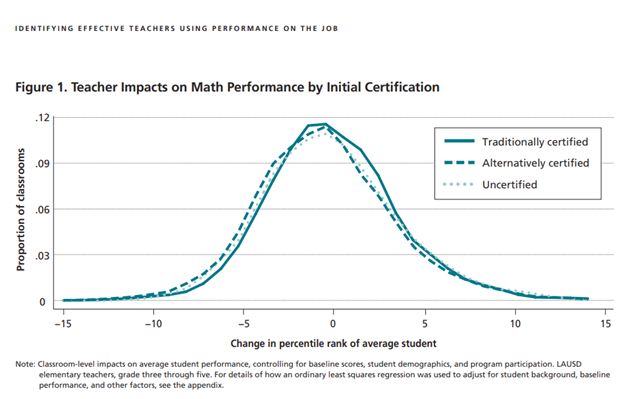
The upshot: Research shows that some teachers are catastrophically poor at getting students to learn (left side of the bell curve) while others are amazing (right side of the bell curve). Obviously what state lawmakers should do is to create a statewide evaluation system to remove the teachers on the left side, and average teacher quality will improve- in theory. As the Times Union article noted, New York had a policy to do just this in theory between 2010 and 2020. Let us then see what happened in New York NAEP scores in practice between 2009 (pre-policy) and 2019 (last NAEP under the policy and before COVID).
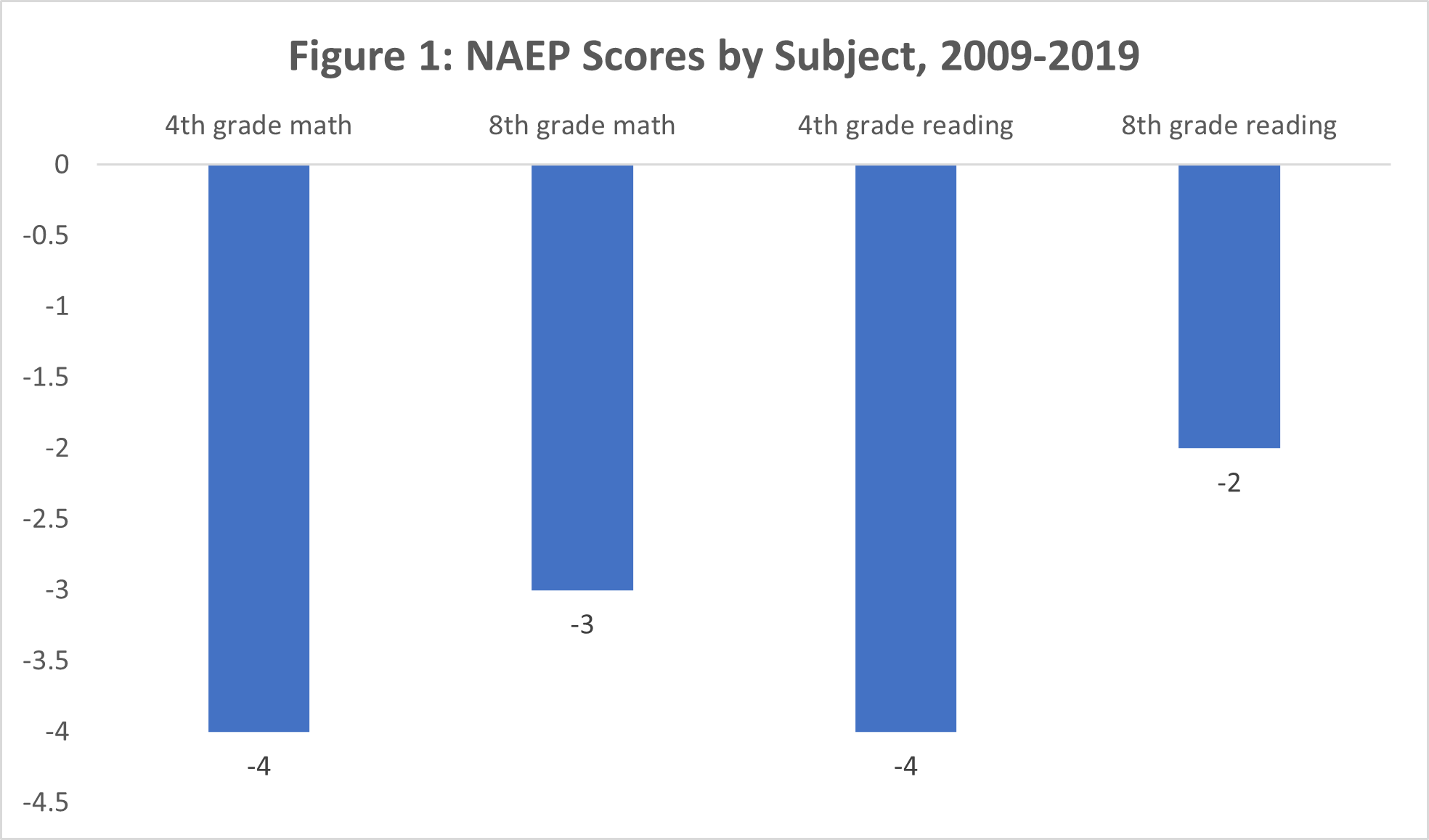
Of course, this does not mean that the New York teacher evaluation policy caused New York NAEP scores to decline. It does however mean that the hoped for large improvement in instruction failed to materialize. I don’t know of any data source to confirm or deny this, but I’d be willing to bet a left toe that very few teachers were removed under the policy.
Despite all the Sturm und Drang surrounding this policy at the time, it limped along ineffectually for a decade or so before repeal effectively never being implemented. It’s almost as if school districts have been subject to a deep level of regulatory capture by reactionaries with abundant ability to engage in passive resistance. Reformers bringing technocracy to a politics fight brings to mind Macbeth:
Life's but a walking shadow, a poor player,
That struts and frets his hour upon the stage,
And then is heard no more. It is a tale
Told by an idiot, full of sound and fury,
Signifying nothing.
It also stands as a great example of Dennis Nedry attempting to get the dinosaur to fetch the stick. Education reform policies require active constituencies in order to work and last. If the supporters of top-down policies recognize this need, they have yet to display much ability to acquire them.
California: A parents group in Los Angeles is using the state's landmark parent trigger law to force the school district to reform a low-performing school. (Los Angeles Times). More from the Associated Press and Education Week. A national report finds the state continues to lead the nation in charter school growth, despite funding disparities and access to facilities (Huffington Post). Oakland district officials say the American Indian Model Schools, a charter network touted for its academic successes, suffers from "corrupt fiscal practices" and should be shut down (Oakland Tribune).
 Michigan: A new report finds the typical Michigan charter school student school gained more learning in a year than a district school peer, amounting to about an additional two months of reading and math learning (The Detroit News).
Texas: Key state lawmakers are looking at the franchise tax on businesses as a vehicle to fund private-school scholarships for low-income students (Austin Business Journal). Critics of a proposed voucher program say all it will strip the public school system of funding and state leaders should instead restore $5.4 billion cut from education in 2011 (KUT News). Similar arguments in stories from KX11.com and the Associated Press.
Florida: Magnet schools continue to grow on the school choice landscape (redefinED). A new bill would require emergency response agencies to notify private schools just like they do public schools (redefinED). In response to the Newtown tragedy, private schools and charter schools are considering additional security measures too (redefinED).
Georgia: Tax credit scholarships are used at private schools that bar gay students (New York Times). (more…)

