 Editor’s note: This article appeared Sunday on thecentersquare.com.
An Ohio policy group continues to push the Senate to adopt universal school choice, testifying a plan passed by the House would leave “many working-class families” out of the option.
Greg Lawson, research fellow at The Buckeye Institute, told the Senate Education Committee in written testimony to make school choice available to all students and increase funding for charter schools, two areas where Lawson said the current House-passed budget falls short.
“EdChoice would grow under House Bill 33, but many working-class families would still be ineligible,” Lawsons said in his testimony. “These working-class families deserve the same opportunity to help their children succeed in school with an educational environment that best fits their students’ needs.”
As previously reported by The Center Square, the House passed budget increases the income limit for the school voucher program from 250% to 450% of the federal poverty level. Rep. Tracy Richardson, R-Marysville, said that a family of four making $135,000 or less would be eligible for private school vouchers, representing nearly 75% of children ages 6-18 in the state.
It also increases the per-student amount of taxpayer dollars the state gives to qualifying charter schools.
Lawson pointed to a Buckeye Institute analysis that showed a family of four in Dayton with jobs as a police officer and teacher with two children attending Chaminade Julieen Catholic High School would not qualify for vouchers and pay nearly $25,000 annually for tuition.
As previously reported by The Center Square, fiscal notes provided by the state’s Legislative Service Commission said universal school choice could cost Ohio taxpayers more than $1 billion.
To continue reading, click here.

Delaware Christian School in Delaware, Ohio, one of 1,370 private schools in the state serving more than 226,000 students, partners with parents and students to promote academic excellence while developing lifelong learners who embrace a biblical worldview.
Editor’s note: This commentary from Sandra O’Brien, a Republican member of the Ohio Senate, appeared Monday on Ohio’s dispatch.com.
The Parent Educational Freedom Act, Senate Bill 11, offers the best educational opportunity for students of both public and private schools.
As a former public school educator, I know each child is unique and what works for one student might not work for another. Parents and students deserve the ability to find a school best suited for their success and well-being. This bill guarantees the right to choose the school that best fits their needs.
My bill will provide $5,500 per year for students in grades K-8 and $7,500 per year for students in grades 9-12. This is exactly the same benefit that is currently being provided through Ohio's existing Ed Choice Scholarship Program for children in academically failing public schools.
For the past 20 years, there have been constant accusations that Ohio taxpayers have underfunded our public schools. This is a false narrative.
Here is what you, the taxpayers, have done for public schools:
Most of us recently received our property tax bills. On average, two-thirds of these dollars go to our local public schools. If my bill passes, not one of these dollars will go to private schools.
To continue reading, click here.
Delaware Christian Academy in Delaware, Ohio, is one of 1,077 private schools in the state serving more than 212,000 students. Delaware Christian School’s mission is to partner with parents and students to promote academic excellence while developing lifelong learners who embrace a biblical worldview.
A new poll of Ohio voters sponsored by education choice advocacy group Yes. Every Kid. shows support for education savings accounts by a nearly five-to-one margin.
Close to two-thirds of respondents – 64% – support implementing the government-authorized savings account that would help families pay for education expenses from kindergarten through 12th grade throughout the state. Forty percent strongly supported implementing ESAs.
A full 75% indicated support for school choice, where parents have the opportunity to choose the best school for their child, whether public, private, virtual or homeschool. Fifty-six percent said they strongly support school choice. Poll numbers showed little difference in total support for school choice between parents and non-parents.
“Ohio families want the ability to customize their children’s education,” said Yes. Every Kid. executive director Craig Hulse. “Every kid is different and deserves access to educational opportunities that take into account these differences.”
HB 11, also known as the Backpack Scholarship Program, would repeal the Educational Choice Scholarship Pilot Program and establish the Backpack Scholarship Program, under which the treasurer of state would establish an education savings account for eligible students to purchase educational goods and services, including tuition at participating chartered and non-chartered nonpublic schools.
Republicans are also looking to adopt a “parent’s bill of rights,” (HB8), to continue phasing in the school financing system established in HB110 of the 134th General Assembly (HB10) and to reform the functions of the state board of education (HB12).
“The Ohio Legislature has the opportunity to empower families to make the best decisions when it comes to their children’s learning experiences,” said Hulse. “We thank Representatives Riordan McClain and Marilyn John, along with all the bill co-sponsors, for their leadership in proposing landmark legislation that would empower families and improve access to educational experiences that fit children’s unique learning styles.”
The poll was conducted by WPA Intelligence from Feb. 6–8, 2023. WPA Intelligence interviewed a total of 556 likely voters with a margin of error of ±4.2%.
Valley Christian Academy in Aurora, Ohio, one of 1,079 private schools in the state that serve more than 212,500 children, exists “to build a godly foundation in its students through Christ-centered education in cooperation with the Christian home and church so that students know, love and obey Jesus Christ.”
Editor’s note: This article appeared Tuesday on Ohio’s fox8.com.
Ohio lawmakers are considering a bill to provide cash to all families with school-aged children in the state to choose their public school district or a private school.
Under the Parent Educational Freedom Act, or Senate Bill 368, every K-12 student in Ohio would qualify for a state-funded voucher to offset the cost of attending a nonpublic school of their choice. Current law limits vouchers, administered through the EdChoice Scholarship Program, to low-income students and those in low-performing districts.
“Ohio is fortunate to have many fine teachers and many public schools that work for students, but the one-size-fits-all approach to education simply does not work,” Sen. Sandra O’Brien (R-Ashtabula), the sponsor of SB 368, said last week.
O’Brien’s proposal, if passed, would be the largest expansion to EdChoice since 2013, abolishing all income requirements necessary for voucher eligibility. It would also boost the homeschool tax credit from $250 to $2,000.
Despite the growing popularity of EdChoice – whose vouchers cost the state $315 million in 2022 – the program is not immune to controversy. More than 120 public school districts, including Columbus City Schools, have joined a class action lawsuit challenging EdChoice’s constitutionality.
“In many ways, this is part of an attack on public education, on the concept of public education,” Eric Brown, a Columbus school board member and former Chief Justice of the Ohio Supreme Court, said. “And that’s unfortunate on many fronts.”
Since its inception in 2005, the use of EdChoice has become more common among Ohio families. About 57,000 Ohio students used an EdChoice voucher to attend a nonpublic school in the 2022-23 school year – more than triple the 18,133 participants in 2014, according to ODE.
“Parents are the ultimate authority on all matters concerning their children, and they want options,” O’Brien said.
To continue reading, click here.

A new policy report from an Ohio-based independent research and educational institute offers commonsense solutions for improving K-12 academic outcomes in the state, all of which center on the availability of additional education choice options.
The Buckeye Institute posits in #StudentsFirst: Empowering Parents to Help Students Regain Lost Learning that allowing parents to make better schooling decisions, making educational resources more available, and raising the public’s trust and confidence in government-funded instruction not only will help reverse COVID-19 learning loss but also will lead to overall education reform.
“The disruption of the pandemic cost Ohio students the equivalent of months of academic instruction,” wrote author Greg R. Lawson, a research fellow at the institute. “Given the negative long-term financial and social effects of this learning loss, Ohio policymakers should pursue student-first strategies to regain lost learning time and improve academic outcomes for elementary and secondary students.”
The most efficient way to accomplish this, Lawson writes, is by dramatically increasing the number of schooling options and educational resources available to parents, thus enabling policymakers to help families tailor academic environments to fit their children’s learning needs.
Specifically, the report calls for the following:
Broad-Based Education Savings Accounts: Create a broad-based ESA initiative to reform Ohio’s education system and its long-standing government-run education monopoly by shifting the focus to fund students before districts.
Universal Open Enrollment: Make it easier for all families to send students to their school of choice by requiring all Ohio public schools to participate in inter-district open enrollment.
Expanded Tax Credit Scholarship: Increase the maximum tax credit from its current $750 limit to $2,500 to make it easier for grant organizations to offer larger scholarships to more students in need.
Enhanced Spending Transparency: Require all public school districts to operate more transparently by sharing their spending data with parents in Ohio Checkbook.
“Families deserve these reforms as their students struggle to overcome the negative long-term effects of the pandemic protocols that cost them valuable years of learning,” Lawson continued.
The report is especially forceful on the subject – and importance – of education savings accounts. While charter schools and voucher programs have produced positive outcomes, the author contends, they lack the flexibility to meet the personalized educational needs of each student. ESAs, on the other hand, with their ability to help parents pay for educational products and services tailored to their child’s unique academic needs, put textbooks, tutors, online classes and group learning pods within reach.
While public support for all school choice options consistently polls over 50%, the report states, support for education savings accounts is generally even higher. A 2013 focus group found that 94% of Arizona families using an ESA were satisfied with their accounts. Since 2017, ESAs have received more than 70% of the public’s support each year, reaching 78% in 2021.
The report points to a study of Florida’s ESA program, which while limited to students with special needs, shows that the longer a family uses an education savings account, the more services it buys.
The author acknowledges that programmatic administrative details need to be worked out for Ohio families to reap the full benefit of ESAs, suggesting that the Treasurer of State operate the ESA program to simplify the process for families and avoid bureaucratic hurdles within the Department of Education.
Additionally, Lawson writes, families with existing Ohio Afterschool Child Enrichment Educational Savings Program accounts should not face a second bureaucratic approval process; those who already have had their income level determined should pre-qualify for the new ESA, thus reducing administrative burdens to help encourage more families to take advantage of the program.
Marburn Academy in New Albany, Ohio, is one of 1,134 private schools in the state serving 215,189 students.
Editor’s note: This commentary appeared Tuesday on the Fordham Institute’s website.
If you’re at all involved in Ohio education policy, you’ve heard about the anti-voucher lawsuit that was recently filed by the Ohio Coalition for Equity and Adequacy of School Funding. The coalition, which is made up of dozens of traditional public school districts, hopes that a victory will spell the end of the EdChoice Scholarship Program, which served over 50,000 kids during the 2020–21 school year.
The lawsuit opens with the assertion that EdChoice poses an “existential threat” to Ohio’s public school system. The claims that follow outline several arguments in favor of abolishing the program. My colleague Aaron Churchill recently did a very thorough and efficient job of debunking the lawsuit’s claim that EdChoice has created an inequitable funding system. But there are a few other erroneous claims that also deserve rebuttals. And one of the most significant is that EdChoice is unconstitutional.
Most of the plaintiffs’ case is predicated on Article VI, Section 2 of the Ohio constitution, which reads:
“The General Assembly shall make such provisions, by taxation, or otherwise, as, with the income arising from the school trust fund, will secure a thorough and efficient system of common schools throughout the State; but, no religious or other sect, or sects, shall ever have any exclusive right to, or control of, any part of the school funds of this State.”
The plaintiffs’ arguments against this provision can be boiled down to this: First, the expansion of EdChoice has, in their words, “created multiple state-wide systems of publicly-funded, uncommon, private schools.” The program offends the constitution in doing so, as they believe the law “authorizes the state only to fund a thorough and efficient system of common, i.e., public, schools.”
Second, because many of the private schools that participate in EdChoice are religious, the lawsuit claims that the program violates the Ohio constitution by “placing hundreds of millions of dollars in school funds within the exclusive, unfettered control of private (mostly religious) institutions.”
Both arguments miss the mark, and here’s why.
To continue reading, click here.
 District boundaries are not racially neutral, nor are the decisions made by districts on whether to participate in open enrollment. American housing patterns are quite segregated by income and race, so ZIP code assignment to schools will naturally reflect those patterns.
An important way to improve education outcomes and potentially school integration is to allow students to attend public schools without regard to their ZIP codes.
The Fordham Institute has created a school district map of Ohio, coloring districts according to whether they participate in open enrollment.
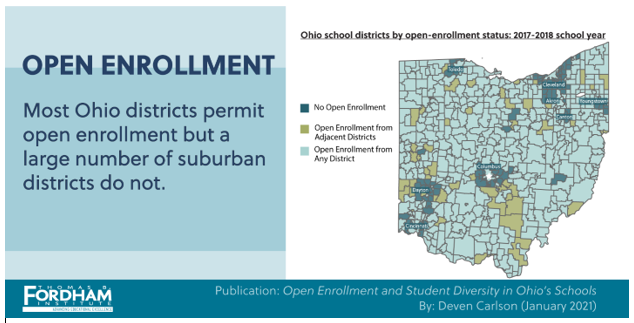
Districts colored dark blue have chosen not to participate in open enrollment, allowing no students from outside the district to attend. Districts colored green allow open enrollment but only for students who reside in adjacent districts. Districts colored pale blue allow open enrollment from any Ohio district.
All of Ohio’s large urban districts find themselves either entirely surrounded by suburban districts that choose not to participate in open enrollment, or nearly so. Notice as well that some of the exurban districts choosing to allow only adjacent district students to enroll sometimes look more than a bit calculated to keep out the urban kids.
Suburban open enrollment policies have profound implications for the segregation of schools. Cleveland, for instance, is surrounded by districts not choosing to participate in open enrollment. The Urban Institute created a tool reveal the race of the under 17 population across metro areas.
Here is the map for the Cleveland region, which shows Black students in yellow and white students in blue. Rarely the twain shall meet.
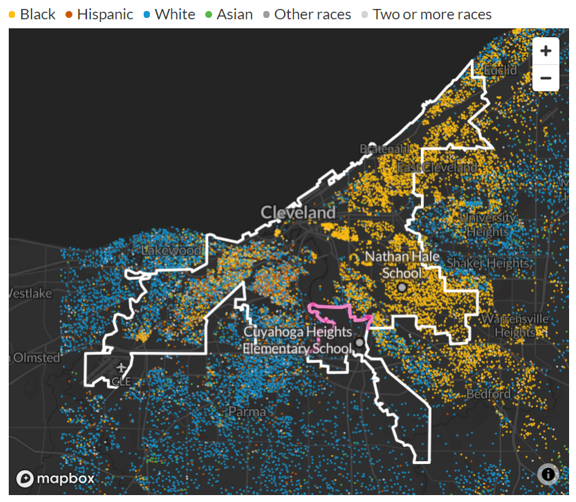
Ohio suburban districts have offered up the claim that rapid population growth precludes them from participating in open enrollment. While this is doubtlessly true in some cases, those districts really should avoid making broad claims that can so easily be refuted.
Parma, for instance, is one of the districts shown on the map with a predominantly Anglo student body. It enrolled 13,197 students during the 2000-01 school year and 9,711 in 2019-20. Lakewood, the other predominantly Anglo suburban district, enrolled 7,538 students in 2000-01 and 4,814 in 2019-20. Neither district participates in open enrollment.
A spokesperson for the Alliance for High Quality Education, a group composed primarily of suburban Ohio school districts, was interviewed on Columbus National Public Radio and speculated (implausibly) that suburban Cleveland districts did not participate in open enrollment because they were “land-locked.”
If you feel like wincing, knowing that the interview was recorded in 2021, you can listen here. The Fordham Institute’s Chad Aldis relates that Black students gain the most from open enrollment but find themselves largely locked out. The Alliance spokesperson then make a series of lame arguments, noting among other things that 80% of districts participate. What you need to know is that “participate” does not always mean “take kids from urban areas,” and the urban areas are surrounded by non-participants).
Additionally, the Alliance spokesperson claims that districts will have trouble estimating capacity to take open enrollment, yet plenty of districts in other states mastered it long ago, along with 80% of Ohio districts currently.
He also claims that the non-participating districts have trouble estimating demand for future seats for students returning from parochial schools, but again, other Ohio districts participate and have parochial schools.
All of this reminds me of Jake Blues explaining why he left his former fiancé at the altar.
Luckily, the Ohio Legislature opened up private and charter choice last session, and hopefully it will encourage Ohio suburban districts to participate. So, let’s not pick exclusively on Ohio, as this is a widespread problem.
If you squint at the Urban Institute-colored Cleveland map long enough, you can see some blue dots within Cleveland-integration! But not so fast my friend; within district boundaries, you can segregate just as much as those between districts.
Consider this map included in a recent Education Next story.
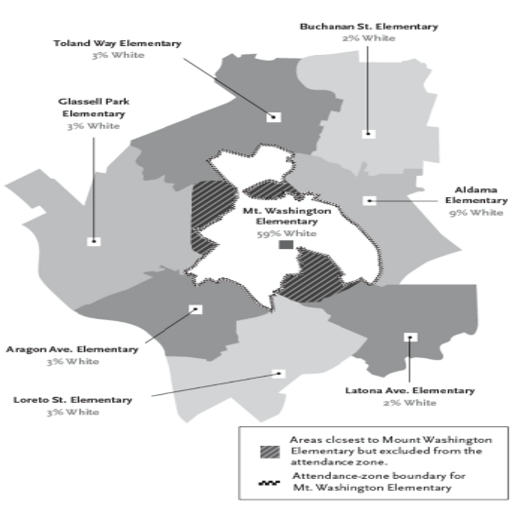
Those are some very carefully drawn school attendance boundary lines.
Oregon nativists made it illegal for parents to send their children to private schools in the early 1920s, but the U.S. Supreme Court struck the measure down as unconstitutional, saying, “The child is not the mere creature of the state; those who nurture him and direct his destiny have the right, coupled with the high duty, to recognize and prepare him for additional obligations.”
Children are not the mere creatures of school districts either, and they should have as many options as possible in schooling.

An Ohio legislator, concerned that the state’s current voucher program isn’t sufficient to address the needs of all Ohio families, is proposing a new bill that would allow universal vouchers for all students, regardless of family income.
The legislation, known as the “backpack bill,” would allow much greater access than Ohio’s EdChoice program, which provides state-funded vouchers for about 35,000 Ohio K-12 students to attend private schools. The bill would allow all parents to send their children to private school or establish an education savings account, which could be used for private school tuition, homeschool expenses, tutoring, books and other educational expenses.
“We want to fund students, not systems, and empower parents to make the best decisions for their children,” said Republican Rep. Riordan McClain.
The bill’s backers say funding of up to $7,500 would follow each child to the private school of the parent’s choice, mitigating a “one size fits all” mentality that doesn’t work for very family.
“Public education is going to continue to be an option that works for some parents and some students, but it doesn’t work for every student and every parent,” Rep. Marilyn John, R-Shelby, said Wednesday at a news conference. “Competition makes us all get better. We believe wholeheartedly it will make things better.”
The legislation would allocate $5,500 per K-9 student and $7,500 for 9-12 students.
“We want this bill to benefit every student in Ohio,” said Troy McIntosh, executive director of the Christian Education Network. “An overwhelming majority of parents are realizing and asking for this sort of program.”

Buckeye Central Schools, a school district in Crawford County, Ohio, that serves more than 600 students in prekindergarten through twelfth grade, is among districts in that state that participate on open enrollment.
Jay Greene and James D. Paul gathered data for a new study for the American Enterprise Institute released Sept. 22 demonstrating that Democrats in state legislative chambers have only rarely made the difference in passing original private choice legislation nationwide.
The authors make the case that choice supporters have erred in seeking constrained and overly regulated programs in search of Democratic support which failed to meaningfully materialize. While they note that the choice movement needs all the support it can get, they fear Republican votes are being taken for granted. Ultimately, Greene and Paul call for private choice bills with universal eligibility and moderate levels of regulation.
My preferences also run toward universal programs with moderate levels of regulation. I think the Greene-Paul case deserves consideration, debate and reflection.
Whether or not one agrees with Greene and Paul’s conclusions, I believe there is an alternate case to make: Constrained and overly regulated private choice programs have only a limited ability to achieve policy goals that liberals, libertarians and conservatives tend to share.
Americans want public schools to teach necessary academic knowledge and to prepare students to exercise the responsibilities of citizenship as adults. Americans also want public schools to serve as engines of social mobility. They’ve been getting too little of any of that for decades. The unions want to max out the number of district employees to expand their membership, money, influence and power. There has been plenty of that going on for decades and too little to show for it.
K-12 choice is a tool which can give the public more of what they want from the education system. It also is respectful of pluralism. Once you get past the broad academic and civic goals, agreement about education quickly falls apart in the abstract. Individual children vary wildly in their interests and needs and thus can benefit from access to a diverse and specialized set of schools.
Ohio Republicans have passed multiple choice programs since 1995 and focused their efforts on the areas of greatest academic need: Cleveland students, students in failing schools, students with special needs, charter schools with geographic limits. Each of these were entirely worthy efforts.
This year, however, they embraced a number of more inclusive measures, in part, I believe, because the Fordham Institute found and documented the fact that students in every major urban district in Ohio find themselves surrounded, or nearly surrounded, by suburban districts that will not accept open enrollment transfers.
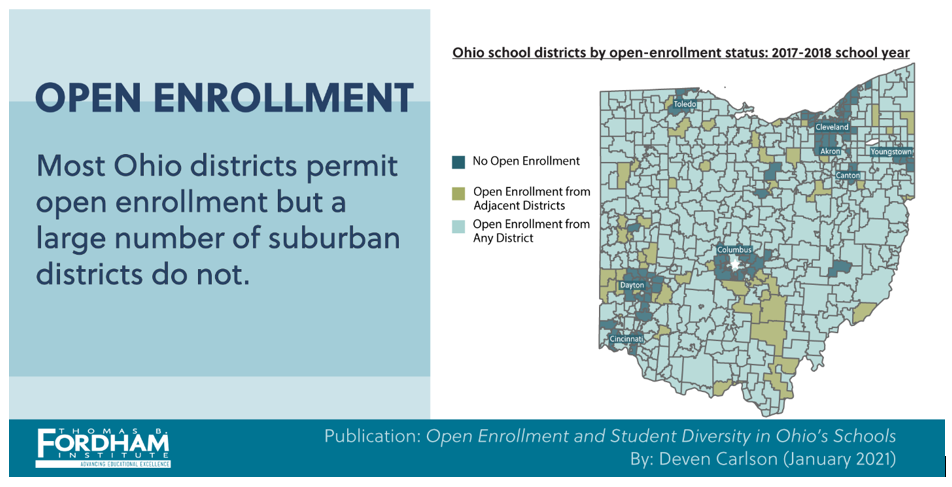
Whether you are a conservative, a liberal, a libertarian or a vegetarian, this map should disgust you as an American.
It apparently disgusted Ohio lawmakers, who took away geographic limits on charter schools, passed a new universal choice program, and improved existing choice programs. If suburban districts want to continue to deny open enrollment opportunities, they will have to do it with fewer students in the future.
K-12 choice deserves bipartisan support, and as Greene and Paul demonstrate, has received too little of it. We should include suburban and rural students in choice programs. They pay their taxes, they have unmet needs.
Our egalitarian desire to give advantage to the poor should be reflected in funding levels rather than in eligibility. No one would ever dream of denying a student access to a university because his or her parents paid too much in taxes. Levels of financial aid routinely vary, however. We should be worried about the sustainability of Republican support if our programs do not include their communities. Those communities pay for the programs; they should have the opportunity to participate.
We should most of all seek inclusive and diverse programs because (ironically) those are the programs that can best serve the interests of the poor. If you want to serve the interests of poor and urban students, yes, give them charter schools. Yes, give them education savings accounts, vouchers and/or education tax credits. It ultimately is untenable to ask suburban and rural voters to pay for such programs and then have them find themselves excluded from participation.
You also, however, want to create incentives necessary to give them access to suburban public schools. Limited, targeted programs won’t be equal to such a task.
The school choice programs that have passed to date usually did not need bipartisan support. A much stronger, impactful, inclusive movement can, however, achieve this and much more.
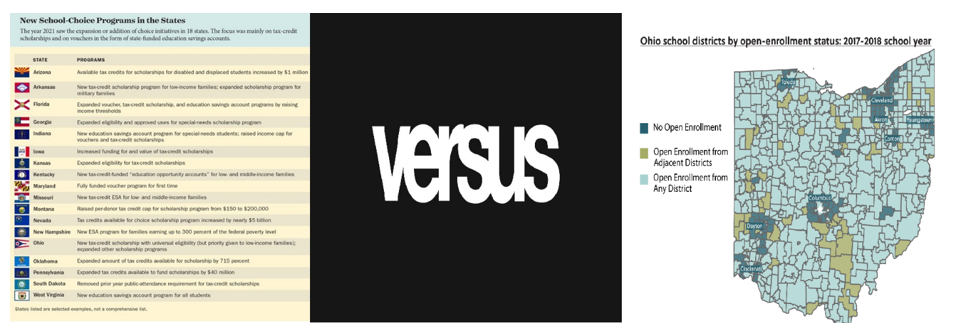 A few years ago, the Thomas B. Fordham Institute documented that the vast majority of Ohio suburban districts did not allow open enrollment transfers from urban districts. Pity the poor children of Cincinnati, Columbus, Cleveland and Dayton as depicted above on the left-hand side of the map, who are surrounded by districts choosing not to participate in open enrollment.
The Ohio legislature, however, took steps in 2021 to set them free.
Ohio stands in stark contrast to Arizona, where almost all school districts allow open enrollment transfers. Ohio had restricted charter schools to urban areas, whereas Arizona’s charter school sector is inclusive and diverse across communities including urban, suburban and rural areas, creating a powerful incentive for districts to put the “open” in “open enrollment.”
Likewise, Ohio’s private choice programs have been focused on urban schools, whereas Arizona’s private choice programs included both targeted and universal eligibility. Almost all Arizona districts participate in open enrollment.
This year, the Ohio legislature took notice and removed geographic restrictions on charter schools and created new and improved existing choice program. The Fordham Institute summarized the change in charters:
Families deserve the opportunity to find a school that’s the best fit for their child, regardless of where they live. And that’s not just pie-in-the-sky, wishful thinking, either. It’s possible. In Arizona, charter schools have long been available to every family regardless of geography, including those who live in affluent, high-performing suburban districts. This open environment has fostered some of the highest-performing charter schools in the country, and has produced high levels of academic growth for both district and charter schools. By eliminating geographic boundaries for new charters, Ohio lawmakers have removed a critical barrier to access and have brought the state one step closer to models like Arizona.
Ohio lawmakers were not alone. Policymakers in Florida, Indiana, New Hampshire and West Virginia also took very strong action on private choice. Private choice programs, however, may play only a supportive role in getting suburban district schools to get more interested in open enrollment. Consider, for instance, the 35% increase in Florida home-schooling in 2020-21.
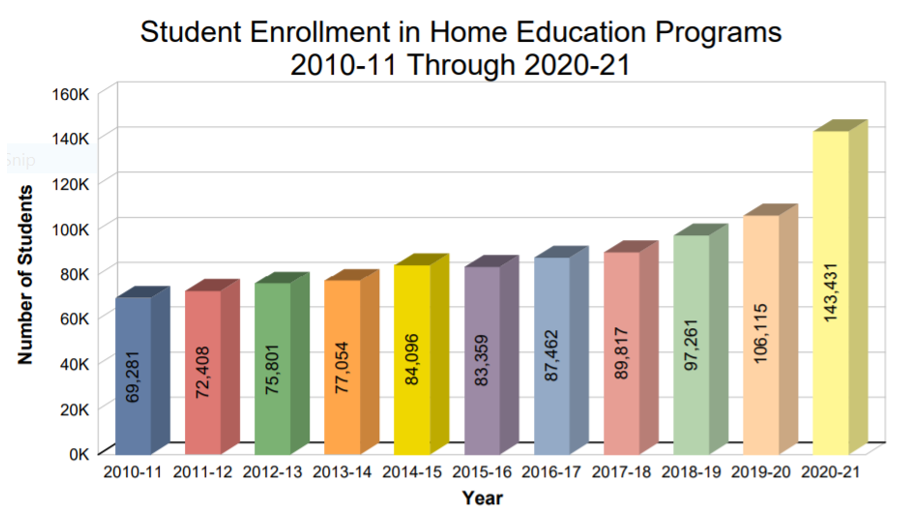
A 35% increase is impressive, but Tyton Partners forecast a 50% increase in micro-school attendance in the fall 2021, from 1 million to 1.5 million. Note for the record that it took the national charter school movement approximately 17 years to reach 1.5 million students.
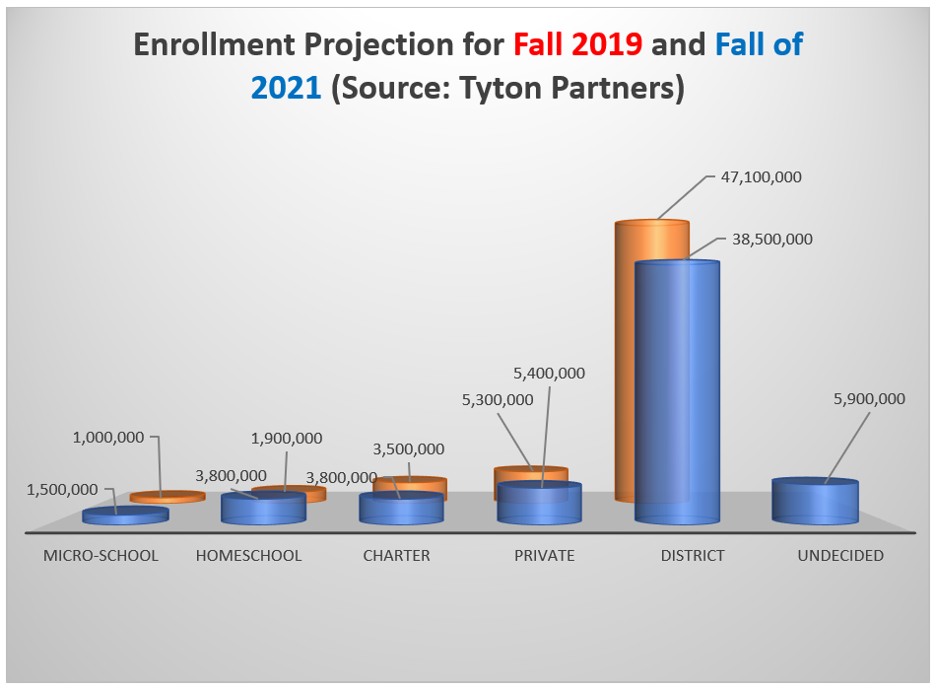
Finally, the United States has had a baby bust going since 2007, and if you guessed that a global pandemic wouldn’t help matters, give yourself a gold star.
But take heart. None of this means public education is doomed. Far from it, in fact.
The federal money printing presses will take the sting off in the short run. In the long run, suburban district schools becoming choice players will have a very positive impact on academic growth. The economic segregation underlying what the map of Ohio shows cannot be defended. An over-built and underperforming school system faces a rough go of things once COVID dollars expire.
A more effective future awaits after families decide which schools to favor and which to avoid. A more humane system of K-12 education beckons, but it will be a rough ride getting there.
Fasten your seat belts.

