Students in Ohio's online charter schools perform worse than their peers in brick-and-mortar schools, and they weigh down statewide charter school performance, a new report by the Thomas B. Fordham Institute finds.
The findings, which jibe with an earlier national report by the Center for Research on Education Outcomes, add new fuel to the debate over virtual charter schools that tends to split the school choice movement.
Ohio's charter school students tend to lag behind their traditional-school peers in academic growth, on average. But a growing number of charter school students in the state attend full-time virtual charters (known as e-schools in Buckeye parlance). The Fordham study finds students in e-schools make slower academic progress than their peers in physical classrooms, both charter and otherwise — even after controlling for student demographics and past academic performance. As a result, e-schools "drag down the impact of the state’s charter sector."
Ohio is one of the "big three" states for full-time virtual charter schools. By focusing on a single state, the Fordham report paints a fuller picture of online students. It finds they're concentrated heavily in urban areas and on the periphery of major cities — places where they presumably have access to brick-and-mortar charters and other school choice options. They tend to be struggling students who are behind on credits. And they're significantly less likely than their peers on physical campuses to enroll in advanced courses.
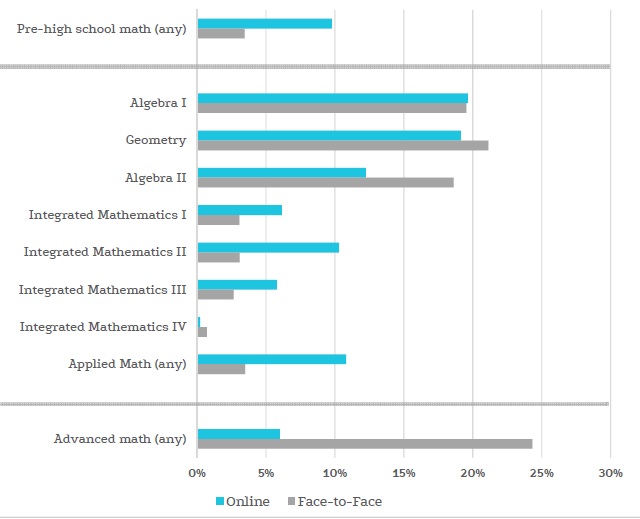
Ohio's e-school students are less likely than their peers to enroll in advanced math courses. Graph via "Enrollment and Achievement in Ohio's Virtual Charter Schools."
Florida is one example: The state-run Florida Virtual School offers online courses that are available to students enrolled in brick-and-mortar public schools. Florida students can also take fully online courses offered by any district in the state, or by a handful of approved external providers (who must demonstrate prior success with online courses), as long as they remain enrolled in their home brickand- mortar school and district. There is no fee for students and no limitation on the types of courses they can take (as long as they are academically qualified), and districts are not allowed to restrict students from enrolling. In other words, the system functions as one giant online school.
This recommendation is likely to get a warm reception from online learning advocates, who typically want states to offer students diverse ways to access virtual courses. (more…)
 North Carolina Supreme Court
Two separate groups filed suit to stop North Carolina's voucher program, but the North Carolina Supreme court ruled 4-3 Thursday in both Hart v. North Carolina and Richardson v. North Carolina that the state's Opportunity Scholarship Program is constitutional.
The Court rejected all five of the plaintiffs' claims, including a claim alleging that vouchers create an unconstitutional "non-uniform" system of education, an argument similar to the one that brought down a Florida voucher program nearly a decade ago. The North Carolina court found the state school fund was created to "preserve and support the public school system, not to limit the State’s ability to spend on education generally."
The program is limited to students in households earning up to 133 percent of the federal poverty level and provides vouchers worth $4,200 for students to attend private schools. More than 2,000 students had been in limbo waiting to hear news of whether they would be able to enroll in private schools using the scholarships. The wait is over, and just in time. School is about to start
Debates over school choice accountability and regulations often become surrogate battles over whether states should have, or expand, options in the first place. This week saw several of these fights flare over charter schools.
Democrats in Philadelphia's mayoral race couldn't agree on whether they support charter schools, but they almost all seemed to agree on imposing a moratorium. In Newark, the city council took a different path, passing a resolution to oppose a bill that would limit charters.
An effort to clamp down on state-approved charter schools in A- or B- rated districts was defeated in Louisiana. A district judge there also ruled 33 charter schools authorized by the state are constitutional.
Differences in minority and special needs enrollment between charter schools and public schools had one Idaho teacher wanting a moratorium on the state's brand new charter school system.
Charter schools in Ohio aren't performing as well as charters in other states, so Republicans and Democrats are looking to overhaul their system of oversight. However, virtual charter schools feel some of the rules aren't appropriate.
Unexpected closures of charter schools in Florida have left legislators looking for ways to reign in unqualified operators. One Florida city is trying to take matters into its own hands by developing policies that may restrict new schools.

This week, a Connecticut columnist played the kitten card on charter schools.
Meanwhile...
President Barack Obama gave remarks on poverty and education at Georgetown University that provoked a strong reaction from conservatives, libertarians and school choice supporters.
Quotes of the Week:
"We have thousands of children in Newark alone who are on waiting lists to attend charter schools. The last thing the legislature should be doing is limiting their growth.” - , Newark City Councilman Anibal Ramos, Jr.
"So, it’s in our hands. Our friends—Governor Cuomo, so many assembly Democrats, and the Republicans—tell me they can’t get it done unless we back them and hold them as accountable as the opposition does. And, it’s not us bishops who have the clout, they whisper, but our parents and teachers You’re the ones who vote! They report to you!" - Cardinal James Dolan, proclaiming efforts in the New York Assembly to pass an Education Investment Tax Credit are not over.
We, for out part, report to you. Send your points and counterpoints to tpillow[at]sufs.org and pgibbons[at]sufs.org.
As the debate continues over improving charter school quality in Florida, it might be worth following developments in Ohio. Legislators there are working on an overhaul of charter school laws.
In essence, they seem to be driving toward the kind of grand bargain that at least some charter school operators and district leaders have been talking about in Florida: Stronger accountability to screen out unqualified schools, coupled with greater access to school facilities (which is a major hurdle, and source of financial stress, for charter schools).
Some issues in Ohio don't apply in Florida. Ohio allows multiple authorizers, while in Florida, by and large, only districts can sponsor charters. "Sponsor shopping" isn't really possible here.
Other elements at the legislation, and the debate swirling around it, could apply here. Take these two excepts from testimony by Andy Smarick, a longtime charter school advocate and consultant with Bellwether Education Partners. The Thomas B. Fordham Institute recently posted his comments on Ohio's charter bill on its Flypaper blog.

