The NAEP released 2024 results last week, and the results continued to disappoint, especially for disadvantaged student groups. While scores began to recover among high end performers, the decline continued among lower performers, as can be seen in the eighth grade math chart below:

Rick Hess summarized the bad news:
Fourth- and 8th-grade reading scores declined again. Between 2019 and 2024, 4th-grade reading is down (significantly or otherwise) in every state but Louisiana and Alabama. Among 8th graders, fewer than one-in-three students were “proficient” readers. Thirty-three percent were “below basic.”
 On fourth grade reading, note the gradual improvement across racial subgroups from 2003 to 2015, but then the backsliding since then across groups. Critically, the slide started before the COVID-19 pandemic (the 2017 and 2019 exams both occurred before the outbreak). The decline between 2022 and 2024 is especially disappointing.
This continued slide occurred despite the federal government putting $190 billion into the school system. The 2024 NAEP was the second post-pandemic data collection (after 2022). With a sad predictability, the return on investment for this staggering funding appears to be minimal.

The defacto “plan” in the public school system appears to be to age the students out of the system unremediated. The 2026 fourth grade NAEP, for example, will be testing students largely too young to have been enrolled during the 2019-2020 school years. The eighth grade NAEP will take longer to age the pandemic fiasco-affected students out, but this will eventually happen as well. The affected students, however, will be aging not out of the elementary and middle schools but into society.
The news was not all grim: nationwide Catholic school students show signs of academic recovery. Unfortunately, the Catholic results are the only private school scores available, but they show a notably different trend than those in the public school system. See for example the trend among Hispanic students in Catholic schools and public school students on eighth grade mathematics:

The gap between Hispanic students attending Catholic schools has effectively moved from approximately a grade level, to approximately two grade levels in 2024. Louisiana was also a bright spot in the 2024 results. More number crunching to follow, but what I am finding thus far is the closer you look, the worse the results seem.
The story: Students with disabilities and English language learners were poorly served before the pandemic and will need urgent, long-term help to recover from learning losses, according to a report from the Center for Reinventing Public Education.
The Arizona State University think tank released its annual State of the American Student report today, with a bit of good news but mostly bad news.
“Our bottom line is we’re more worried at this point than we thought,” said Robin Lake, the center’s executive director. “COVID may have left an indelible mark if we don’t shift course.”
The good: Students are bouncing back in some areas. The average student has recovered about a third of their pandemic-era learning losses in math and a quarter in reading.
States and districts nationwide have implemented measures like tutoring, high-quality curricula, and extended learning time, and more school systems are making these strategies permanent. Florida, which offers the New Worlds Scholarship for district students struggling in reading and math, is on a list of states lauded for providing state-funding for parent-directed tutoring.
 Rigorous evaluations confirm the effectiveness of tutoring at helping students catch up.
Education systems across the country – as well as students and families – are starting to recognize the value of flexibility. “As a result, more new, agile, and future-oriented schooling models are appearing.”
That includes microschools and other unconventional learning environments, which are multiplying to meet increasing parent demand.
The bad: These proven strategies aren’t reaching everyone. The recovery is slow and uneven. Younger students are still falling behind. Achievement gaps are also widening with lower-income districts reporting slower recoveries. And the positive studies that show tutoring’s massive boosts to student learning tended to operate on a small scale. Making high-quality academic recovery accessible to every student remains an unmet challenge.
Districts face “gale-force headwinds,” including low teacher morale, student mental health issues, chronic absenteeism, and declining enrollment.
The ugly: The report singled out services to vulnerable student populations for a special warning. The report said this group, poorly served before the first COVID-19 infection, suffered the most. Evidence can be found in skyrocketing absentee rates and academic declines for English language learners.
Special education referrals also reached an all-time high, with 7.5 million receiving services in 2022-23. The report attributed some of this to the pandemic’s effects on young children, especially those in kindergarten who were babies at the pandemic’s onset, but other factors, such as improved identification techniques and reduced social stigma around disability, are also at play.
In short, school systems face larger numbers of students requiring individualized support than ever before.
‘Heart-wrenching struggles’: While some families adapted well, most parents reported difficulty getting services for their children with unique needs. Schools were often insufficient in their outreach. Even the most proactive parents reported difficulty reaching school staff, the report said. Parents who were not native English speakers also had the additional burden of trying to teach in a language they were still learning.
“Many families said schools didn’t communicate often or well enough, and many parents felt blindsided when they found out just how far behind their child had fallen,” the report said.
Recommended fixes: Schools should improve parent communication. The report called for schools to “tear down the walls” by adding schedule flexibility to ensure students’ special education services don’t conflict with tutoring and adding more individual tutoring and small-group sessions. It said schools should also seek help from all available sources, including state leaders, advocates and philanthropists. Schools should also prioritize programs such as apprenticeships and dual enrollment to prepare students for life after graduation.
How policymakers can help: The report urged policymakers to gather deeper data on vulnerable populations so problems can be identified and corrected; provide parents with more accurate information about their children’s progress and offer state leaders a clearer picture of whether those furthest behind are making the progress they need, and help teachers use AI and other tech tools to engage students with unique needs.
The report urged policymakers to place more control in the hands of families by making them aware of their right to compensatory instruction or therapies for time missed during school closures. It also advocated offering parents the ability to choose their tutors at district expense.
The bottom line: Urgent efforts to improve education for students with exceptional needs will benefit all students, the report said. “There can be no excuse for failing to adopt them on a large scale. National, state, and local leadership must step up, provide targeted support, and hold institutions accountable.”
This year, as students across Indiana head back to school, more than 10,000 have signed up for the second year of a state tutoring initiative.
A key difference between Indiana Learns and other tutoring programs: It places funding in parents' hands, letting them choose providers that fit their children's needs and schedules.
The Mind Trust, a nonprofit organization that supports charter and district-run innovation schools in Indianapolis, administers the program.
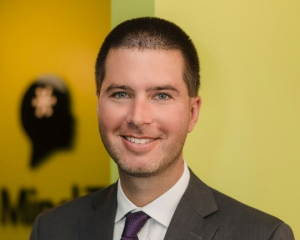
Brandon Brown, CEO of The Mind Trust
How it works: Scholarships are available to students in third through eighth grade who qualify for free or reduced lunch and score "below proficient" in math or language arts on the state’s standardized tests. Families receive $1,000 to spend on English and math tutoring or approved out-of-school academic programs.
Parents can pick a tutoring provider and monitor their fund balances online. The program doesn't allow them to mix and match different providers, so, according to Mind Trust CEO Brandon Brown, "it's not a full-blown ESA."
Who’s involved: The Mind Trust tracked down trusted vendors and community groups across the Hoosier State to provide tutoring in-person and online. Groups must meet a lengthy list of qualifications, get approval from a committee of experts, and send quarterly reports so families can track progress.
Why it matters: Students lost more than a third of a normal school year’s worth of learning when schools closed during the public health crisis. The harm continues to grow. New data show students still lost ground last school year.
Strong evidence suggests tutoring can help stop the slide. But school systems across the country are struggling to find enough tutors. Students aren't showing up for tutoring sessions. And parents don't think it's necessary or aren't aware of opportunities.
Speading the word: Indiana Learns hopes to enroll 15,000 students. The marketing plan included radio ads and school outreach to families.
How it's going: This year, the program expanded to allow schools to serve as providers and deliver the tutoring onsite while students are in class. Research shows this can make tutoring more effective by making it easier for students to participate consistently.
Early results appear positive, Brown said. However, because the program started last fall, it will likely be next year’s annual assessment results that will be able to show its full impact.
Paying it forward: Indiana is paying for the $15 million program with non-recurring federal pandemic relief money. Brown said leaders are in early stage talks to finding a long-term funding source.
“I think state leaders are clear-eyed that this going to take a long-term multi-year commitment, and we need to find ways to scale and sustain existing programs that are working.”
 This is our first attempt at a weekly compendium of news and insights that provide relevant insight to efforts to transform education.
Abundant Opportunity
One of the most insightful responses to the recent U.S. Supreme Court decision blocking affirmative action policies in university admissions came from NYU Marketing professor Scott Galloway. The solution, he argues, is to create radically more space in top universities.
Rejectionist Nimbyism is a means of transferring of wealth from young/poor to old/rich: skyrocketing value in existing degrees and houses while the cost for young people to attain their dreams has — in lock step — also skyrocketed.
If we can scale companies 40% per year, then we can expand enrollments at our great public universities 6% per year. The system is ready. Remote learning and utilizing campuses during non-peak periods (summer, nights, weekends) could double capacity. Stop building luxury dorms and lazy rivers. Abandon our obsession with four-year liberal arts degrees — we can continue to produce poets and philosophers, but also plumbers and cybersecurity technicians.
Why it matters: So much parental anxiety, and so many barriers to meaningful change to education systems at all levels, trace back to a common problem: Scarcity. Parents perceive, often correctly, that spaces in desirable public schools or sought-after universities are hard to come by. Opportunities should be abundant.
Cheaper and Easier
Technology industry watcher Benedict Evans explains why, like other technological leaps, AI will likely create more jobs than it destroys.
New technology generally makes it cheaper and easier to do something, but that might mean you do the same with fewer people, or you might do much more with the same people. It also tends to mean that you change what you do. To begin with, we make the new tool fit the old way of working, but over time, we change how we work to fit the tool.
Why it matters: In theory, making existing work cheaper and easier should help make opportunities more abundant (e.g., a tutor for every child). Unfortunately, our education system has a history of domesticating new technologies rather than being transformed by them.
Numbers to Know
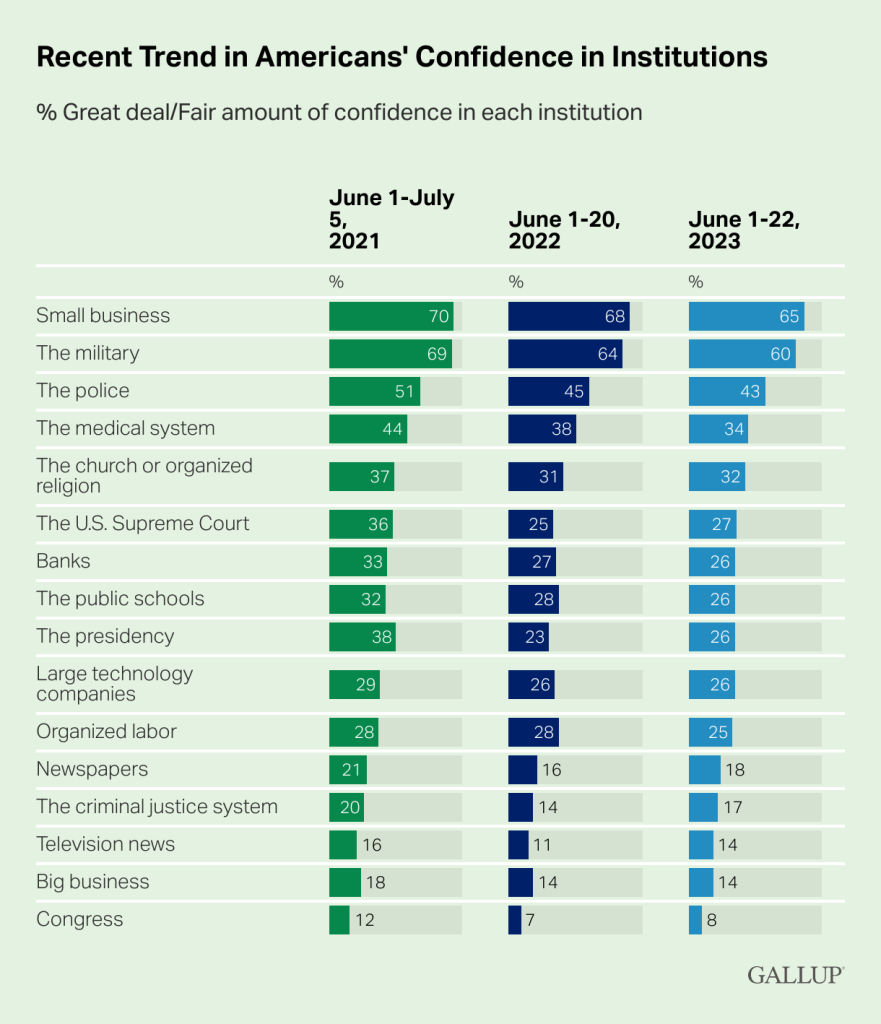
26: Percentage, according to Gallup, of Americans who express at least "a fair amount" of confidence in the nation's public schools.
2,180: Number of Florida students who started homeschooling last year.
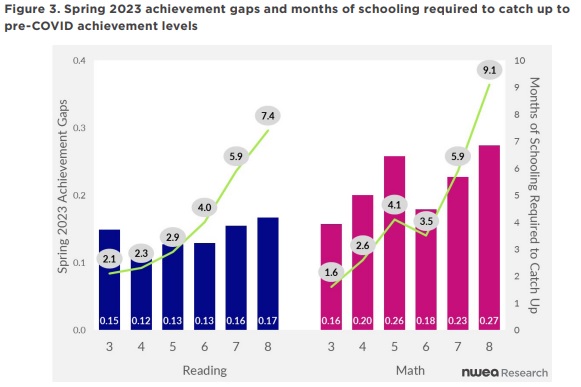
9.1: The number of additional months of schooling the typical U.S. 8th grader would need to return to pre-pandemic achievement levels, according to new estimates by NWEA.
-7: Percentage difference between those 8th graders' academic progress last school year and pre-pandemic growth levels. (Translation: At a time when their learning needs to be accelerating, it's still moving backward.)
33: Percentage of American students estimated to be chronically absent from school in 2022.
The Last Word
The U.S. is in the midst of an unprecedented decline in learning, with students falling far behind over the past few years. So why are the millions of children performing below grade level not in summer school? America is missing a critical opportunity and, sadly, tragic consequences will result.
- Michael Bloomberg, writing in The Wall Street Journal.
Was pandemic learning loss a necessary evil to create a more just society?
One teachers union representative from Richmond, Virginia seems to think so. In an interview with ProPublica, Melvin Hostman, who serves on the Richmond Education Association’s executive board, remarked that “the whole thing about learning loss I found funny is that, if everyone was out of school, and everyone had learning loss, then aren’t we all equal? We all have a deficit.”
When confronted with evidence that learning loss disproportionately affected already-disadvantaged populations, Hostman doubled down, pinning the blame on American society’s intrinsic inequities. “Now people are saying, ‘We’re going back to the way things were before,’” Hostman added. “But we didn’t like the way things were before.”
It’s worth noting that Hostman’s position is extreme and uncommon. The vast majority of educators — including those affiliated with prominent unions — are not only worried about learning loss, but also support traditional methods (like extra instructional time and targeted tutoring) of overcoming it.
However, a disturbing number of union representatives and advocacy groups see the pandemic’s aftermath as an opportunity for social and educational re-engineering. In other words, terms like “learning loss” and merit” are now considered old-fashioned at best and something far more sinister at worst.
If union representatives like Hostman want an honest conversation about reform, they have to stop trying to put lipstick on a pig. School closures were incredibly harmful — particularly for disadvantaged students who needed in-person education the most.
More specifically, learning loss, at least in the 2020-2021 school year, was by no means an inevitability. Kids didn’t fall behind because of structural inequities in the American educational system; kids fell behind because many states and districts made a conscious decision to keep them out of school for extended periods of time.
Salt Lake City didn’t even start reopening their schools until February 2021. Students in other places endured even greater turmoil — for New York City, Washington DC, and many school districts in states like California and Illinois, full reopening wouldn’t come until the 2021-2022 school year.
As a result, private schools, which were much more likely to be open for in-person instruction, saw an influx of students. The greater awareness of alternatives helped fuel parents' demand for more choices and led many states to establish or expand education choice programs.
The results speak for themselves. A Harvard study released last year, which analyzed data from more than 2.1 million students, found that school districts that employed remote learning for longer suffered a higher degree of learning loss. In contrast, students in states like Texas and Florida, which resumed in-person learning as quickly as possible, “lost relatively little ground.”
“Interestingly, gaps in math achievement by race and school poverty did not widen in school districts in states such as Texas and Florida and elsewhere that remained largely in-person,” said Thomas Kane, one of the study’s authors, in an interview with the Harvard Gazette. “Where schools remained in-person, gaps did not widen…where schools shifted to remote learning, gaps widened sharply.”
Taken to their logical end, Kane’s comments directly contradict Hostman’s claim, and confirm that America’s children’s experiences were not “all equal.” Children, many from already disadvantaged backgrounds, were kept out of school unnecessarily and suffered disproportionate learning loss as a result.
I’m not about to claim that the chaos was intentional. I’m sure most school closures were done in good faith, even though the scientific research overwhelmingly backed reopening. However, all policy choices have consequences, and these consequences were particularly severe.
Simply put, Hostman’s claim was just plain wrong. Any debate regarding what to do next must start there.
Garion Frankel is an incoming doctoral student in PK-12 education administration at Texas A&M University. He is a Young Voices contributor, and frequently writes about education policy and American political thought.

Welcome to a new kind of tension
All across the alien nation
Where everything isn't meant to be okay
-Green Day, American Idiot
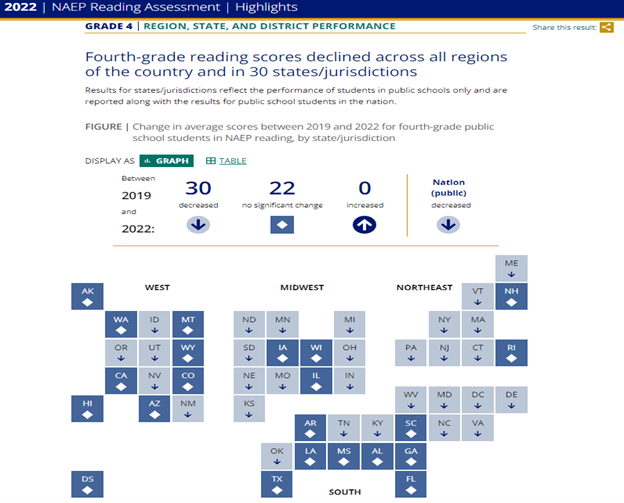
NAEP’s 2022 state release had catastrophic news on the math front, but it should not overshadow the very bad news on reading. Reading wasn’t exactly trending in a positive direction before the COVID-19 pandemic, and the last thing the country needed was to accelerate that trend. In a majority of states, sadly that is exactly what happened. NAEP released the below modern-art maps showing 2019 to 2022 trends in fourth grade reading by state. A down arrow signifies a statistically significant decline in scores, a star no significant change.
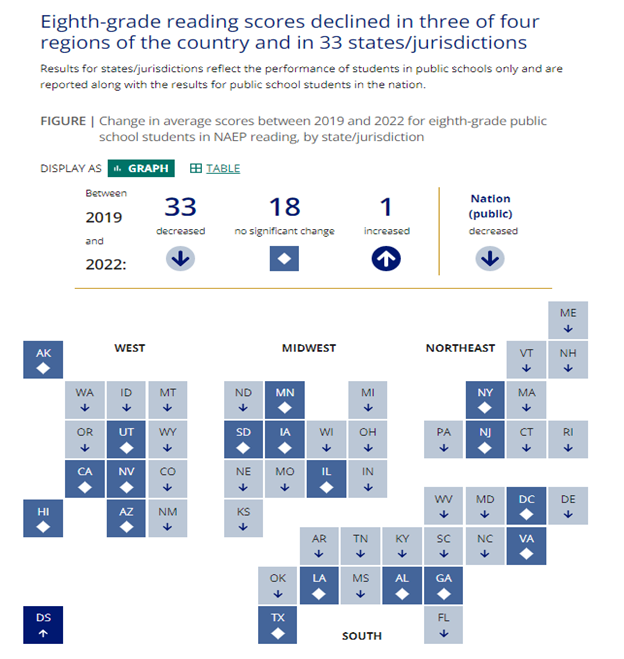
And here is the map for eighth grade reading:
Let’s just get right to the harsh realities part of the post: reading deficits are very difficult to remediate, and the public school system is not designed to detect and remediate academic deficits in any kind of broad fashion. Not to say that it never happens, rather that for decades young Americans score better on international exams than middle school Americans. They’ve acquired unaddressed deficits, and then many go on to drop out and/or require remediation after high school. There have been some efforts at remediation, such as Arizona lawmakers paying for 100,000 students to attend summer camps in 2022 (after the NAEP). Gov. Doug Ducey has announced they will repeat the camps in 2023.
America will be less literate, less numerate, and poorer in the long run. There are federal billions lying around in school district accounts, and just look at the maps above to see how effectively they have been used thus far. If you have school-aged children or grandchildren, I can only recommend that you investigate private tutoring services. If you are waiting around hoping the public school system will clean this up, you are making a terrible mistake. Don’t want to have an American illiterate? You’ll need to take matters into your own hands.
Editor's note: This post originally appeared in K-12 Dive.
The Nation’s Report Card is in, and it’s one that the U.S. Department of Education begrudgingly signed off on — but not without a warning to do better.
The scores show declines in both reading and math at grades 4 and 8 for the majority of states in 2022, according to results released Monday for the National Assessment of Educational Progress. Average national reading scores in 2022 reverted back to levels last seen in the 1990s, and math scores saw the largest declines ever recorded in that subject.
“Results in today’s Nation’s Report Card are appalling and unacceptable,” U.S. Education Secretary Miguel Cardona told reporters. “This is a moment of truth for education.”
The average math score for 4th graders fell 5 points since 2019 (from 241 to 236), while the score for 8th graders dipped 8 points (from 282 to 274), according to the Education Department’s National Center for Education Statistics, which administers NAEP.
In reading, average score declines were not as steep, but still decreased by 3 points in both grades compared to 2019.
NCES Commissioner Peggy Carr described the results, which are based on tests administered in early 2022, as “massive comprehensive declines everywhere.”
To continue reading, go here.
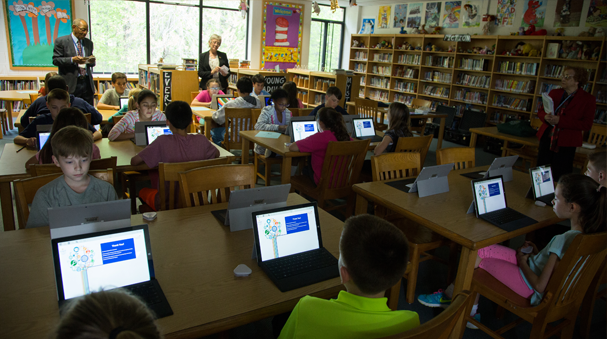
NAEP released 2022 state and large urban district data early this morning. Scores dropped in all four tested subjects (fourth and eighth grade math and reading) almost across the board. Nationally the drops were -3, -3, -5 and -8 points on fourth grade reading, eighth grade reading, fourth grade math and eighth grade math, respectively, from 2019. On these exams 10 points approximately equals a grade level of average progress, and the scores in 2019 were also generally down.
Florida’s scores fell in both math exams, held steady on fourth grade reading and declined modestly on eighth grade reading.
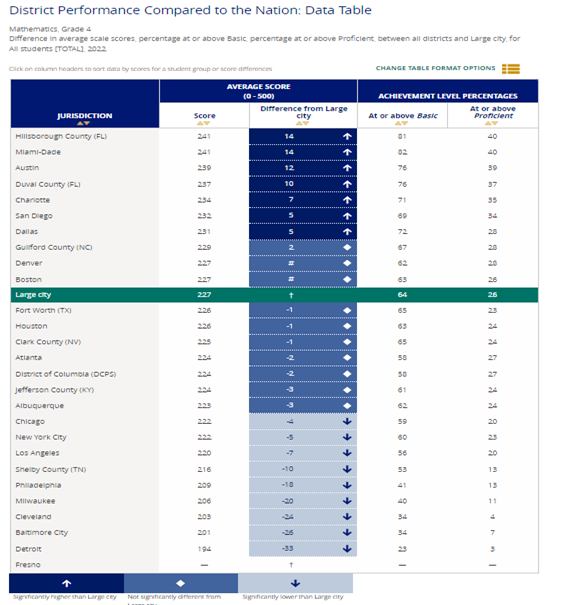
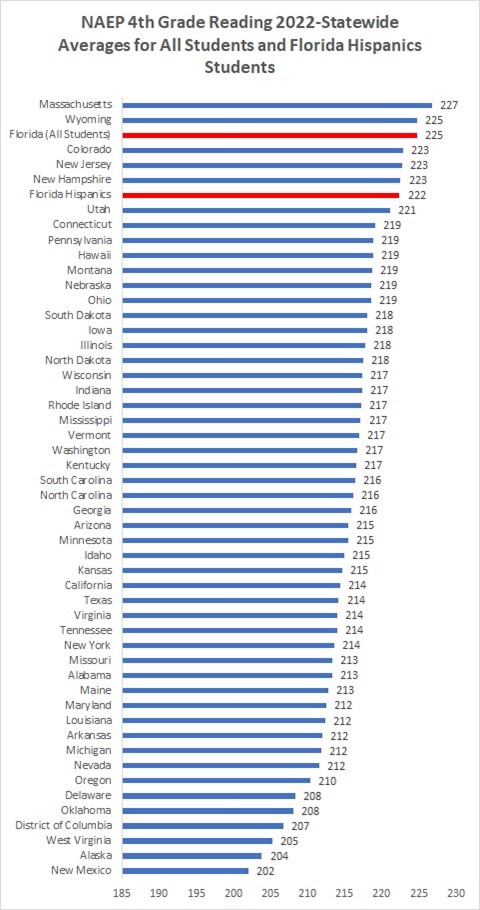
Some bright spots: Florida’s fourth grade reading performance still shines. For example, on the Trial Urban District Assessment (TUDA- the NAEP for select large urban districts) the three Florida districts ranked first, second and third with differences 14, 14 and 10 points above the national average for large cities nationwide. Florida students ranked third on fourth grade reading in 2022, and if Florida’s Hispanic students ranked seventh compared to statewide averages for all students.
Charter school students and students with disabilities also appear to be relative bright spots for Florida, but the overall challenge on the math front is considerable. And nationally the news is nothing short of a catastrophe, as you can see in the chart below by state:
If there is a silver lining here, it is that math is not as difficult to remediate as reading. Given these huge deficits and the even more gigantic amounts of unspent COVID-19 funding, let’s just say that a sense of urgency has been noticeably lacking. If you have children or grandchildren, I would advise you to get them to a math tutoring service ASAP- don’t give the system the chance to let them down again. Florida pioneered a micro-grant for the purposes of reading remediation; lawmakers would do well to do the same for mathematics.

