I agree with Utah state Sen. Aaron Osmond’s assertion that over the last 150 years government has used compulsory school attendance laws to inappropriately usurp much of the parents’ responsibility and authority for educating their children. But while I believe this educational responsibility should be restored to parents, I also believe compulsory school attendance laws should be maintained, with some modifications.
Tuthill
When mandatory school attendance laws were first passed in the mid-19th and early-20th centuries, brick-and-mortar schools and formal instruction were synonymous. That’s not necessarily the case today. In this new era of digital technology and customized teaching and learning, students are increasingly being educated in venues as diverse as libraries, community centers, private homes, museums, and Starbucks.
This proliferation of eclectic learning environments suggests our education laws should focus on compulsory learning and not compulsory school attendance. As long as children are making adequate progress mastering their state’s academic standards, the public should not care where this learning is occurring.
I oppose Sen. Osmond’s proposal to eliminate mandatory attendance (or learning) laws because the parents’ authority to education their children should not be absolute. Parents should never have the authority to purposely raise an illiterate child. That’s child abuse.
The Washington Post made a similar point in its recent editorial criticizing Virginia’s religious exemption law, which allows parents to opt out of the school attendance law without providing any evident their children are becoming literate:
“States have an interest and an obligation to see that children get a basic education; that’s why we have compulsory attendance laws. By writing such a broad exemption, Virginia has tipped the scales that balance a parent’s religious freedom with a child’s right to an education.”
In many ways, we’ve already begun making the transition from compulsory attendance to compulsory learning. In most states, homeschooling satisfies compulsory school attendance laws if parents can prove their children are making adequate academic progress. Unfortunately, what constitutes adequate academic progress is often vague and a source of disagreement between parents and local officials tasked with enforcing school attendance laws. If we're going to properly balance the parents' authority to educate their child with the government's interest in protecting children from abuse, then we must improve our ability to determine what constitutes acceptable academic progress for each child.
The new Common Core State Standards should help with this task since most students nationally will be working toward mastering the same content standards and their collective progress should help inform the progress we should expect from individual children.
Public policy should be more deferential to parental authority, but this authority cannot be absolute. We can create and implement policies that honor parents’ authority to educate their children while still protecting the child and society from abuse.
An expansive power of parents over their own children has been recognized by the U.S. Supreme Court since the 1926 decision in Pierce v. Society of Sisters. There, Oregon had attempted to make education in State schools compulsory; the court unanimously reaffirmed the independence and supremacy of the parent. This was guaranteed, it said, in the “due process” clause of the 14th Amendment. This rather mystical phrase - and similar potent, if obscure, clauses - have since been employed repeatedly to reaffirm the broad parental sovereignty. Even loving grandparents need parental permission to visit little Susie.
So parental authority has, in Pierce and its progeny, a certain protected status. Would it, nonetheless, be prudent and helpful - assuming the argument is plausible - for champions of parental authority to assert its reality as a source of law that exists quite independent of the Constitution, but is recognized and protected by it in the Bill of Rights?
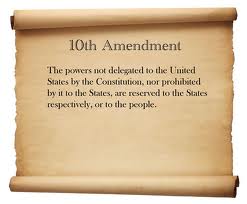
Perhaps so. I will argue the institution of parenthood might be considerably more secure under the 10th Amendment than under the ever malleable “due process.” The court could be grateful for the relative clarity - and judicial restraint - that under the 10th would mark the boundary between the power of mother and the rights of Susie. Equally important, the child herself could claim this precious parental authority as a right of her own.
The primary example of this possibility could emerge in the effort to make parental school choice a reality for all families. The present economic compulsion experienced by modest and low-income parents to accept the free schools of The State as their mentor could well appear a violation of the child’s own right as well as an unjustified intrusion upon the parental authority which today, in practice, is reserved to our higher-income families. And sheer human dignity could come as a bonus for all. (more…)
 President Obama has often called on us to be true to who we are as a people, as Americans. And in his second term, he has the opportunity to transform the education system back to our core - to where parents are primarily in charge of children’s educations.
We have paid a price for transferring authority and responsibility for educating children from parents to government entities. With mostly though not always good motives (remember Brown v. Board of Education), we allowed the dream of the government-owned and operated common school to live on despite overwhelming evidence that, in reality, it wasn’t working. A child’s educational destiny continues mostly to be a function of his/her zip code and the competence of strangers who sit on local school boards.
For more than three decades, a long, slow correction of this anomaly in American society has been underway. First, intradistrict and interdistrict transfers began to appear that allowed limited parental choice within some parts of the public school system. Then magnet schools surfaced, offering options such as vocational, talented and gifted, and language immersion programs, and responding to more demands. In 1992, charter schools emerged. Today they account for almost 6 percent of all public schools, approaching 6000 total, and the number grows steadily each year because the demand from parents so far is insatiable.
Thanks to my colleague at the American Center for School Choice, Gloria Romero, a new tool has appeared. The parent trigger empowers parents to make changes to their school when they are not satisfied. Already 20 states have considered the approach and seven have adopted laws.
Private school choice programs continue to gain support, too. And they have done so despite fierce opposition from forces that want to defend market share over a parent’s right to choose. Today, 32 such programs operate in the country. And in recent years, many school choice bills have either been passed by legislatures with Democratic majorities or signed by Democratic governors. Just as important, once enacted, these programs have only grown. No state has repealed a program or decided choice does not serve the public well. Moreover, the doomsday scenarios that opponents consistently forecast for public education systems have never happened.
It’s said you can’t argue with a river; it is going to flow. Parents are going to take back the authority and responsibility for educating their children. The river has been flowing for more than 20 years and the current is gaining speed. It’s time for more Democrats to stop arguing as families assert their fundamental and universally accepted American value that they know the best choice for their children. Democrats need to work in positive ways to transform our system. We need good schools and there’s plenty of room for all types - public, charter, and private.
President Obama has the life experience, as well as the political skills and credentials, to lead this transformation, and to make it less jarring and less confrontational. (more…)
The gurus of school choice have often shuddered at the word “regulation.” On occasion this instinctive hostility has been tactically justified. Viewed objectively, however, it is meaningless - even self-contradictory. And too often has it driven fair-minded listeners from the civic conversation about the ideal structure of this very necessary reform called “school choice.”
Regulation is itself a pre-condition of any system of choice, whether the intended beneficiary be the have-not family or the comfortable suburbanite. The empowerment of parents always comes as the effect of a particular set of rules. Nor is this reality limited to reforms aimed at the complex and private world of the family. The simplest of legal systems - one, for example, that embraced the most complete market freedom - would depend upon the regulatory oversight of some third-party authority to interpret and enforce those promises which constitute any market. Contracts are not self-enforcing. Nor is parental choice or any other human regime.
Children present perhaps the most obvious example of my point; by nature their lives will be regulated by someone. The only question is “by whom?” That the state will be one of the players seems quietly accepted by all. This includes the school choice reformer who has unequivocally embraced compulsory education - a thing to be enforced and paid for by the state. The issue, then, becomes how far beyond the requirement of schooling shall the state penetrate the natural territory of the family?
We appear to agree on rules forbidding child abuse. Beyond this and compulsory schooling, where shall we the people allow (or require) the state to go? The answer can come only in some cluster of regulation - some that command, some that limit the state. If it is parents who are to rule (i.e., to regulate their children), then government must be commanded (again, regulated) first - in a positive way - to subsidize the family’s preference in schooling, and second – negatively - to avoid subverting parental authority by unnecessary busybody rules. The state itself must be ruled in both positive and negative ways: it must do this; it may do this - but not that. (more…)
Most parents try to protect their child from dangers, to nourish their child's development, and to instill values and a sense of purpose in their child so that, as he or she matures, each child will be able to make sensible choices for his or her own life path.
Yet, most parents need government assistance in order to promote their children's best interests. For one thing, if left unchecked outside forces may overwhelm parental efforts. These include the child's peers, undesirable cultural and commercial influences, and so on. In addition, family poverty and ignorance may prevent parents from effectively carrying out their roles.
To be clear, parents need help, not only from extended family members and the community at large, but also from government. For example, public regulation can increase parental power and authority over their children by preventing others (like retail cigarette sellers) from tempting children into self-destructive behaviors. The state can also provide information (or require others to provide information, like movie ratings) that parents need to enable them to make good decisions for their children. Moreover, government can provide resources (like food stamps) that some parents lack. In all of these power-enhancing ways, government can help parents better fulfill their responsibilities to their children.
Sometimes, in the name of "child protection," government reduces rather than enhances parental power. To be sure, as a last resort it may be necessary to substitute collective or professional decisions as to what is best for children. Yet policymakers may be too quick to override parental control when further empowering parents would, overall, be best for children.
Other times, government actions are misleadingly framed as "child protection" measures that, on closer analysis, may be better understood as actually parent-empowering (like issuing teenage driving licenses that limit when youths may drive and who may be in the car with them).
Add to that this key point: it may often be politically easier to win the adoption of a policy when it is understood as helping people be good parents than when it is understood as curtailing parental authority. Isn't helping people be good parents something on which conservatives (the "family values" groups) and liberals (who talk of "personal empowerment") agree? By contrast, the constituency may be narrower for "child protection" measures, especially those that are seen to push a large share of parents around because "legislators or experts know better."
Take the problem of childhood obesity, for example. Getting colas out of middle school vending machines and junk food commercials off TV programs aimed at children ages eight and younger removes temptations that parents generally would like to be out of sight. Policies that would achieve those ends empower parents to have more control over what their children eat. This is not the nanny state. Parents who still want to feed their kids Froot Loops and have them drink Cokes are free to do that.
Finally, then, consider the debate over school vouchers (or scholarships) for children from households of modest means. They should not be defended on the ground that this mechanism will improve the test scores of America’s children or that it will destroy teachers’ unions and unleash the wondrous innovations of capitalism. Those are collective objectives that some people favor (and others oppose, doubt, or care little about). Rather, subsidized school choice is best promoted on the ground that it empowers additional families to make decisions for their children that nearly all parents want to be able to make. Just like food stamps, school scholarships for needy families can help parents be better parents.

