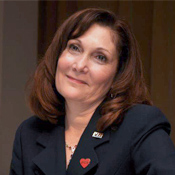
Segal
Editor's note: This post first appeared as an op-ed in the Tampa Tribune. Step Up For Students, which administers the state's tax credit scholarship program, co-hosts this blog.
Eileen Segal is a gracious Florida PTA president who welcomed to her annual conference last summer a contingent of low-income parents who take advantage of a state scholarship for their children.
So she was speaking from the heart in a crowded House committee room last month when she said: “What you’re doing here today is very sad; it hurts my heart. Parents should not fight against parents. We all need to work together because we all want the same thing for our children — the best-quality education.”
Eileen is right, and yet she was part of a PTA group that had come to the Legislature to condemn the educational option that parents of 60,000 of the state’s poorest students have chosen this year. The audience that day was crowded with scholarship parents and their children, who in some cases sat next to PTA parents who stood on the other political side.
The PTA is not alone in this regard. A group called Parents Across Florida has written rather viciously about how the Tax Credit Scholarship for low-income children should be abandoned, even arguing that “vouchers actually strip away parents’ ultimate choice” and that parents want only neighborhood schools and “don’t want to be forced to shop around.” A group called Fund Education Now, which is led by three women who have played a constructive role in fighting for greater investment, has called the legislative effort to expand the scholarship to more underprivileged children “shameless.”
This jarring juxtaposition is hard to miss and harder to explain.
The general politics of school choice is relatively clear. Many of the established education groups reflexively oppose initiatives that are viewed as Republican priorities, which is why Democrats — even those who have supported help for low-income students in the past — are apt to run to the other corner. School boards see it as their mission to fight any program that reduces enrollment in the schools they operate, and the Florida Education Association continues to fight any option whose teachers are not represented by the union. But do parents really have to fight against each other? (more…)

Shirley Ford
The mom on stage described how she and other low-income parents rode a bus through the darkness - six hours, L.A. to Sacramento, kids still in pajamas - to plead their case to power. In the halls of the legislature, people opposed to the idea of a parent trigger accused them of being ignorant, of not understanding how schools work or how laws are made. Some called them a “lynch mob.”
Then, Shirley Ford said, there was this sad reality:
“I would have thought that the PTA would have been beside me,” Ford said. But it wasn’t. “I’m not PTA bashing when I say this,” she continued. “To see that the PTAs were on the opposite side of what we were fighting for was another level of awareness of how the system is.”
Ford is a member of Parent Revolution, the left-leaning group that is advocating for parent trigger laws around the country. She spoke last week at the Jeb Bush education summit, sharing the stage with former California state Sen. Gloria Romero and moderator Campbell Brown. Her remarks, plain spoken and passionate and sometimes interrupted by tears, touched on a point that is vital and obvious and yet too often obscured.
Parents are not a monolith.
The divides are as apparent as the different dynamics that play out in schools on either side of town. In the affluent suburbs, a lot is going right. There is stability in the teaching corps. The vast majority of kids don’t have issues with basic literacy. The high schools are stocked with Advanced Placement classes. And there, behind it all, are legions of savvy, wonderfully dogged, politically connected parents who know how to mobilize when their schools are shortchanged.
The view is starker from the other side of the tracks. A parent in a low-income neighborhood is more likely to see far more teacher turnover in her school – along with far more rookies, subs and dancing lemons. She’ll see far more students labeled disabled and far fewer AP offerings. Issues like these plague many high-poverty schools, yet they don’t get much attention from school boards or news media or, frankly, from established parent groups like the PTA. (more…)
Editor's note: Here's our latest round-up of interesting stuff from other ed blogs.
Rick Hess Straight Up: Self-Pitying Tantrums Are Poor Way for Educators to Win Friends, Influence People
 Fact 1: Teachers feel like they're getting a bad rap in the public discourse.
Fact 2: I've long since stopped reading the comments proffered on RHSU.
What in the world do these two statements have to do with each other? I think it's simple. Self-proclaimed advocates of educators and public education have become so vitriolic, mean-spirited, arrogant, and unreasoning that it's becoming inane to anyone who's not a fellow true believer. This means that they're poorly positioned to convince Americans, and painfully uninteresting to anyone who doesn't agree with them already. ...
I was enamored by the self-identified teacher who wrote, "I honestly wonder what you're doing, writing about a profession that you so clearly despise. I also wonder about the integrity of Education Week, since it keeps publishing more and more hit-pieces by people like you, who openly brandish his anti-union, anti-public education, and anti-public school teachers attitudes, just to satisfy the whims and expectations of sponsors such as the Gates foundation and others...Unlike hacks like you, we can not charge over time, or demand to be payed [sic] by the column, or the word. You sir, are the worst kind of demagogue, attacking a noble profession, while disguising your broadsides as concerns over our benefits." Another wrote, "Well, Rick anyone can blog on and on about the virtues of deceit. Pity the folks in Wisconsin who couldn't quite get it together to alter the lopsided equation." Truthfully, I'm not even sure what this means. Full post here.
Cato@Liberty: State Rep. Balks at Voucher Funding for Muslim School
Just as Louisiana’s legislative session was wrapping up earlier this month, state Rep. Kenneth Havard refused to vote for any voucher program that “will fund Islamic teaching.” According to the AP, the Islamic School of Greater New Orleans was on a list of schools approved by the state education department to accept as many as 38 voucher students. Havard declared: “I won’t go back home and explain to my people that I supported this.”
For unreported reasons, the Islamic school subsequently withdrew itself from participation in the program and the voucher funding was approved 51 to 49. With the program now enacted and funded, nothing appears to stand in the way of the Islamic school requesting that it be added back to the list, and it is hard to imagine a constitutionally sound basis for rejecting such a request.
This episode illustrates a fundamental flaw in government-funded voucher programs: they must either reject every controversial educational option from eligibility or they compel taxpayers to support types of education that violate their convictions. In either case, someone loses. Either poor Muslims in New Orleans are denied vouchers or taxpayers who don’t wish to support Muslim schools are compelled to do so.
It doesn’t have to be that way. Read post here. (more…)
Discussions about how best to improve student learning often get contentious, so at redefinED we try to make a positive contribution by identifying areas of possible common ground and clarifying the historical record when we see errors or omissions. Rita M. Solnet’s recent Huffington Post column on how Florida might better utilize its standardized testing data gives us an opportunity to do both.
Rita is a founder of Parents Across America, a group that opposes excessive reliance on high-stakes standardized tests. And since Rita lives in Florida, she is particularly unhappy with how Florida uses – or, she would say, abuses - its state testing data. Rita ends her column with some ideas that provide the basis for common ground, but her piece also includes some erroneous Florida history, which I want to correct.
In 1991, the Florida Legislature passed the Education Reform and Accountability Act, commonly known as Blueprint 2000. Florida had experimented with giving teachers and schools more decision-making power in the late 1980s, and Blueprint 2000 was intended to accelerate this effort. The grand bargain was that state and local government would stop micromanaging schools in exchange for individual schools being held accountable for results.
While the legislation passed with strong bipartisan support, the primary advocates were all Democrats. They included Gov. Lawton Chiles, Lt. Gov. Buddy McKay, Commissioner of Education Betty Castor, Rep. Doug “Tim” Jamerson and Sen. George Kirkpatrick.
Two months after the legislation passed, the Florida Commission on Education Reform and Accountability was convened to create the legislatively mandated standards, assessments and accountability system. I was the teachers union president in Pinellas County in 1991, and Commissioner Castor appointed me to be one of three teacher representatives on the commission.
The U.S. Department of Labor released the Secretary of Labor's Commission on Achieving Necessary Skills (SCANS) report in June 1991, outlining the knowledge and skills students would need to succeed in the 21st Century. Our commission was impressed and decided to base Florida’s standards on the SCANS recommendations, which included literacy skills (reading, writing, mathematics), thinking skills (problem solving, decision making), personal qualities (honesty/integrity), resource management (time, money), information management (organizing, processing, interpreting), and technological competence.
Several commissioners argued that we could measure the SCANS standards using an International Baccalaureate-type assessment system that included multiple internal and external assessments, but the Florida Department of Education’s student testing staff strongly disagreed. Its concerns were legal and operational. (more…)
Media coverage of education reform in Florida never ceases to amaze. What you should be hearing today are the sputtering responses of critics who have drawn widespread media attention in recent weeks with reckless claims that Florida’s ed reforms are an “unmitigated disaster.” Instead ...
The easy prompt for fair and obvious questions was yesterday’s release of the annual “Diplomas Count” report from Education Week. The independent analysis found that between 1999 and 2009, Florida’s graduation rate climbed 18 percentage points – more than all but two states. It also found that Florida’s black and Hispanic students are graduating at rates higher than the national average for like students, which is of no small import for a majority-minority state like Florida. The 2009 rate for Florida’s Hispanic students, in fact, put them at No. 2 among Hispanic students in all 50 states.
So how did the Florida media cover this compelling news? For the most part, it didn’t. (more…)
 Families who benefit from expanded school choice options – charter schools, virtual schools, vouchers, tax credit scholarships – are increasingly being portrayed as pawns in a coordinated campaign to privatize public schools. That’s especially troubling given that the voices of those families are so rarely included in the conversation.
The latest example: Statements from a movement to end high-stakes, standardized testing.
United Opt Out National, which led an effort over the weekend to “occupy” the U.S. Department of Education in Washington, D.C., says it wants to “end Wall Street Occupation of Education.” Among its goals: An end to "the use of public education funds to enact school 'choice' measures influenced and supported by the corporate agenda."
This story in The Florida Independent about the group’s efforts (a Miami-Dade teacher/parent is among the group’s leaders) focused most specifically on its concerns about for-profit charter schools. But by referencing vouchers and tax credit scholarships, the story suggested those options were also part of a plot to undermine public schools.
That kind of characterization about school choice is happening more and more as newspapers and TV stations echo the emotional story line that gets repeated the most. (more…)

