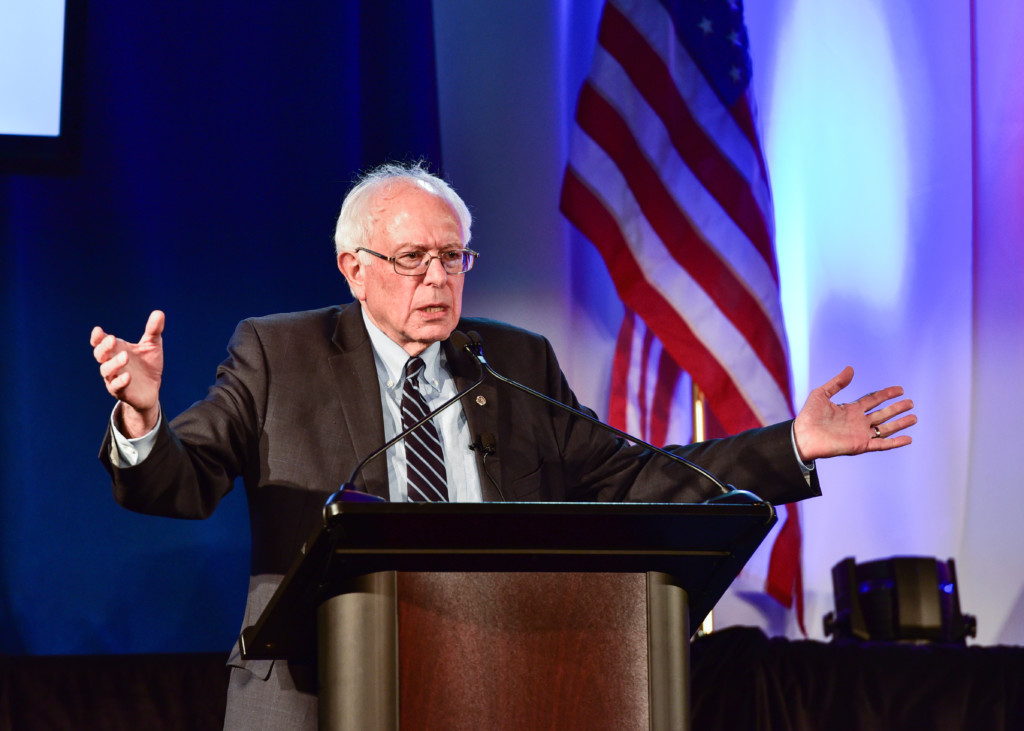
 With the presidential primary election in delegate-rich Florida just two months away, Democratic candidates are beginning to knock on the door.
In a Monday column in the South Florida Sun-Sentinel, Vermont Sen. Bernie Sanders found little to like about Florida’s public education system. But our focus is on educational choice and three assertions he made while insisting that “Florida is ground zero of a school privatization movement intent on destroying public education.”
“Each year almost $1 billion in state money goes to private schools instead of public schools.”
“These private schools operate with little to no accountability.”
“In many cases, their students’ math and reading skills have declined.”
These claims are misleading, at best.
Claim No. 1: The $1 billion citation draws attention but does not prove Sanders’ point. He implies that private school voucher and scholarship programs harm public schools financially, which is a longstanding and erroneous argument advanced by the Florida Education Association (FEA) that we have dealt with previously in this space. There is simply no evidence to support it.
Eight different independent financial studies all have concluded the scholarships, which cost less per student than the total amount spent in a traditional public school, save tax money that can be used to enhance public schools. Florida TaxWatch weighed in last year, finding existing scholarships cost 60 cents on the public school dollar. And the FEA lost its legal challenge to the 19-year-old Tax Credit Scholarship program in part because the trial and appellate courts summarily rejected its argument that public schools “have been and will continue to be injured by the scholarship program’s diversion of resources from the public schools.”
Claim No. 2: The qualifier in this assertion – that private schools operate with “little to no” accountability – gives Sanders some wiggle room in part because accountability is hard to objectively measure. But Sanders seems to dismiss entirely the accountability that is inherent with any school that survives only if parents choose it for their children.
That market concept may not appeal to a self-professed socialist but does have real-world consequences and, in the case of the state’s two scholarships for underprivileged students, gives genuine educational power to parents who typically have little.
As to the regulatory oversight, Florida’s largest program, the Tax Credit Scholarship serving 108,570 economically disadvantaged students this year, is ranked among the nation’s most aggressive. The students, schools and scholarship organizations are subject to roughly 17,000 words of statutory and agency regulations.
Among those requirements: scholarship students must take state-approved standardized tests; those test results are reported publicly every year; schools must submit annual financial reports by certified public accountants; and scholarship organizations must be audited each year by the state Auditor General and independent accounting firms.
Sanders is entitled to believe the program is not subject to sufficient regulation, but we rate his claim of “little to no” accountability as misleading.
Claim No. 3: Once again, Sanders uses an interesting qualifier – “in many cases” – in his assertion that scholarship students’ “math and reading skills have declined.” Eleven years’ worth of standardized test reports refute his claim.
Students who receive the Tax Credit Scholarship must take a nationally norm-referenced test each year approved by the state, and most take the Stanford Achievement. The test scores are sent to Florida State University’s Learning Systems Institute, which is paid to aggregate and report them publicly.
For the most recent year, 2017-18, scholarship students scored on average at the 47.4 percentile in reading and 45.2 percentile in math. That’s basically average, which is encouraging given that these scholarships students are among the poorest in the state and were among the lowest-performing students in the public schools they left behind.
More to the point, their annual gains have been remarkably consistent. The scores reflect that these low-income students have achieved the same annual gains as students of all income levels nationally.
In other words, they have increased, not declined.
Certainly the average doesn’t reflect every student. In the most recent report, about as many students – 0.6 percent – achieved extraordinary gains of more than 40 percentile points as those who dropped an equivalent amount. But Sanders’ qualifier that “many” students declined seems intended to distort the overall test findings. We rate it mostly false.

Of the 220 private schools participating in scholarship programs from November 2018 to December 2019, 86 were fully compliant, while another 44 schools became compliant before the DOE issued a report to the school, according to the latest DOE accountability report.
The Office of Independent Education and Parental Choice at the Florida Department of Education visited more than 200 private schools participating in scholarship programs between November 2018 and October 2019 to ensure compliance with state regulations. In addition to the visits, the DOE investigated 123 written complaints, reviewed hundreds of fiscal reports, handled 14,656 calls, 12,158 voicemails, and 67,653 emails from private schools, scholarship parents and school districts.
That’s a lot of work for a department often accused of overseeing private school scholarship programs with no accountability.
The DOE’s report, released Dec. 16, provides details of school compliance regarding regulations on safety, employee background checks, financial soundness, and legal complaints from the general public.
According to the report, 2,117 private schools from the 2018-19 school year requested permission to continue participating in state scholarship programs. Of those schools, 131 were considered new.
Few of those more than 2,000 schools had regulatory issues according to the DOE’s report:
State law allows the DOE to visit any private school that has had a notice of noncompliance in the last two years or received a complaint about a violation of state law. Beginning in 2019, the DOE also is required to conduct a site visit on any new school wishing to participate in the program. Of the 220 schools visited, 86 were fully compliant, while another 44 schools became compliant before the DOE issued a report to the school. Of the remaining schools, all but one corrected their issues to remain qualified for the state’s scholarship programs.
Schools participating in the Florida Tax Credit Scholarship program for lower-income students also must submit national norm-referenced test results to researchers at the Learning Systems Institute at Florida State University. According to researchers, 234 schools failed to report test scores in a timely manner. By the time the DOE released the accountability report, just 23 schools had failed to submit test results.
The DOE also received 128 signed complaints from students, parents and faculty regarding private schools. The DOE determined 35 of the complaints were not legally sufficient to investigate. Legally sufficient complaints must demonstrate the school has failed to follow the law, such as having a fire inspection, completing a fiscal report, or conducting background checks on employees. During its investigation, the DOE concluded that 81 of the 93 remaining complaints had been resolved by the private school demonstrating compliance with state law. Twelve complaints remain open, though none is serious enough to require referral to the Office of the Inspector General.
The remainder of the report details the department’s outreach efforts, along with any recent legislative changes to the scholarship programs it oversees.
 Editor's note: Another year, another legislative session, another stack of school-choice bills in Florida. Here's a roundup of choice legislation that lawmakers will consider in the annual session that begins today.
Career Academies:
SB 1076 by Sen. John Legg, R-Lutz. Expands the "Career and Professional Education Act (CAPE)," revising requirements for high school graduation and accelerated high school graduation, and allowing students to earn and substitute certain industry certifications for certain course credits. Also requires districts to make digital materials available to students and to use the Postsecondary Industry Certification Funding List in determining annual performance funding distributions to school districts and Florida College System institutions, etc.
Charter Schools:
HB 373 by Rep. Joe Saunders, D-Orlando. Provides that a contract for a charter school employee or service provider may not extend beyond the school’s charter contract, and that the employee or service provider is not entitled to compensation after the school’s closure. (Identical to SB 780 by Sen. Geraldine Thompson, D-Orlando.)
HB 453 by Rep. Victor Torres, D-Orlando. Requires the compensation and salary schedules for charter school employees to be based on school district schedules. (Identical to SB 784- Charter Schools by Sen. Geraldine Thompson, D-Orlando.)
SB 744 by Sen. David Simmons, R-Altamonte Springs. Requires charter school applications to demonstrate the applicant is financially qualified to open and maintain a high-quality charter school, requires the charter to set forth detailed reporting of the financial operations of the school to ensure employees are not paid unreasonable compensation, and requires that the term of the charter must provide for cancellation of the charter if the school becomes insolvent, fails to provide a quality education, or does not comply with applicable law. The bill also clarifies that a charter school system shall be designated a LEA solely for the purpose of receiving federal funds if certain criteria are met.
SB 828 by Sen. Rene Garcia, R-Hialeah. Grants school districts the ad valorem tax exemption given to charter schools, and restricts the use of capital outlay funds for property improvements if the property is exempt from ad valorem taxes. It restricts charter schools or technical career centers having financial problems from certain activities, and grants flexibility to high-performing school choice districts.
HB 1001 by Rep. Karen Castor Dentel, D-Maitland. Prohibits charter schools from requiring, soliciting, or accepting certain student information before student's enrollment or attendance. Also requires charter schools to submit attendance plans to the school district for students enrolled in school; provide funding to the school district in event of student transfers; and report to the school district certain student enrollment and wait-list information.
SB 1092 by Sen. Geraldine Thompson, D-Orlando. Requires charter school to submit attendance information for each student to the school district, and requires the charter school to provide a prorated portion of per-student funding to the school district if a student transfers to another public school in the school district before the last day of the school year.
SB 1164 by Sen. Kelli Stargel, R-Lakeland. Revises the eligibility criteria for extracurricular activities to include students in charter schools, and revises the criteria for bylaws, policies, or guidelines adopted by the Florida High School Athletic Association. (Compare to HB 1279 by Rep. Larry Metz, R-Groveland.) (more…)

Tony Bennett
Tony Bennett on testing voucher students. From Gradebook: “I do believe we have a responsibility, be it at a public school or whatever, when we are spending taxpayer dollars - and I go back to what I believe we should do, set expectations, set standards and hold people accountable - that we should be able to prove that schools perform for the money they are given.” Full Q&A in Tampa Bay Times here.
More Tony Bennett. Lakeland Ledger: “Let's just hope he brings to the position a more inclusive management style than that of his predecessors."
“Life is combat.” From the Palm Beach Post’s Jac Versteeg: “Good morning, children, and welcome to your first day of first grade at Eddie Eagle Charter School. We will be piloting the new NRA curriculum the Florida Legislature has mandated for all public schools. My name is Mr. LaPierre.” Putting deputies in elementary schools makes more sense that arming teachers, editorializes the Northwest Florida Daily News.
Ed funding. The Gainesville Sun’s Ron Cunningham references the Legislatures “slash-and-burn approach to funding education” in his year-ahead column. The Ocala Star-Banner’s editorial board says the state’s “cheap route on education” is to blame for the Marion school district’s failure to meet class-size requirements. The Sun makes the same case for noncompliance in Alachua County.
On the right track. Broward Community College President J. David Armstrong notes how much academic progress Florida has made in the past decade. South Florida Sun Sentinel.
Career academies. Students in Palm Beach County’s career academies will get a chance to shadow professionals at their jobs, thanks to a partnership with the business community, reports the Palm Beach Post.
Rocky year in the rearview. A glance at the past year in Florida education from the Tallahassee Democrat. Some superintendents want a break from new mandates in 2013, the Democrat also reports.
School grades don’t show much. Editorializes the Palm Beach Post.

