The story: With less than a week to go before the U.S. Supreme Court hears arguments about the constitutionality of religious charter schools, supporters and opponents are making wildly different predictions about the possible effects.
 Supporters, who include advocates for religious education, are framing a win for their side as a victory for religious freedom and a logical extension of recent rulings that affirmed faith-based schools’ right to participate in publicly funded programs.
“This is a way of getting new choice options in the context of performance accountability,” said Andy Smarick, a senior fellow at the Manhattan Institute, during a recent debate about religious charter schools sponsored by the American Enterprise Institute. “A small number of religious organizations might apply to run charter schools, and I think that’s wonderful and not going to change the world.”
The Manhattan Institute is among the organizations weighing in on the side of religious charter schools.
Opponents, which include the National Alliance for Public Charter Schools, are sounding the alarm over what they say could cripple a movement that began more than 30 years ago to launch innovative new public schools.
The other side: The National Alliance for Public Charter Schools warned that a ruling allowing religious charter schools could carry “catastrophic consequences” for the nation’s existing charter schools.
For religious charter schools to exist, they argue, the high court would have to redefine charter schools as private. That would overturn laws in 46 states, plus Washington, D.C., and Puerto Rico, that define charters as public and thus threaten their ability to be funded under the same per-pupil formulas as school districts.
Yes, and: Charter supporters also point out the potential for ripple effects, such as charter schools losing facilities funding, questions about teacher participation in state benefit programs, or more drastically, calls to halt the approval of new schools or even funding of existing ones.
“This could lead to the destruction of chartering or limiting of chartering,” said Kathleen Porter-MaGee, a managing partner at Leadership Roundtable, an organization that brings together laity and clergy to support the Catholic church.
Instead of extending charters to religious groups, she encouraged a doubling down on private K-12 scholarship programs, which are now established in 29 states, with Texas poised to become the 30th.
Expanding scholarship programs for private education would let faith-based schools maintain instructional and employment practices that align with their beliefs, free from government interference, while allowing them to serve families who would not have access without private funding.
Catch up: The legal and political battle rocketed to the Supreme Court shortly after two Catholic dioceses won approval from Oklahoma’s statewide virtual charter review board in 2023 to open St. Isidore of Seville Catholic School, an online charter school that would include the same Catholic teachings as the church’s in-person schools.
The fight pitted Republicans against one another, with the current Oklahoma attorney general taking a position opposite his GOP predecessor and filing a lawsuit. It also divided the charter school movement, with national groups forcefully opposing a legal argument that could redefine their status as public entities and some charter schools arguing they would welcome the change.
While Oklahoma has a refundable tax credit that pays up to $7,500 per child for private school tuition, the program was not available until January 2024, about six months after St. Isidore applied for charter school authorization.
Possible upsides of a win for St. Isidore:
“Catholic schools have been doing things on the cheap for far too long,” Smarick said. “This is the opportunity to say you can remain private for as long as you want…but if you think you can do more for your mission in the charter school context, you can.”
Possible downsides:
Charter groups preparing: In case the court rules in favor of St. Isidore, advocates of established charters are working on model legislation that would allow states to maintain funding. A finding that says charter schools are not state actors also raises many questions, such as whether the ministerial exception, a legal doctrine that shields religious organizations from non-discrimination laws in the hiring of staff with ministerial duties, would apply to faith-based schools.
“No one knows what the court is going to say,” Smarick said. “State legislatures need to step up fast and answer these questions.”
Tune in: The U.S. Supreme Court has scheduled oral arguments in the case for 10 a.m. April 30. Audio will be livestreamed.

In 2022 I wrote a piece here at Next Steps declaring myself President of the “Religious Charter Schools Should Be Permitted, Mandatory and Non-existent” club. Every other group under the sun operates charter schools and infuses the curriculum with their point of view, which is fine because charter schools should be viewed as state contractors, as they are out here in the 9th Circuit. Moreover no one is ever forced to attend.
In that context, telling Lutherans etc. that they are some kind of menace to society that we must protect children from seems both bigoted and silly. It is also contrary to the principle of religious neutrality. Moreover, the equivalents of religious charter schools operate in Europe, and while it may not be optimal, it is hard to argue that such a prospect is catastrophic.
I also attempted to explain that the charter movement of today is not the movement of decades past. We’ve spent a couple of decades passing charter school laws perfectly designed not to open many actual charter schools. When states passed laws perfectly designed not to pass many charter schools, national charter groups sang the praises of the new laws.
This is not as strange as it sounds. This is not to say that it isn’t pathetic — it is in fact entirely pathetic — but it is not unheard of. Public choice economists long ago identified a Baptist and Bootlegger problem whereby sincere opponents (Baptists in this case are the unions and their groupies) and opportunistic incumbents (in this case charter management organizations with a legal team that can file a 900+ page application etc.) team up to throttle competition…err…I meant ensure quality charter authorizing.
Actually, I had it right the first time.
If you’ve been keeping half an eye on the Supreme Court for the last 20-plus years, you’ll know that the majority (delightfully) takes a dim view of discriminating against people or groups based upon their religious affiliations. I could be wrong (it has happened plenty of times before) but I’m thinking it is pretty clear how this case is likely to go.
Even if/when the high court allows religious charter schools, enthusiasts need to remember that this is what awaits even if you win the case:

The B and B alliance does not want m(any?) new charter schools to open, and both will be aghast at the idea of religious charter schools. I am not going to help them dream up insidious ways to discriminate against religious groups. If I did, it wouldn’t take me long to dream up five or six ways. On principle, I am with the religious charter school enthusiasts. Color me skeptical that this effort will prove a productive way to provide new schools and seats, but non-discrimination and an experimental mindset should prevail.
Enthusiasts should, however, understand the politics of what they are getting into.
Editor’s note: The NAEP will release 2024 fourth and eighth grade math and reading scores Wednesday. Buckle up!
The big news: In a closely watched case that could have national ramifications, the Oklahoma Supreme Court ruled a proposed religious charter school that the state approved last year violates the state constitution and charter school law.
What it means: The high court’s decision could halt the planned fall opening of the nation’s first religious charter school. The majority found that St. Isidore of Seville Catholic Virtual School was a governmental entity and state actor and therefore required to be non-sectarian. Six of the nine justices concurred with the majority, while one dissented and another partially concurred and partially dissented. Another justice recused himself.
It also said that Oklahoma’s approval of St. Isidore’s contract violates the state’s charter school laws, the state constitution, and the U.S. Constitution’s establishment clause and ordered the state to rescind its contract with St. Isidore.
The ruling also stated that a trio of recent U.S. Supreme Court decisions did not apply to St. Isidore’s assertion that prohibiting it from receiving public funding would conflict with federal protection of religious freedom.
In the court’s words: “St. Isidore cannot justify its creation by invoking free exercise rights as a religious entity. St. Isidore came into existence through its charter with the state and will function as a component of the State’s public school system. This case turns on the State’s contracted-for teaching and religious activities through a new public charter school, not the State’s exclusion of a religious entity.”
Case history: The statewide virtual charter school board approved St. Isidore’s application by a 3-2 vote. The decision prompted two lawsuits, one from a parents and faith leaders' group at the lower court level, and the other from state Attorney General Gentner Drummond, who asked the state Supreme Court to rule on the constitutionality. The high court’s ruling was on the attorney general’s lawsuit. The other case remains in the lower court. However, the high court’s ruling will likely render that case moot.
Why it matters: Charter schools are publicly funded but privately managed and have historically been classified as public schools. That makes them subject to federal requirements to be non-sectarian and comply with anti-discrimination policies. If St. Isidore is allowed to open, it would throw the doors wide open to efforts in other states to allow religious schools to directly receive taxpayer money. The Oklahoma Supreme Court ruling could tee up the case for the U.S. Supreme Court to decide whether charter schools are state actors. So far, the nation’s high court has declined to address conflicting lower court rulings.
Fraying alliances: The case pitted Oklahoma’s GOP leadership against each other, with Gov. Kevin Stitt and state Superintendent of Public Instruction Ryan Walters supporting St. Isidore and Drummond opposing it. Drummond called the decision “a significant victory.” Stitt expressed concern that the ruling sends a “troubling message” that religious groups are second-class citizens in the state educational system and that he hopes the U.S Supreme Court will consider the case. Walters also promised additional legal action. “This ruling cannot and must not stand,” he posted on X.
The Oklahoma lawsuit and related cases also divided the charter school movement, with the National Alliance for Public Charter Schools taking a strong stand against St. Isidore and Great Hearts Academies, a network of 40 classical charter schools in Texas and Arizona, taking the opposite position in a related case.
What they’re saying: The Archdiocese of Oklahoma City and the Diocese of Tulsa, which sponsored St. Isidore’s application, issued statements expressing their disappointment with the ruling and suggesting plans to appeal.
“The educational promise of St. Isidore Virtual Catholic School is reflected in the 200-plus applications we have received from families excited for this new learning opportunity,” wrote Laura Schuler, senior director of Catholic education for the archdiocese. “Clearly, we are disappointed in today’s ruling as it disregards the needs of many families in Oklahoma who only desire a choice in their child’s education. We will remain steadfast as we seek to right this wrong and to join Oklahoma's great diversity of charter schools serving all families in the state.”
St. Isidore principal Misty G. Smith called the ruling “a setback” for the state’s K12 students and pledged not to give up hope “that court’s error may be corrected.”
Eric Paisner, acting CEO for the National Alliance for Public Charter Schools, called the decision “a resounding victory.”
“All charter schools are public schools. The National Alliance firmly believes charter schools, like all other public schools, may not be religious institutions. We insist every charter school student must be given the same federal and state civil rights and constitutional protections as their district school peers. The Oklahoma Supreme Court’s decision reassures all Oklahoma families that their students’ constitutional rights are not sacrificed when they choose to attend a public charter school.”
Shawn Peterson, president of the Catholic Education Partnership, a national nonprofit organization advocating for school choice, didn’t take a position on the ruling but said he expects an appeal. A U.S. Supreme Court ruling in favor of St. Isidore could have implications for the 46 states, the District of Columbia Puerto Rico and Guam, which all have charter school laws.
“This case will be one of the more interesting school choice cases to watch as there is a great deal at stake, including some big policy questions and what actions state legislatures might take depending on the outcome of the ruling,” he said.
On this episode, senior writer Lisa Buie talks with Nina Rees, president and chief executive officer of the National Alliance for Public Charter Schools. Founded in 2005, the alliance’s stated mission is to ensure all children have access to a high-quality public education regardless of their ZIP code.
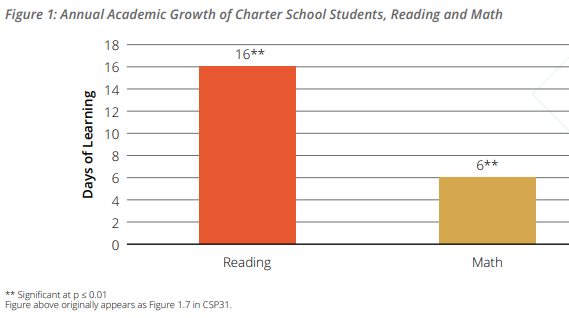
Rees discusses the recent study by the Center for Research on Education Outcomes, also known as CREDO, that showed over time, charter schools outperformed district-run schools in their communities and narrowed the achievement gap.
“If there was ever a doubt as to the effectiveness of charter schools, in their ability to close the achievement gap, this study definitely proves that gap can be closed and it's just a matter of doubling down and investing more in building these great schools in more places.”
Rees also discussed Oklahoma’s recent approval of St. Isidore of Seville Catholic Virtual Charter School, which, if it survives
Nina Rees
a court challenge, would be the nation’s first religious charter school.
Rees’ organization issued a statement disagreeing with the decision, arguing that the law has established that charter schools are public schools therefore required to operate as secular institutions. A coalition that includes Americans United for Separation of Church and State, the American Civil Liberties Union and the Education Law Center filed a lawsuit challenging the virtual charter school, which is set to open in 2024.
Episode details:

An Oklahoma board made history last week by approving the nation’s first religious charter school, a move that could set the stage for a legal battle over whether such schools, which receive taxpayer money but are independently managed, are public or private.
Editor’s note: This compilation of commentaries from the Thomas B. Fordham Institute appeared last week on the institute’s website. To read a report of the Oklahoma decision from reimaginED senior writer Lisa Buie, click here.
In a 3-2 decision last week, an Oklahoma state board defied the attorney general and approved the nation’s first religious charter school. Those of us at Fordham have been following the debate closely.
These blog posts and podcasts will help you get up to speed:
Education Gadfly Show #872: The religious charter school debate, with Kathleen Porter-Magee (2023)
Just last week, Kathleen Porter-Magee—choice advocate and superintendent of a network of urban Catholic schools—spoke with Mike Petrilli and David Griffith about religious charter schools on our podcast.
3 reasons why religious charter schools should give us pause (2023) by Kathleen Porter-Magee
In a guest post, Porter-Magee raised cautions about the religious charter school movement.
The extended case for faith-based charter schools (2023) by Andy Smarick
In another guest post, Manhattan Institute Senior Fellow Andy Smarick reflected on legal developments opening the door to religious charter schools.
Education Gadfly Show #853: The Supreme Court and religious charter schools, with Nicole Garnett (2023)
Nicole Garnett, law professor at Notre Dame and expert on faith-based schools, spoke with Mike Petrilli and David Griffith on the podcast.
Is It Finally, At Long Last, Time for Religious Charter Schools? (2020) by Chester E. Finn, Jr.
Checker Finn reflected on the U.S. Supreme Court’s landmark decision in Espinoza v. Montana Department of Revenue (2020), which determined that publicly-funded vouchers could not be barred from religious schools.
Why Not Religious Charter Schools? (2003) by Chester E. Finn, Jr.
Two decades ago, when the concept was far less mainstream, Checker asked Gadfly readers to consider religious charter schools as a way to grow quality choices for children.
 Editor’s note: This article appeared last week on the Thomas B. Fordham Institute’s website.
A little-noticed event in late 2022 destabilized a pillar of contemporary American K–12 education, namely that all schools considered part of the public system must be secular.
Last December, the attorney general of Oklahoma issued an advisory opinion stating that, due to recent U.S. Supreme Court decisions, the state could no longer prohibit faith-based groups from operating charter schools. Catholic leaders seized the opportunity and applied to do just that; the state’s virtual charter board voted down their application this week, but delayed a final decision until a revised application is submitted.
Not long after, in Arizona, one of the nation’s most successful charter operators announced it was launching an initiative to start faith-based classical schools. Though technically part of the private-school sector, these schools would be based on the organization’s charter-school model and would access public funding available via a new state Education Savings Account program that gives education dollars directly to families.
Though the efforts are distinct – the Arizona case brings faith-based education and public schooling closer, while the Oklahoma case merges them – they are, in a sense, the logical conclusion of thirty years of choice-based reform. Backers and detractors, however, see “logical conclusion” very differently.
Opponents might say they suspected choice advocates were fighting from day one to raze the wall separating church and state. Proponents might say this is an obvious, sensible consequence of American pluralism: Given the nation’s long history of faith-based nonprofits, once government engaged civil society in school operations via chartering, it was inevitable that religious groups would want to participate.
Like so much today, this issue divides observers along political lines. Indeed, the idea deeply troubles many progressives. But those on the political left might consider whether they could support faith-based charters, even if just as a pilot program.
Part of this consideration should be strictly pragmatic, as it pertains to keeping families engaged with the public school system. Opinion on public education is souring, with Americans now giving lower grades to schools both locally and nationally than before the pandemic. Today, only about one in five give the nation’s schools an A or B; only 21% of non-parents think American K–12 education is headed in the right direction.
A 2022 Gallup poll revealed that public satisfaction with K–12 schools was at its lowest level in more than 20 years.
To continue reading, click here.
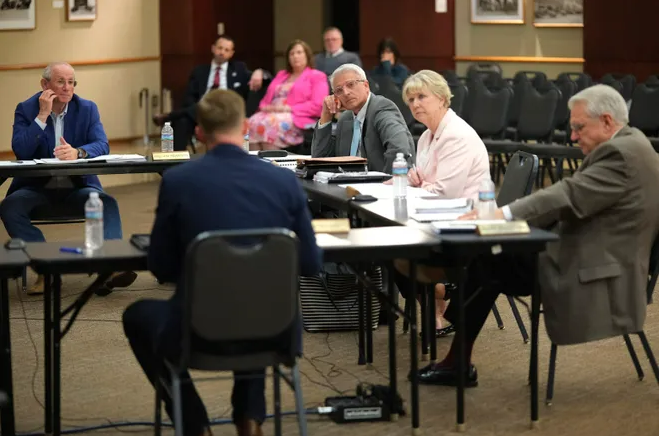
The Oklahoma Statewide Virtual Charter School Board met Tuesday to discuss a vote on whether to approve creation of St. Isidore of Seville Catholic Virtual School. PHOTO: Doug Hoke/The Oklahoman
Editor’s note: For related posts from reimaginED senior writer Lisa Buie, click here and here.
Concerned about conflicting attorney general opinions and the certainty of a lawsuit, members of Oklahoma Statewide Virtual Charter School Board unanimously voted to disapprove the application for what would be the nation’s first religious charter school.
The vote was a procedural move to buy time so board members could gauge the risk of personal liability following their final vote on St. Isidore of Seville Catholic Virtual School. Board members turned down the application on Tuesday after sidestepping the legal issue and instead raising questions about the school’s governance structure, special education plan, how it would prevent government money and private donations from co-mingling and technology.
“Do we have assurance from counsel if we are sued that we would have protection and support from the Attorney General’s Office?” board Chairman Robert Franklin asked during the discussion. “In recent history this board has been sued collectively and individually.”
The board’s counsel, Deputy Attorney General Niki Batt, said board members would receive representation if they were following state law and their actions were in the scope of their board position.
She said Oklahoma law explicitly states that no public money can be applied to support any religion.
That drew concern from board member Scott Strawn, who said, “Candidly, it feels like – intentional or not – that we’re basically being told make a decision against the advice of the attorney general and you may or may not have immunity.”
Heightening the tension are two conflicting legal opinions and statements the governor made about them.
Former Attorney General John O’Connor issued an opinion in December as his final official act that came as the statewide virtual charter school authorizing board was set to decide on the application for St. Isidore of Seville Catholic Virtual School, which the Archdiocese of Oklahoma City and the Diocese of Tulsa want to open to serve students in rural areas without a traditional Catholic school and to expand course offerings for students who already attend Catholic schools.
O’Connor said in his opinion that the state’s ban on publicly funded charter schools operated by sectarian and religious groups could violate the U.S. Constitution’s First Amendment and should not be enforced.
His successor, Gentner Drummond, withdrew O’Connor’s opinion and argued that it was based on precedent for private schools. Drummond said that state law defines, and the attorney general has previously recognized, charter schools as public schools, and that allowing the state to sponsor a religious school would create “a slippery slope” to use religious liberty to justify state-sponsored religion.
The clash promoted Gov. Kevin Stitt to weigh in by releasing a letter disagreeing with Drummond’s withdrawal of his predecessor’s opinion.
“You contend that the United States and the Oklahoma Constitutions permit, and indeed require, the state to discriminate against religious organizations seeking authorization to operate charter schools,” Stitt’s letter said. “In fact, the opposite is true.”
The letter continued, “These prohibitions run afoul of the non-discrimination principle articulated by the U.S. Supreme Court in recent cases.”
During Tuesday’s board meeting, state schools Superintendent Ryan Walters said he and the Oklahoma Department of Education would provide support to board members who approve the school’s application, thought it was unclear if that include legal representation.
Brett Farley, executive director of the Catholic Conference of Oklahoma, told The Oklahoman that the vote came as no surprise.
"This is fairly normal for their application process," Farley said. "It gives us more time to address their concerns, and so we'll do that and come back and present those and see where we go."
By turning down the application, members reset the clock on when a final vote must be taken. The rules allow applicants who are initially disapproved to make changes and resubmit their applications for a vote within 30 days. Had the board simply postponed Tuesday’s vote, the deadline for final approval would have been April 29.
You can watch a recording of the meeting here starting at the 49:22-minute mark.
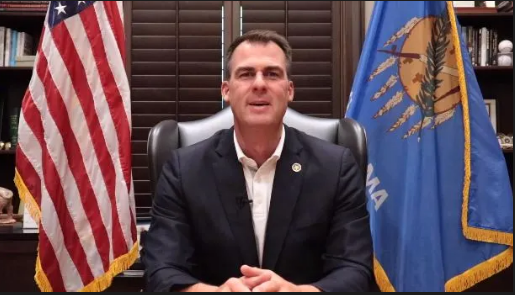
Oklahoma Gov. Kevin Stitt, in a letter to state Attorney General Gentner Drummond contesting the latter’s opinion, stated Drummond’s prohibitions “run afoul of the non-discrimination principle articulated by the U.S. Supreme Court in recent cases.”
Oklahoma Gov. Kevin Stitt, who was recently elected to a second term on a platform of expanding education choice, came out in “strong disagreement” against the state Attorney General Gentner Drummond’s withdrawal of a legal opinion issued by his predecessor supporting the approval of a Catholic virtual charter school.
Stitt released a letter to Drummond Monday evening, four days after his newly elected fellow Republican withdrew an advisory opinion written by the outgoing John O’Connor. The opinion, which was O’Connor’s last official act, said the state’s ban on publicly funded charter schools operated by sectarian and religious groups could violate the U.S. Constitution’s First Amendment and should not be enforced.
“You contend that the United States and the Oklahoma Constitutions permit, and indeed require, the state to discriminate against religious organizations seeking authorization to operate charter schools,” Stitt’s letter said. “In fact, the opposite is true.”
The letter continued, “These prohibitions run afoul of the non-discrimination principle articulated by the U.S. Supreme Court in recent cases.”
O’Connor’s opinion came as a statewide virtual charter school authorizing board was set to decide on an application for St. Isidore of Seville Catholic Virtual School, which the Catholic church seeks to open to serve students in rural areas without a traditional Catholic school and to expand course offerings for students who already attend Catholic schools.
The proposed school is named for the saint that Pope John Paul II in 1997 declared the “patron saint of the internet.”
In withdrawing his predecessor’s opinion, Drummond stated that request for the opinion should have come from the statewide authorizer’s governing board rather than the executive director. He also argued that the opinion was based on precedent for private schools and that state law defines, and the attorney general has previously recognized, charter schools as public schools.
Drummond also said allowing the state to sponsor a religious school would create “a slippery slope” to use “religious liberty” to justify state-funded religion.
The Oklahoma board’s vote, which could come as early as this month, is expected to spark litigation regardless of the decision. If approved, St. Isadore of Seville Catholic Virtual School would be the nation’s first religious charter school.
Oklahoma City Archbishop Paul Coakley and Tulsa Bishop David Konderla issued a statement praising Stitt for affirming “a correct and well-reasoned understanding of religious freedom in Oklahoma. As the U.S. Supreme Court has opined in numerous recent decisions, public funds cannot be denied to religious institutions simply because they are religious.”
The statement noted that privately-run religious schools in Oklahoma have benefited from public funding in the form of scholarships, tax credits and other modes for many years, and that these programs have allowed “countless students in our state to receive the education their parents determine is best for them.”
The U.S. Supreme Court ultimately could decide the issue before any Oklahoma lawsuits reach the courts if the justices choose to consider a U.S. Fourth Circuit Court of Appeals ruling against a conservative charter school in North Carolina that required girls to wear skirts.
A group of parents who sued argued that the public school’s policy violated their daughters’ constitutional rights. In its defense, Charter Day School argued that charter schools were not “state actors” but essentially private schools, with only broad state oversight.
In its ruling for the plaintiffs, the appellate court, however, called charter schools public schools and therefore subject to state and federal anti-discrimination laws.
The high court has asked the solicitor general, the Biden administration’s top Supreme Court lawyer, for guidance before deciding whether to consider the case.
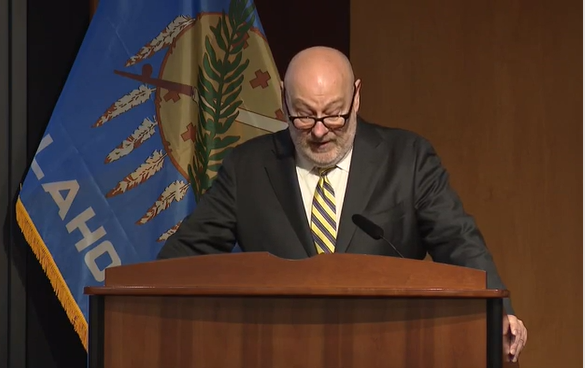
Keith Upton representing Americans United for Separation of Church and State spoke earlier today in opposition of the creation of an Oklahoma religious charter school.
This statement appeared today on the website of the Office of the Oklahoma Attorney General.
Attorney General Gentner Drummond today withdrew an opinion issued by his predecessor, stating that the Opinion “misuses the concept of religious liberty by employing it as a means to justify state-funded religion.”
In one of his final acts in office, then-Attorney General John O’Connor issued the Dec. 1, 2022, opinion in response to a request by Rebecca Wilkinson, the executive director of the Statewide Virtual Charter School Board (SVCSB). Drummond notified Ms. Wilkinson of his decision to withdraw the Opinion in a letter to her, with board members of the SVCSB included in the communication.
“Religious liberty is one of our most fundamental freedoms,” Drummond wrote. “It allows us to worship according to our faith, and to be free from any duty that may conflict with our faith. The Opinion as issued by my predecessor misuses the concept of religious liberty by employing it as a means to justify state-funded religion.”
He noted in the letter that charter schools are public schools that receive public funding, a position that is consistent with current state law and the Oklahoma Constitution. Drummond said the former Attorney General’s Opinion incorrectly concluded that Oklahoma taxpayer dollars could be tapped to fund religious charter schools.
As the Statewide Virtual Charter Board is currently considering an application for a religious virtual charter school, Drummond cautioned that approval of an application that is overtly religious in its teachings and operations will set a precarious precedent.
“While many Oklahomans undoubtedly support charter schools sponsored by various Christian faiths, the precedent created by approval of the … application will compel approval of similar applications by all faiths,” Drummond wrote.
“I doubt most Oklahomans would want their tax dollars to fund a religious school whose tenets are diametrically opposed to their own faith. Unfortunately, the approval of a charter school by one faith will compel the approval of charter schools by all faiths, even those most Oklahomans would consider reprehensible and unworthy of public funding.”
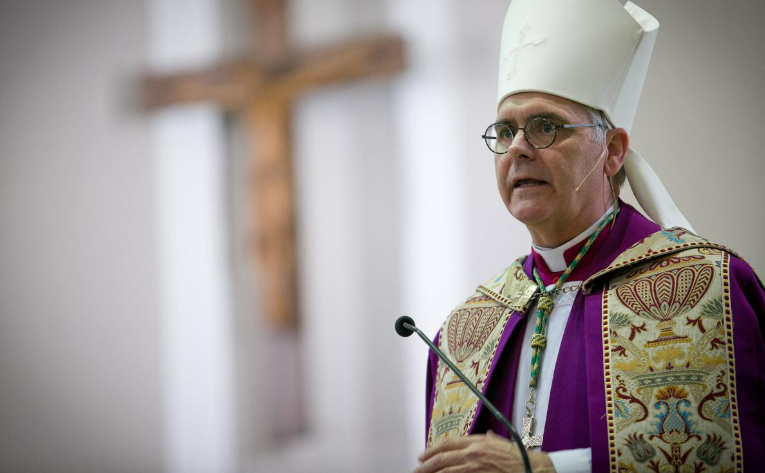
Oklahoma City Archbishop Paul S. Coakley wrote to the Statewide Virtual Charter School Board in November 2021, asking: “Before the Archdiocese undertakes the necessary time and expense to prepare a charter school application, I request confirmation that such an application will not be denied because of our religious affiliation or because of the integration of religion into our schools’ operations and programs.” Photo courtesy of Chris Porter
A meeting of an obscure state board set for Tuesday could swing open the door to religious charter schools nationwide.
Members of the Statewide Virtual Charter School Board in Oklahoma are expected to consider an application by the Archdiocese of Oklahoma City and the Diocese of Tulsa to open an online charter school that would include religious instruction among its offerings. If approved, it would be the nation’s first religious charter school.
So far, the two Catholic organizations in Oklahoma have been the only ones pursuing charter school authorization, said Shawn Peterson, president of Catholic Education Partners, a nonprofit that supports education choice efforts across the nation.
However, if Oklahoma gets authorization, which is not expected to be announced for a couple of months, look for other states to follow, he said.
“I think it may become a reality in Oklahoma in the short term, although I suspect that it will be challenged in court,” he said.
The two organizations began planning to apply for permission to open the virtual charter school in November 2021, when Archbishop Paul Coakley sent a seven-page letter to the board outlining the case for allowing a religious organization to open a charter school.
“The Archdiocese is enthusiastic about sponsoring a virtual charter school to improve educational opportunities for children and families in the state,” he wrote. “Yet we cannot ignore the reality that, regrettably, the discriminatory and unlawful exclusion of religious schools remains at least formally on the books of the state’s Charter School Act.”
Coakley cited the 2020 U.S. Supreme Court ruling in Espinoza v. Montana Department of Revenue that found that exclusion of religious schools from participating in a tax credit school choice scholarship program because of their religious status was unconstitutional. In his letter, Coakley also referenced Carson v. Makin, then a pending case that involved Maine’s ban on religious schools’ participation in “town tuitioning” programs that give private school scholarships to students in towns without public high schools.
Shortly after the archbishop’s letter was written, the U.S. Supreme Court agreed to hear Carson. On June 21, 2022, the justices ruled in favor of the plaintiffs, who had been barred from using the scholarship to send their daughter to a private Christian school.
The archbishop also references a case that the U.S. Supreme Court is considering hearing that involves a conservative North Carolina charter school whose dress code required that girls, whom it describes as “fragile vessels,” wear skirts to promote a traditional of “chivalry” and “respect.”
A group of parents who sued argues that the public school’s policy violated their daughters’ constitutional rights. In its defense, Charter Day School argues that charter schools were not “state actors” but essentially private schools, with only broad state oversight. In its ruling for the plaintiffs, the Fourth Circuit Court of Appeals, however, called charter schools public schools and therefore subject to state and federal anti-discrimination laws.
The high court has asked the solicitor general, the Biden administration’s top Supreme Court lawyer, for guidance before deciding whether to consider the case.
Meanwhile, Oklahoma Attorney General John O’Connor issued an opinion that says a state law that prohibits religious organizations from operating a public charter school likely violates the First Amendment of the U.S. Constitution and therefore “should not be enforced” because of rulings from the Oklahoma Supreme Court and U.S. Supreme Court.
In the Dec. 1 opinion, O’Connor cited three U.S. Supreme Court rulings: Trinity Lutheran v. Comer, in which the court ruled that religious organizations can’t be barred from participation in general benefit programs based on their status, as well as school cases Espinoza and Carson.
“As the U.S. Supreme Court emphasized in Carson, ‘a neutral benefit program in which public funds flow to religious organizations through the independent choices of private benefit recipients does not offend the Establishment Clause.’ … No student is forced to attend a charter school—it is one option among several for parents. … The Establishment Clause therefore provides no cover for a clear Free Exercise Clause violation here.”
The opinion drew praise from the American Federation for Children, a national education choice advocacy group.
“We applaud Attorney General John O’Connor’s opinion that underscores the right of families to access the best educational options for their kids,” Jennifer Carter, senior adviser for the American Federation for Children -- Oklahoma, said in a statement. “Today’s AG opinion is entirely in keeping with the spirit of what charter schools are meant to be: free public schools that offer tailored experiences to students in addition to those available in traditional public schools.”
However, not all education choice advocates share that view.
“Specifically, we take issue with the Attorney General’s assertion that charter schools are private entities/contractors that are not bound by the First Amendment’s Establishment Clause,” said Nina Rees, president and CEO of the National Alliance for Public Charter Schools. “The legal precedent cited in the Oklahoma Attorney General’s opinion (Trinity Lutheran, Espinoza, and Carson) are cases dealing exclusively with private schools, not charter schools, and we believe the precedent simply does not apply to public charter schools.”
Rees went on to say that her organization “believes there is no such thing as ‘private religious charter schools’… All charter schools are public schools. Public schools have never been able to, and cannot now, teach religion, require attendance to religious services or condition enrollment or hiring on religious beliefs. While a sectarian organization may be permitted to operate a charter school, that school must remain a nonsectarian, open enrollment, non-discriminatory public school.”
Other education choice advocates have raised questions the possible fallout if the religious charters are allowed.

