 Around the state: An old mascot was retired and a new one was chosen at a Hillsborough high school, schools in Lee are reopening after Hurricane Ian, school board races heat up statewide, and school threats occurred in various districts. Here are details about those stories and other developments from the state's districts, private schools, and colleges and universities:
Palm Beach: Years after a scandal involving grade changing at Palm Beach Central High School, the principal and his former assistant principal agreed to probation with the state education department. An investigation by the school district's inspector general found that Principal Darren Edgecomb and then-Assistant Principal Laurence Greenberg raised the grades of at least 11 students — without the knowledge of their teachers.
Hillsborough: The Hillsborough School Board voted on Tuesday to retire the Chiefs mascot at Chamberlain High in a 5-1 vote after students earlier this month chose the "Storm" to replace it, ending a public debate over racial stereotypes and community traditions. Fox 13. ABC Action News. Tampa Bay Times. If you're researching charter schools, information that includes test scores, discipline, complaints and other factors has been included in an interactive table. Hillsborough has a larger percentage of charter schools than the average Florida school system. Tampa Bay Times. Over the past five years in the county, enrollment in charters rose by more than 15,000 students while district-run schools lost more than 7,500. Hillsborough is seeing the result of a shift that began more than two decades ago in Florida. Tampa Bay Times.
Orange: The new superintendent for the public schools here, Dr. Maria Vazquez, held a town hall meeting on Monday to hear from parents in the district. Teachers and staff were also able to attend a meeting prior to the meeting with parents. "Sometimes, it's not about getting the information, but it's truly engaging with them and having a true conversation," Vazquez said. WKMG.
Duval: The school board here reviewed refurbished sex education curriculum after pulling materials midyear. The original curriculum that Duval County Public Schools planned to use was rescinded because of concerns they may not meet the requirements of a new state law. Board members discussed the new curriculum on Tuesday and will take a vote on whether to approve the plan during a board meeting in the future. News 4 Jax.
Lee: All 80 PreK-12 schools in this school district will be open in one form or another by Friday, three weeks after Hurricane Ian. The final seven schools were either cleared to open or created an alternative plan to resume classes. Ft. Myers News-Press.
Brevard: Rep. Randy Fine wants to debate Brevard school officials on the need for an increase in property taxes. Fine challenged Superintendent Mark Mullins to a debate as voters in Brevard consider an increase in the local property tax supporting the school district. If the tax is approved on Nov. 8, the revenue would help fund salary increases in the district. Florida Politics.
Volusia: School veterans Jamie Haynes and Al Bouie vie for a District 1 seat, which includes DeLand, DeBary and the southwest portion of the county. The election takes place on Nov. 8. The race is a re-run of the 2018 election where Haynes narrowly beat Bouie to win the seat. The Daytona Beach News-Journal.
Manatee: The Palmetto Police Department responded to a rumored threat at Manatee School for the Arts on Tuesday. A text message spread misinformation about a potential threat to the school, and eventually reached some parents, police said. The rumored threat follows a plethora of swatting calls across high schools nationwide. Sarasota Herald-Tribune.
Escambia: The school board hosted a string of workshops in preparation for its monthly meeting. In the midst of ongoing controversy about where to draw the line on book restrictions, one school board member suggested giving the superintendent authority to veto book bans. Pensacola News Journal.
Clay: An individual was arrested on Tuesday after a possible threat against Clay High School was posted on social media. After an investigation, the person was arrested for "disrupting a school function and threats against the school." News4Jax.
Charlotte: While schools reopen in southwest Florida, others continue to clean up Hurricane Ian's damage. Peace River Elementary is opening its doors early to help out parents, with donations coming in from all over the country. WINK.
Nassau: Four candidates are competing for two seats in the Nassau County School Board runoffs. Candidates Jamie Deonas, Shannon Hogue, Curtis Gaus and Albert Wagner are putting thousands toward signage to win their spots. Florida Politics.
Rumored threat: A brief lockdown at Manatee School for the Arts occurred after a rumored threat arose that prompted worry among parents on Tuesday at the charter school. The parent of a sixth grader reported the social media threat, police said. The student responsible may face school discipline but it is unknown whether they will face criminal charges. The Bradenton Herald.
Teacher arrested: A first grade teacher was charged with lewd and lascivious conduct with a student on the heels of a similar investigation. Damian Francis was arrested Monday. The Miami Herald.
Parents and midterms: A majority of parents are more likely to vote in the upcoming midterm elections than they were four years ago, according to a new poll. The 74th.
University and college news: Miami Mayor Francis Suarez teamed up with the Miami Foundation and local universities and technology leaders to fund scholarships for Miami students accepted into a STEM program at one of several south Florida universities. The scholarships are only open to recipients receiving Pell grants, the federal program that provides need-based grants to low income graduates. "If we are to have a technological boom in Miami, everyone has to benefit," said Fishman Lipsy, who began her career as a public school teacher in Harlem. The Miami Herald. An anonymous tipster who is a Palm Beach State College student filed a tip that led to the arrest of Saul Allain Jean, a fellow student accused of making online posts that threatened to carry out a mass shooting. In a notice to students, college leaders applauded the tipster for helping stop a possible tragedy. Palm Beach Post.
Opinions on schools: Expanding electric vehicle transportation solutions is a good economic and environmental solution for Florida, and voters agree. School buses, which use diesel, would help scale the cost savings and pollution reduction benefits for Floridians. Ali DySard, Tallahassee Democrat.
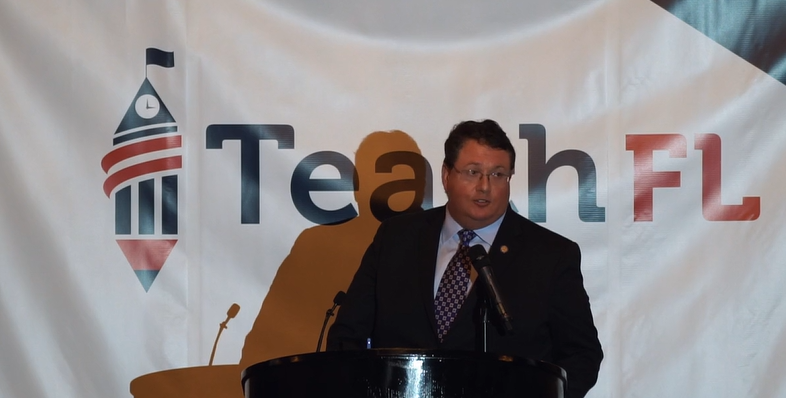
Florida state Rep. Randy Fine reported at the annual Teach Florida breakfast that half of all students attending Jewish schools in Florida receive state scholarships due to the Legislature's recent expansion of the program.
More than 600 people joined Teach Florida’s board and staff for the organization’s annual legislative breakfast this week at the Signature Grand in Davie, Florida.
Attendees included state legislators, elected local officials and members of the Jewish day school communities of Miami-Dade, Broward and Palm Beach counties. The focus of the event, which began in 2017, is to celebrate the organization’s legislative victories in securing government funding for families sending their children to Jewish day schools.
To see a video recap of the event, click here.
Speakers included Allan Jacob, a South Florida physician and chairman of Teach Florida; Daniel Aqua, Teach Florida’s executive director; state Rep. Randy Fine, R-Palm Bay; and Florida Senate President Wilton Simpson, R-Spring Hill; as well as Carol Lasek, a local lay leader, and Rabbi Elie Estrin, a chaplain in the Air Force Reserve and parent of a Florida choice scholarship recipient.
During the event, the organization named Fine its Legislator of the Year and gave Simpson its School Choice Champion Award. Fine sponsored HB 7045, the largest expansion of education choice in the nation. Simpson was a strong supporter of the bill, which the Senate ultimately approved, and Gov. Ron DeSantis signed into law this past spring.
“By fixing our education system, by putting parents in charge, by getting bureaucrats out of the way, we’re not only going to solve the problem of opportunity for our children, but we’re also going to solve the problem of crime and other problems that exist in our society,” Simpson said.
Fine pointed out that thanks to the expansion, 50% of students attending Jewish schools are receiving state scholarships.
Estrin shared the story of his son, Nissi, who was born with life-threatening health issues. Now 6, Nissi is benefiting from a Family Empowerment Scholarship for Students with Unique Abilities.
“Every child deserves a school that can provide him or her with their unique needs,” Estrin said. “Every parent deserves the right to make that choice. We hope that our legislators find inspiration in Nissi’s story and continue increasing educational options for all of Florida’s children.”
Jacob said this year’s event drew supporters from Orlando as well as South Florida. He said Florida’s scholarship programs allow schools to provide high quality education and improve the quality of life for the entire Jewish community.
“We are always giving support to the politicians who advocate for school choice,” he said. “It’s the most significant issue in the Jewish community in Florida.”
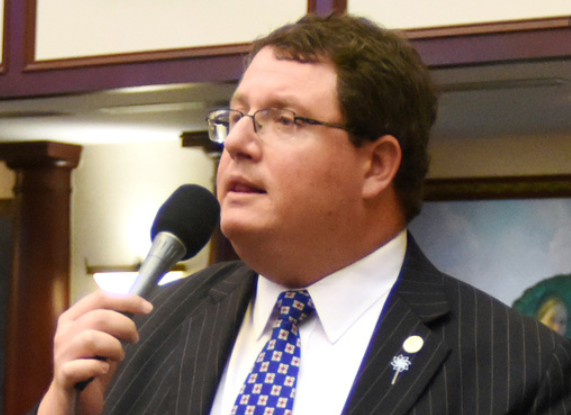
Brevard County Republican Rep. Randy Fine, who is carrying the bill, said discussions between the House and Senate are ongoing.
Ryan Dailey, News Service Florida
A House bill that would expand eligibility for school vouchers advanced Wednesday but has marked differences from a voucher proposal being considered by the Senate.
The Republican-controlled House Education & Employment Committee approved the bill (PCB EEC 21-01) on an 18-3 vote, with Democrats casting the dissenting votes.
The measure would end what are known as the Gardiner and McKay scholarship programs, which serve students with special needs. Those programs would be absorbed into the state’s Family Empowerment Scholarship program, which currently serves a broader population of low- to middle-income families.
Rep. Randy Fine, a Brevard County Republican who is carrying the bill, said it “removes complexity without consequence” for parents looking to enroll children in voucher programs.
“We have multiple school choice programs that all do the same thing and create confusion; McKay, Gardiner, Family Empowerment. This will shrink down those numbers of choices while having the same scholarships, but with fewer entry points,” Fine said during Wednesday’s committee meeting.
The measure also would eliminate a requirement that parents annually renew participation in the programs.
“It will also make it simpler to be in these programs because it will not require parents to jump through hoops every year to get renewals,” Fine said.
The amount of money provided through school vouchers also would increase under the House measure. Currently, students who receive Family Empowerment scholarships, Florida Tax Credit scholarships or Hope scholarships receive funding that is 95 percent of what they would have generated in the public-school funding formula. The bill would increase the voucher amounts to 100 percent of the funding formula level.
But the House plan is significantly different from a voucher bill (SB 48) that has been moving through the Senate.
The Senate proposal would consolidate the state’s five major voucher programs into two. One would combine current scholarships serving special needs students to create the McKay-Gardiner Scholarship program.
The broader population of students would be served by the Family Empowerment Scholarship program, which would absorb the Tax Credit Scholarship and Hope Scholarship programs. The Tax Credit Scholarship program provides tax credits to businesses that help fund vouchers, while the Hope Scholarship program offers vouchers to students who have been bullied.
All voucher programs would be established as what are known as education savings accounts under the Senate plan. The accounts would give parents flexibility in spending, with the amounts at 97.5 percent of the public-school formula level.
Parents could use money to purchase things like electronic devices, educational materials and tutoring. McKay-Gardiner recipients would have additional flexibility for expenses like specialized therapies.
The House measure would allow similar flexible spending only for special needs students.
“Ours is more voucher-driven,” Fine said of the House proposal. “If it’s a voucher, it’s easier to monitor what spending is going on, you take it, you give it to a school and off you go to the school.”
Fine said education savings accounts would be available to students with special needs.
“We’re not eliminating ESAs. One of the programs will still have them, but our view is, we’re just a little bit more focused on vouchers,” Fine said.
The House measure also would expand eligibility for voucher programs by removing a current requirement that students must previously have attended public schools. That proposed change is also in the Senate bill.
In addition, the House proposal would exempt students from military families or children in foster care from a cap on the number of Family Empowerment Scholarship recipients.
The conservative group Americans For Prosperity has backed the Senate measure but also supports the House proposal.
“We think that it moves the ball forward and continues the conversation. We believe that it gives the ability for kids to have more options. More students will be eligible,” Skylar Zander, the group’s state director, told The News Service of Florida on Wednesday.
Zander’s group has supported the part of the Senate bill that would convert voucher programs to education savings accounts.
“We think that ESAs are much more flexible and allow people to do more things with them overall,” Zander said.
The Florida Education Association teachers union opposes both bills. Among its concerns is part of the House bill that would change funding for what are now the Gardiner scholarships. Those scholarships currently receive legislative appropriations, but the bill would lead to them being funded through the Florida Education Finance Program, the longstanding system for funding public schools.
“There’s so much uncertainty with next year’s student enrollment for existing students, this may not be the time to make a large structural change in our funding mechanism for public school students,” Florida Education Association lobbyist Cathy Boehme said.
A House staff analysis of the measure said it would have an indeterminate fiscal impact to the state.
“The reason the fiscal is indeterminate is because we don’t know how many parents will take advantage,” Fine said.
Negotiations between the House and Senate on the voucher bills are underway, Fine said.
“There are ongoing discussions. I think both sides want the same thing, more choices for more parents. But sometimes how you get there is (done) a little bit differently,” Fine told reporters.
Fine said he expects his proposal to go to one more committee before heading to the House floor. The Senate bill is ready for consideration by the full chamber.
 Statewide races: Republican Ron DeSantis, who strongly backs school choice, wants 80 percent of all education spending directed into the classroom and pledges to expand the state's K-12 scholarship programs and career and technical education opportunities, narrowly wins the governor's race over Democrat Andrew Gillum. In other statewide races, Gov. Rick Scott defeats incumbent Democratic Sen. Bill Nelson, Republicans win all three Cabinet seats, and 11 of the 12 constitutional amendments are approved with the required 60 percent majority. Associated Press. Politico Florida. Orlando Sentinel. The 74.
Tax initiatives: Voters approve all eight tax increases for education in the state. Sales tax hikes for construction and repairs of schools pass or are renewed in Alachua, Hillsborough, Lee, Martin and Polk counties. In Miami-Dade, Palm Beach and Charlotte counties, voters approve higher property taxes to pay for school safety and teacher salaries. Politico Florida. (more…)
FSA test results: Florida students improved their test scores in the state's math, science and social studies exams, and in reading in some grades, according to results released Thursday by the Florida Department of Education. The Florida Standards Assessments measure reading and math for students in grades 3-12, science for 5th- and 8th-graders and end-of-course exams in biology, civics and U.S. history. Test results also show a narrowing of the achievement gap between white and nonwhite students in language arts, algebra 1 and geometry. Testing results are part of the formula used to assign grades to individual schools and districts. Orlando Sentinel. Sun-Sentinel. Bridge to Tomorrow. Florida Department of Education. More reports on how school districts around the state did in the testing. Ocala Star-Banner. Palm Beach Post. TCPalm. Tampa Bay Times. Gradebook. WJXT. Sarasota Herald-Tribune. Gainesville Sun. Space Coast Daily.
Proposed tax hikes: If the Palm Beach County School Board agrees to the placement of a property tax increase on the November ballot, it would be the third school tax increase voters have been asked to approve in the past four years. This time, the request is for an extra $1 per $1,000 of taxable property value, which would be used for teacher salaries, school security and mental health care. The tax is projected to raise $200 million a year for four years. The board vote is scheduled Wednesday. Sun-Sentinel. A school tax referendum in Hillsborough County is likely to be delayed beyond November because it might take up to eight months or longer to get the financial audit that is now required by the state before voters can be asked to approve an increase in taxes. District officials say when they contacted the Legislature's Office of Program Policy Analysis and Government Accountability to request the audit, they were told there might be a six-month wait and that the results would have to be posted for two months before a vote could take place. Tampa Bay Times.
The Florida House PreK-12 Appropriations Subcommittee this morning unanimously approved an allocation of $2 million to fund security at Jewish day schools.
Last year, legislators approved $654,491 in funding for Jewish day schools in Florida after a rash of anti-Semitic threats throughout the country. The concept has since received public backing from Gov. Rick Scott, who requested $1 million.
“Sadly, there has been a rise of anti-Semitic viewpoints,” Rep. Jason Fischer, R-Jacksonville and a co-sponsor of HB 2791, told RedefinED. “There have been bomb threats. There have been spray-painted swastikas and other threatening things toward them, and we have to stand up and fight for the people in our community.”
The allocation would fund the hardening of building and equipment upgrades, fences, video access, ballistic glass, alarms and communication systems at 46 Jewish day schools around the state. (more…)
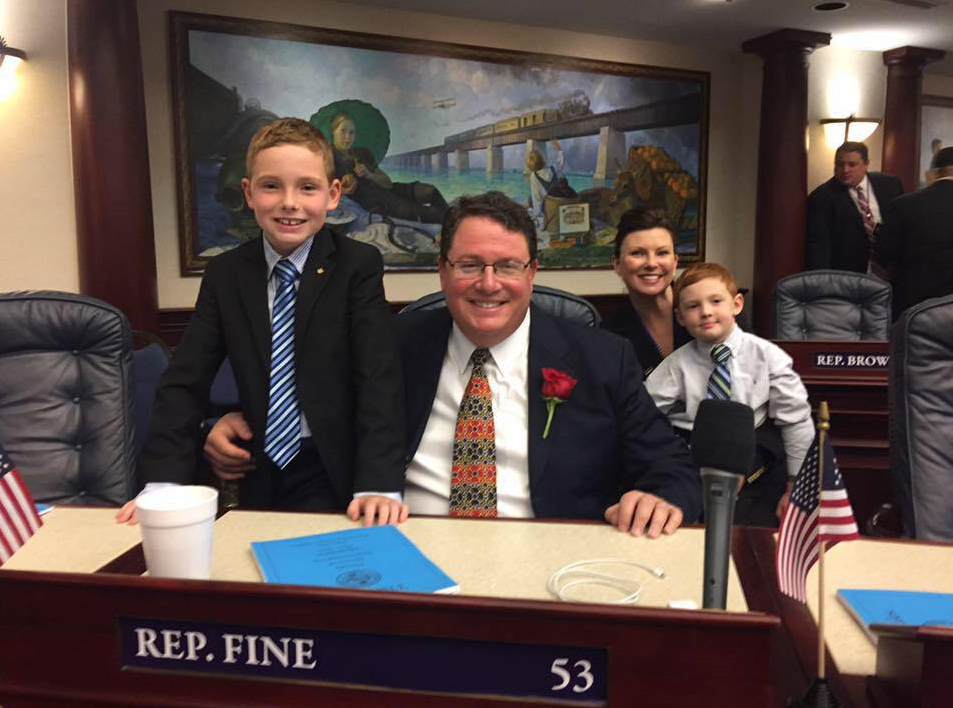
Rep. Randy Fine, R-Palm Bay, is pictured here with his two sons, Jacob Fine and David Fine and his wife Wendy.
No one would have guessed that a simple math problem, answered correctly by a six-year old but marked wrong by his teacher, would one day help pass one of Florida’s largest education reform bills.
But that math problem encouraged one young father to run for office and advance reforms.
Earlier this year, state Rep. Randy Fine, R-Palm Bay, advanced legislation that opened statewide assessments for public review. Lawmakers incorporated that proposal into one of the largest education bills passed in recent years.
Since he was first elected in 2016, he's also advocated for families to have more education options, which he's exercised with his own kids.
Fine recalls how it all started. His son came home from school one day, troubled and frustrated with math. He no longer liked the subject. In fact, he told him he hated it.
The source of the frustration was a simple math problem: What is 9 plus 6? His son had answered 15. But his teacher marked him wrong because he didn’t explain how he reached the answer.
“On what planet does nine plus six not equal 15?” Fine asked. He requested to review the test, but school officials refused. Eventually, this battle with the Brevard County school system inspired him to run for state representative in 2015.
Two years later, Fine filed HB 549, the testing transparency legislation. And he's gotten involved in other issues, from school choice to student safety.
A parent’s frustrations become motivations (more…)
District audit request: State Rep. Jason Fischer, R-Jacksonville, is calling on the state to audit the Duval County School District to find out how it spent $21 million more than it budgeted to last year. Fischer acknowledges that the call for an audit is motivated, at least in part, by the school board's consideration of joining a lawsuit against the new state education law, H.B. 7069. “I’m deeply concerned that the school district is taking their eye off the ball by considering frivolous lawsuits against the state rather than getting their financial house in order,” Fischer wrote to Sen. Debbie Mayfield, chairman of the Joint Legislative Auditing Committee. Florida Times-Union. Florida Politics. The Lee County School Board will consider this week whether to join the lawsuit against H.B. 7069. Several districts say they will join Broward and St. Lucie school districts in bringing a suit, or are considering it. Fort Myers News-Press.
School budgets: The Marion County School Board votes today on a proposed $534.7 million budget that hikes spending by $12.7 million over last year. About $7.8 million of that comes from state and federal spending, and the rest will be taken from reserves to help offset increased health-insurance premiums for employees. Ocala Star Banner. Brevard school officials say the tight state budget for education has put raises for teachers in jeopardy. Rep. Randy Fine, R-Palm Bay, says the state budget includes raises for teachers rated highly effective or effective, which are on top of potential payouts from the teachers bonuses program. "So teachers will make more money because of the budget that we passed," Fine says. "Brevard Public Schools doesn’t need to give them a raise to make that happen." Meanwhile, Superintendent Desmond Blackburn gets a raise of $10,500. Florida Today.
Schools of hope: Three schools in north Florida could be home to the first "schools of hope" under the new education law, but 37 other schools that have struggled for three or more years also could qualify in the 2018-2019 school year. Under the plan, the state can offer financial incentives to recruit charter school companies into areas that have persistently low-performing schools. redefinED. The Sarasota County School District is taking a closer look at the Suncoast School for Innovative Studies, the only Title I charter school in the county. It received a D grade from the state. “... Why did (Title 1 elementary school) Emma E. Booker get a B and you got a D when you’ve got the same demographics?” asks board member Eric Robinson. Sarasota Herald-Tribune. (more…)
State seeks ESSA waivers: The Florida Department of Education is seeking waivers to the new federal Every Student Succeeds Act (ESSA) in its draft for public comment. The state wants a transition period for students who aren't fluent in English, a waiver on reporting student learning gains, and a waiver on the rule that requires school grade changes if 95 percent of every subgroup doesn't participate in testing. The public can submit comments here until July 31. Orlando Sentinel. Gradebook.
Religious expression: School districts around the state are starting to prepare for the implementation of the new freedom of religious expression in schools law. Students will now be permitted to include religious beliefs in their schoolwork, and pray at school. Some educators expect little change, since the law already permits those things. Others worry that the law will encourage some teachers to veer into religion-based instruction that ignores commonly accepted facts. Many districts are waiting for guidance on the issue from the Florida Department of Education before writing local policies. Tampa Bay Times.
Charter marketing: An Orange County charter school has budgeted almost $250,000 of taxpayer money over three years to advertise for students. The K-6 Renaissance Charter School will open later this summer on the south side of Orange County, with 661 students expected. To help fill those seats, the school has budgeted $148,725 for marketing in 2017-2018, $55,539 in 2018-2019 and $40,498 in 2019-2020. A spokesperson for Charter Schools USA, the for-profit company that was hired by Renaissance to run its schools, says the ad spending is “smart marketing,” and added, “Parents choose charters for a variety of reasons. We have to market it to let parents know it is there.” Orange County School Board member Linda Kobert says, "Charters have a different set of rules. The school district, the state of Florida, and the taxpayers have no say in how charters spend those taxpayer dollars.” WFTV.
Meal policies reconsidered: Schools across the United States are reconsidering how they deal with students' meal debts. This month, the U.S. Agriculture Department is requiring districts to inform parents about school meal payments at the start of a school year, and encouraging districts to contact parents directly about delinquent accounts so children don't go hungry. Several states are going one step further, prohibiting meal shaming or denying food to delinquent students. Associated Press. The Clay County School District is hiking prices for school meals next year. Breakfast at all schools will be $1.50, up 25 cents. Lunch at elementary schools will be $2 for, 25 cents more, and $2.25 at secondary schools, up 15 cents. Florida Times-Union. (more…)
Rep. Randy Fine
Emboldened by a recent U.S. Supreme Court decision, a key Florida lawmaker says he wants to make school vouchers available to every child in the state.
The state already offers tax credit scholarships to low-income and working class students. It offers vouchers and education savings accounts for children with special needs. For early learners, the Voluntary Pre-K offers universal vouchers for public and private preschools*.
Rep. Randy Fine, R-Palm Bay, said he wants to file legislation that would eliminate "the income threshold and open it up to everybody," so all K-12 students could receive public support to attend any school of their choice.
Fine, a wealthy technology entrepreneur, said he wants every child to have access to the same options as his own kids.
"There is nothing more important we do than educating our kids,” he said. “We spend $24 billion on education. I want every kid to have the same opportunities I did as a child. I am the product of public education and started a number of companies and have a great career. I am making sure my boys have the same opportunities I did. I want to make sure every kid has those same opportunities.”
However, the representative hasn't decided whether to create education savings accounts, similar to what Gov. Rick Scott proposed in 2011, or more traditional vouchers.
Scott's proposal struggled to gain traction in the Legislature. But since then, two other states — Nevada and Arizona — have created education savings account programs with universal or near-universal eligibility. Parents can use the money to pay for private-school tuition, homeschool curriculum, public-school courses, college savings and other approved education-related expenses.
If Fine chooses a more traditional voucher program, that would mean simply giving parents vouchers to enable them to put their children in private schools.
School choice advocates across the country hailed last week's Trinity Lutheran Church v. Comer ruling, which held private religious schools should have the right to participate in publicly funded programs.
Vouchers could still face a different constitutional hurdle, however. The Florida Supreme Court ruled in Bush v. Holmes that vouchers violated the state constutional mandate for a "uniform" public school system. Top Florida Republicans, including House Speaker Richard Corcoran, have criticized that decision.
*Step Up For Students, which publishes this blog, administers the tax credit and Gardiner Scholarship programs.

