Apart from Jeb Bush's comments at a panel discussion yesterday, New Jersey Gov. Chris Christie offered the RNC's most extensive comments yet on education in a speech late last night. Full speech here. Coverage here. Education excerpts here:
They said it was impossible to touch the third rail of politics. To take on the public sector unions and to reform a pension and health benefit system that was headed to bankruptcy.
With bipartisan leadership we saved taxpayers $132 billion over 30 years and saved retirees their pension.
We did it.
They said it was impossible to speak the truth to the teachers union. They were just too powerful. Real teacher tenure reform that demands accountability and ends the guarantee of a job for life regardless of performance would never happen.
For the first time in 100 years with bipartisan support, we did it. (more…)
The whole platform was just passed by the convention and released. Here are the sections on K-12 education (for highlights go to the Politics K-12 blog):
Education: A Chance for Every Child
Parents are responsible for the education of their children. We do not believe in a one size fits all approach to education and support providing broad education choices to parents and children at the State and local level. Maintaining American preeminence requires a world-class system of education, with high standards, in which all students can reach their potential. Today’s education reform movement calls for accountability at every stage of schooling. It affirms higher expectations for all students and rejects the crippling bigotry of low expectations. It recognizes the wisdom of State and local control of our schools, and it wisely sees consumer rights in education – choice – as the most important driving force for renewing our schools.
Education is much more than schooling. It is the whole range of activities by which families and communities transmit to a younger generation, not just knowledge and skills, but ethical and behavioral norms and traditions. It is the handing over of a personal and cultural identity. That is why education choice has expanded so vigorously. It is also why American education has, for the last several decades, been the focus of constant controversy, as centralizing forces outside the family and community have sought to remake education in order to remake America. They have not succeeded, but they have done immense damage.
Attaining Academic Excellence for All
Since 1965 the federal government has spent $2 trillion on elementary and secondary education with no substantial improvement in academic achievement or high school graduation rates (which currently are 59 percent for African-American students and 63 percent for Hispanics). The U.S. spends an average of more than $10,000 per pupil per year in public schools, for a total of more than $550 billion. That represents more than 4 percent of GDP devoted to K-12 education in 2010. Of that amount, federal spending was more than $47 billion. Clearly, if money were the solution, our schools would be problem-free. (more…)
 Peace? Check.
Worker’s rights? Check.
A greener planet? Check.
K-12 ed reform? … Not so much.
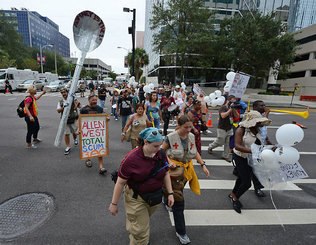
What was anticipated to be the biggest protest during RNC week in Tampa kind of fizzled in the drizzle today, drawing about 500 people instead of the expected 5,000. “Education affordability” was a top issue for many in the crowd, which included a fair smattering of college students, but it was a nod to higher ed. Dozens of speakers bypassed K-12 issues. And if there were any teachers and/or teachers union members in the crowd, they didn’t draw attention to themselves.
“Education is a right. Fight! Fight! Fight! Fight!” shouted one of the speakers, Skye Schmelzer, 20, a University of Florida student who was representing Students for a Democratic Society.
She was referring to rising college tuition, she said in a brief interview, and did not think educational rights extended to K-12 students who may benefit from vouchers, tax credit scholarships or charter schools. “The privatization of schools, I completely disagree with,” said Schmelzer, who graduated from the IB program at King High School in Tampa. “The problem with private schools is they separate children, so rather than having children of the 99 percent mixing with the children of the 1 percent, you have mostly 1 percenters in these schools or higher middle class.”
One of the day's most fiery speeches was given by Omali Yeshitela, leader of the International People’s Democratic Uhuru Movement, an activist group in St. Petersburg, Fla., better known as the Uhurus. More than a decade ago, the Uhurus tried to start a charter school in Pinellas County – where black students perform worse than black students in every other urban district in Florida – but were denied by the local school board.
Yeshitela told redefinED that while he and today’s protesters were on the same page on many concerns, he was probably an outlier when it comes to school choice. He said he disagreed with many progressives who think the issue is funding. (more…)

