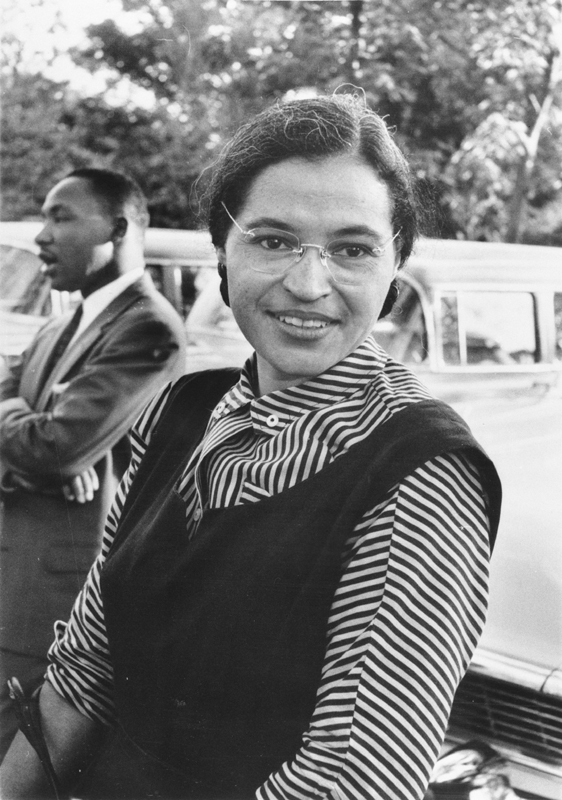
Soft-spoken and reserved, Parks did not want a big to-do about her proposed charter school. She simply wanted to help kids in her neighborhood, and she was uneasy with the possibility the school could become “political.” (Image from Wikimedia Commons)
Editor’s note: This month, redefinED is revisiting the best examples of our Voucher Left series, which focuses on the center-left roots of school choice. Today’s post from March 2016 illustrates how civil rights activist Rosa Parks believed in the value of giving parents more educational choice.
If the full, rich history of school choice wasn’t so hidden, perhaps it’d be less shocking to stumble on a link (hat tip: Chris Stewart) between charter schools and “the first lady of civil rights.” But since so much of that history remains off radar, I have the honor of amplifying the blip.
Rosa Parks liked school choice, too.
In the late 1990s, she and her foundation applied for a K-12 charter school in Detroit in the hopes of uplifting black students in tough neighborhoods. Bad timing and twisted ed politics apparently doomed the effort, but it’s clear Parks, the product of a private Christian school, saw value in giving parents more options.
Said the application:
The mission of the Rosa and Raymond Parks Academy for Self Development (the “Academy”) is to provide mentoring and alternative learning, through creative education techniques, that incorporate the philosophies of Rosa and Raymond Parks. The Principles are based on their life experiences of pride, dignity and courage. Students will be educated and trained in a community environment to transfer common sense and survival skills into leadership and marketable skills.
The Academy will also provide training in life skills that incorporate the philosophies of Rose and Raymond Parks: dignity with pride, courage with perseverance and power with discipline.
Parks and her husband moved to Detroit in 1957, not long after her quiet act of courage on that Deep South bus sent dominoes falling. Their Rosa and Raymond Parks Institute for Self Development operated an after-school program that stressed character education. Parks wanted a school that did the same.
Pride, dignity and courage "were the words that were important to her, and that she wanted translated into a bigger educational program,” said Anna Amato, an education consultant who worked with Parks on the application and hasn’t talked publicly about it for nearly 20 years.
The Rosa Parks charter school also planned to emphasize project-based, experiential learning. For instance, students would take field trips to Michigan “stops” on the Underground Railroad and use that as a springboard for lessons in reading, writing, history - and more.
"Our students and parents, as an entire family," said the application, "will be provided opportunities to develop a thorough knowledge of the history of the African American struggle for civil rights, along with a sense of responsibility for themselves and their communities."
Soft-spoken and reserved, Parks did not want a big to-do over the school, Amato said. She just wanted to help kids in her neighborhood, and was uneasy with the possibility the school could become “political.”
Of course, the idea that low-income parents should have options beyond district schools has become ridiculously political.
Michigan was a pioneer in the charter school movement – it opened its doors in 1994, just three years after Minnesota did it first – and blazing the path triggered a particularly partisan reaction. Meanwhile, Amato said, other changes on the education landscape added to the turbulence, like the state taking over low-performing district schools.
Parks submitted her application to the Detroit school board in 1997. The board had only approved two charters up to that point, and even more snags were surfacing, including a power struggle between the district and state. (The Michigan Legislature ended up removing the elected school board in 1999, and another elected board didn’t return until 2005.)
Incredibly, the Detroit newspapers seemed to have ignored Parks’s proposal (I found zilch in the archives of the Detroit News and Detroit Free Press), and it drew little attention in the national press (the New York Times story above being an exception). It did, however, turn a head in the White House.
"I am pleased that Rosa Parks, who taught us a lot about dignity and equality, is now working to open a charter school in Detroit," President Bill Clinton told the NAACP as he pitched charter schools to its national convention in 1997. "And I urge you to consider doing so in your communities. If you believe it will help, the Department of Education will help you."
It's unclear exactly what happened to Parks's application. According to Amato, a number of charter proposals that came before an unfriendly school board and superintendent at that time fell through the cracks. Amato said she vaguely remembers that Parks's application made it on to the board agenda, but the board took no action.
Parks, increasingly frail, turned to other issues. She died in 2005.
“I was personally crushed,” Amato said. “I had the great honor of taking her vision and turning it into an application. But there were too many hurdles that I couldn’t overcome. I still get sad about it.”
The fact that Rosa Parks didn’t get to realize her vision of a charter school, though, doesn’t diminish the fact that Rosa Parks had such a vision.
Isn’t that something?
In the late 1990s, Rosa Parks and her foundation applied to start a charter school in inner-city Detroit. She wasn't thinking about privatizing education; she was thinking about ways to lift up the struggling students in her community. The same impulses have guided the African-American drive for educational freedom for centuries. (Image from Wikimedia Commons)
A few weeks ago, an African-American parent in Florida took the NAACP to task in a guest column for one of the state’s leading African-American newspapers.
Wevlyn Graves was upset because the NAACP’s Florida chapter had joined the state teacher union in a lawsuit to kill the state’s tax credit scholarship.* The 15-year-old initiative is now the largest private school choice program in America, and it’s expected to serve more than 90,000 students this fall. That includes more than 20,000 African-American children. That includes Graves’s 10-year-old son.
“You’re telling me the NAACP is fighting against the ability of African American parents to have more options and choices to further their children’s education,” Graves wrote, “when African Americans have been fighting for that since the beginning? Are you serious?”
I thought of Graves’ op-ed when it surfaced last week that delegates to the NAACP’s national convention had passed a resolution calling for a national moratorium on charter schools.
I appreciate her column because it offers the view of a school choice parent. Their views are too often absent from school choice debates, including this ongoing debate over the NAACP and charters.
I also think Ms. Graves makes a particularly powerful point about school choice history.
Before I go on, a disclaimer: I have nothing but respect and admiration for the NAACP. It pains me to not be on the same page, on this issue, with a group that has done so much, for so many, for so long.
At the same time, I think it’s fair to offer a little more context, especially to progressives who may not follow education issues closely, and who may be reflexively swayed by the NAACP position. They should know there is far more to the NAACP story, and they can read and hear some of the pushback from African-American leaders here, here and here.
To add to Ms. Graves’s thread, there are strong currents of educational freedom that course throughout American history, and they are particularly deep in African-American communities. The NAACP and its surrogates say they’re worried about privatization when it comes to both charter schools and state-supported private school scholarships. But African-American communities have not shied from private schools, charter schools or private philanthropy in education, not when it enabled them to access or create better alternatives for their children.
Mary McLeod Bethune wasn’t aiming to privatize education in 1904, when she founded a private school, the Daytona Educational and Industrial Training School for Negro Girls. She created the school because the public schools were so bad.
Privatization wasn’t on Marva Collins’s mind in 1975, when she took $5,000 from her teacher’s retirement fund to start Westside Prep, an acclaimed private school for low-income black kids in Chicago. She was moved to do so because she could not stomach the epidemic of black children being labeled “disabled” in public schools, and doomed by low expectations.
Rosa Parks wasn’t trying to ring up cash registers in the late 1990s, when she and her foundation applied to start a charter school in Detroit. She wanted to lift up the struggling kids in her inner-city neighborhood, and instill in them the traits that made her an American hero: “dignity with pride, courage with perseverance and power with discipline.” (more…)
Soft-spoken and reserved, Parks did not want a big to-do about her proposed charter school. She simply wanted to help kids in her neighborhood, and she was uneasy with the possibility the school could become “political.” (Image from Wikimedia Commons)
This is the latest installment in our occasional series on the center-left roots of school choice.
If the full, rich history of school choice wasn’t so hidden, perhaps it’d be less shocking to stumble on a link (hat tip: Chris Stewart) between charter schools and “the first lady of civil rights.” But since so much of that history remains off radar, I have the honor of amplifying the blip.
Rosa Parks liked school choice, too.
In the late 1990s, she and her foundation applied for a K-12 charter school in Detroit in the hopes of uplifting black students in tough neighborhoods. Bad timing and twisted ed politics apparently doomed the effort, but it’s clear Parks, the product of a private Christian school, saw value in giving parents more options.
Said the application:
The mission of the Rosa and Raymond Parks Academy for Self Development (the “Academy”) is to provide mentoring and alternative learning, through creative education techniques, that incorporate the philosophies of Rosa and Raymond Parks. The Principles are based on their life experiences of pride, dignity and courage. Students will be educated and trained in a community environment to transfer common sense and survival skills into leadership and marketable skills.
The Academy will also provide training in life skills that incorporate the philosophies of Rose and Raymond Parks: dignity with pride, courage with perseverance and power with discipline.
Parks and her husband moved to Detroit in 1957, not long after her quiet act of courage on that Deep South bus sent dominoes falling. Their Rosa and Raymond Parks Institute for Self Development operated an after-school program that stressed character education. Parks wanted a school that did the same.
Pride, dignity and courage "were the words that were important to her, and that she wanted translated into a bigger educational program,” said Anna Amato, an education consultant who worked with Parks on the application and hasn’t talked publicly about it for nearly 20 years.
The Rosa Parks charter school also planned to emphasize project-based, experiential learning. For instance, students would take field trips to Michigan “stops” on the Underground Railroad and use that as a springboard for lessons in reading, writing, history - and more.
"Our students and parents, as an entire family," said the application, "will be provided opportunities to develop a thorough knowledge of the history of the African American struggle for civil rights, along with a sense of responsibility for themselves and their communities."
Soft-spoken and reserved, Parks did not want a big to-do over the school, Amato said. She just wanted to help kids in her neighborhood, and was uneasy with the possibility the school could become “political.”
Of course, the idea that low-income parents should have options beyond district schools has become ridiculously political. (more…)

