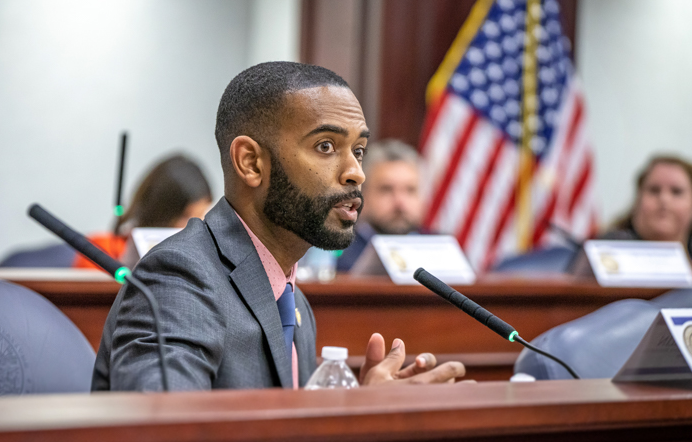
Gallop Franklin II of Tallahassee joined 14 Republicans in voting for SB 202. Gallop noted that he would “be in jail today” if his mother hadn’t homeschooled him.
Historic legislation that would expand education choice in Florida got a big boost Wednesday as two committees approved House and Senate versions of bills that would allow every K-12 student in the state to be eligible for education savings accounts.
Members of the Senate Appropriations Committee on Education voted 9-4, with Republicans in support, to approve SB 202, which would convert all traditional scholarships to flexible spending accounts called education savings accounts. Known as ESAs, they give each student an amount commensurate with the per-student amount appropriated for students attending a public school.
Parents can then spend the money for approved uses such as private tuition and fees, part-time tutoring, curriculum and learning devices such as laptops.
In addition to the increased eligibility for previously income-based scholarships, the bill also would increase funding for ESA-based scholarship programs for students with unique abilities, a program that now has a waitlist of more than 9,000.
SB 202 also includes some sweeteners for public schools, such as cutting regulatory red tape and allowing districts to transport students in vehicles other than school buses. The public school provisions won it an endorsement from the Florida Association of District School Superintendents.
The bill was tweaked to separate homeschoolers who don’t choose to accept the scholarships for fear of government control. Those who do accept the money would be required to take a nationally norm-reference test and consult with “navigators,” though the navigators can’t force them to follow their guidance.
“Homeschoolers who don’t want the scholarship will have life as it is,” said Sen. Corey Simon, the Tallahassee Republican sponsoring SB 202. “We do want the accountability for those who are taking those taxpayer dollars.”
An amendment filed by Sen. Shevrin Jones, D – Miami Gardens, which won unanimous approval, would require private schools that accept scholarship money to reimburse the state if they close during the middle of a school year and would prohibit their owners and directors from opening new schools if the money has not been repaid.
The bill now moves on to the Senate Appropriations Committee for a vote before heading the Senate floor.
“What we’re trying to do is lift up what’s going on in our schools,” Simon said, addressing critics who accused lawmakers of trying to de-fund public schools. “We’re trying to raise the bar in our education. We’re not going to fund a system; we’re going to fund a child.
Simon also brought up “the opposite side of this conversation,” in which families who pay private tuition still must pay school taxes.
“What we’re doing is saying to parents, we’re giving you a choice, what to do with your child, what situation fits your child best. We owe it to that student going forward to fund that child. Our students can’t wait for us to figure it out when we have an opportunity for them now.”
While House fiscal analysts put the cost of the program at $210 million, the Senate staff has yet to release an estimate.
“We’re still waiting on the numbers from the EDR (Florida Office of Economic and Demographic Research),” Simon said.
Those speaking in support of the SB 202 included alumni of education choice scholarship programs, including Ny’Reon Shuman, whose life was changed after the grandmother who ended up raising him was able to send him to Catholic school on a choice scholarship. Now a student at Florida State College in Jacksonville, he described himself as “the product of parents who were drug addicts.”
“Imagine a toddler crawling on the floor eating cigarette butts,” he said. “That child was me.”
On the House side, an amended committee substitute for HB 1 won bi-partisan support, with Democrats Kim Daniels of Jacksonville and Gallop Franklin II of Tallahassee joining the 14 Republicans in voting for the bill. (Rep. Karen Gonzalez Pittman, R-Tampa, was absent.)
Rep. Susan Vades, D-Tampa, whose proposed amendment adds language from SB 202 that would loosen regulations on public schools, explained that she was voting no Wednesday because House rules require her amendment to be considered at the House Education Quality Subcommittee meeting, which is set for Friday.
Valdes promised that once the amendment is approved, she will support the bill on the House floor.
“You have my word,” she said.
Among the amendments that did receive approval Wednesday was one filed by Rep. Patricia Williams, a Fort Lauderdale Democrat and the committee’s ranking minority leader. It requires that first priority be given to families making less than 185% of the federal poverty line, or $51,337 for a family of four.
The next priority would go to families whose incomes fall between 185% and 400% of the federal poverty line, which translates to a maximum of $111,000 for a family of four.
Like the Senate version, the House bill includes the same new classification and oversight requirements for homeschool families who accept scholarships.
During the debate, several House members shared personal stories about their educational experiences.
Rep. Randy Fine, who last year described the bullying he endured from classmates at a public school, on Wednesday recalled how an algebra teacher flunked him on a test because Fine, who is Jewish, stayed home with his family to observe Yom Kippur.
Fine said he had to stay in the public school because his parents couldn’t afford private school.
Franklin, the Tallahassee Democrat, shared a story of how homeschooling likely helped him escape the school-to-prison pipeline.
“I embody school choice and I would not be who I am today without those options,” he said. “I completely support public schools, but I don’t believe every shoe fits all feet, and I would be in jail today if not for my mother making the sacrifice to save my life.”
Franklin added that before state scholarship programs were enacted, only wealthy people had a choice, “but now that we’re prioritizing this bill to ensure that we can focus on low middle class and middle class working families to have that option, I believe it will help with student success.”
 In the Legislature: During a hearing on Tuesday, freshman Sen. Corey Simon introduced a proposal to make private school vouchers available to all Florida students, and the Senate Education PreK-12 Committee voted 9-3 along party lines to approve SB 202. The bill would end current eligibility requirements for vouchers, such as limits on household income. Under the bill, families could qualify to receive vouchers if "the student is a resident of this state and is eligible to enroll in kindergarten through grade 12 in a public school in this state." The bill would also allow families of home-schooled students to receive vouchers. Orlando Sentinel. Pensacola News Journal. TC Palm. Citrus County Chronicle. The state Legislature, after financing a University of Florida study, will consider financing twice weekly music classes for kindergarten through second grade students in a proposal brought forward by state Sen. Keith Perry. The Early Childhood Music Education Incentive Program helps elementary schools host music classes by paying $150 per student enrolled in the class. Main Street Daily News. Rep. Michelle Salzman is filing legislation to help military families in state schools. HB 633 removes the ability for school districts to limit access for military families to certain types of schools, and would also remove some penalties for exceeding class size. Salzman is presenting HB 633 to the Escambia County School Board at their Tuesday night meeting. WEAR. Asian American and Pacific Islander studies could become mandatory in Florida schools. SB 294 would require Florida schools to teach the culture and contributions of AAPI people. The Legislature could consider the bill during the upcoming March session, and if passed, it could be implemented by the fall. Spectrum News.
Around the state: Bus issues abound in Pinellas, Gov. Ron DeSantis rolled out a list that includes more than a dozen school board members he plans to target in 2024 to protect Florida students and parents from particular ideologies, the Martin county schools superintendent resigned, options are being discussed for a school in Lee that was badly damaged by Hurricane Ian and a statewide demonstration is planned on college campuses. Here are details about those stories and other developments from the state's districts, private schools, colleges and universities:
Miami-Dade: A group of parents from North Beach Elementary pleaded with city officials to help them pressure the school district to make crucial repairs at a recent Miami Beach Commission meeting. Issues include exposed rebar, mold and peeling paint, among others. CBS Miami.
Orange: Support continues to grow for a sixth-grade teacher placed on administrative leave last week. District officials accused him of using students as "political pawns" in videos posted on TikTok. WESH.
Pinellas: Buses running on time remains an issue in the school district here. Superintendent Kevin Hendrick unveiled several steps to the school board that are designed to reduce the need for additional drivers and make routes more efficient. Tampa Bay Times.
Lee: School officials here will discuss options Wednesday for Fort Myers Beach Elementary. The school was severely damaged during Hurricane Ian. Options range in cost from under $5 to nearly $25 million, and include sending students to other schools and restoring the campus, a phased rebuild and a portable campus with an option to rebuild, according to the meeting's agenda. Fort Myers News-Press.
Seminole: Seminole State College of Florida and Seminole County Public Schools partnered to give 700 high school seniors the stools needed to take the next step in their education. Students throughout the district attended Decision Day earlier in February. WKMG.
Martin: Superintendent John Millay resigned Tuesday after less than two and a half years in his position. Millay, who was appointed in 2020, told the school board he would work until June 30. "I love the students, I love the families and I love the professional staff," Millay told the board. TC Palm.
Target list: Gov. DeSantis on Tuesday rolled out a list of more than a dozen school board members he plans to target in 2024 to protect Florida students and parents from ideologies that are seeping into classrooms across the state. DeSantis met with Florida House Speaker Paul Renner, Moms for Liberty co-founders Tina Descovich and Tiffany Justice in addition to leaders from the state's school board reform movement. During the meeting, DeSantis unveiled his 2020 school board target list, which includes 14 school board members across the state. Fox News.
Walkout planned: Students of the Florida College Democrats and Dream Defenders are organizing a demonstration at college campuses statewide in response to recent education-related efforts by Gov. Ron DeSantis. The "Stand for Freedom" movement and walkout will be held Thursday on Florida college campuses with the intent to request the restoration of diversity, equity and inclusion initiatives in colleges across the state. Tallahassee Democrat.
Earthquake funds: National Junior Honor Society members at a school in Tallahassee found a way to give back to loved ones in need of aid in Turkey and Syria after two earthquakes hit resulting in the loss of over 30,000 lives. Students at the Tallahassee School of Math and Sciences began fundraising with the encouragement of faculty and staff. Tallahassee Democrat.
Best school hero: Nominations were sought to find people in South Florida school communities who make big impact in the lives of students. The field is now narrowed down to the Sweet 16. Miami Herald.
University and college news: Former UCF president John Hitt died at the age of 82, less than five years after retiring from the university where he spent 26 years at the helm. Hitt oversaw tremendous growth at the school including the addition of a medical school, on-campus football stadium and more than 100 new buildings. Orlando Sentinel. WESH. Tiger Woods and Rory McIlroy stuck shovels in the dirt at Palm Beach State College for the ceremonial groundbreaking of an indoor tech golf league. Palm Beach Post. Meanwhile, Palm Beach Atlantic University is investigating whether a professor was "indoctrinating" students with discussion about racial justice. Palm Beach Post. Students at the University of North Florida called out the school's president and the state's governor during a demonstration on campus. They demanded that diversity, equity and inclusion programs on college campuses be protected, and said school officials should take a stand. First Coast News.
Opinions on schools: Vermont's school voucher program — which is 154 years old — is in jeopardy because of a new bill introduced in the state Senate this month. The legislation offers a unique way of circumventing a string of U.S. Supreme Court victories that have expanded school choice over the last two decades. Patrick R. Gibbons, reimaginED. Gov. Kim Reynolds of Iowa recently signed the nation's third publicly funded education choice program for all K-12 students, following Arizona and West Virginia. This represents a stunning reversal, since a smaller proposal failed to clear the Legislature last year. Jason Bedrick, reimaginED. To be honest, listening to other teachers often makes me feel a bit guilty about how much I still enjoy teaching after more than 10 years as an early childhood educator. Margi Bhansali, Chalkbeat.

