
Jason Bedrick and I published a piece at the Daily Signal about the Roosevelt Elementary School District in South Phoenix. The Roosevelt district has experienced enrollment loss for decades, and the school board of the district has announced plans to close five schools.
I first learned of Roosevelt Elementary School district some 20 years ago when a Roosevelt student brutally assaulted a co-worker’s child. The staff’s response was far less than satisfactory, but at the time, it was difficult to locate mid-year transfer spots for my co-worker’s children, even after we enlisted the aid of a person who specialized in such situations.
I’m happy to report that in 2025, it is less difficult for desperate parents to execute a mid-year transfer.

Multiple factors explain the decline of Roosevelt’s enrollment, including a nationwide baby bust that began around 2007. Students living in the boundaries of Roosevelt but attending other public schools, both districts and charters, outnumber ESA students approximately 10 to 1. So, Arizona’s open enrollment and charter statutes deserve more credit than the ESA program. An examination of the reviews of Roosevelt Elementary schools left by students, parents and staff on private school navigation websites made my co-worker’s experience from 20 years ago seem to be far from an isolated, unfortunate incident. Here are some examples:
“Please do not take your children here. Almost every child is bullied, and the staff won't do anything. If you truly care about your kid's school experience, don't sign them up.”
“This school makes kids act out by tolerating relentless bullying and cruel treatment by teachers for special needs kids.”
“The kids get bullied, my son got a Black eye the 1st day of school and they told me that because he didn't know who the kid was there was nothing they could do.”
“This school should be shut down.”
“…They don’t take care of bullies; they just ignore the problem and leave the kids (to) fend for themselves; it seems that this is a safe place for bullies not for other kids. I would recommend that you should never enroll your kid here, and if you do, be prepared to endure what seems to be a never ending bully problem, and its not only the teachers that don't do anything about bullies.”
“I would rate it ZERO stars. This school is not SAFE NOR ORGANIZED. Roosevelt school district needs to step up their game or close this school down.”
“Students are constantly fighting or involved in some type of confrontational altercation with each other. Teachers behave more as peers than educators. My grandchild has attended this school for the past five years. I have seen very little improvement. If it were my choice, they would not attend.”
People who work for school districts have organized, and they use the fact that Americans dislike school closures. I would submit, for your consideration, that it is not wicked legislators or dastardly choice supporters who have forced the looming closures of Roosevelt schools. Rather, it has been due to the action of thousands of families who live in the boundaries of the district, who desire safe schools that will equip their children with the knowledge, habits and skills necessary for success. They have chosen to prioritize the long-term interests of their children over the short-term preferences of Roosevelt staff in increasing numbers for decades.
This is a thumbs up for Roosevelt students, whose interests the community has collectively put first, more than a thumbs down for the district schools. Roosevelt district schools will remain the best funded option on a per-pupil basis and might just stage a comeback if they can secure the confidence of families regarding safety and academics. Some of my friends in Arizona’s K-12 reactionary community would prefer that Roosevelt schools receive unconditional immortality. It is difficult to view these folks as engaged in anything other than macabre traffic in other people’s children. Perhaps I judge too harshly; the Phoenix area K-12 industrial lobbying complex is probably large enough to delay the need for difficult decisions in Roosevelt. If they are willing to enroll their own children in Roosevelt schools through open enrollment or otherwise, they might be able to stave off the need for safety and academic improvements.
Opponents of choice in Phoenix have been avid users of choice. One of your humble author’s children graduated from a South Phoenix charter school just a few miles away from Roosevelt. He attended with the children of two gubernatorial nominees who campaigned against choice (including Gov. Katie Hobbs), a child of the president of the Arizona Education Association and a co-founder of Save Our Schools Arizona, among others. Rather than choosing safe and academically performing charter and district schools, this community could instead put their families where their mouths are and lead the renaissance of Roosevelt district schools by enrolling their own children and grandchildren.
While this noble project gets off the ground, we in the Arizona choice community will continue to prioritize the interest of families above those institutions.
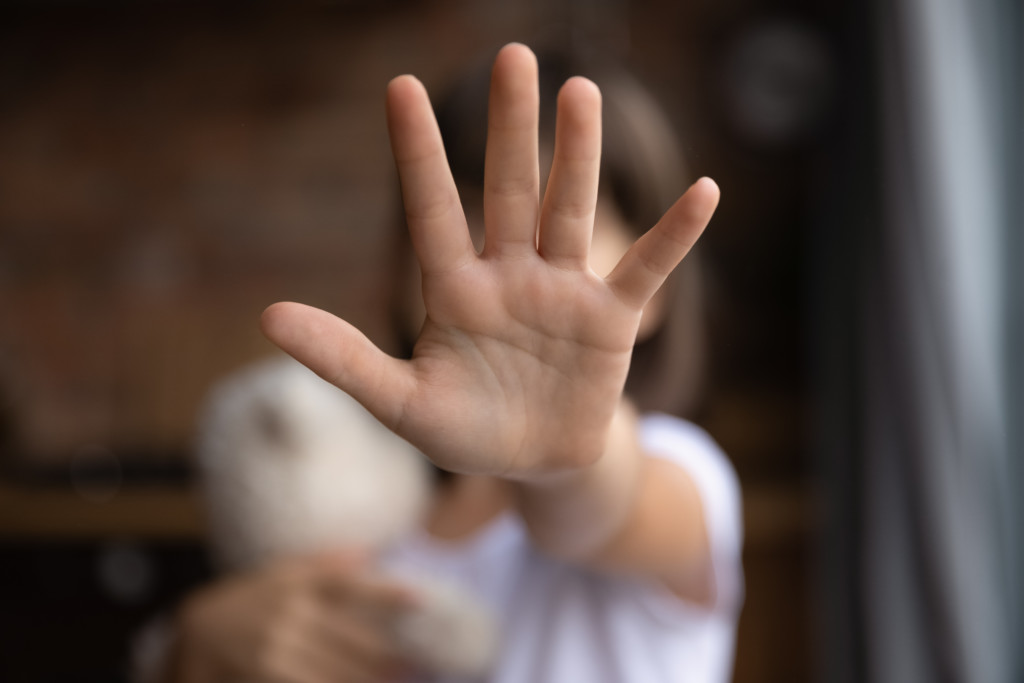
The Florida Legislature created the Hope Scholarship for students in grades K-12 who are enrolled in a Florida public school and have been bullied, harassed, assaulted or threatened at school or at a school-related or school-sponsored program or activity or while riding a school bus or waiting at a school bus stop. The scholarship allows the student to transfer to another public school or enroll in an approved private school.
' Editor's note: Cherie Sanders asked that her daughter's image and name be omitted from this story to protect the girl's privacy.
On this episode, reimaginED Senior Writer Lisa Buie talks with Cherie Sanders, mother of a thriving eighth grader at a faith-based school in the Fort Lauderdale area. Sanders’ daughter feels safe at school, but that wasn’t always the case. A frightening incident three years ago prompted the family to seek an alternative environment in a bully-free zone.
Sanders talks about the incident at school that she felt put her daughter’s safety at risk and how she and her daughter dealt with those circumstances.
School leadership refused to move the bully from her daughter’s class, but offered to move her daughter to another class, a solution that was not acceptable to Sanders. While school districts are required by law to inform families of the Hope Scholarship, created to help students who have experienced bullying transfer to private schools, Sanders’ district didn’t know about it.
Approved in 2017, the Hope Scholarship law provides for eligible sales tax contributions from the purchase of a motor vehicle to be sent to eligible nonprofit scholarship funding organizations. (Step Up For Students, which hosts this blog, is among the organizations that manage the Hope Scholarship program.) Contingent upon available funds, scholarship funding organizations then award scholarships to eligible students on a first-come, first-served basis.
“He had threatened the teacher and the teacher’s child … He threatened to murder [my daughter] and he said that he could do it because he had a knife … he perceived my daughter and a friend as being in his way and this was how he responded to that … She went immediately to her teacher and reported.”
EPISODE DETAILS:
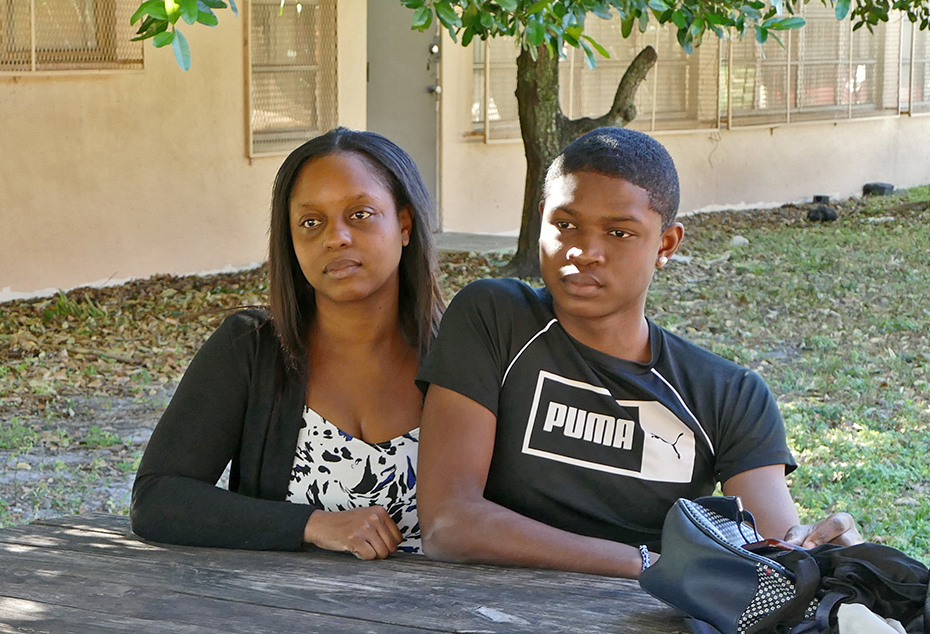
Lamisha Stephens and her son, Marquavis Wilson. PHOTO: Lance Rothstein
Among those who traveled to the state Capitol Wednesday to speak in favor of legislation that will simplify Florida’s education choice programs by merging five scholarships into two and add a flexible spending option was a 16-year-old student from South Florida who knows first-hand the value of education choice.
Marquavis Wilson found a safe haven at West Park Preparatory School after being bullied mercilessly at his former school because of his sexual identity. Marquavis says the Florida Tax Credit Scholarship that made his attendance possible changed his life.
His mother, Lamisha Stephens, says the scholarship saved his life. Without it, Stephens affirms, her son probably would be a dropout. Or maybe he’d be in jail. Perhaps, Stephens says, he would have taken his life.
Please take a moment to watch the video below. And to learn more about SB48, click here.
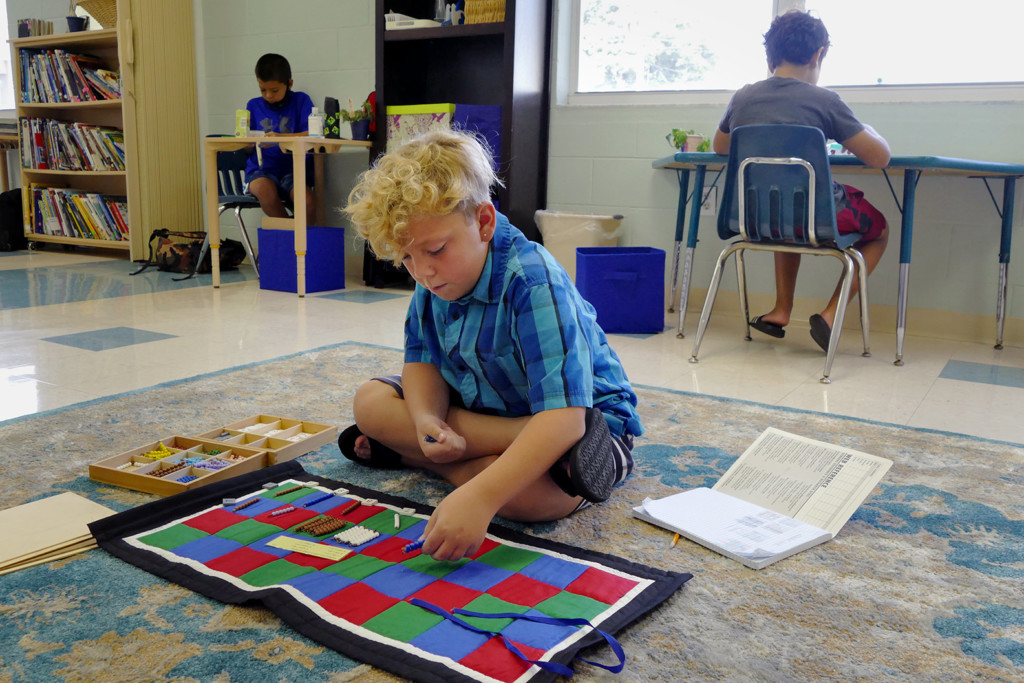
Parker Hyndman, who attends Montessori by the Sea in St. Pete Beach, Florida, is described by the assistant to the head of school as “an old soul” with “a big heart” who clicked immediately with teachers and classmates at the private school he attends on a Hope Scholarship. PHOTO: Lance Rothstein
Editor’s note: To hear Tamara Arrington and her son, Parker, tell the story in their own words, watch the video at the end of this post.
The other student was older and bigger. But Parker, a 35-pound “runt” of a first grader, as his mom described him, didn’t hesitate. When the other student called his friend a racial slur on the bus, Parker piped up: “Don’t call her that.”
Parker felt proud for sticking up for his friend. But daring to do so tripped off a chain of events that would plunge him and his mom, Tamara Arrington, into a year-long nightmare. Some of the other kids put Parker in their sights. When Arrington asked them to stop, one of their parents called police. Eventually, Arrington sought relief in court.
“It was a very dark tunnel for us,” said Arrington, a personal chef and published author. “I had no way to protect my son. I had no way to make sure that my son was getting the education that he needed.”
Hope arrived unexpectedly when Arrington stumbled on to the existence of the Hope Scholarship, an education choice scholarship that Florida lawmakers created in 2018 for students like Parker. Having that option, she said, changed everything.
“Our light came in the form of a Hope Scholarship,” she said.
Parker Hyndman. PHOTO: Lance Rothstein
Arrington and her son moved to the Suncoast six years ago. For more than a year, the school she handpicked, an A-rated elementary near some of America’s sweetest beaches, couldn’t have been more perfect. Parker excelled socially and academically. Arrington joined the PTA.
When Parker got to first grade, he wanted to ride the bus. Arrington said okay, thinking it would boost his independence. But after Parker stood up to the other kid, things went south.
A group of students on the bus started making fun of his name. (Parker’s last name is Hyndman, so they called him variations on “Hiney.”) They made of fun of his teeth. (Some of his baby teeth were discolored after a tumble down some stairs.) They threw paper balls and candy wrappers at him.
Nearly every day, it was something. Arrington said she went to school officials repeatedly, and was assured repeatedly things would get better. But they didn’t get better – and Parker went from loving school to “despising it.”
“I no longer had that smiling little kid that got off the bus and was happy to see me,” Arrington said. “I had a child in tears, in a rage, just so upset that sometimes he … couldn’t even form words to tell me or any of the other mothers at the bus stop what had happened.”
Arrington felt she had no choice but to take matters into her own hands, but the conflict escalated in ways she never would have imagined. One time, she told one of the students, while at the bus stop with other parents, to please stop picking on her son. That night she got a call from police, who said they got a call from the student’s parent. Another time, she did the same thing – only to have police show up at the bus stop. Arrington now had to respond to allegations that she was the bully.
Meanwhile, Parker started getting frequent headaches and stomach aches. At one point, Arrington took him to the emergency room. The doctors couldn’t find anything physically wrong. They asked, “Is Parker under a lot of stress?”
In late 2018, the stress boiled over. At a community event, there was an incident involving Parker and one of his friends and one of the same students on the bus. Afterwards, Arrington went to court and was granted a temporary restraining order. Two weeks later, a judge extended it three months, and urged the other parent to “get professional help” for the other child.
At school, things still weren’t right. Arrington said the school was upset because now it had to make special accommodations to keep the students separated. There was still too much tension.
She started thinking more about a potential solution she learned about a few months prior. She said she was Googling bullying prevention when an article about the Hope Scholarship popped up. Arrington thought it was too good to be true. But in the spring of 2019, she applied.
She and Parker were at the beach at sunset when she saw the email from Step Up For Students saying he had been awarded. Moments later, Parker said, a pod of dolphins started leaping out of the water.
“Definitely a sign,” he said.
“I just felt this wave of relief coming off of me,” Arrington said.
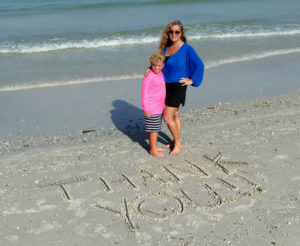
Parker Hyndman and his mother, Tamara Arrington. PHOTO: Lance Rothstein
Arrington began checking out other schools. She wanted a place where Parker could find peace. A friend suggested Montessori by the Sea, overlooking the sand dunes and sea oats in St. Pete Beach. Parker sat in on classes for two days – including yoga on the beach – and loved it.
“When I was at the other school, I felt like okay, I’m going into the worst day in my life repeatedly,” said Parker, now a fourth grader. “But here, I’m excited to get out of bed to come to the beach at my own school. And I’m excited to learn about fun stuff. Definitely.”
Christina Warnstedt, the assistant to the head of school, said Arrington told them about the trauma Parker had endured. But there was never any trepidation about enrolling him. “It was more like, ‘This could be the answer for him,’ ” she said.
And it was. Warnstedt described Parker as “an old soul” with “a big heart” who clicked immediately with teachers and classmates. He became a comforter to another student who was experiencing emotional challenges. “He’s just a light,” she said.
Arrington called the school a hidden gem “tucked away in this little bubble of happiness.”
“I have no doubt that every morning when I drop off my son at school,” she said, “he’s going to come home a better human being.”
Arrington said she’s not sure what would have happened had the scholarship not made that possible.
“There’s no better word than to say that it gave Parker hope for his future. And it gave me hope,” she said. “Making sure that as a mother, that I was making the right decisions for my son. And that he would thrive. Thrive in school. Thrive in life. Thrive. That’s what I wanted. So, the Hope Scholarship truly gave us hope.”
[penci_video url="https://www.youtube.com/watch?v=m9H1PWT7Vew" align="center" width="750" /]
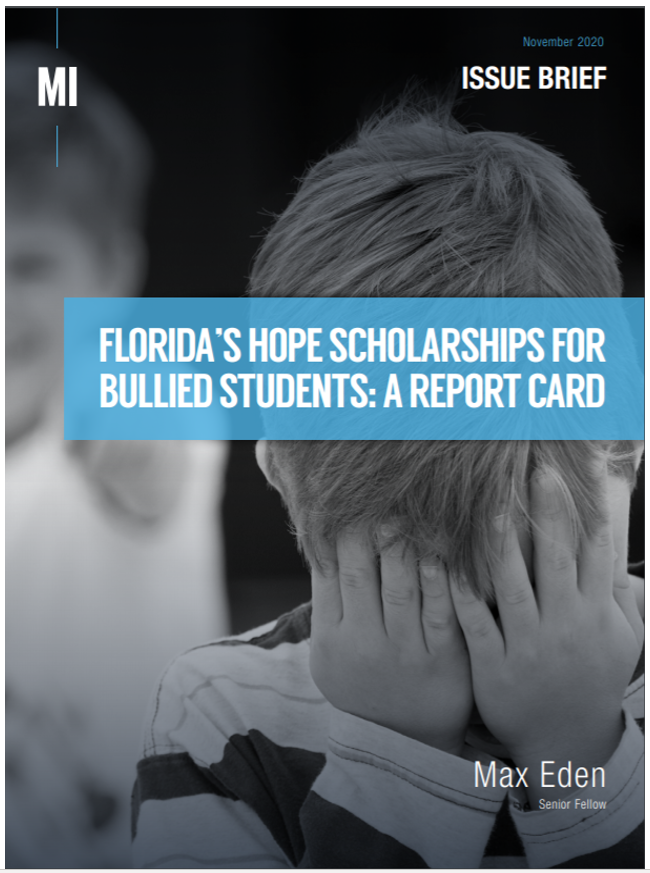 Manhattan Institute senior fellow Max Eden recently authored a report on the legislative origins and history of the first education choice program for students who have experienced bullying in public schools.
In the report, Eden wrote:
“Education reformers have long lamented America’s persistent racial and socioeconomic achievement gap and framed school choice as a means to provide low-income students of color trapped in failing schools with a ticket to a better education. Yet when parents who participate in school choice programs in states like Georgia or Indiana have been surveyed, at least half of them cite safety as a primary motivating factor.”
Eden familiarized himself with the subject of bullying in Florida public schools when he co-authored the book Why Meadow Died about the Parkland, Florida, school shooting. Why Meadow Died lays out a methodical case regarding the dozens of times a disturbed and violent public school student has been mishandled by school and police authorities before finally going on a murder spree.
In this new report, Eden more happily profiles a program designed to allow the victims of bullying to escape from their tormentors. He writes:
“The Speaker’s office noticed that they were receiving e-mails from parents who were upset at the school’s inability to protect their kids. Parents were saying, ‘This has been happening for years, and they do nothing. They just, at most, give the kid a detention or an in-school suspension and say, ‘That’s the most we can do.’
“Corcoran and his staff reviewed data from Florida’s School Environmental Safety Incident Reporting (SESIR) system, which showed 47,000 incidents in the latest reported year (2015–16) — a figure they felt certain represented only a small fraction of the total. They estimated that there could be as many as 100,000 victims of bullying and abuse. ‘We started brainstorming,’ Ochs says. ‘What could we do? There were already policies in place to address bullying. Maybe we could increase the penalties based on the number and type of an incident? Then a lightbulb just kind of went on for us: this fits with the school choice paradigm. We need to empower parents. They just want their kids protected, and that’s not always happening, so we need to give them the power to force the school’s hand or just get their kid to a safer environment.’ ”
The report quotes several families whose lives have been transformed by the program. One parent described their child as having previously been through “daily torture” while another described a public school whose discipline was so ineffective that that the family sought and received a restraining order from a judge.
In Year 2 of existence, the Hope Scholarship remains a small program. A lack of public awareness and a seeming unwillingness on the part of school district officials to follow the law seem to be contributing factors.
A spring 2020 survey of participating parents by Florida State University’s Learning Systems Institute found that about 70% of respondents learned of the Hope Scholarship on their own or from a third party, not from the school district that had a legal obligation to inform them of it. Some parents reported resistance from public school officials. According to one parent, “The school seemed very hesitant to give me the form. I had to go to the office and basically demand it and make them sign it.”
Another group of parents indicated that the school had refused to acknowledge that bullying had occurred. One parent indicated “the Hope notification form was a challenge because the principal and dean at [school name redacted] refused to acknowledge that the bullying was taking place. They refused to communicate with me in a timely manner. I had to make threats to go to the school board commissioner to get them to respond to the bullying issues.”
While Florida’s bullied children have access to a variety of education choice programs beyond the Hope Scholarship, the Florida Legislature should make this program more accessible. Expecting district school principals to investigate and acknowledge in writing that bullying may be occurring in their schools is unrealistic and is an obstacle that few families are able to overcome.
A program for bullied children would be substantially more useful if it were not so easily thwarted.
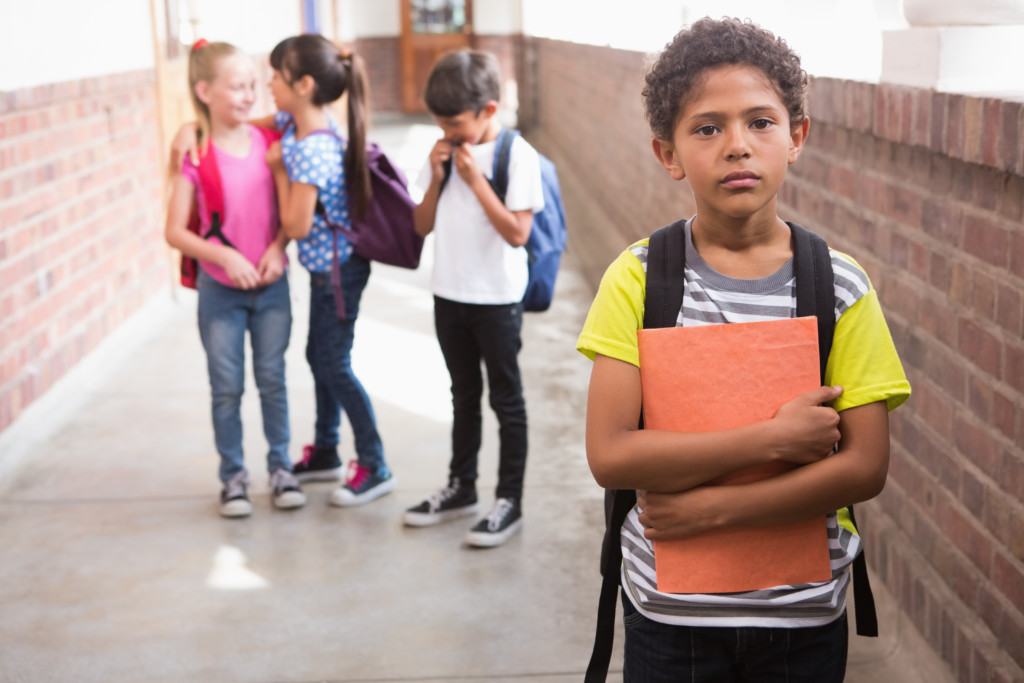 Florida education officials are considering changes that could lead to wider use of a school choice scholarship for bullying victims that has so far seen few takers despite tens of thousands of qualifying incidents each year.
The proposed rule changes to the Hope Scholarship, the first of its kind in America, would require that school districts routinely tell the state how many Hope notification forms they’ve given to parents.
Currently, there is no such requirement, even though districts are required by law to notify parents about the Hope Scholarship within 15 days of a reported incident, and to provide them the Hope form they need to start the application process. (The scholarship is administered by Step Up For Students, the nonprofit that hosts this blog.)
The Florida Department of Education will consider the changes at a June 19 workshop.
Lawmakers created the Hope Scholarship in 2018, led by then House Speaker and now Education Commissioner Richard Corcoran. Students are eligible if they report being victims of bullying or similar incidents, including assault, battery, hazing, harassment, and sexual misconduct. They can use the scholarship to attend private schools, or to transfer to another public school.
At present, 429 students are using Hope at private schools, even though tens of thousands fall into the eligibility categories and state officials projected in 2018 that as many as 7,000 a year would use them. The scholarships are worth about $7,000 a year.
To date, the best available evidence suggests a leading reason for the gap is that districts are not telling parents they have this option.
Seventy-one percent of Hope parents surveyed by the Learning Systems Institute at Florida State University said they learned of the scholarship through other means, such as private schools, internet searches and social media. Two-thirds disagreed or strongly disagreed that the incidents were investigated in a timely manner, and many expressed frustration with district officials who they said didn’t know the legal requirements or didn’t want to follow them.
Hope Scholarships are funded by individuals who contribute up to $105 in return for sales tax credits on motor vehicle purchases. So far this year, they’ve contributed $60.8 million. By law, unused Hope funds can be used for the Florida Tax Credit Scholarship for lower-income students.
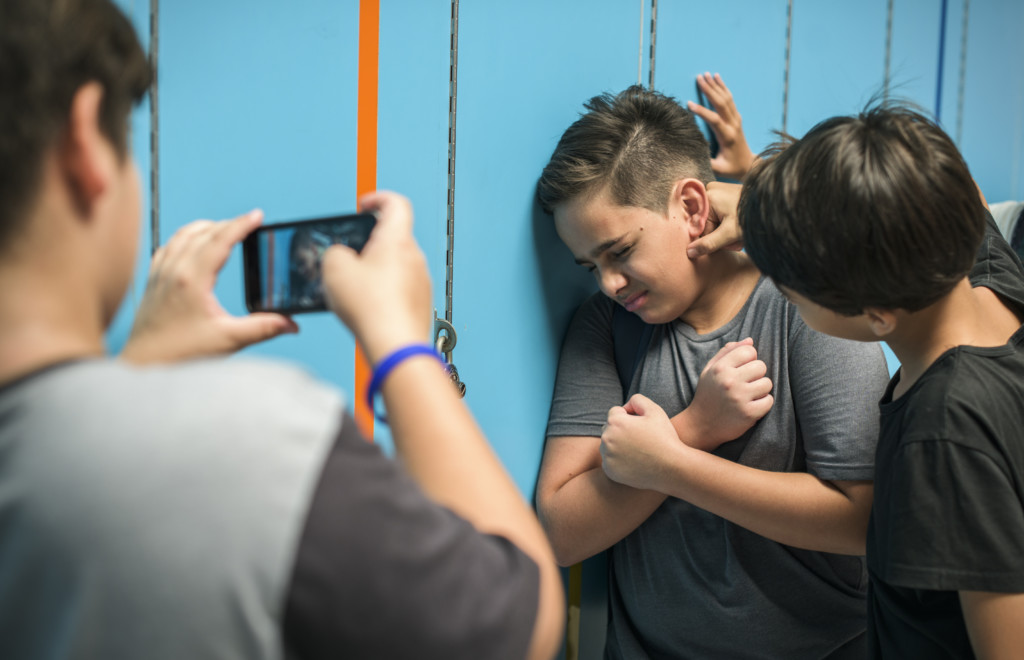 Florida school districts are routinely failing to notify parents of bullying victims that their children are eligible for new school choice scholarships aimed at giving them safer options, say parents who responded to a survey about the new program.
Districts are required by law to notify parents about Hope Scholarships after bullying incidents are reported. But 71 percent of Hope parents surveyed by the Learning Systems Institute at Florida State University said they learned of the scholarship through other means, such as private schools, internet searches and social media.
The survey size is small – 49 of 122 parents who secured the Hope Scholarship in its inaugural year. But their responses may help explain why two years after its creation, the scholarship is only serving a few hundred students, even though tens of thousands of students every year meet the eligibility criteria.
There are 368 Hope students this year, up from 127 in year one.
“Nobody at the public school told us anything about it even after repeated instances of bullying and us complaining about it,” one parent wrote.
“The school seemed very hesitant to give me the (Hope Scholarship notification) form,” wrote another. “I had to go to the office and basically demand it and make them sign it.”
Former Florida House Speaker and now Florida Education Commissioner Richard Corcoran spearheaded creation of the Hope Scholarship in 2018. The first-of-its-kind scholarship gives victims of bullying, harassment and similar incidents the option to attend private school or transfer to another public school.
The new report is rife with heart-wrenching quotes. One victim was slapped in the head 20 times in class. One had his head slammed against a concrete wall so hard it made him dizzy. Another had his lunch stolen nearly every day by kids who would eat it, step on it and throw it in the garbage. “I was crying in the car,” said the parent of another, “and (my child) is like, please mama, I don’t want to go back to that school.” The school climate, said yet another, was “like a slaughterhouse.”
Two thirds of the parents disagreed or strongly disagreed that the incidents were investigated in a timely manner or taken seriously by the district. Many expressed frustration with district officials who didn’t know the legal requirements for Hope – or, in their view, didn’t want to follow them.
By law, school districts must inform parents about the Hope Scholarship within 15 days after incidents are reported. They must provide the parent with a completed Hope notification form that verifies the incident was reported and the parent was informed. The form is needed to start the application process.
“Staff seemed to view the completion of the form as admitting their own guilt in some way,” one parent wrote. “There was resistance to signing at first until I produced the statute and accompanying memo from the (Florida Department of Education).”
In light of an ongoing debate about policies regarding LGBTQ students at some private schools, it’s worth noting that several Hope parents said their children were bullied in district schools because of their actual or perceived sexual orientation.
“He was ostracized from his peers and when kids would hang out with him, they would get bullied as well or told to watch out, if he touches you he’ll make you gay too,” said one. “My son was repeatedly called names such as f-----, gay boy, loser, etc. along with adult language,” said another.
Hope Scholarships are worth about $7,000 a year. They are funded by contributions in return for sales tax credits on motor vehicle purchases. So far this year, taxpayers have contributed $42 million.
The parent survey is part of a program evaluation required by statute. The Florida Department of Education hired the Learning Systems Institute.
Among other findings:
· Most Hope Scholarship recipients are white (48 percent). Most were in middle school (47 percent). Bullying was the most common incident reported (34 percent).
· Most respondents said the application process was easy (83.7 percent) and most disagreed or strongly disagreed that it took too long (75.5 percent).
· Seventy-three percent said finding a safe school using the scholarship was very easy or somewhat easy. Twenty-seven percent found it somewhat or very challenging.
· Respondents gave their children’s new schools high marks for safety, environment and engagement. On a scale of 1 to 4, overall ratings for the new schools averaged 3.58, compared to 1.85 for the prior schools.
One Hope parent said her son was two grade levels behind in reading in his prior school “because of all the issues.” But in his new school he revved two grade levels ahead.
“It’s the best experience I could have ever hoped for,” she said.
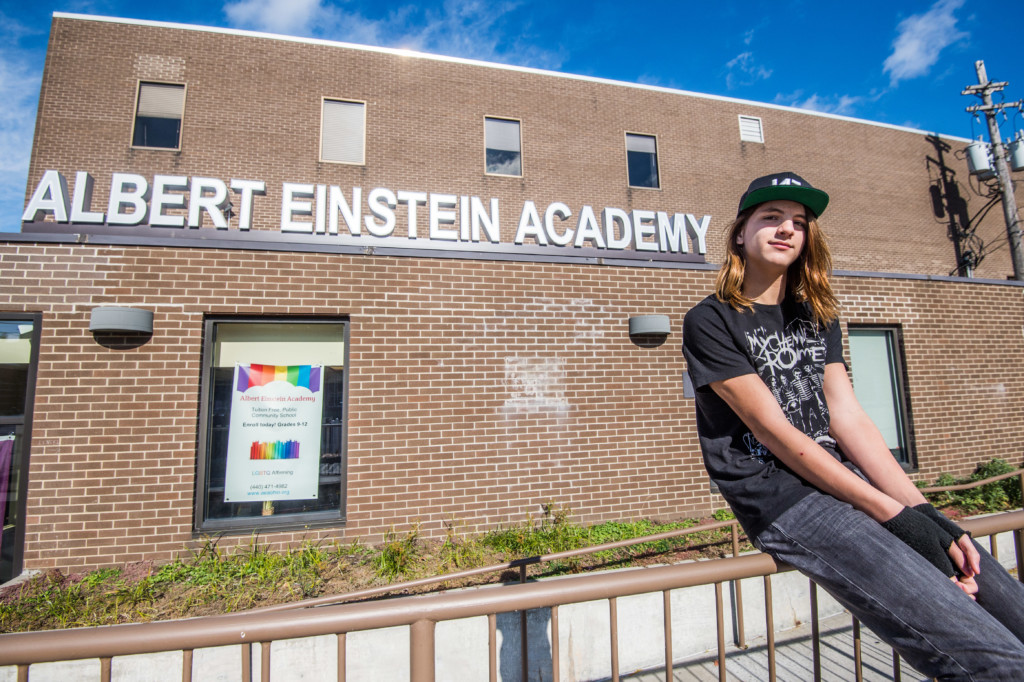
Albert Einstein Academy opened in August 2018 to serve mostly LGBTQ high school students in metro Cleveland. Nearly 40 students enrolled and another 15 signed up to enter as ninth-graders this fall. About 80 percent of the students at the charter school identify as LGBTQ.
Sixteen-year-old Channing Smith of Tennessee killed himself after classmates circulated sexually explicit messages he exchanged with another boy. Fifteen-year-old Nigel Shelby of Alabama killed himself after peers bullied him over his sexual identity and school officials reportedly told him “being gay is a choice.” When 9-year-old James Myles of Colorado came out at his school, fellow students reportedly told him to kill himself. Tragically, he did.
In Florida, Elijah Robinson was harassed to the edge too. But for an educational choice scholarship that gave him an option – a safe, accepting private school – Elijah, 18, said he would no longer be alive.
Channing, Nigel, James and Elijah were students in public schools. That’s not a slam on public schools. It’s just a reminder, which I wish wasn’t necessary, that far too many LGBTQ students are tormented in far too many schools of all types.
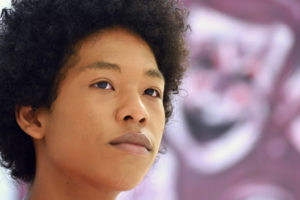
Elijah Robinson, 18, a student at Foundation Academy in Jacksonville, Fla., experienced severe bullying at his assigned public school. PHOTO: Lance Rothstein
It’s also a plea. LGBTQ students are two to three times more likely to experience bullying than non-LGBTQ students. I hope all of us who want to end that hostility will think twice about a narrative, recently buoyed by legislation filed in Florida, that casts programs that provide private school options as though they are inherently part of the problem. If the goal is ensuring the safety and affirmation of LGBTQ students – and not simply the tarring of educational choice – that doesn’t make sense.
Please consider what LGBTQ students say. According to the most recent survey by GLSEN, 72 percent of LGBTQ students in public district schools said they experienced bullying, harassment and assault due to their sexual orientation, compared to 68 percent of LGBTQ students in private, religious schools, and 60 percent in private, non-religious schools. For bullying, harassment and assault based on gender expression, the numbers in those three sectors were 61, 56 and 58 percent, respectively.
All those numbers are horrifically high. All lead to dark places. LGBTQ students are three times as likely as non-LGBTQ students to suffer from depression or anxiety. They’re twice as likely to experiment with drugs and alcohol. While 15 percent of non-LGBTQ high school students considered suicide over the past year, 40 percent of LGBTQ students did.
Educational options are not an antidote. But they can help.
In Florida, recent scrutiny over a relative handful of private schools that are not LGBTQ welcoming ignores a key point. Students are not assigned to those schools. Their parents can enroll them elsewhere. That’s often not the case for LGBTQ students suffering in assigned public schools. Elijah Robinson endured nearly two years of abuse in his assigned school before a scholarship gave him a way out. “If I had stayed,” he said, “I honestly think I would have lost my life.”
In Ohio, educators concerned about LGBTQ bullying in district schools opened a charter school for LGBTQ students. To be sure, some supporters had mixed feelings. As one parent told me, “We’re saying, ‘You’re so different, you need your own school’.” On the other hand, for many students at this school, having an option was literally a matter of life and death. “There’s a need,” said Henry, a transgender student who considered suicide in fifth grade, “for a school where people can feel like they belong.”
One day, I hope, all schools will be safe and affirming. In the meantime, it’s unconscionable to trap Elijah, Henry or any other student in any school that isn’t.
Charter schools. Democratic lawmakers have filed several bills to reign in problems that arise when charter schools close, reports Gradebook. Miami-Dade County planners reject a charter school's proposal to grow on the site of a former private school, reports the Miami Herald.
Jeb Bush. Talks Florida-style ed reform in Texas. Dallas Morning News. Texas Tribune. Associated Press. Austin American Statesman. KUT.org.
School spending. Lawmakers should loosen the strings on impact fee money, writes the Ocala Star Banner.
More sequestration. WOKV.com. Gradebook.
Teacher evaluations. Seminole officials fear good teachers could lose their jobs under the new system, reports Orlando Sentinel. In southwest Florida, only four people sound off on the evals at a DOE meeting, reports the Naples Daily News.
Teacher pay. Seminole teachers ask for more. SchoolZone.
Broad Prize. A Broad Prize site-visit team suggests Orange County could soon be in the running. Orlando Sentinel. (more…)
AP results. Florida students rank No. 4 in the nation in the percentage of graduates passing an AP exam. redefinED. Tampa Bay Times. Miami Herald. Tallahassee Democrat. Orlando Sentinel. CBS Miami. Florida Today. Associated Press. Fort Myers News Press.
Tutoring oversight. The Tampa Bay Times elevated a handful of bad actors to taint the overall tutoring effort in Florida and ridicules a program championed by the late Sen. Ted Kennedy to help low-income families, writes Steve Pines, executive director of the Education Industry Association, in an op-ed response to the Times series and editorial.
Teacher evals and school grades. Despite the concern of Education Commission Tony Bennett and others, the two systems are not meant to be in sync. Shanker Blog.
More conspiracy! Now in Education Week.
Class size flexibility. There's bipartisan support for a bill to provide that. StateImpact Florida.
Common Core. Florida Education Commissioner Tony Bennett talks more about the why's behind Plan B. Education Week. (more…)

