
The Rev. H.K. Matthews, front row, second from left, and John Kirtley, front row, far left, joined more than 6,000 marchers at a 2010 Tallahassee rally to support expanding the income-based Florida Tax Credit Scholarship Program.
By John Kirtley
The Rev. H.K. Matthews passed away Monday at the age of 97. As I urge you to read in this obituary, he was one of the towering figures in the Florida civil rights movement.
He was arrested over 30 times fighting for equal rights in Northwest Florida. He was beaten, along with John Lewis and other brave activists, on the Edmund Pettus Bridge in their first attempt to march from Selma to Montgomery. There is now a park named in his honor in Pensacola. You can also read his autobiography, “Victory After The Fall.”.
On a 2010 visit to Pensacola to recruit schools for the Florida Tax Credit Scholarship program, former Step Up For Students grassroots organizer Michael Benjamin and I met the operator of a faith-based school in town. He urged us to meet with Rev. Matthews, who he thought might respond well to the social justice message of the scholarship program. At the time, the average household income of our students was less than $30,000, and 75% were minorities. Michael and I said we would love to meet him.
Rev. Matthews didn’t say much during our initial visit; Michael and I explained how the scholarship program empowered low-income families to choose a different school if the one they were assigned to wasn’t working for them. He seemed to just take it all in but offered neither affirmation nor disagreement.
Almost as an afterthought, I invited him to a march and rally we were having the next month in Tallahassee. We needed the legislature to pass a bill to expand the scholarship program to relieve our waitlist, and we asked scholarship families to come to the Capitol to show their support. To my surprise, he agreed to attend.
On that day, over 6,000 people marched from the convention center to the Capitol. I invited Rev. Matthews to walk in front of the crowd with other faith leaders. Normally I would never walk in the front row, but I wanted to make sure everything went smoothly for him. He was very quiet as the huge crowd marched.
When we had gathered for the rally in the Capitol, I placed him in a prominent seat on the stage. A few minutes into the event, he motioned me over and asked if he could speak to the crowd. I had no idea what he was going to say, but I wasn’t going to say no. I went to the minister running our show and asked him to introduce Rev. Matthews.
What would he say? Was he with us?
I soon had my answer.
“This reminds me of the old movement,” he said. “Seeing thousands walking in the streets, fighting for the right to determine their own future, to fight for what is best for their children. When I worked with Dr. King back in the day …”
When he said those words, there was a murmur in the crowd, both students and adults. These kids had read about Dr. King in their history books. Some of them knew that there were not one but two marches across the Pettus Bridge, and here was someone who was there at the first attempt, someone who took the blows.
He was indeed with us.
Immediately after the rally, Rev. Matthews was swarmed by students young and old, some asking questions about his time with Dr. King, some young ones who just wanted to touch him — I suppose just to make sure this hero was real. They did not let him go for at least 20 minutes.
I could tell at the time this moved him. He told me so later. After that day he would call me to ask if there was anything he could do to help the movement. We had him appear at events with donors, governors, and legislators.
He would lead another march for us in 2016, when over 10,000 people came to protest the lawsuit filed by the Florida teachers union demanding that the courts shut down the Tax Credit Scholarship, which would evict 80,000 poor kids from their schools. That day Rev. Matthews was joined at the front of the procession by Martin Luther King III, the son of the man Matthews marched with 50 years prior. You can watch a 60-second video of that march here.
I had the pleasure of joining him at his church in Brewton, Alabama, where he moved in later years. He was being honored for his years of service to that church. I was honored, though very surprised, when he called me up to speak that day. Luckily, the words to praise him came easily.
They come again easily today, but not without a few tears.
How fortunate I was to have my life intersect with his, however unlikely that would have been to me before this movement changed the course of my life.
How fortunate the education freedom movement was to have his blessing and his involvement.
How fortunate the state of Florida was to have his tireless efforts fighting for civil rights.
How fortunate, all.
Rest in peace, Rev. Matthews.
John Kirtley is founder and chairman of Step Up For Students.

As we celebrate National School Choice Week, we’re reflecting on educational freedom's profound impact on students, families, and communities. This week, we’re not just celebrating the opportunities that school choice offers, but also the incredible stories of individuals whose lives have been transformed by it.
Ilen Perez-Valdez: Overcoming adversity through choice
Ilen Perez-Valdez’s story is one of resilience and determination. Growing up, Ilen faced numerous challenges; she was born with four chronic medical conditions that required constant treatment and medication. Her mother, a Cuban immigrant, had to flee her home country at a young age and worked multiple jobs to provide for Ilen and her grandmother. As a child, Ilen’s medical needs were often too complex for the local public schools to accommodate.
 However, Ilen’s life took a dramatic turn when she received a Florida Tax Credit Scholarship through Step Up For Students. The scholarship allowed Ilen to attend St. Agatha Catholic School in Miami, where she received the personalized care and support she needed. She went on to attend Immaculata-La Salle High School, where her education was tailored to meet her unique needs. Thanks to the flexibility of school choice, Ilen was able to flourish in a smaller classroom setting, where she not only received the medical support she required but excelled academically.
Today, Ilen attends the University of Miami on a full academic scholarship and is pursuing a degree in neuroscience. She attributes her success to the opportunities she was given through the Florida Tax Credit Scholarship. Ilen now advocates for other children who face similar challenges, sharing her story to help others understand the life-changing impact of school choice.
Caitie Barnes: A story of resilience and opportunity
As a child, Caitie underwent open-heart surgery, which required special care and attention throughout her education. Her family faced significant financial challenges when her father was laid off during the recession, making it difficult to afford private school tuition. But, thanks to private school financial aid and, later, the Florida Tax Credit Scholarship when her family moved from Tennessee to Florida during her junior year, Caitie could continue her education at a school that could meet her academic and medical needs.
 When her family relocated due to her father’s new job at Eglin Air Force Base in Florida, Caitie found a perfect fit at Rocky Bayou Christian School. There, Caitie thrived in a supportive environment, graduating as class valedictorian. Today, Caitie attends Covenant College and is pursuing a psychology degree with a pre-law concentration and a minor in community development. Caitie’s story is a testament to the power of educational choice and the doors it can open for students facing personal challenges.
Why these stories matter
Ilen and Caitie are just two shining examples of the countless lives transformed by the power of school choice. Their stories are a powerful reminder of why it’s crucial to ensure every child has access to a high-quality education regardless of their background, circumstances, or medical needs.
As someone who has experienced this firsthand, I can attest to the life-changing impact of educational choice. My family’s journey was forever transformed by the opportunity to choose the best educational path. This is not just about policy; it's about real families, real futures, and the incredible potential that can be unlocked when students are given the chance to thrive in the environment that works best for them.
As we close out National School Choice Week, let’s remember that our children’s future depends on the opportunities we provide today. Every child deserves the chance to succeed, and with the freedom to choose the education that best fits their needs, we unlock limitless potential. Let’s continue to stand together, celebrate our progress, and fight for even more opportunities so that every student, like Ilen and Caitie, has the chance to thrive.
The power to change a life starts with choice, and that choice is in our hands.
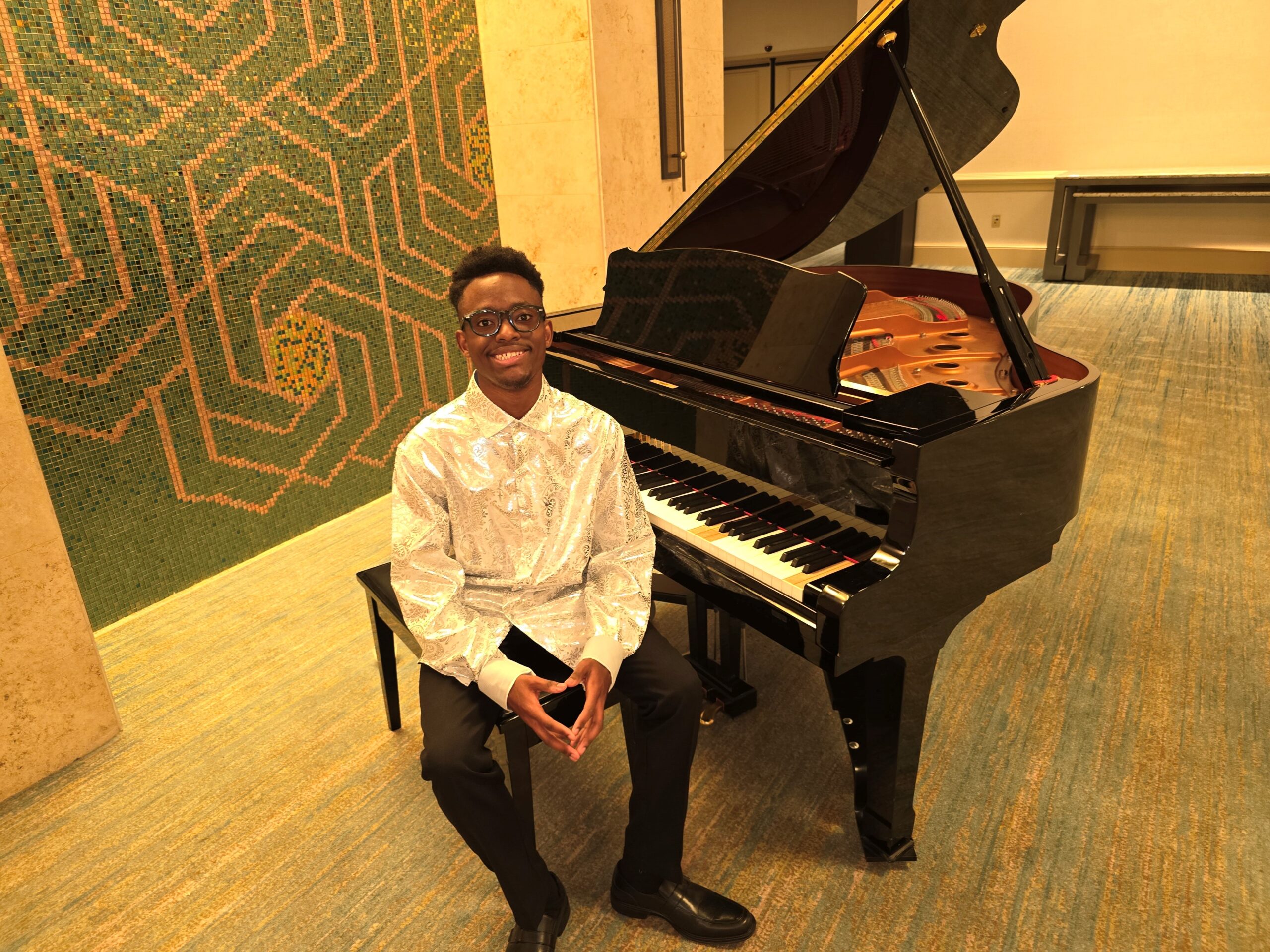
Gabriel is the first PEP alumnus to join the American Federation for Children.
Gabriel Lynch III is new to his role as an education choice advocate. Though in essence, he’s been doing it nearly all his life.
He’s a product of both private and homeschooled education. He’s attended brick-and-mortar schools and studied virtually.
Along the way, Gabriel, 19, has become an ordained minister, a motivational speaker, an accomplished pianist, and a published author.
Those wondering about the benefits of education choice need only listen to Gabriel.
“School choice changed my life to who I am today,” he said.
Today, Gabriel is a college freshman majoring in music at Seminole State College in Lake Mary. His education from kindergarten through high school was supported by scholarships managed by Step Up For Students, from the Florida Tax Credit Scholarship to the Family Empowerment Scholarship for Educational Options to the Personalized Education Program (PEP), which he used to homeschool in 2023-24, his senior year of high school.
“I want kids to have the same experiences I had,” he said.
That’s why Gabriel joined the American Federation for Children (AFC), an organization that strives to bring education choices to families nationwide. Gabriel was recently accepted into AFC’s Future Leader Fellowship, a year-long internship program that will prepare him to meet with lawmakers around the country to promote education choice.
Read about Gabriel's story here.
A number of Step Up For Students alumni advocate for AFC. One of them, Denisha Merriweather Allen, founded Black Minds Matter and serves on Step Up For Students' governance board. Gabriel is the first to have benefited from a PEP scholarship. The scholarship, which began during the 2023-24 school year, is an education savings account (ESA) for students who are not enrolled full-time in a public or private school. This allows parents to tailor their children’s education by allowing them to spend their scholarship funds on various approved, education-related expenses.
Gabriel’s mom, Krystle, used PEP to homeschool Gabriel and his two brothers, Kingston (eighth grade) and Zechariah (sixth grade).
A longtime advocate for education choice, Krystle and her husband, Gabriel Jr., who live in Apopka, want to take control of their children’s education. PEP allowed them to tailor the curriculum for each son.
“They have different learning paths,” she said.
Krystle is ecstatic that her oldest son is following in her advocacy footsteps.
“This has been something that has been on my heart for many years, and to see him carry on the message, that's exactly what I've always dreamed of,” she said.
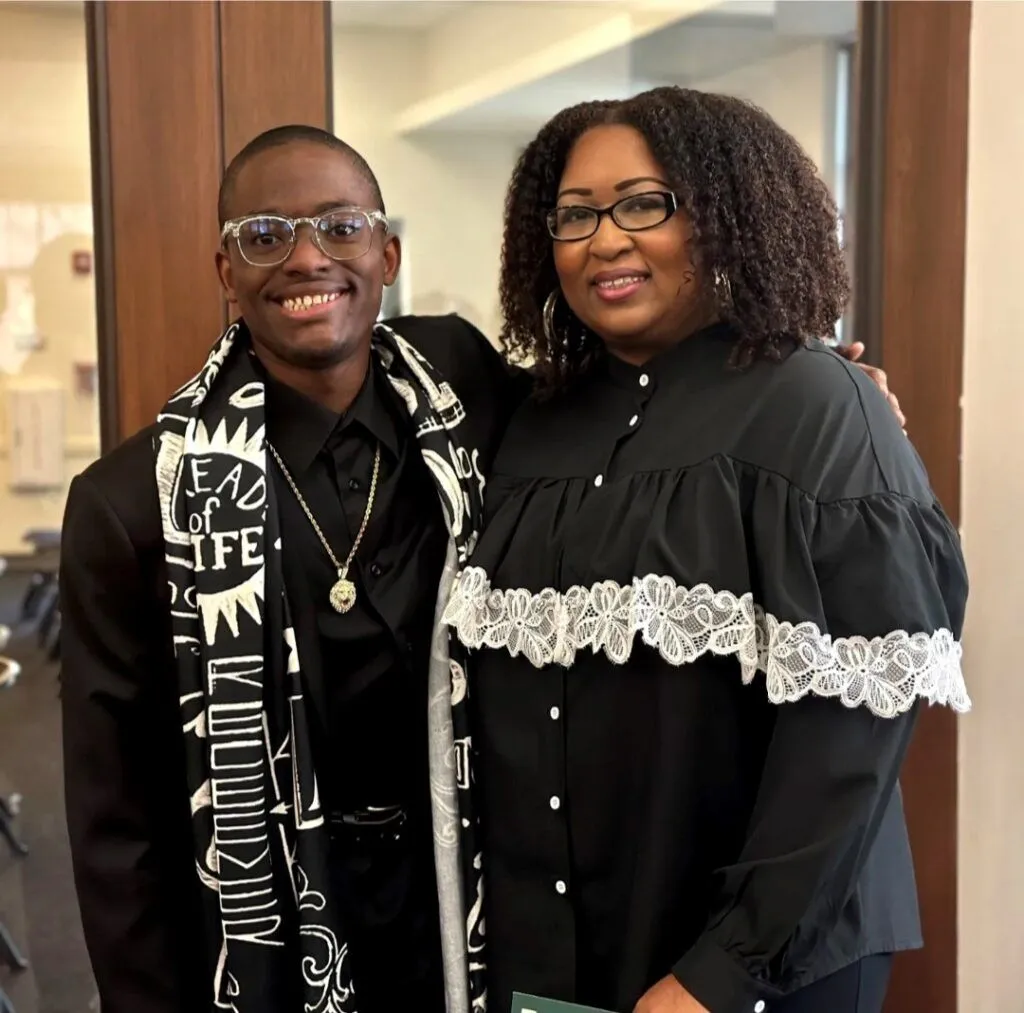
By joining the American Federation for Children, Gabriel is following in Krystle's footsteps as an advocate for education choice.
Gabriel said school choice helped mold him. Attending a faith-based school led him to become an ordained minister and a public speaker. Using the PEP scholarship for piano, guitar, and voice lessons fostered his love of music and helped shape what he hopes to be his career path. He wants to be a composer.
“There are so many things I am right now because of school choice,” Gabriel said. “I think it’s because my parents put me where I fit best because even when I was in private school, I could fit in. I found my group, I found my clique, and that's why I say it really changed my life.”
Gabriel is eager to share his story with lawmakers in states that don’t have education choice. Last year, advocates from the AFC Future Leaders program volunteered on the front lines of the fight to support education choice legislation in Nebraska.
“It’s giving parents options to choose where their kid fits best,” he said. “that’s what I will tell them. I think that would be amazing for those states that don't have school choice options.”
 Editor’s note: This commentary from Robert Pondiscio, a senior fellow at the American Enterprise Institute, originally appeared on the Institute’s web site.
It is a truth so obvious that it scarcely needs to be said: successful businesses have satisfied customers while unsatisfied customers take their business elsewhere. It’s true of restaurants, garages, and all manner of retail outlets and consumer services.
Forgive the mercantile comparison, but schools are no different. Parents who are happy with their child’s school, teachers, curriculum, and culture have no reason to leave, especially given how disruptive changing schools can be to family routines and scheduling. You don’t even consider it unless you’re deeply upset, or your kids are miserable.
Given this unremarkable observation, it’s hard to account for the outsize response — and outright anger — that greeted a recent paper from Heritage Foundation scholars Jay Greene and James Paul, who functionally made the same anodyne point: Unhappy parents are more likely to support school choice.
And right now, parents are deeply unhappy about critical race theory, gender ideology, and other strident manifestations of “culture war” in their kids’ schools. These parents are an obvious target for school choice advocacy as the answer to their problem.
Quelle horreur!
While the paper carries the provocative title, “Time for the School Choice Movement to Embrace the Culture War,” the only sin Greene and Paul committed is to favor dispassionate analysis over bland big-tent pieties which aren’t true and haven’t been for years.
“School choice offers a sensible resolution to cultural debates,” they wrote. “School choice gives parents what they want, regardless of which side they are on — more control over their children’s education. And, it acknowledges that parents have pluralistic views about which values to instill in their children.”
This is so obvious that one wonders how choice advocates would propose to motivate parents to demand choice instead. A free toaster with every new enrollment? Five hundred dollars back when you trade in your old school?
Schools are the institutions we build to transmit to children the values, habits, stories, and ideas we value: In a word, our culture. To think there should be no debate about what that comprises is to misunderstand entirely what a school is and the purpose it serves in civil society.
If Greene and Paul erred, it was in using the imprecise and provocative phrase “culture war” to characterize the inevitable disagreements over these issues among people in a politically, socially, and intellectually diverse nation —a nation, not incidentally, that is more than large and advanced enough to support a broad range of school options and flavors for the more than 50 million children we need to educate and usher toward rewarding and responsible adult life.
So why the immune response to the obvious ideas offered by the authors? There’s no real mystery.
As a recent paper by Ian Kingsbury in the Journal of School Choice noted, ed reform organizations and personnel tilt overwhelmingly to the progressive left. To many, the idea that some parents might be less than enamored with the “woke agenda” is prima facie evidence of racism and white supremacist impulses that cannot be countenanced under any circumstance.
There’s no reason even to be curious about such parents’ discomfort in their public schools and whether they might see that agenda as culture warring. Through this lens, it’s school choice as the new white flight, period.
It’s also a hangover effect of ed reform’s era of technocracy and paternalism. A generation of advocates and activists have no conception of reform as anything other than a social justice initiative and not a lot of use for choice apart from that agenda. The suggestion by Greene and Paul that the culture war represents an opportunity to advance choice is not just counterintuitive but anathema to this way of thinking.
My sense is that the scorpions in the ed policy and advocacy bottle have all lost the thread. Even choice advocates who view choice as an intrinsic good tend to underestimate the extraordinarily radical proposition they are championing: asking Americans to overthrow the cultural habit of sending their children to local public schools that has persisted, largely unquestioned, for generations.
That’s a tremendously heavy lift and one that is unthinkable for most parents until or unless displeasure with their child’s school makes staying put untenable. The endgame of the school choice movement is changing the model of how Americans educate their children. Sitting in judgment of parents’ reason for wanting to avail themselves of choice distracts from that mission. It’s an act of self-sabotage.
Still, the critics may have a point. It was probably a bad idea for the authors to suggest that it’s time for the school choice movement to “embrace the culture war.” They should have added three words for clarity and emphasis: “Get over it.”
 Longtime education choice advocate Corey DeAngelis, national director of research at the American Federation for Children and executive director at the Educational Freedom Institute, continued to champion the rights of families to make education choices for their children recently, speaking on behalf of the American Federation for Children at America Fest in Phoenix.
Here are some excerpts from DeAngelis’ pitch for school choice:
“It’s a great time to be an American. And it’s also a great time to be a school choice advocate. The teachers’ unions have finally overplayed their hand, showed their true colors, and in a way, inadvertently done more to advance the concept of homeschooling, parental rights and educational freedom than anyone could have ever imagined.”
“This year has been the year of school choice, and we’re just getting started. Nineteen states have already expanded or enacted programs to fund students as opposed to systems. Parents have woken up. A way that I would put it is that COVID didn’t break the government school system, it was already broken. And families are never going to forget how powerless they felt in 2020 and they’re going to fight to make sure that they never feel powerless ever again.”
“We already fund students directly when it comes to Pell grants and the GI bill for veterans. The money doesn’t go straight to the community college regardless of your choice. Instead, the money goes to the student, and you can pick the community college if you want, but you can also take that money to a private, religious, or non-religious university. We do the same thing for pre-K programs.”
“Imagine if we forced low-income families to take their food stamp dollars to a government-run provider of groceries. That wouldn’t make any sense. Instead, the money rightfully goes to the families, and they can choose Walmart if they want. We can also take that money to Safeway or Trader Joe’s. The money follows the decision of the family. We do the same thing with Medicaid; we do the same thing with Section 8 housing vouchers. All I’m arguing is that we apply the same logic to K-12 education and fund people, not buildings.”
“Choice is the norm with higher education, pre-K and thankfully, for now, just about everything else in the United States. Choice threatens an entrenched special interest only when it comes to the in-between years of K-12 education. So, they fight as hard as possible against any change to the status quo, and they make up stuff and repeat the same arguments over and over again.”
“School choice doesn’t defund government schools; government schools defund families. School choice initiatives just return the money to the hands of the rightful owners — or at least the intended beneficiaries.”
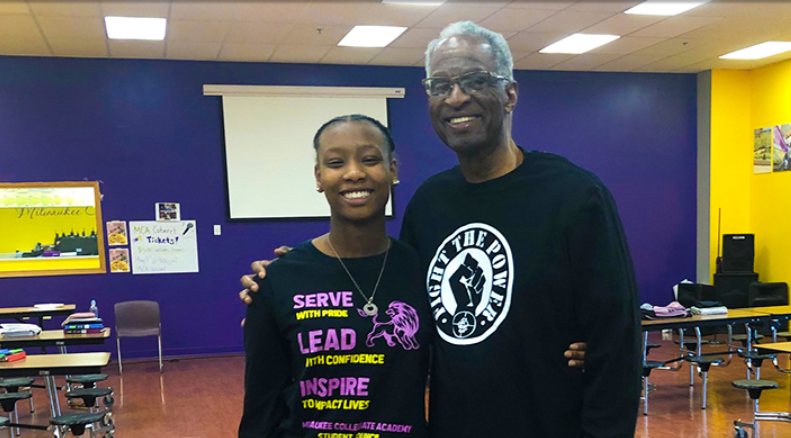
Education choice advocate Howard Fuller poses with a student at Milwaukee Collegiate Academy during a visit to the school in 2019. The school, which he co-founded in 2004, has been renamed Dr. Howard Fuller Collegiate Academy.
Editor’s note: This article about education choice pioneer Howard Fuller from Jon Hale, associate professor of education at the University of Illinois at Urbana-Champaign, appeared Monday on The Conversation, a nonprofit, independent news organization that encourages Creative Commons republication.
As a longtime civil rights activist and education reformer, Howard Fuller has seen his support for school choice spark both controversy and confusion. That’s because it aligns him with polarizing Republican figures that include Donald Trump and Trump’s former secretary of education, Betsy DeVos.
But unlike those figures, Fuller’s support for school choice is not rooted in a conservative agenda to privatize public schools. Rather, it is grounded in his ongoing quest to provide Black students a quality education by any means necessary.
I write about Fuller in my new book “The Choice We Face,” which traces the history of school choice as well as demands for radical education reform by Black activists. Unlike most other school choice advocates I interviewed, Fuller’s activism predates the current debate and has firm footing in the Black Power movement.
Now 80, Fuller retired in June 2020 from Marquette University, where he was a longtime education professor and founded the Institute for the Transformation of Learning to improve education options for low-income students in Milwaukee. During the 1990s he served as superintendent of Milwaukee Public Schools.
Here are five aspects from Fuller’s career that suggest a nuanced lens into the school choice movement.
Advocated for Black Power in the 1960s
Fuller first became involved in the civil rights movement when he joined the Congress of Racial Equality in 1964 as a graduate student at Case Western Reserve University in Cleveland, Ohio.
In Cleveland, Malcolm X delivered a version of the “Ballot or the Bullet” speech in April 1964. Days later, Rev. Bruce Klunder, a 27-year-old white Presbyterian minister, was accidentally crushed to death by a bulldozer as he and several other activists protested the construction of a new, all-Black school. The school was the city’s attempt to avoid desegregation.
Fuller later helped establish and lead Malcolm X Liberation University in Raleigh, North Carolina. The independent, Black-run school, which operated from 1969 to 1973, offered a unique African and African American studies curriculum as well as technical training for students to work as activists in the freedom struggle.
Controlling and safeguarding a school for one’s own community became a defining principle of the Black Power movement. For Fuller and others, education was liberation for Black communities. As Fuller described it, the mission of the university was to educate students “totally committed to the liberation of all African people.”
Proposed an all-Black school district in the 1980s
In 1978, Fuller was embroiled in a struggle in Milwaukee to save his alma mater, North Division High School, from closing. That year, Derrick Bell, who is regarded as the “godfather” of critical race theory, delivered an address in Milwaukee titled “Desegregation: A New Form of Discrimination.”
In his speech, Bell criticized education reforms that were more concerned with balancing racial demographics in schools than with improving Black education. He argued that building programs that did not always accept local Black students but made space for white students who lived outside the neighborhood hurt Black students. Much like Fuller’s North Division High School, Black students were not guaranteed admission to the school closest to their home if those schools were designed to attract white students.
Several years later, Howard Fuller drafted the “Manifesto for New Directions in the Education of Black Children.” The treatise proposed carving out an all-Black school district within the Milwaukee public school district to serve over 6,000 students. The district was to be controlled by and geared toward families of color. The plan was a response to a call made in 1935 by W.E.B. DuBois, who argued that Black educators and activists should invest more in building Black schools than integrating hostile white schools.
Supports school vouchers today
Fuller’s proposal for an all-Black school district gained traction, but Wisconsin legislators opted instead for a voucher plan in 1989 – the Milwaukee Parental Choice Program. The program covered the tuition of students who wanted to enroll in private schools.
The Republican Party seized on the new voucher plan and pushed it through the state legislature. Ever since the Brown v. Board of Education decision in 1954, when the Supreme Court declared school segregation unconstitutional, the Republican Party has increasingly aligned itself with school privatization efforts through vouchers and “freedom of choice” plans.
Fuller also supported the Milwaukee voucher plan, as did some other Black activists, despite criticism from academics and organizations, including the NAACP.
“If you’re drowning and a hand is extended to you, you don’t ask if the hand is attached to a Democrat or a Republican,” noted Wisconsin State Rep. Annette “Polly” Williams, a Black Democrat who worked with Fuller to propose the legislation for a separate school district and also supported school vouchers.
Helped build the school choice movement
Howard Fuller helped build the foundation for civil rights activists who are interested in school choice. As he told me during our interview in 2019, “I’ve always seen school choice from a social justice framework as opposed to a free market framework.”
Many activists saw it the same way.
For example, Wyatt Tee Walker, one of Dr. Martin Luther King Jr.’s trusted strategists, opened a charter school in New York City in 1999. James Forman Jr., a civil rights lawyer, scholar, author and son of the prominent Black Panther Party organizer, opened a charter school in Washington, D.C. in 1997. Both leaders argued that failed desegregation attempts placed a burden on Black families by catering to white families without promising quality education for Black students.
Meanwhile, education activist Geoffrey Canada was awarded the National Freedom Award in 2013 for his charter school network, the Harlem Children’s Zone. And in 2016, Martin Luther King III led one of the largest school choice rallies in the nation. “This is about freedom,” King told the crowd gathered in Florida, “the freedom to choose for your family and your child.”
Support for choice is not limited to a small cadre of activists. A 2019 poll by the American Federation for Children estimated that 73% of Latinos and 67% of African Americans support school choice.
Drew scorn for working with Republicans
Fuller allied with prominent Republicans on school choice. He met with George W. Bush in 1999 while Bush was running for president. A year earlier, he debated then-Sen. Barack Obama on the issue of vouchers. His school reform work in New Orleans in the 2000s led him to collaborate with Betsy DeVos, who at that time was a GOP financier and charter school advocate. He also later supported DeVos’ contested nomination for secretary of education.
Fuller drew strong criticism from the press and some education reformers for his connections with the GOP, who earned a tarnished reputation on civil rights, and for embracing what many defined as a conservative agenda.
In his own defense, he noted in our interview that while he agrees with some Republicans on school choice, he strongly disagrees with them “on voter ID, on drug testing for people getting public assistance. I support the minimum wage. I support Obamacare.”
Though his position on school choice did not curry favors with progressive education reformers, Fuller demonstrated that not all demands for school choice are the same. For instance, he believes “mom and pop” charter schools are more emblematic of the long history of the Black freedom struggle than schools proposed by national charter school networks, as these grassroots schools are more often driven by the demands of historically marginalized communities.
“You’re going to be fighting for something for entirely different reasons than some of the people out there who are your allies,” Fuller said in our interview.
I believe this difference is imperative to understanding the nuance of school choice today.

