
Fair
In an effort aimed at boosting black student achievement, a new group is forming in Florida to develop a cadre of black entrepreneurs and executives to lead high-quality schools, including charter and private schools.
Black Floridians C.A.R.E. – which stands for Choice Advocates Reforming Education - is chaired by T. Willard Fair, a former chair of the state Board of Education and longtime leader of the Urban League of Greater Miami.
“It’s important because we believe that the rest of the battle for effectiveness and equality (in education) rests with us,” Fair told redefinED. “Why should I expect whites and Cubans to care about black children in Liberty City? It’s not their children.”
Fair said more black leaders in education - principals, owners, board members, chief executives - would galvanize support in the black community generally. But it’s especially critical for establishing deeper roots for school choice, he said.
“When you have a movement that comes out of the adults in the community, then it does not die,” said Fair, who co-founded Florida's first charter school in 1996 with former Gov. Jeb Bush. “Then the community says, ‘We have ownership of this.’ “
The group’s executive director is Isha James. She too has strong ties to school choice efforts, including stints at the Black Alliance for Educational Options, the National Association of Charter School Authorizers and Partners for Developing Futures, a social investment fund for people of color who want to open charter schools.
“Students who see people in power that look like them, they have higher aspirations,” James said. “I can’t continue to tell a child that he can be the principal of a school if the only thing he sees that’s ever looked like him is a janitor.”
Black Floridians C.A.R.E. will develop a leadership pipeline through training academies and mentoring programs, then serve as a conduit between black professionals and private, charter and district schools. James said primary recruitment efforts will be aimed not at educators, but at people with backgrounds in finance, law and business. (more…)
 There’s no doubt parents are exercising school choice in growing numbers. But teachers and principals, too, are increasingly taking their talents to classrooms beyond traditional public schools.
Yvonne C. Reed-Clayton, 73, of St. Petersburg, Fla., was ahead of the curve.
In 1996, she retired after 34 years as a teacher and administrator in the Pinellas County school system, one of the biggest in the nation. Days later, she became head of a new private school, and two years after that, founded her own.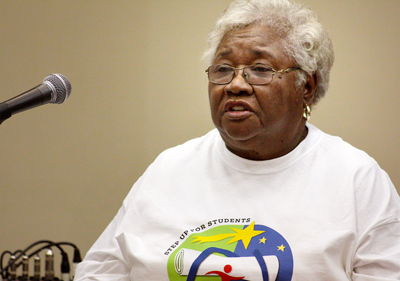
The reason was simple, she told redefinED. She wanted to help struggling students, particularly black males. And in a private, religious school, she had access to tools – Bible lessons and “prayer corners” among them - that weren’t available in public school.
“If a child was doing something, I’d say, ‘Remember this Bible lesson we had? If Jesus came here right now, do you think he would be happy with you?’ “ Reed-Clayton said in the podcast interview attached below. She continued: “I’m receiving a lot of children in my private school, coming from public school, who were discipline problems. But after I got them, they weren’t. They changed.”
Reed-Clayton’s no-frills school in the economically depressed Midtown area is highly regarded, with a reputation for especially good results in reading instruction and parental engagement. Last year, 61 of 85 students used tax-credit scholarships available to low-income families; 11 used McKay scholarships for students with disabilities.
This week, Reed-Clayton is retiring for a second and final time. To mark the occasion, more than a hundred parents, teachers, former students and community leaders will honor the diminutive, beloved “Ms. Reed” with a party befitting someone who was in the vanguard of the most sweeping educational changes of the past 50 years.
After attending segregated schools in St. Petersburg and Greenville, Fla. (where blind phenom Ray Charles was a playmate), Reed-Clayton was among the first black teachers in Pinellas to teach in desegregated public schools. Even now, as a school choice pioneer, she continues to count herself as a supporter of public schools.
“We have to do what fits for the parent and the child,” she said. “If it’s public school, go to public school. If it’s private school, do that.”
 The assertion that school choice somehow exacerbates segregation and separatism in American society surprises me every time it pops up. The ideal of traditional public education, a “common school” available equally at no cost to all citizens to impart a high level of academics as well as a core set of American values, has always been a myth. Yet it has amazing staying power despite the facts.
Put aside a hundred years of state-sanctioned racism that outlawed education for slaves, and then engendered “separate, but equal” schools for another 90 years until the 1954 Supreme Court decision banned the practice. Let’s look at how this “common school” system serves Americans now.
The statistics on K-12 education in the Department of Education’s "The Condition of Education, 2011" report are informative. Nationally, 31 percent of African-American students are in schools that have 75 percent or more African-American students. The figure is nearly 33 percent for Hispanic students. Nationally, 62 percent of whites attend a school with a population over 75 percent white, while those schools serve around 7 percent of the African-American and Hispanic populations.
When city demographics are analyzed, the segregation of traditional public schools dramatically jumps. Forty-two percent of African-Americans and 39 percent of Hispanics are in schools with 75 percent or more of those same students. Not surprisingly, school enrollment and especially urban school enrollment reflects how a public education monopoly assigns students to schools - by zip codes.
Another way to look at how this “common school” system is serving us is the distribution of the free and reduced lunch (FRL) population, which the Department of Education identifies as a proxy for low-income students. High-poverty elementary schools, those with 75 percent or more of an FRL population, enroll 45 percent of Hispanic students and 44 percent of African-American students. For whites, the enrollment is 6 percent in high-poverty schools. Nationally, urban areas account for 29 percent of our student population, yet 58 percent of all students in high-poverty schools live in our cities.
Combine this data with dropout statistics in the 40-60 percent range for inner-city minority populations, and abysmal academic outcomes for so many of the remaining students, and you have the “common school” myth stripped bare. (more…)

