The school choice movement has entered a new era.
A clear signal of that came today with the announcement that Institute for Justice, the national public interest law firm that successfully argued the 2022 landmark U.S. Supreme Court case establishing parental freedom in state school choice programs, is partnering with the national research nonprofit EdChoice to defend future legal challenges to school choice programs.
The organizations will join forces to provide legislative counseling and legal defense of choice under the joint banner of the Partnership for Educational Choice, with the newly founded EdChoice Legal Advocates eventually taking over those responsibilities from IJ, according to a news release.
“IJ and EdChoice have worked together for decades to pass, promote and defend educational choice programs and we are excited about our new partnership to ensure vigorous defense of state programs throughout the country,” IJ President and Chief Counsel Scott Bullock said in a statement. “IJ has accomplished what it set out to do three decades ago: establish the constitutionality of educational choice programs and, in turn, make it possible for millions of families across the country to benefit from the opportunity that those programs provide.”
The phased handoff of all choice program defense to EdChoice will allow IJ to focus on barriers to forms of education choice such as microschools, homeschool co-ops and other innovative programs that have emerged as the result of newly adopted education savings account programs. Entrepreneurs seeking to establish these non-traditional learning environments are often stifled by government-imposed land use and zoning regulations, as well as building codes criticized as outdated and discriminatory.
For example, a Florida law passed in 2022 reined in local government rules that blocked new charter schools. But the law didn’t protect private schools. The exclusion kept a South Florida Jewish day school from opening a few weeks before classes were set to begin, sending families scrambling for options.
IJ leaders say that while they have met the goal set at the organization’s founding in 1991 of being the premier lawyers for the education choice movement and establishing the federal constitutionality of ed choice programs, legal battles continue in state courts. That’s where EdChoice, with its long history of working in statehouses, comes in.
“To realize Milton and Rose Friedman’s vision of universal choice, we must not merely create educational freedom programs, but also ensure they withstand legal challenge in state courts,” EdChoice President and CEO Robert Enlow said in a statement. “Just as we anticipate a need to help implement school choice, we also anticipate an increased need to represent parents and defend these statutes across the country. By partnering with IJ to launch EdChoice Legal Advocates, we will safeguard the Friedmans’ legacy and preserve choice programs for families.”
EdChoice has tapped Tom Fisher, former solicitor general of the state of Indiana, to lead the effort. Fisher has argued five times at the U.S. Supreme Court and many more in the Supreme Court of Indiana, including in Meredith v. Pence, in which, along with IJ, he successfully defended the state’s Opportunity Scholarship Program.
IJ senior attorney Michael Bindas, who leads IJ’s educational choice practice and argued the landmark Carson v. Makin case at the Supreme Court, called the partnership a “force multiplier” for the education freedom movement and will ensure that state-adopted programs will be robustly defended while at the same time, barriers to innovation are vigorously challenged.
“Every child deserves the education that will work best for her, and this partnership will bring us closer to making that a reality,” he said.
Update (Nov. 2): Douglas County has filed its petition for the U.S. Supreme Court to hear the case.
A 19th-century constitutional provision, born during a period of anti-Catholic bias, has long threatened school choice programs in most states by banning state aid to religious organizations — including parochial schools.
Now, a small suburban Colorado school district is looking to fight its state's so-called Blaine Amendment in the U.S. Supreme Court, arguing the provision leads to religious discrimination in a case that has the attention of school choice choice watchers all over the country.
The legal challenge might be a long shot. There's no guarantee federal justices will even agree to hear Douglas County's appeal of a Colorado supreme court ruling that struck down its voucher program.
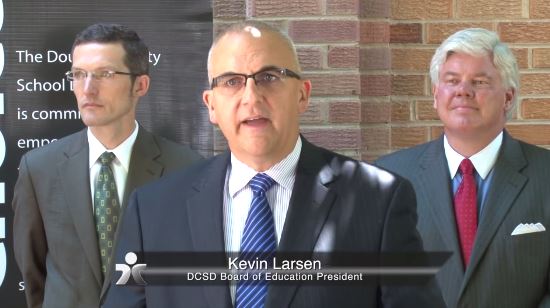
Douglas County School Board members discuss their legal options at a press conference this summer.
But there are quirks in the Colorado case that some observers say give them one of the best shots they've had at their ultimate goal: Ending the use of Blaine Amendments to hamstring publicly supported private-school scholarships.
The case, which the district is expected to appeal before October 30th, could have widespread impact if it succeeds. Blaine amendments remain in force in 37 states, and they are being cited in lawsuits against school choice programs in Florida, Georgia, Oklahoma and Nevada.
In other words, supporters hope this summer's court ruling, which cited Colorado's Blaine Amendment to strike down the Douglas County voucher program, may prove to be a Pyrrhic victory for school choice opponents. (more…)
 The Orlando Sentinel recently published a blog entry about a new website that opposes students using publicly-funded vouchers to attend private schools that teach creationism. The site asserts, “Teaching creationism with public money is unconstitutional. It violates the First Amendment of the U.S. Constitution which lays out a clear separation of church and state.”
I’m fine with citizens opposing the teaching of creationism. I would not send my child to a school that taught creationism in lieu of evolution, but the assertion that it’s unconstitutional is false.
In the 1925 Pierce v. Society of Sisters decision, the U.S. Supreme Court ruled parents are responsible for determining how and what their children are taught. And in the 2002 Zelman v. Simmons-Harris decision, the court ruled parents may use public money to pay for tuition at faith-based schools provided their choice is genuinely independent, and the funds go first to the parents and then to the school.
Florida’s school voucher programs all adhere to the Zelman requirement that funds go first to the parent and then the school, which is why using publicly-funded vouchers to attend faith-based schools is an exercise of the First Amendment’s freedom of religion clause, and not a violation of the Establishment Clause. (By the way, the term “separation of church and state” does not appear in the U.S. Constitution. That phrase was used by President Thomas Jefferson in a January 1, 1802 letter he wrote to the Danbury Baptist Association of Connecticut, reassuring them that he opposed the government interfering with their religious practices.)
The Sentinel wrote that some state officials think tax credit scholarships are more constitutional than vouchers because tax credit funds never touch the state treasury, but, again, the key to the Zelman decision is the path the funds travel to arrive at a faith-based school. Once public funds are given to the parents, they become less public and more private, which is why their expenditure is an exercise of religious freedom and not government-supported religion. (more…)
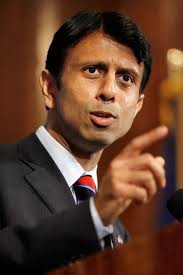
Gov. Jindal
A district judge ruled Friday that Louisiana's statewide voucher program is unconstitutional because of the mechanism it uses to send public funds to private entities, prompting groans from school choice supporters, cheers from teachers unions and promises of an appeal from Gov. Bobby Jindal.
"Today is really significant," said Steve Monaghan, president of the Louisiana Federation of Teachers, according to Reuters. "What the governor was doing was unprecedented and unconstitutional under Louisiana law."
The reaction from Jindal: "Today's ruling is wrong headed and a travesty for parents across Louisiana who want nothing more than for their children to have an equal opportunity at receiving a great education," he said in a statement reported by the New Orleans Times Picayune. "That opportunity is a chance that every child deserves and we will continue the fight to give it to them."
More coverage from Associated Press, Wall Street Journal, Washington Post, Baton Rouge Advocate, Houma Today, Alexandria Town Talk, Christian Science Monitor, Education Week.
Reaction from American Federation for Children, Friedman Foundation, Louisiana BAEO, Dropout Nation, Time-Picayune columnist Andre Perry and the Louisiana School Boards Association.
Editor's note: This op-ed ran in today's Orlando Sentinel.

This photo is from the St. Andrew Catholic School website.
Florida allocates five different scholarships from prekindergarten to college that allow students to attend faith-based schools. They don't violate the U.S. Constitution because students choose, and government doesn't coerce.
Both factors were why, in 2002, the U.S. Supreme Court ruled that a Cleveland school voucher did not violate the Establishment Clause, even as 96 percent of the students chose faith-based schools. To the court, in the landmark Zelman v. Simmons-Harris case, the program met three critical standards that also apply to Florida: The primary objective is education; students can choose among secular and sectarian schools; and parents exercise an independent choice that is not steered by government.
The article "Many church schools get tax cash" in Sunday's Orlando Sentinel did not mention the Zelman case or that the Florida Supreme Court specifically avoided religion in 2006, when it overturned the private-school portion of the Opportunity Scholarship program. Consequently, readers might have thought that these programs are constitutionally suspect, when they are not.
The tax-credit scholarship is one of Florida's five scholarships. It strives to give low-income students access to the same learning options now available to more affluent families, via a $4,335 scholarship. This program complements other choice programs, such as magnet and charter schools, and is built on the truism that students learn in different ways. Last year, parents placed more than 1.2 million public-education students in schools other than their assigned district school.
In this new world of customized learning, encouraging differentiated instruction while maintaining quality control is a challenge. The tax-credit scholarship does this, in part, by requiring nationally norm-referenced tests that show these students are achieving the same gains in reading and math as students of all income levels. (more…)
 Oklahoma: The state supreme court tosses out a lawsuit challenging a voucher program for special needs students, saying the two school districts that filed suit did not have standing (The Oklahoman).
Indiana: The state supreme court hears arguments over the constitutionality of the state's fledgling voucher program (Indianapolis Star). Enrollment in the state's voucher program skyrockets in year two (Huffington Post).
Colorado: The Colorado State Court of Appeals hears the appeal over the Douglas County voucher program (Denver Post).
Louisiana: The state's voucher program heads to court this week (thetowntalk.com).
Georgia: In the wake of election victories, school choice supporters aim to expand the state's tax credit scholarship program (Atlanta Journal Constitution).
Florida: Incoming House Speaker Will Weatherford creates a new school choice and innovation committee to ensure choice issues don't get lost in the general education discussion (redefinED). (more…)

