Since Alberto Carvalho became Miami-Dade County Public Schools superintendent a decade ago, the number of charter school students in his district has tripled to nearly 70,000, while the number of low-income students using state scholarships to attend private schools has jumped five-fold, to 26,272. Parents in America’s fourth-largest school district now send their children to 570 non-district schools that didn’t exist or weren’t accessible 20 years ago.
So what’s a big district to do?
In the case of Miami-Dade, it’s ride the wave.
In a videotaped address for the American Federation for Children conference in May, and released by AFC Tuesday, Carvalho turned to a metaphor he’s used to powerful effect a few times before (see here and here):
“We anticipated this tsunami as it was approaching, and we made a determined decision,” says Carvalho, the National Superintendent of the Year in 2014 and National Urban Superintendent of the Year in 2018. “We decided and recognized that trying to swim under that tsunami of choice would only bring about our own demise. If we decided to outrun it, we would lose. If we allowed quite frankly to let choice be the trademark of others rather than ourselves embracing it, we would not be participants in the educational process of our students.
“So we embrace choice. We recognized that choice was powerful to every single community, every single family, every single child. So we developed a choice portfolio unlike any in the country today.”
Sixty-one percent of Miami-Dade students are enrolled in district choice – magnets, career academies, “international” programs like International Baccalaureate and Cambridge, etc. – up from 30 percent 10 years ago. Add charter schools and choice enrollment reaches 69 percent. Throw in private schools and it tops 70 percent. For context, consider that in Florida as a whole, 47 percent of students in PreK-12 now attend something other than assigned district schools.
Those who applaud the district’s theory of action don’t think it’s coincidence that academic trend lines are rising as choice is expanding. Among other notables, the district earned an A rating for the first time last year; hasn’t had an F-rated school in two years; and was a standout on the most recent National Assessment of Educational Progress.
“School systems of today, that rely and bank on one single approach to deliver education to their students, are losing the potential of choice,” Carvalho says in the video. “They’re losing the powerful relevance, rigor and relationships that choice brings to school. Our choice is an umbrella approach that reflects the ambitions, the dreams, the aspirations and quite frankly the opportunities that every single kid, regardless of the zip code they’re born into, should have. This is no longer a privilege. This is a right every single child in America must have.”
As fate would have it, Education Next also put a bit of a spotlight on Miami-Dade this week, with Paul Peterson, director of the Program on Education Policy and Governance at Harvard, interviewing yours truly about the district for The Education Exchange podcast. At the risk of jinxing both, I said Miami-Dade may be to big urban districts what the Tampa Bay Rays are to Major League Baseball: Low-cost (relatively speaking), innovative, fun to watch – and maybe even thriving amidst the competition.
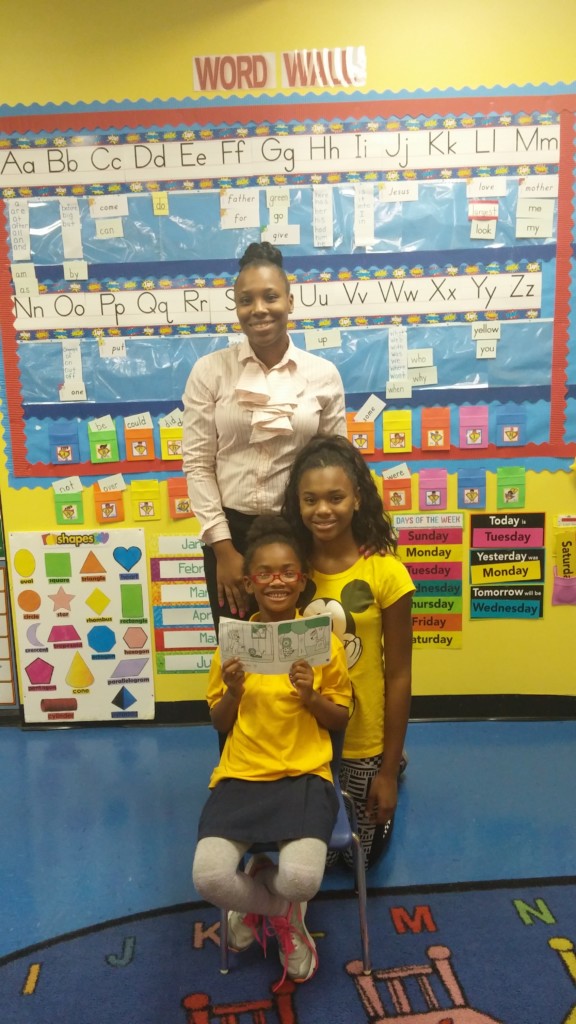
Toccara Barron, a public school science teacher in Jacksonville, is one of more than 1,400 public school district employees using a Florida school choice scholarship this year to send their children to private schools. Her oldest daughter attends a public school. Her youngest attends a private school thanks to a Florida Tax Credit Scholarship.
More than 1,400 public school district employees are benefiting from America’s largest private school choice program.
Their kids are a small percentage of the more than 100,000 low-income and working-class students who are using the Florida Tax Credit Scholarship. But their participation further underscores the diversity of parents who value options.
Parents list their employers on applications to Step Up For Students, the nonprofit that helps administer the program. By my count, there are 1,471 district-employed parents in the mix this year. We don’t have a breakdown by job title, but eligibility is based on income. So, just as it was in past years, it’s likely most of these employees are custodians, bus drivers, teacher assistants and other “support staff.”
It’s not hard to find teachers who secured scholarships for their children, either, like this one and this one. Clearly, none of these employees are motivated by some twisted desire to dismantle public education. They simply want what all parents want: the school that best fits their kids’ needs.
Toccara Barron is one of them. She’s a science teacher in Jacksonville. Her oldest daughter is an eighth-grader in a magnet middle school. Her youngest is a first-grader at a private school.
Barron thought the private school was best positioned to give her youngest the individualized attention she needs to be challenged academically. Thanks to a scholarship, she was able to access it.
“All parents should have the right to choose a school for their child,” she said, “not just the ones who could afford to pay tuition.”
The scholarship parents who are district employees hail from 57 of Florida’s 67 districts. Another 60 scholarship parents work for charter schools. A half-dozen work for the public Florida Virtual School.
Even parents who work for choice schools, it seems, are happy to have more choice.

The teachers union doesn't like school choice. But school district employees do. More than 1,200 parents of tax credit scholarship students in Florida work for public school districts. As you'll see from some quoted in this post, they wish the union would stop its attack on a program that is benefiting their children. (Image from Wikimedia Commons)
Katisha Rucker works for a school district. She’s a member of a labor union. And her daughter attends a private school thanks to a scholarship from the nation’s largest private school choice program.
You could be forgiven if you think Rucker’s profile is unique. But it’s not.
This fall, more than 1,200 low-income and working-class parents whose children benefit from Florida’s tax credit scholarship program are employees of school districts, according to data from Step Up For Students, which helps administer the program, hosts this blog and pays my salary.
That’s a lot of district employees. And it comes despite the fact Florida’s statewide teachers union is so hostile to the program, it’s aiming to kill it with a lawsuit.
The lawsuit “would hurt me a lot, it would hurt my child,” said Rucker, an 11-year bus driver for the Marion County school district in north central Florida. “As a single parent, I can’t afford a private school.”
The employer information is available at Step Up because parents list their employers on scholarship applications. This fall, by my count, 1,256 employees in 58 districts are scholarship parents. The program is serving more than 92,000 students total.
We don’t know the job titles. But it’s a safe bet many of the district employee who are scholarship parents are “support staff” and blue-collar workers: clerks, custodians, bus drivers, receptionists, food service workers, paraprofessionals and so on. Given their incomes, a far greater percentage of workers in these categories would be eligible for tax credit scholarships than teachers.
It’s also fair to assume many of them, like Rucker, are represented by unions other than teachers unions, such as SEIU and AFSCME.
This puts a new twist on the lawsuit. If it succeeds, the teachers union will not only be throwing 90,000 economically disadvantaged students under the bus, but 1,200 fellow district employees who, in many cases, are brothers and sisters in the labor movement.
The First District Court of Appeal dismissed the lawsuit last month. The union now has a matter of days to decide whether it will appeal to the Florida Supreme Court.
At this stage in the case, a crucial issue is whether the plaintiffs can show the school choice program harms public schools. A Leon County Circuit Judge and a unanimous panel of three judges on the First District Court of Appeal have all concluded the teachers union and other groups behind the lawsuit have not demonstrated that it does.
Rucker said she’s not surprised so many district employees value the scholarship. She said she has recommended it to other bus drivers and fellow union members. They have the same concerns about safety and bullying the general public does, she said, and like all parents, want a school that is the right fit for their child.
Rucker said she sought a scholarship after her eighth-grade daughter, Taliyah, got into a fight and school officials decided to place her in a school for disruptive students. Rucker didn’t think the placement was fair, given what she said were no other disciplinary issues on Taliyah’s record. She also thought her child would suffer in the unruly atmosphere she feared would be the norm at the other school.
Now “she’s doing better grade wise and everything else than she was in public school,” Rucker said. “She loves going to school. If I’m late, she has a fit. It’s been an amazing turnaround for her.”
Rucker also secured a tax credit scholarship for her son, Clyde, who is in sixth grade, but decided for now to leave him in public school. So far, so good. “But if something happens, I know I have that option,” she said. “It’s very important to have a choice.”
It shouldn’t be a secret that some Florida school districts perform better than others, despite more challenging demographics. Yet for years, it’s been a fact hidden in plain sight. Now, though, a leading think tank is giving the Legislature and the Florida Board of Education a compelling reason to take a closer look.
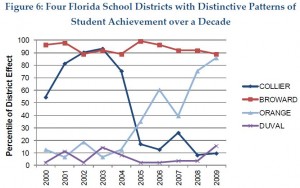 A new study from the Brookings Institution, released this morning, relays what FCAT data has been trying to tell us. Some Florida districts are chugging ahead despite a heavier load of high-poverty kids, while some with lighter loads lag. Some are making sustained gains relative to the pack, while others progress in fits and starts. The differences are puzzling, fascinating and, if you happen to live in an underperforming district, maddening. Yet they’ve been given scant attention by researchers, reporters, policy makers and advocacy groups.
Stepping into the vacuum, Brookings’ Brown Center on Education Policy analyzed a decade’s worth of test data for fourth- and fifth-graders in Florida and North Carolina. It controlled for race, income and other variables. And it came away with two findings: 1) School districts account for only a small percentage of the total variation in student achievement – 1 to 2 percent. (Teachers account for about 7 percent). But 2) the differences between districts are still so great that by the end of the school year, a kid in a higher-performing district can be nine weeks ahead - a quarter of a school year ahead - of a like student in a lower-performing district. Over time, the accumulated deficits would obviously be staggering.
“We suggest that a variable that can potentially increase productivity by 25% is important,” the researchers wrote. “These are differences that are large enough to warrant policy attention.”
It's not just Florida and North Carolina that should be crunching more numbers. As the report notes, there are roughly 14,000 school districts nationwide. In this age of accountability and choice, parents routinely compare schools, and all kinds of think tanks compare states. But districts? Not so much.
The Brookings researchers pointed to districts that showed distinctive patterns relative to other districts – they were either consistently high performing, consistently low performing, dramatically rising or dramatically tanking. In Florida, the districts that fit that bill were Broward, Duval, Orange and Collier, respectively. These districts weren’t necessarily the ones that made the most pronounced pattern in each category. And the researchers offered a number of cautionary caveats, including, again, that they only looked at data for two grades, and that comparisons were made “relative to their demographic odds” – not to a set standard like FCAT pass rates.
But still, the trend lines punctuate the point: District performance deserves a spotlight. (more…)
Similar to food, medicine, and housing, accountability in public education is a balance of government regulations and customer choice, and finding the proper balance is increasingly important as parental choice becomes more prevalent. Generally regulations and choice are inversely related such that as one increases the other decreases.
When I was growing up we had only one choice for phone service, which meant our phone company was highly regulated. Government regulators determined the services we were provided and their costs, and even prohibited consumers from owning phones. This began to change in 1984 when the government broke up AT&T’s monopoly and allowed more companies to enter telecommunications. More providers led to consumers having more choices and the telecommunications industry being less regulated. Today consumers may own phones and may pick from a plethora of service and cost plans.
A similar rebalancing of regulations and consumer choice is occurring in public education. School district dominance is slowly eroding as public education expands and incorporates new providers such as charter schools, virtual schools, dual enrollment programs and private schools accepting publicly funded vouchers and scholarships.
School boards and teacher unions are resisting this transformation and arguing that overregulated district schools are unfairly having to compete with less regulated choice schools. But their solution -- to require that all publicly funded schools adhere to the same regulations -- ignores the consumer choice component of accountability. Choice schools should be less regulated than non-choice schools, just as telecommunications companies today are less regulated that AT&T was in 1980. If school districts want to reduce the regulatory burdens on their schools and level the regulatory playing field, they should convert them to charter schools.
The macro forces driving change throughout our society are also transforming public education. Inevitably the future of public education will include more customer choice, more diverse providers and less regulation. Therefore, public education needs a well balanced accountability system that reflects these new realities.
Florida school districts are increasingly adapting to a more market-driven public education system. They are aggressively expanding within-district choices via more magnet schools, career academies and dual enrollment programs, and they are grudgingly approving more charter schools. But it’s in online learning where the most significant transformation is occurring.
During the legislative session which begins in January 2012, school districts will be partnering with the Florida Virtual School and private online providers to support legislation making it easier for more families to access online learning. Personalities as diverse as Jim Horne, Florida's former education commissioner, Mark Maxwell, the Florida Virtual School's chief governmental affairs officer, and JoAnne Glenn, assistant principal with the Pasco County, Fla., district's eSchool, have been deliberating in an effort we call the Florida Alliance for Choices in Education, or F.A.C.E. The district online providers have concluded that using regulatory barriers to protect their market share is no longer viable, so they now support expanding the online market in hopes a smaller piece of an expanding pie will increase their enrollment numbers.
Given school districts still control 88 percent of the bricks-and-mortar market, they have shown no interest in abandoning their reliance on regulatory barriers to maintain this market share. But as their enrollment in this realm starts to slip, they will also begin rethinking their bricks-and-mortar strategy. The Miami-Dade school district, for instance, has already begun creating its own charter schools to keep charter school revenue within the district, and several other Florida school districts are expressing interest in following Dade’s lead.
The Berlin Wall in public education is slowing coming down, and as it does school districts are becoming more entrepreneurial and customer-focused. District online educators are ahead of the curve in navigating a more market-driven public education system, but their bricks-and-mortar colleagues are not far behind.

