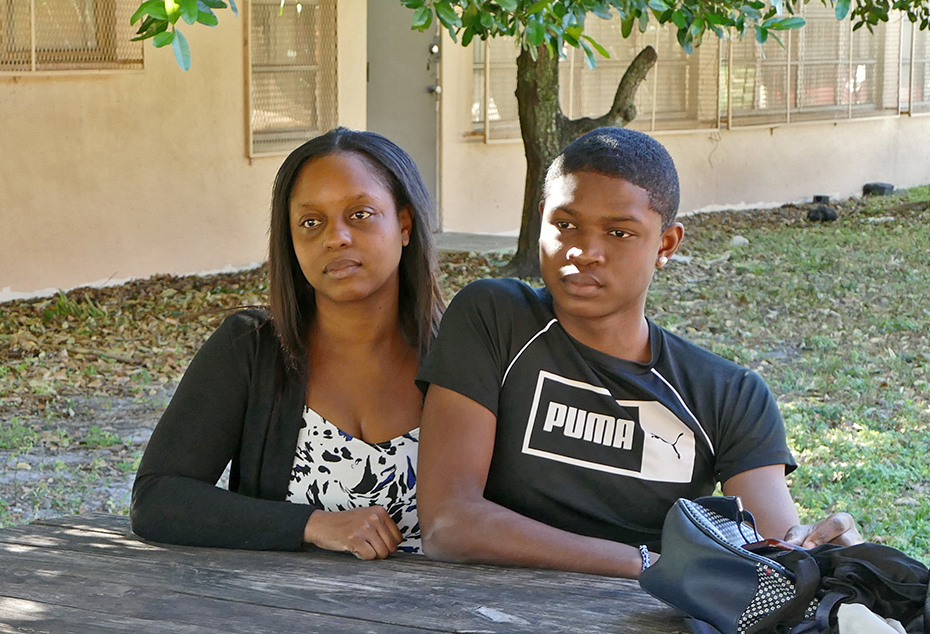
Marquavis Wilson, right, attends West Park Prep in Hollywood, Florida. A Florida Tax Credit Scholarship allowed his mom, Lamisha Stephens, to send him to the LGBTQ-affirming faith-based private school after he was bulled at his district school for his sexual identity. PHOTO: Lance Rothstein
Editor’s note: To hear Lamisha Stephens and her son, Marquavis Wilson, tell the story in their own words, watch the video at the end of this post.
HOLLYWOOD, Fla. – In fourth and fifth grades, Marquavis Wilson was tormented because of his sexual identity. In public schools, he was taunted with repeated slurs, teased for how he walked and talked, told he was going to hell. His life was a blur of fights and suspensions. “I am not the type of gay boy who takes stuff,” Marquavis said. “I stuck up for myself.”
But the bullying and battling took a toll. Marquavis no longer wanted to go to school. His grades fell to D’s and F’s. He told his mom, Lamisha Stephens, he wanted to kill himself.
Stephens knew she had to make a change. First, she secured a Florida Tax Credit Scholarship, a school choice scholarship for lower-income students. Then she enrolled Marquavis in West Park Preparatory School, a tiny, faith-based private school she concluded would be the safe haven he needed.
It was. Now 16 and in tenth grade, Marquavis is no longer fighting. His grades have improved to B’s and C’s. He’s thinking about college and careers.
He said the scholarship and the school changed his life.
His mom said they saved his life.
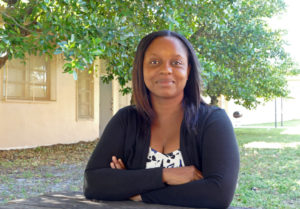
Lamisha Stephens. PHOTO: Lance Rothstein
“If Marquavis hadn’t come to this school,” said Stephens, a part-time supervisor at a delivery company, “he would probably be a dropout. Maybe in jail. Or he wouldn’t be here with us.”
“He would probably have taken his life,” she continued, “because he was tired of the bullying.”
Marquavis’s story reflects the tragic reality of hostility and intolerance for far too many LGBTQ students. At the same time, it offers a strong counterpoint to misleading narratives pushed by opponents of education choice. In Florida and other states, some religious schools have come under fire for policies adhering to their faith. But LGBTQ students themselves tell a more complicated story.
The most recent survey from the LGBTQ advocacy group GLSEN shows LGBTQ students in public district schools experience bullying, harassment and assault at higher rates than LGBTQ students in private religious schools. (For the details, go to survey page 119.) Given that backdrop, it’s no surprise that schools of choice aimed at LGBTQ students are springing up (see here, here and here), and that LGBTQ students are among those using – and in some cases, being saved by – education choice scholarships.
In Marquavis’s prior public schools, Stephens said she was having conferences with school officials every other week. Students weren’t the only problem.
At one point, a school security guard asked Marquavis if he had been molested, suggesting a link between molestation and sexual identity. “No,” Marquavis responded, “God made me this way.” Stephens complained to the principal. Eventually, she said, the guard was disciplined for inappropriate remarks.
Marquavis is athletic, confident, reflective, honest. His words sometimes roll out in torrents before he punctuates them with a “so” … or a “you know” … or, sometimes, a quick smile.
He said he was nervous when his mom told him he would be going to West Park Prep. The K-12 school is predominantly Black, with 110 students, nearly all of them on choice scholarships. He wondered if he’d have to fight there, too.
But his new classmates embraced him.
“On the first day,” Marquavis said, “all the kids were coming up to me. They were talking to me, asking what school I was from. They were friendly. All of them. It was unexpected.”
The school feels like a family, Marquavis said. The founder and principal, Jovan Rembert, encouraged him to be himself. He said no bullying or disrespect would be tolerated, ever.
“He was like, ‘Don’t let people get in your head,’ " Marquavis said. “I told him about my past, and he said that’s not going to happen here. He kept his word.”
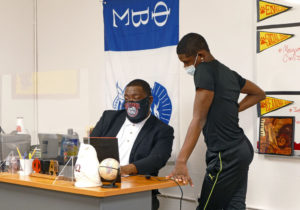
Marquavis found a safe space at West Park Prep that has allowed him to focus on being a student again.
Marquavis said there was only one incident involving his sexual identity at West Park. A new student called him a slur and was quickly suspended. The student apologized to Marquavis when he returned – and the two have been friends ever since.
Tragically, Rembert died in March, struck by a car when he went to check on an accident involving some of his students. But the warm, welcoming culture he established lives on, said teacher Billy Williams.
Last December, Williams said, Marquavis and other members of the dance team were set to rehearse for the holiday show when they veered into a little free-styling. Marquavis, comfortable among friends, poured his personality into a few new moves. “His body language and freedom of expression was so different,” said Williams, who worked in public schools 13 years before joining West Park full time. “But what was so magical was all the students embraced it. They hyped him up.”
The safe space allowed Marquavis to focus on being a student again. “He has more confidence in participating in group activities,” Williams said. “He’s more vocal. He speaks up. He asks questions.”
He’s thinking about the future, too. A diploma. Then college maybe. Then, maybe, a career in fashion.
Marquavis said without the scholarship and the new school, the fighting would have continued until he got expelled or dropped out. But West Park Prep won’t let him fail, he said.
“It’s like all love here,” he said. “It’s really all love.”
[penci_video url="https://youtu.be/0SpCrGnVo6A" align="center" width="750" /]
Jim Saunders / News Service of Florida
TALLAHASSEE --- In a decision that could have statewide implications, an administrative law judge Tuesday ruled that the Palm Beach County School Board is required to assign safety officers to charter schools under a law passed last year.
Judge John Van Laningham sided with Renaissance Charter School Inc., which operates six schools in Palm Beach County and wanted the School Board to provide “safe school” officers. The School Board refused, leading to the legal battle.
Van Laningham, in a 43-page order, pointed to a law passed after the February 2018 mass shooting at Parkland’s Marjory Stoneman Douglas High School that included a requirement for safe-school officers.
“In sum, after a thorough study of the statute's plain language, including a review of related statutes at the board's request to determine whether some latent ambiguity exists, the undersigned concludes that (the law) clearly and unambiguously requires school boards and superintendents --- not charter school operators --- to ‘establish or assign’ SSOs (safe-school officers), with the assistance of local law enforcement agencies, to every public school within their respective jurisdictions, including charter schools,” Van Laningham wrote.
The judge indicated the ruling was the first of its kind, describing the dispute as a “first-impression question of statewide interest,” as schools and districts try to comply with the post-Parkland requirements.
Charter schools are public schools that often are operated by private entities. The dispute about safe-school officers comes amid broader clashes across the state about the interplay between school boards and charter schools.
The 2018 law required placing safe-school officers at all public schools. That can include using law-enforcement officers or “guardians,” who are trained school personnel allowed to carry guns. Palm Beach County does not use guardians, according to Van Laningham’s ruling.
Renaissance requested in March 2018 that the School Board provide a full-time safety officer at each of Renaissance’s charter schools, but the board denied the request. The board also later declined a request to mediate the issue, which ultimately led to the dispute going before Van Laningham, the ruling said.
“There is no dispute in this case that, under the safety act, one or more SSOs must be assigned to each charter school facility in the district, including RCS's (Renaissance’s) six schools,” the judge wrote. “The question is, whose duty is it to assign SSOs to charter schools? The board's answer, clearly expressed in word and deed, is this: It's not our job; rather, the obligation falls to each charter school to arrange police protection for its own campus, as though each charter school were a school district unto itself.”
Van Laningham said he was not deciding issues such as who is required to pay for the officers.
“While disputes concerning this financial obligation might someday be ripe for adjudication, the narrower question of law … is, simply, who must satisfy the duty to ‘establish or assign’ SSOs at charter schools,” he wrote. “The plain and obvious answer to this pivotal question is: the district school board and district superintendent.”
After the Parkland shooting in February, Gov. Rick Scott signed into law legislation increasing security measures at schools.
The Marjory Stoneman High School Public Safety Commission wants lawmakers to require Florida’s sheriffs to train public school staffers to carry a gun on campus.
The commission voted unanimously on Thursday to recommend the change to a guardian program that was named after the Stoneman Douglas coach, Aaron Feis, who died protecting students. The program provides law enforcement training to public school staffers, excluding teachers, who want to carry a gun on campus, but current law does not require sheriff’s offices to participate.
So far, only 25 of 67 school districts are participating in the program, according to the Florida Department of Education, and only $9.3 million of the $67 million lawmakers appropriated for the program has been spent.
Charter school officials struggling to comply with the new campus safety mandates are hoping the program will be expanded. Lynn Norman-Teck, executive director of the Florida Charter School Alliance, applauded the recommendation.
“We are pleased that the commission understands the challenges public schools face when trying to meet the safe school mandates,” she said.
Polk County Sheriff Grady Judd, who is a member of the commission, proposed the requirement.
“We need to tell the sheriffs, ‘Do your job,’” he said. “A majority of those sheriffs want to do the Guardian program but fear the Guardian program because of insurance companies.”
Pinellas County Sheriff Bob Gualtieri, chairman of the commission, agreed. “We need to be part of the solution and not part of the problem,” he said. “We have to come up with a way to allow these districts that want to do it to get around the sheriff where the sheriff won’t do it.”
After the Parkland shooting in February, Gov. Rick Scott signed into law legislation increasing security measures at schools. The Marjory Stoneman Douglas High School Public Safety Act requires all public schools to hire a school resource officer (SRO), a sheriff’s deputy, or a trained employee to carry a gun on campus.
However, many charter schools, which receive less money than traditional public schools according to a 2017 Florida TaxWatch study, can’t afford SROs. Finances are not the only obstacle. In many areas, there simply are not enough officers to meet the needs of each school.
State Sen. Lauren Book, D-Plantation, said thorough training is paramount. “We want to make sure that training is what it is supposed to be,” she said. “What we want it to be. Anything else would be a recipe for a problem.”
Charter schools across Florida are hoping lawmakers will allow them greater access to the Aaron Feis Guardian Program, established after the Parkland massacre, to be able to comply with the state’s new campus safety mandates.
Florida charter school officials struggling to comply with the state’s new campus safety mandates are hoping lawmakers can help: Expand access to the Coach Aaron Feis Guardian Program by requiring all county sheriffs to participate in training armed school personnel.
After the Parkland shooting in February, Gov. Rick Scott signed into law legislation increasing security measures at schools. The Marjory Stoneman Douglas High School Public Safety Act requires all public schools to hire a school resource officer (SRO), a sheriff’s deputy or trained employee to carry a gun on campus.
However, many charter schools (which receive less in revenue than traditional public schools, according to a study from Florida TaxWatch) can’t afford SROs. Finances are not the only obstacle. In many areas, there simply are not enough officers to meet the needs at each school.
The law created a cheaper alternative to SROs: the Guardian program, named after the Stoneman Douglas coach who died protecting students. It provides law enforcement training to public school staffers, excluding teachers, who want to carry a gun on campus. Both the school districts and the sheriff’s offices must agree to participate in the program.
So far, though, only 25 out of 67 school districts are participating in the Guardian program, according to the Florida Department of Education, despite the fact the state appropriated $67 million to fund it.
Lynn Norman-Teck, executive director of the Florida Charter School Alliance, said her organization would like to see all the sheriff’s offices participating in the Guardian program.
“This would help all schools – whether charter or district-run -- to comply with the state mandate,” she said. “We need to make sure there are personnel available to hire for the security positions on campuses,”
Senator-elect Manny Diaz, R-Hialeah, said he believes charter schools should be afforded greater opportunity to participate in the Guardian program.
He suggested one solution would be allowing personnel to be trained in other counties that have a Guardian program.
“That would probably be the best compromise where we are not forcing a sheriff to have a program,” he said. “I don’t see a reason we couldn’t have a Guardian certification program statewide.”
Osvaldo Garcia is principal at Passport Charter School in Orange County, where the school board chose not to participate in the Guardian program. He said he is not able to afford a full-time SRO at a cost of $50 an hour when the school was given only a little over $9,000 to hire one.
As a result, Garcia is sharing an SRO with 13 other schools, meaning the officer is not at the school on a full-time basis.
“If we had (an officer) on a daily basis it would be a struggle for us,” Garcia said of the costs of affording such a position. He said 41 other charter schools in Orange County are encountering similar issues.
Garcia said the Guardian program could help alleviate his situation, but that he also had concerns.
“How prepared are these people legitimately to have a handle on a difficult situation?” he asked. “They are not trained police officers who go through so many hours of training.”
Meanwhile, in Duval County, the sheriff’s office and school district are participating in the Guardian program.
Even so, Simaran Bakshi, principal at Wayman Academy of the Arts, a charter school serving 281 students in Jacksonville, said she is finding it difficult to find employees who are interested in applying for the program.
With the program requiring 170 hours of training, staff is expected to be absent a month, which is also a burden, she added.
Bakshi said she currently has an SRO at the school based on an affordable rate negotiated between the school district and sheriff’s office. But that rate will soon expire, leaving her paying more than $35 an hour for an SRO -- an amount she can’t afford.
Ralph Arza, director of government relations for the Florida Charter School Alliance, said while it seems unlikely lawmakers will change the law to mandate sheriff’s offices participate in the program, there could be another compromise.
He said if charter schools could hire a trained, licensed armed guard, which is not applicable under the law, that could provide an affordable option.
The number of anti-Semitic incidents in the United States grew by 57 percent in 2017, according to the Anti-Defamation League.
Officials from Jewish schools in Florida said Monday they are remaining vigilant after a gunman killed 11 people Saturday at a synagogue in Pittsburgh, Pa.
Rabbi Chaim Friedman, director of development for Yeshiva Elementary School in Miami Beach, said he is always looking at ways to upgrade security at his school, which serves 500 students. (About half use the Florida Tax Credit Scholarship for low-income students). “We are worried about the future,” he said.
In recent years, Yeshiva has beefed up security and now has its own armed guard.
Even before the Pittsburgh shooting, security at Jewish schools in Florida has been a statewide concern. This past spring, the Florida Legislature approved $2 million in security funding for 46 Jewish day schools. Unfortunately for Yeshiva, that appropriation did not cover the hiring of security personnel. The Florida Board of Education has requested another $2 million for Jewish day schools for the 2019 session. (more…)
Students at private schools, for example, were 8 percent more likely to have never experienced physical conflicts, 28 percent more likely to have never experienced another student possessing a weapon on campus, and 13 percent more likely to have never experienced racial tension between students.
As the nation’s first private school scholarship for bullied students shifts into higher gear, a new study finds that private schools are more likely than public schools to offer safer learning environments.
Private schools are far less likely to report problems such as physical conflicts, robbery, drug abuse, possession of illegal weapons, and bullying, according to researchers Danish Shakeel and Corey DeAngelis, in a recently published report in the Journal of School Choice.
The researchers examined responses to the national School and Staffing Survey from both public and private schools, including self-reported safety practices, and occurrence of problems and crime. Even when controlling for school-level characteristics, private schools came out ahead. (more…)
WEST PALM BEACH, Fla. - The student’s behavior changed after he broke up with his girlfriend. He became withdrawn from friends and family and gave up playing tennis, a sport he loved.
Spiraling into depression, the mock scenario depicted the student leaving a disturbing note in a friends’ locker and for his girlfriend.
This was a scenario outlined for teachers at Cardinal Newman High School. They were learning how to intervene in a potential suicide and spot the signs leading up to it. The training, sponsored by a grant in Palm Beach County, was intended to help their faith-based private school respond to students' mental health needs.
Teachers learned to spot warning signs, including anxiety, change in behavior, academic performance, and non-verbal changes.
“We are learning from the previous incident that recognizing signs early and reaching out to help students that may be in a crisis is important to defusing any further escalations and a lot of times it is just reaching out to someone that might make a difference,” said Christine Higgins, principal at Cardinal Newman.
Cardinal Newman is one of the first Catholic schools in Palm Beach County to implement mental health training. At the same time, Cardinal and other neighboring Catholic schools are making sure each of their students are nurtured, so they may be able to prevent them from acting out in a destructive way. (more…)

