Editor’s note: This February marks the 43rd anniversary of Black History Month. redefinED is taking the opportunity to revisit some pieces from our archives appropriate for this annual celebration. The article below originally appeared in redefinED in July 2016.
This is the latest post in our series on the center-left roots of school choice.
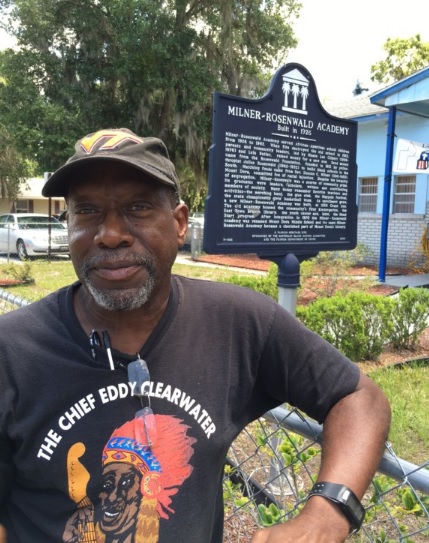
Former student Ozell Ward stands in front of a historical marker of the Milner-Rosenwald Academy in Mount Dora, Fla.
The school was all black. The textbooks, hand-me-down. The teachers paid less. Yes, the Milner-Rosenwald Academy in Mount Dora, Fla., was separate and unequal, said Ozell Ward, who attended 60 years ago.
And yet, in his view, it was better.
Teachers were invested, he said. Parents were engaged.
The community made it their “anchor.”
“Education-wise, I think I had one of the best foundations, period, despite the so-called handicaps,” said Ward, 69, a retired human resources consultant.
It may seem odd to highlight a segregated, Deep South school for a series about the roots of school choice. But the K-8 Milner-Rosenwald Academy was built during an all-but-forgotten campaign, nearly a century ago, to expand educational opportunity throughout the South. Like today’s school choice movement, it was propelled by a desire to give more and better to the kids who need it the most. The school and literally thousands like it reflected many of the core characteristics that have long defined the struggle for educational freedom, particularly in the African American experience.
It offered options (in this case, of having one formal, quality school or none at all). Private sector support. Close ties to churches and faith leaders.
And local control.
“The school was the center of the community,” said Vivian Owens, a former chemist and retired public school science teacher who also attended Milner-Rosenwald. “And the community supported it in every way.”
Irony abounds. Mount Dora, population 12,000, is a charmer of a town in the middle of Lake County, an easy-on-the-eyes stretch of Central Florida known for citrus-covered hills, stunning lake vistas – and notorious, racist violence. For nearly 30 years, it was ruled by Sheriff Willis McCall, the overseer for the county’s white bankers and citrus barons. McCall was the dark force at the center of the Groveland Four case, which generated international headlines in the 1940s and ‘50s and pitted him against Thurgood Marshall, the larger-than-life NAACP lawyer who, at the same time, was leading the charge to desegregate public schools. Thanks to the 2012 Pulitzer Prize winning book, “Devil in the Grove,” a movie is being made about the case, potentially giving millions of Americans a glimpse of the home-grown terrorism that, not long ago, was as much a part of the Florida landscape as sugar-sand beaches.
This was Florida at its worst. Yet for many African Americans here, it was also a golden age for education. (more…)
By Lloyd Dunkelberger
The News Service of Florida
Although Florida is becoming a more racially diverse state, its public-school system is becoming more segregated, a new study from the LeRoy Collins Institute shows.
“Student enrollment trends in Florida over the past decades show growing racial isolation for Hispanic and black students on some measures, with signs of continuous segregation on others,” the study said.
Some 32 percent of Hispanic students and 35 percent of black students in Florida attend “intensely segregated” schools, defined as have a nonwhite student body of 90 percent or greater, according to the study.
One out of every five schools was intensely segregated in the 2014-2015 academic year, about double the 10.6 percent of the schools that fell into that category in 1994-1995. (more…)
Ken Brockington was one of the best teachers I ever had. Cerebral. Serious. Always dapper. In the mid-1980s, he inspired me and countless others in AP American History. Time has fuzzed the details, but I can’t forget Mr. B’s yellow suit, or his red pen. “Interesting,” he’d write in the margins of my papers, next to yet another half-baked idea, “but keep thinking.”
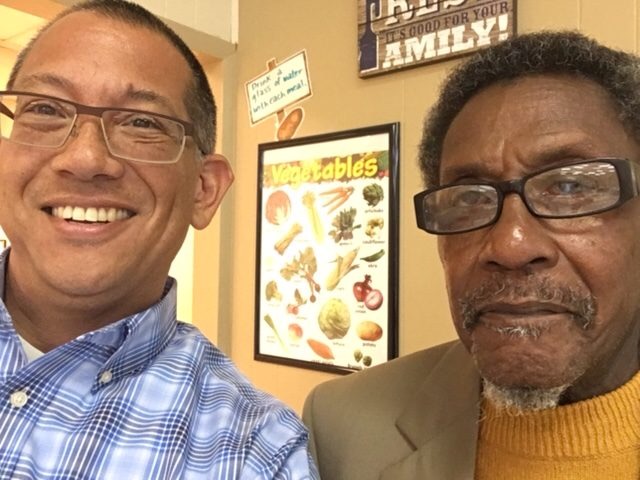
Me and Mr. B. Ken Brockington taught me AP American History in high school. Little did I know that he'd become a school choice pioneer.
The teenage me had no clue, but Mr. B was a pioneer. In the late 1960s, he was on his way to law school when a brief gig as a GED teacher detoured him into the teaching profession – and on to a new frontier. In Jacksonville, Fla. he became one of the first black teachers in integrated public schools. To get a sense of the challenge, consider many of those schools were named after Confederate generals, and one was named after the founder of the KKK. That’s where Mr. B taught me.
Today, at 68, Brockington is again surfing history. After 30 years as a teacher and principal in one of Florida’s biggest school districts, he’s now the academic dean of a private school. Cornerstone Christian seeks to uplift disadvantaged kids, and it’s able to serve them thanks to the Florida tax credit scholarship, the nation’s largest private school choice program.
 Educators like Ken Brockington are part of another sea change in American education. At its heart, the school choice movement is fueled by the same drive for educational opportunity that spurred Brown v. Board of Education, and there’s no state where choice is becoming mainstream faster than Florida. Despite much-publicized skirmishes, like the lawsuit against tax credit scholarships and the NAACP attack on charter schools, choice is here to stay.
Take it from a history teacher.
Parents aren’t going back, Brockington said: “They’re beginning to understand the power of choice.”
Teachers aren’t going back either. Mr. B (now Dr. B) said many of his colleagues are exceptionally skilled, but constrained in conventional schools. “Choice will allow them to get outside the box,” he said.
As fate would have it, I am again in Mr. B’s orbit.
I work for Step Up For Students, the nonprofit that helps administer the tax credit scholarship and hosts this blog. This year, the program is serving 95,000 students, including 7,000 in Jacksonville and 229 at Cornerstone. When work brought me to Jacksonville last month, I got to thank Mr. B in person for teaching me. As a bonus, I got to learn from him again.
The lawsuit that aims to kill the scholarship program is led by the state teachers union. Brockington was a union member; at one time, he said, he was the local vice president. But he had no qualms about switching from public school to private school more than a decade ago.
At the time, Cornerstone contracted with a social service agency to teach some of the city’s most “at-risk” students – students with, as Mr. B described it, “a suitcase of problems.” Teen moms. Dads in jail. A long list of learning disabilities. Today’s students, while not as disadvantaged as those in the past, still face so many of the hurdles that come with poverty.
Mr. B said this is where he can best help them. Their academic outcomes aren’t where they should be, yet, but they’re getting the right mix of toughness and compassion, he said: “They’ve been written off. But now there’s light at the end of the tunnel.” (more…)
Former student Ozell Ward stands in front of a historical marker of the Milner-Rosenwald Academy in Mount Dora, Fla.
This is the latest post in our series on the center-left roots of school choice.
The school was all black. The textbooks, hand-me-down. The teachers paid less. Yes, the Milner-Rosenwald Academy in Mount Dora, Fla., was separate and unequal, said Ozell Ward, who attended 60 years ago.
And yet, in his view, it was better.
Teachers were invested, he said. Parents were engaged.
The community made it their “anchor.”
“Education-wise, I think I had one of the best foundations, period, despite the so-called handicaps,” said Ward, 69, a retired human resources consultant.
It may seem odd to highlight a segregated, Deep South school for a series about the roots of school choice. But the K-8 Milner-Rosenwald Academy was built during an all-but-forgotten campaign, nearly a century ago, to expand educational opportunity throughout the South. Like today’s school choice movement, it was propelled by a desire to give more and better to the kids who need it the most. The school and literally thousands like it reflected many of the core characteristics that have long defined the struggle for educational freedom, particularly in the African American experience.
It offered options (in this case, of having one formal, quality school or none at all). Private sector support. Close ties to churches and faith leaders.
And local control.
“The school was the center of the community,” said Vivian Owens, a former chemist and retired public school science teacher who also attended Milner-Rosenwald. “And the community supported it in every way.”
Irony abounds. Mount Dora, population 12,000, is a charmer of a town in the middle of Lake County, an easy-on-the-eyes stretch of Central Florida known for citrus-covered hills, stunning lake vistas – and notorious, racist violence. For nearly 30 years, it was ruled by Sheriff Willis McCall, the overseer for the county’s white bankers and citrus barons. McCall was the dark force at the center of the Groveland Four case, which generated international headlines in the 1940s and ‘50s and pitted him against Thurgood Marshall, the larger-than-life NAACP lawyer who, at the same time, was leading the charge to desegregate public schools. Thanks to the 2012 Pulitzer Prize winning book, “Devil in the Grove,” a movie is being made about the case, potentially giving millions of Americans a glimpse of the home-grown terrorism that, not long ago, was as much a part of the Florida landscape as sugar-sand beaches.
This was Florida at its worst. Yet for many African Americans here, it was also a golden age for education. (more…)
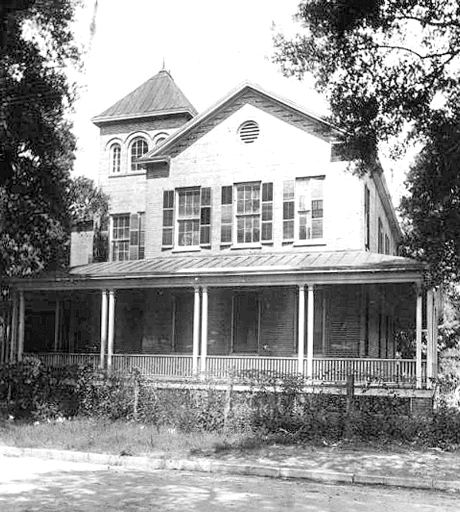
St. Benedict The Moor School, St. Augustine, Fla. Source: Wikimedia Commons.
A century ago, three Catholic sisters in St. Augustine, Fla. were arrested for something the state Legislature had recently made a crime: Teaching black children at what, in the parlance of the time, was known as a "negro school."
The ensuing trial propelled a 266-year-old French Catholic order and America's youngest Catholic Bishop into the middle one of the wildest and most racially charged gubernatorial campaigns in Florida history. A hundred years ago today, the white sisters won their legal battle, vindicating the rights of private institutions like the Saint Benedict the Moor School that fought to create educational opportunities for black children in the era of Jim Crow segregation.
Black parents' demand for quality education didn't begin with Brown v. Board, but hundreds of years before, in chains and in secret. But near the turn of the twentieth century, as Jim Crow laws reversed the progress made under post-Civil War reconstruction, public institutions intended to uplift freed blacks became increasingly inadequate and unequal. Black parents often turned to their own churches or to missionary aid societies, like the Sisters of St. Joseph, to educate their children.
The story of the three white Catholic sisters has been examined over the years by multiple scholars, whose work informs this post. And while details in the historical record are at times murky and ambiguous, the episode sheds light on the countless struggles across the South to educate black children who were pushed to the margins by oppressive public institutions.
* * *
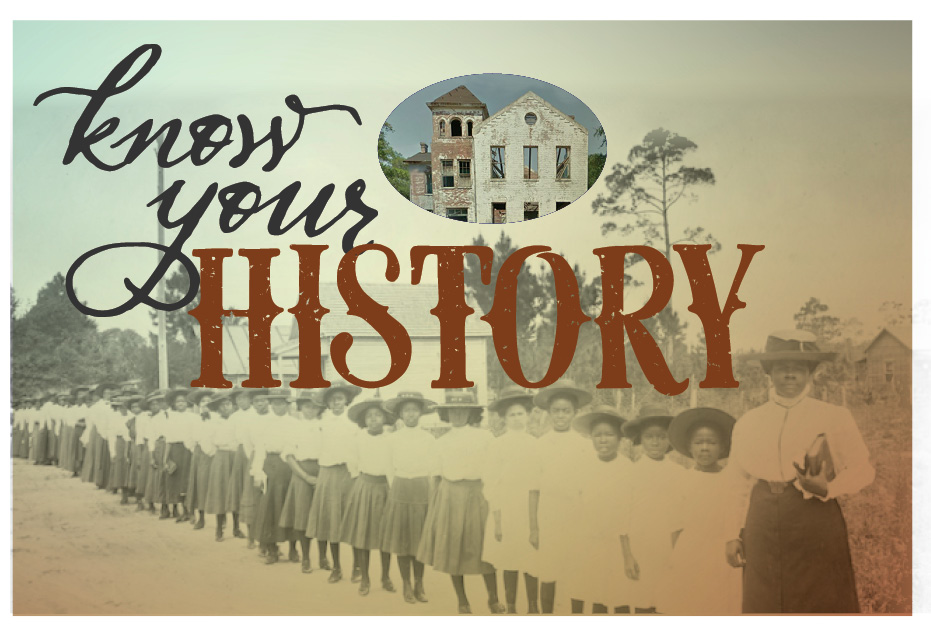 Founded in 1650 in Le Puy-en-Velay, a rural mountain town in southern France, the Sisters of St. Joseph took up a mission to serve, educate and care for the poor and disadvantaged. For the next 200 years, the sisters pursued their mission throughout France until they were invited to Florida by Bishop Augustin Verot after the end of the U.S. Civil War.
Verot, a native of Le Puy, recruited eight sisters for a new mission: To educate newly freed slaves and their children.
The sisters established Florida's first Catholic school for black students in 1867 along St. George Street in St. Augustine. They would go on to establish schools in Key West and in Ybor City. With the financial backing of a wealthy heiress, Saint Katharine Drexel, the Sisters of St. Joseph opened St. Benedict the Moor School in 1898.
The Sisters of St. Joseph, along with other religious groups like the Protestant American Missionary Association, educated black students in private and public schools in Florida for several decades. But then the legislature lashed out against their efforts. "An Act Prohibiting White Persons from Teaching Negroes in Negro Schools" unanimously passed through both chambers without debate, and was signed into law on June 7, 1913. (more…)
Do charter schools hurt the academic achievement of minority students that enroll? Do charters hurt the minority students who remain in public schools? How does closing traditional public schools and replacing them with charter schools impact these students?
Those are valid questions. But relying on unsubstantiated claims and ignoring credible evidence detracts from the thoughtful discussion the topic deserves. Unfortunately, that’s the route taken by the Journey for Justice Alliance, a coalition of left-of-center education activists and parents that recently garnered a fair amount of ink for its position.
During the 60th anniversary of Brown v. Board of Education, the alliance released a report, “Death by a Thousand Cuts,” which was part of a larger civil rights complaint against charter schools and public school closures. It claimed charter schools and school closure policies were “racially discriminatory.”
The alliance treats the racial demographics of charter schools, and the fact that charters are less popular in whiter suburban areas, as evidence that minority communities are being treated differently than their white counterparts. While it’s true there are disproportionally more black students and fewer white students in charters (see the highly regarded CREDO study on charters, page 16), it is a broad jump to conclude this occurred because of racism or discrimination on the part of charters or education reformers.
The alliance doesn’t consider the possibility that urban charters may be growing because they’re outperforming traditional public schools in urban areas, while suburban charter schools may not be because they’re not outperforming suburban public schools. Research seems to back up this explanation.
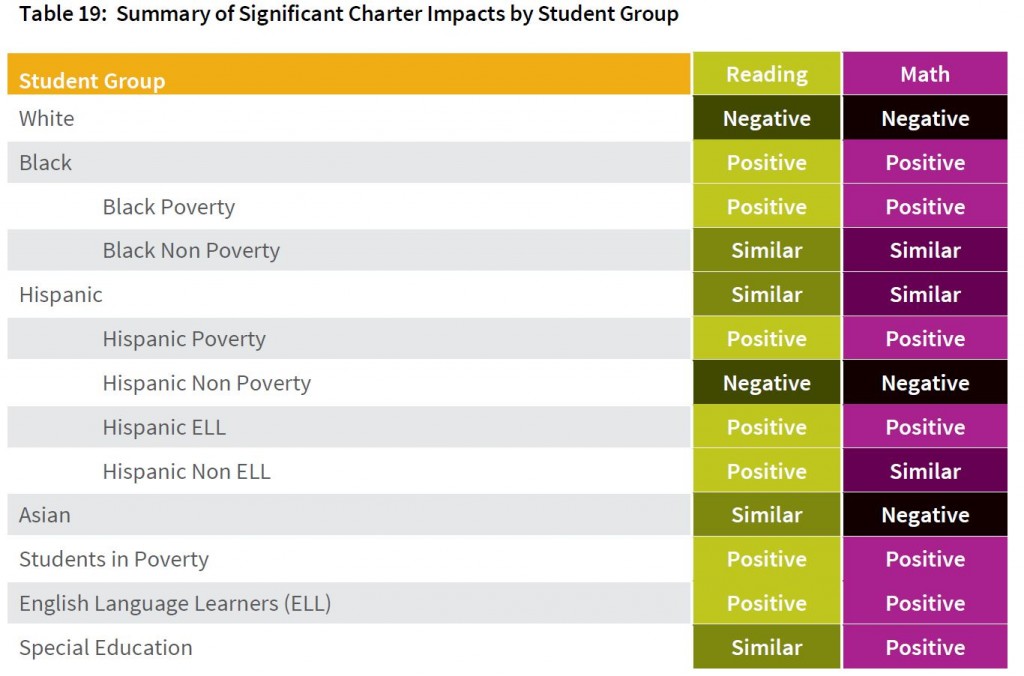
*CREDO National Charter School Study 2013, page 81.
The 2013 CREDO study found low-income black students attending charters benefited a lot – the equivalent of 29 extra days of learning in reading per year and 36 extra days in math (page 65-66). (more…)

Hanley
Editor's note: This is the third post in our series commemorating the 50th anniversary of Dr. King's Dream speech.
It was January 18th, the Saturday of the MLK weekend in 1997, when I printed out the “I Have a Dream” speech. I’m not completely sure why, except that I was transitioning in my life from international business to education reform. The powerful language and ideas King conveyed, especially the notion that we had defaulted on our promissory note, captured me then and have stayed with me. The speech has been in my briefcase ever since. Multiple times each year, I pull it out when I need to refresh my memory as to why I remain engaged in what is often such an arduous struggle.
By now, I hope, people are familiar with the dismal stats. Our schools remain mostly separate and unequal. Schools that enroll 90 percent or more non-white students spend $733 less per pupil per year than schools that enroll 90 percent or more white students. That’s enough to pay the salary of 12 additional new teachers or nine veteran teachers in an average high-minority school with 600 students. Almost 40 percent of black and Hispanic students attend those high minority schools, whereas the average white student is in a school that’s 77 percent white. Whites now constitute only 52 percent of K-12 demographics.
Meanwhile, only 19 percent of Hispanic 4th graders and 16 percent of black 4th graders scored proficient or above on the 2011 NAEP reading exam. About half of Hispanic and black students were “below basic,” the lowest category. Even our best students often leave the K-12 system unprepared, as best evidenced by a 60 percent remediation rate in the first year of college and large numbers of dropouts.
Although progress has been made, America remains in default on its promise of access to a high quality educational experience for all. In the words of Dr. King, we are addicted to the “tranquilizing drug of gradualism,” and mired in a “quicksand of racial (as well as class) injustice.” Powerful adult interest groups continue to benefit. That part is analogous to the civil rights struggle of the 50’s and 60’s, though thankfully so far without the snarling dogs, fire hoses and bullets. My frustration with the pace is that the vision of justice, of what is right and what is possible, is so clear. We see hundreds of charter schools, private schools and traditional public schools achieving at high levels with children of all classes and ethnicities. When we know better, as we do, we should do better. But mostly we do not.
Parental school choice alone is no panacea. Standards need to be raised; teacher recruitment, preparation, training, evaluation, and compensation systems dramatically restructured; and technology integrated to improve efficiency. But Dr. King would likely look askance at using school district attendance boundaries to corral families the way we do cattle, allowing them in and out only when it pleases the owner. This system is inherently unjust, immoral, and even evil when it condemns families to poor performing schools year after year, generation after generation. It forcibly segregates us from one another. Without choice, we de facto have Plessy v. Ferguson’s “separate, but equal” that has never actually been equal. Often it destroys hope. (more…)

