For a decade, Yamilette Albertson Rodriguez served her country as a Marine sergeant. She spent seven months deployed in the Middle East where she fought to stem the tide of pirates that terrorized commercial vessels.
“My kids love that I chased pirates,” said the 37-year-old single mother of three from Bluffton, a city with a population of 27,716 in the southernmost tip of South Carolina’s Lowcountry.
Today, Rodriguez fights to make ends meet. The salary she earns as an operations manager at a Sherwin-Williams store is barely enough to support her and her 17-year-old daughter and 6-year-old twin sons. Her 65-year-old father recently had to move in with her. He’s also a military veteran and suffers from several chronic health conditions. Now he’s battling cancer.
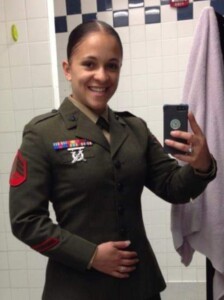 “I’m the sole income provider,” Rodgriguez said. “I basically live at work.” Her daughter said she felt invisible in her district and sometimes struggled in math. Her twins learned to read in pre-kindergarten and were ready for first grade, but the school district required them to be in kindergarten because they turned 6 after the Sept. 1 cutoff.
A new state scholarship program offered lower-income families $6,000 per child that could be spent on private school tuition, tutoring and textbooks. Rodriguez wasted no time getting approved. The kids started at Cross Schools, an Anglican church-sponsored K-12 program. Her daughter was succeeding in pre-calculus and receiving support to pursue higher education. Her twins were thriving in first grade.
A month into the school year, everything changed. The South Carolina Supreme Court declared the scholarship program unconstitutional. That day, the state Department of Education notified the nearly 3,000 families whose kids were enrolled in the program that it would immediately cut off all payments for private school tuition.
“I was in shock,” recalled Rodrigeuz, who had been unaware of the teachers union-backed lawsuit that put the program in jeopardy. Her daughter offered to get a job to help her mother pay the tuition.
“She said, “I feel like with them taking this away from you, it will just burden you financially,’” Rodriguez said.
Relief could come if the state legislature calls a special session to work out a plan that passes constitutional muster. Gov. Henry McMaster this week petitioned the court to rehear the case. However, lawmakers called that a waste of time and said they will come up with a new plan when the legislature reconvenes in January. That’s too late for Rodriguez and other families, whose incomes had to be at or below 200% of the federal poverty level to qualify for the program.
Without a quarterly scholarship payment she was supposed to receive from the state in October, Rodriguez is scrambling. She is trying to develop a plan to pay out of pocket and keep her kids in their private school for at least the rest of the school year. She had been working to build her savings, but she expects the absence of the scholarship will quickly deplete those. She has even sought out food pantries for help.
“I know for a fact I’m going to be living paycheck to paycheck,” she said.
Despite all that, Rodrigeuz remains hopeful.
“My strings are tight," she said. “But I’m holding on.”
The Japanese art of pottery, kintsugi, uses gold in the process of reconstituting something broken. Rather than attempting to conceal the repair, kintsugi makes something new and even more beautiful than the original. Author Jay Wolf notes a spiritual lesson:
The story of kintsugi — this style of pottery — may be the most perfect embodiment of all our trauma-shattered lives... Instead of throwing away the broken beloved pottery, we’ll fix it in a way that doesn’t pretend it hasn’t been broken but honors the breaking—and more so, the surviving — by highlighting those repaired seams with gold lacquer. Now the object is functional once again and dignified, not discarded. It’s stronger and even more valuable because of its reinforced, golden scars.
South Carolina choice supporters have suffered a trauma in a recent ruling striking down the state’s Education Scholarship Account program. In an absurd 3-2 ruling, the majority found that the ESA program violated language in the South Carolina Constitution prohibiting “direct” state funding to private schools. ESA funding goes to a parent-directed account, which has numerous educational uses other than private school tuition. The Arizona courts, for example, recognized this distinction between ESAs and vouchers when choice opponents made a similar challenge in the Grand Canyon State. From the unanimous Appeals Court decision (which the Arizona Supreme Court later refused to reconsider):
The ESA does not result in an appropriation of public money to encourage the preference of one religion over another, or religion per se over no religion. Any aid to religious schools would be a result of the genuine and independent private choices of the parents. The parents are given numerous ways in which they can educate their children suited to the needs of each child with no preference given to religious or nonreligious schools or programs. Parents are required only to educate their children in the areas of reading, grammar, mathematics, social studies, and science.
Where ESA funds are spent depends solely upon how parents choose to educate their children. Eligible school children may choose to remain in public school, attend a religious school, or a nonreligious private school. They may also use the funds for educational therapies, tutoring services, online learning programs and other curricula, or even at a postsecondary institution.
The specified object of the ESA is the beneficiary families, not private or sectarian schools. Parents can use the funds deposited in the empowerment account to customize an education that meets their children’s unique educational needs.
Thus, beneficiaries have discretion as to how to spend the ESA funds without having to spend any of the aid at private or sectarian schools.
South Carolina students deserved a Supreme Court majority which would have recognized the soundness of this thinking. As an alternative, South Carolina choice supporters should emulate the actions of their Grand Canyon State peers in performing school choice kintsugi. It was the loss of two small voucher programs, one for students with disabilities, the other for foster care students, that inspired the creation of the nation’s first account-based choice program. Lawmakers from across the country obviously appreciated the beauty of Arizona’s kintsugi choice program, as it has been widely emulated.
While the loss in the South Carolina Supreme Court leaves thousands of families in limbo, Palmetto State lawmakers should seize the kintsugi opportunity. Judges would have to engage in truly absurd mental gymnastics to find a version of Oklahoma’s Parental Choice Tax Credit to be “direct” aid. What Oklahoma lawmakers created lawmakers in South Carolina can optimize and perfect. A perfected Oklahoma style credit could be even more robust and indeed more beautiful than the ESA program. Beauty, as Dante observed, awakens the soul to act.
For David Warner, choosing a school for his son was a “very personal” decision, he said. The ability to select the place where he could learn near their home in Myrtle Beach, South Carolina, made him and his family feel valued, a stark contrast, David said, to his experience with assigned public schools.
But [yesterday], a state supreme court ruling in a lawsuit supported by teachers unions will cancel the scholarships for some 3,000 children from low and moderate-income families. “It feels like the light has gone out,” David told me, “and we fear being left in the dark again.”
In 2023, South Carolina lawmakers enacted the Education Scholarship Trust Fund Program, which offered children from homes with incomes at 200 percent or less of the federal poverty line (approximately $60,000 for a family of four) the opportunity to use an education savings account. Participating families were awarded accounts worth $6,000 for use on education products and services such as personal tutoring, textbooks, private school tuition, and more. Some 19 states around the U.S. had similar account-style options for families.
Now the number is 18. The state chapter of the National Education Association (NEA), a teacher union, filed a lawsuit against the accounts last October. The South Carolina Supreme Court has ruled the program unconstitutional, saying the accounts are a “direct” benefit to private schools and violate the state constitution, even though the state awards the accounts to parents, not schools.
The ruling is devastating for families like the Warners because their child’s account may end immediately. “In just a few weeks of being in this program, we saw a completely different approach to education. We had more communication from teachers and staff, greater family interaction, and they valued our input in ways the public school never did,” David said.
He explains that the private school aligned with his family’s values and was transparent about what was being taught in the classroom. “The curriculum and teaching were totally transparent, allowing us to know exactly what our children were learning,” he said.
He fears having a “tough conversation” with his son about returning to the assigned school where he struggled to fit in. “He just made new friends, and now he may have to leave them, all because of this decision,” David said. “This ruling implies that low-income families are irresponsible and that the educational elite know better than parents, but that’s not true for us,” he says.
The Warners’ other son has special needs, and David adjusted his work commitments to care for this child. “Just because a family is low-income doesn’t mean they can’t make the best, most responsible choices for their children’s education,” David said.
Thousands of stories like this one should reach state lawmakers this fall as they prepare for the next legislative session. Policymakers can still help South Carolina families by considering other education choice innovations such as the new Parental Choice Tax Credit in Oklahoma. With this state tax credit, parents can receive tax credits worth up to $7,500 for private school tuition expenses and other education products and services. Every K-12 student in Oklahoma is eligible to apply.
Lawmakers nationwide continue to adopt new learning options for students, even in states with existing private school scholarship offerings such as vouchers. Lawmakers in Wyoming and Louisiana approved education savings accounts this year, and Louisiana added these accounts in addition to the state’s existing voucher program. Oklahoma families can “stack” their tax credits on top of the existing voucher options in that state. South Carolina lawmakers should consider solutions such as these as they look for ways to help families.
“We hope that, in the end, families in South Carolina will prevail so we can continue making the best decisions for our children,” David says. Unions shut the lights off for children in the state for now, but lawmakers have plenty of alternatives at their disposal to give families and students a bright future.
 The big story: Nearly 3,000 low-income students and their families now find themselves scrambling for education options a month into the new school year after the South Carolina Supreme Court tossed out the state’s fledgling education savings account program as unconstitutional.
The state Department of Education announced on Wednesday afternoon that it has halted all tuition and fee payments being directed to private schools and courses. However, a department spokesperson said the actions relate only to payments made on or after Sept. 11 and that families would not have to return funds already spent. Also, all other allowable expenses would continue to be paid.
"The Department will work closely with parents to assess viable alternatives for their children if continued attendance at their current school is no longer an option, thanks to this lawsuit and subsequent ruling," department spokesperson Jason Raven said.
Raven added that the department will "do everything in its power to work with the Governor, General Assembly, and impacted schools to support the low-income families who are the victims of this ruling and will communicate with them regarding options that remain within the Education Scholarship Trust Fund program."
State Education Superintendent Ellen Weaver blasted the timing of the lawsuit, which the state NEA affiliate filed six months after the law’s passage and said the ruling “wreaks havoc” on families.
 “Families cried tears of joy when the scholarship funds became available for their children, and today’s Supreme Court ruling brings those same families tears of devastation,” said Weaver, a school choice champion. “While I respectfully disagree with the holdings of the majority decision, I remain committed to working with the governor and the General Assembly to find a way forward to support these students and educational freedom for all South Carolina families. These students deserve better, and I will not rest until they get it.”
The ruling: The 3-2 decision, handed down Wednesday, ruled that taxpayer dollars can’t be used to pay for private school tuition. It relied on the state’s Blaine Amendment, which keeps popping up as the battle for education choice shifts from federal to state courts in the wake of landmark U.S. Supreme Court rulings. The wording varies by state, with South Carolina’s version stating that taxpayer dollars cannot directly benefit private schools. At issue was what qualified as a direct benefit.
Specifically, the court struck down broad sections of the Education Scholarship Trust Fund (ESTF) – a program created last year by lawmakers and administered by the South Carolina Department of Education, which provides roughly 5,000 academic scholarships totaling $6,000 each for eligible K-12 students.
Justice Garrison Hill wrote for the majority that the program already in place for this school year violates the state constitution’s prohibition against public dollars directly benefiting private schools and said he found the arguments in support of the program’s constitutionality were “unconvincing.”
“They read our Constitution as allowing public funds to be directly paid to private schools as tuition as long as the funds are nudged along their path by the student, who may, through an online portal, choose to use the funds that way,” Hill wrote, with former Chief Justice Donald Beatty and acting Justice James Lockemy concurring.
The other side: In a scathing dissent, newly installed chief justice John Kittredge, backed by justice John Few, wrote that “the majority opinion pays lip service to the policy-making role of the legislature.”
“Our constitution allows the legislature — and only the legislature — to make this policy decision,” he wrote.
Kittredge added that the funds flow through the state treasury to a third-party trust fund, then to a family’s account, which parents can direct to the school of their choice, which includes some private schools.
“The majority opinion finds this is a direct benefit to the private school, that is, that public funds are ‘immediately’ going from the State Treasury to the private school,” he wrote.
Kittredge also disputed that the program, which includes $30 million of the state’s $14 billion education budget, has harmed district schools, noting that the legislature has steadily increased funding each year and approved a record amount this past year.
School choice leaders across the nation criticized the decision and expressed sympathy for the participating families.
“Today, a court overturned a duly passed piece of legislation on the basis of an indefensible misreading of the words of our State Constitution,” said Wendy Damron, president of Palmetto Promise Institute, a think tank that supports education choice. “It is unconscionable that the Supreme Court would rip away these scholarships from children and families counting on the funds for their education this year.” Damron encouraged state education officials to appeal.
Neal McCluskey, director of the Cato Institute's Center for Educational Freedom, responded in a post on X: “Sad news for South Carolinians.” He added that Cato filed a brief in the case “making clear, among other things, that by empowering diverse families to freely seek what they think is right, choice is important to defusing social conflict.”
Next steps: Gov. Henry McMaster said the state would ask the court to “expeditiously reconsider” its ruling due to concerns about effects it may have on other programs.
Fallout for pre-Kand college programs: The ruling comes despite the existence of other state programs that have allowed pre-kindergarteners and college students to use public funds at private schools, which choice advocates say supports the constitutionality of the K-12 ESA program. The pre-K program “is clearly in violation of the state constitution based on the school choice ruling,” Shawn Peterson, president of Catholic Education Partners, noted in an X post to point out the double standard.
Possible long-term solution: Jason Bedrick, a research fellow at the Heritage Foundation suggested that the legislature act quickly and examine other funding methods such as a tax credit program in the wake of the court’s “flawed decision.”
The latest: With about a month left before the new school year begins, nearly 3,000 South Carolina students and their families still face uncertainty as they wait for the South Carolina Supreme Court to rule on the program’s constitutionality. The good news for families is that it’s business as usual, at least for now.
Driving the news: Four months after hearing oral arguments in a court challenge filed by the state affiliate of the National Education Association, the high court has yet to issue a decision on whether the program, which gives parents control of $6,000 for their child’s education, violates the state’s ban on spending public funds to directly benefit religious and private educational organizations.
Meanwhile, the state Department of Education has directed its vendor to load funds into each student’s scholarship account by the end of July.
“Until a ruling is handed down, the program is fully operational and will proceed as directed by the South Carolina General Assembly,” said Jason Raven, spokesperson for the South Carolina Department of Education. “At this point, it would be premature and unproductive to speculate on hypothetical scenarios.”
However, Raven stressed that the department would “vigorously comply” with any ruling that the high court hands down, though he didn’t say how that would work if the court were to shut down the program after families had started using their money.
Catch up quick: The teachers union and a group of parents sued the state six months after the legislature passed the state’s first Education Trust Fund Scholarship Program, limited to 5,000 low-income K-12 students in its inaugural year. Previously, the state offered only a tax credit fund and a refundable individual tax credit for families of students with special needs. Eligibility for the new education savings account program will expand each year, with universal eligibility in 2027.
Public schools included: Besides allowing parents to spend funds on tuition and fees for approved non-public providers, it also lets them direct funds to transportation and fees for public schools outside the student’s assigned school district.
Who signed up: During the two-month application period, parents had applied on behalf of 7,907 students, nearly 3,000 more than the state’s first-year cap of 5,000. However, only 2,990 ended up receiving the scholarships. State officials attributed the rejection rate to parents not meeting income or residency requirements or improperly filling out forms. That led to an unsuccessful effort in the House to add a budget proviso that would allow the education department to take applications on a rolling basis until all the slots were filled.
Advocacy group calls for changes: The Palmetto Promise Institute, a think tank that championed education choice for years, criticized the short application window as “impractical” and said many applications lacked required information because parents struggled to meet the strict deadline. The group also cited the income limit, 200% of federal poverty guidelines, or $62,500 for a family of four, as a reason fewer families qualified as well as how income was calculated. “The narrow confines of the existing ESTF program leave a huge gap for many families who still need extra help affording customized education, disability therapy, or tutoring for their child,” Palmetto Promise said in a news release. Despite the “bumps in the road,” the group called it a victory and expressed confidence that the legislature would address the issues.
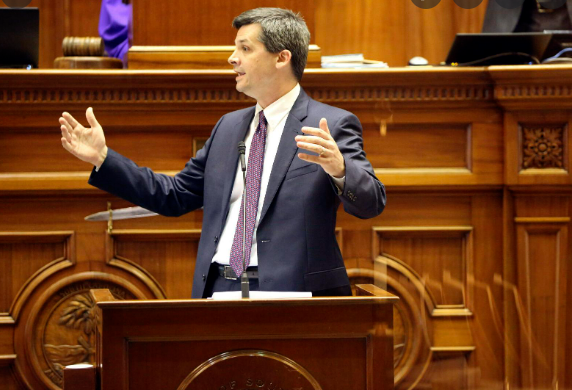
South Carolina Senate Majority Leader Shane Massey, who chaired numerous subcommittee hearings on the education choice bill, called the elimination of a requirement that scholarship recipients take the same end-of-course tests as traditional public school students a “deal breaker” for him.
Editor’s note: This article appeared today on thestate.com.
After roughly two decades of fruitless deliberation over voucher programs, South Carolina lawmakers appeared finally to be on the verge of expanding school choice this year.
The House and Senate, energized by a wave of frustration over pandemic-era education policies, passed companion bills to establish a scholarship fund that select parents could tap for their children’s educational expenses, including private school tuition.
Republican lawmakers were in broad agreement that low-income children whose needs were not being met by public schools should be afforded their choice of private education options on the public dime. It was just a matter of deciding how best to smooth out the differences between the House and Senate plans to accomplish that.
The House favored a three-year pilot program that would take $75 million from the state’s contingency reserve fund to provide annual $5,000 scholarships to 5,000 low-income elementary-age students. The Senate wanted a permanent program open to a larger, but still limited number of K-12 students who were Medicaid-eligible or had an individualized education plan.
Under the Senate plan, parents could use money earmarked for K-12 public schools — $6,000 annually per scholarship recipient — to pay for a variety of educational expenses.
The joint panel tasked with hammering out a compromise voucher bill was optimistic its report would be adopted, as such reports often are, but their plans hit a fatal snag when lawmakers returned to Columbia last week for a one-day special session to finalize the budget and resolve differences between competing versions of adopted bills.
The compromise voucher bill passed the House without discussion and had enough support to clear the Senate also, but never got a vote in the upper chamber. The Senate’s decision to adjourn without voting on the bill effectively killed it for the year.
“Voucher Bill DEAD!” Sen. Mike Fanning, a Fairfield Democrat and ardent school voucher opponent, triumphantly tweeted moments after the Senate adjourned last week. “HUGE News!”
To continue reading, click here.

