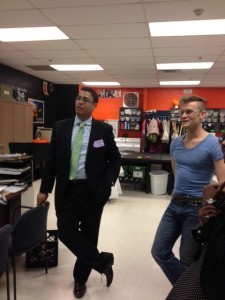
Scott Thomas, left, and Blake High School costume design teacher Jared Porter, talk about the magnet school's arts program and how it gets students excited about learning. Thomas is the new executive director of Magnet Schools of America in Washington, D.C.
It was the impromptu performance that theater students live for, and exactly what the stranger who walked inside their classroom came to see.
Fifteen-year-old Samantha Ely, a freshman in Blake High School’s performing arts magnet program, was front and center, singing a cappella to an entourage of visitors including Scott Thomas, the new executive director of Magnet Schools of America.

Blake High freshman Samantha Ely sings for visitors from Magnet Schools of America.
“That was amazing,’’ said the former social studies teacher from Minnesota.
Not satisfied as a mere audience member, Thomas took the stage at the Tampa, Fla. school, polling Samantha and her classmates on what they liked best about attending a school with a specialized track of study.
“Freedom,’’ said one girl as she brushed her hands across her ripped jeans. “There are no cliques. And I can dress like this.’’
“We’re all doing exactly what we like the most,’’ said another.
Thomas wanted to hear more.
“How do you know when you’re in high school what you want to do with the rest of your life?’’ he asked the room full of future singers, dancers and actors.
“I go to bed singing songs,’’ said one of the seniors. “I wake up singing songs.’’
And in between, she said, she feeds her passion at Blake, singing in two to three classes. (more…)
A bill filed in the Florida Legislature this week could give the families of disabled students quicker access to McKay Scholarships, state-funded vouchers for private schools, and likely result in an expansion of the $151 million program.
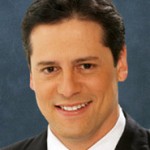
Florida Sen. Miguel Diaz de la Portilla
Senate Bill 172, sponsored by Sen. Miguel Diaz de la Portilla, R-Miami, nixes the requirement that students spend the prior school year in a Florida public school before becoming eligible for the scholarship. Similar bills were proposed in 2009, but died in committee.
The idea behind the public school rule, said Miami attorney Allison Hertog, an advocate for students with special needs and their parents, was to allow school districts time to get to know students and properly evaluate what kind of services they needed.
Then districts could develop a comprehensive education plan known as an IEP or 504 – a federally mandated road map that helps set a course for learning. The better the plan, Hertog said, the better the services and, ultimately, the more money families receive.
So why remove the requirement?
“When students struggle, the goal is to try to get them into the most successful environment as quickly as possible,’’ said Steve Hicks, president of the Coalition of McKay Scholarship Schools, which represents private schools that accept the scholarship dollars.
Families don’t necessarily want to wait a year before they can move their child into a better setting – and they shouldn’t have to, Hicks said.
“Kids, if they feel like they’re going to fail, they will shut down,’’ he said. “Trying to get them going again is very difficult. Our goal is to expand the program to allow parents to access immediately all the services available, whether it’s public or private school, tax credit scholarships, or whatever.’’
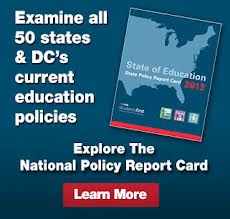 Florida earns a C- for policies and program aimed at empowering parents, but that’s good enough for a No. 4 ranking nationally, according to a report card released today by StudentsFirst.
Overall, the state earned a No. 2 rank – and a B- grade – from the report, which looked at progress in three areas: elevating the teaching profession; empowering parents; and spending wisely/governing well. Louisiana came in at No. 1, also with a B- grade. A dozen states earned F’s. StudentsFirst is led by Michelle Rhee.
In the parent category, Florida racked up points for grading public schools and requiring public school parents to be notified when their kids are placed with ineffective teachers. But the group says Florida should require consent from parents whose children are placed with such teachers. It also says Florida should pass a parent trigger bill.
Among other areas, Florida got dinged a bit for its tax credit scholarship program (which is administered by Step Up For Students, the co-host of this blog). In short, StudentsFirst doesn’t think the program is funded enough or accountable enough, although the report doesn’t spell out how it falls short on the latter.
The program is available to all low-income students – which we think is a good thing - but the report says it should be limited to low-income students in “chronically failing public schools.” The report also says Florida should amend the program to provide a scholarship amount “that is competitive with private school tuition.” The amount this year, $4,335, is far below the amount spent per student in Florida public schools.
With charter schools, the report says Florida should allow other bodies besides school boards to be authorizers (although that involves issues with the state constitution). It also says the state should reform "skimming provisions" that allow school districts to keep up to 5 percent of charter school funding.
A 73-second exchange between Gov. Rick Scott and capital reporters last week has raised the profile of testing in Florida’s scholarship for low-income children, but done little to deepen the debate. The question of testing is a legitimate one, but cannot be separated from the educational context.
Gov. Scott had no time to deal with such complexity. He was fielding rapid-fire questions after a state Cabinet meeting when he was asked whether students on vouchers should take the same test as those in public schools. His first answer: “Look, if you’re going to have state dollars, you’re going to have similar standards.” On followup, he said: “I believe anybody that gets state dollars ought to be under the same standards.”
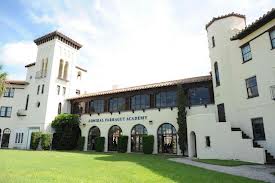
If the state required tax credit scholarship students to take the same tests as their public school counterparts, what might that mean for say, the 21 scholarship students at the highly regarded Admiral Farragut Academy in St. Petersburg? They’re a tiny portion of the 400 students at the school, which accepts the $4,335 scholarship as full payment. Would those students lose out on a remarkable learning environment?
The governor’s instinct is strong, but the statement took on a life of its own, spurring news coverage, editorials and a distinguished post from the Fordham Institute. Not surprisingly, much of the reaction was one-dimensional, focused on apples and oranges and what Ralph Waldo Emerson might have called a “foolish consistency." So allow me, as policy director for Step Up For Students, the nonprofit that oversees the Florida Tax Credit Scholarship for 50,812 low-income students this year in Florida, to try to paint the broad landscape.
Under Florida’s scholarship program, students are required to take nationally norm-referenced tests approved by the state Department of Education. More than two-thirds take the Stanford Achievement Test. Another fifth, which comprises mainly the Catholic schools, take the Iowa Test of Basic Skills. The test-score gains are then reported publicly each year by an independent researcher, respected Northwestern University professor David Figlio. Starting this year, those gains are also reported for every school with at least 30 students who have current- and prior-year test scores. The validity of these testing instruments is not really in dispute, which is why it is more than a little disconcerting that their results have been scarcely mentioned. The state’s leading newspaper managed to write an entire editorial directive, “Holding voucher schools to account is overdue,” without a single reference.
So, for the record, the state so far has issued five years of test reports for the tax credit scholarship, and two findings have been persistent: 1) The students choosing the scholarship were the lowest performers from the traditional public schools they left behind; and 2) On the whole they are achieving almost precisely the same test gains in reading and math as students of all incomes nationally. For the 70 schools that met the disclosure threshold this year, 50 kept pace with the national sample, eight exceeded and 12 fell short.
Not incidentally, these results provide the kind of data that is needed to judge whether students are making academic progress. (more…)
Editor's note: Step Up For Students president Doug Tuthill wrote the following letter, which was published this morning in the Tampa Bay Times. It's in response to this Times editorial about testing for students in Florida's tax credit scholarship program and recent comments from Gov. Rick Scott. Some recent news stories have also suggested that testing for scholarship students is limited or nonexistent.
 Florida's public education system is so rich with learning options that last year 1.3 million students chose something other than their assigned neighborhood school. So the debate about how best to hold these diverse programs accountable for student progress is important.
Unfortunately, the manner in which the Times questioned testing for one of those programs — a Tax Credit Scholarship for low-income students — was incomplete and misleading. While it is true scholarship students are not required to take the FCAT, that doesn't mean the test most of them take annually, the Stanford Achievement, is irrelevant. This test is considered the gold standard in national exams, and has now been administered for six years with two consistent findings: 1) The students choosing the scholarship were the lowest performers in their district schools; and 2) They are achieving the same test gains in reading and math as students of all incomes nationally.
The expansion of options such as magnet programs, charter schools, virtual schools and scholarships for low-income children strengthens public education. These options all undergo rigorous academic evaluation, and the new national Common Core standards will hopefully make comparative evaluations even easier for parents and the public.
It's not news that Florida Gov. Rick Scott is a strong supporter of parental school choice. But some of his comments Wednesday night in Tampa are still noteworthy. Scott was the keynote speaker at the annual donor appreciation dinner for the state’s tax credit scholarship program, which now serves more than 50,000 low-income students.
In the excerpts below, Scott refers to John Kirtley, who founded Step Up For Students and now serves as its chairman. Step Up administers the scholarship program and co-hosts this blog. Scott also refers to results released this week from a test called PIRLS – the Progress in International Reading Literacy Study, which is given to a representative sampling of fourth graders from around the world. In reading, Florida students finished second only to their peers in Hong Kong. Here's a sampling of what you'll hear from Scott in the video:
Over 50 percent of the families in our state make less than $50,000 a year. Every one of them has the same goal we have: They want to be able to choose where their child gets an education …
I tell people all the time: you can get anything passed in Florida you want, if you can explain how it impacts a family making $40,000 a year. This impacts families making $40,000 a year. Families like mine that lived in public housing. Families like mine that the father never had a job at Christmas. Families like mine that didn’t have the money to pay for junior college, college …
If every child has a choice, then the thing I ran on – getting the state back to work – will actually happen. There is no reason for this state not to be No. 1 in job creation. But the only way that’s going to happen is through a great education system. And a key component of that is choice, which makes everybody better and gives different students – like my daughters are both different – different opportunities. …
What John started, what you’re continuing, is forcing the rest of the country to change. Because they see how well Florida is doing. I don’t know if you saw the numbers yesterday, but everybody can be proud of our students. In the international test, we’re right at the top. We weren’t at the bottom. We were at the top.
 On top of the world. Gov. Rick Scott calls the PIRLS results (an international assessment that shows Florida fourth-graders are second only to their peers in Hong Kong in reading) “great news for Florida as our state becomes a hub for global commerce.” Jeb Bush says Florida students are “again busting all the myths.” No more Flori-duh, writes EdFly Blog: “Florida has gone from one of the worst reading states in the nation to one of the top reading nations in the world. And just last month I read a story about Jeb Bush’s education reforms in Reuters, which concluded: 'But a close examination raises questions about the depth and durability of the (education) gains in Florida.' Think we’ll see a follow-up?” More from Florida Today, Associated Press, Bloomberg, Eduwonk, Jay P. Greene’s Blog. (Image from questprblog.com)
FCAT for voucher kids? Gov. Scott seems to suggest that in comments to reporters Tuesday. Here’s the clip (starts at about the 13-minute mark). Coverage from Gradebook, WTSP, Orlando Sentinel, Associated Press, News Service of Florida. The governor will be speaking in Tampa tonight, at the annual donor dinner for Florida’s tax credit scholarship program (which is sponsored by Step Up For Students, which co-hosts this blog).
Race to the Top. Miami-Dade wins this round, reports the Miami Herald.
Conversion. The Broward County school board considers creating a countywide K-12 digital arts magnet in an effort to help a low-performing middle school meet accountability standards, reports the Sun-Sentinel.
Protection. From the Orlando Sentinel: "After listening to nearly six hours of testimony on both sides of the issue, the Orange County School Board added protections for gay, lesbian and transgender students and staff to the district's nondiscrimination policy early Wednesday."
Wait a minute. The Polk County school board and new superintendent John Stewart may delay the opening of six district-run charter schools for at-risk students, reports the Ledger.
School-to-prison pipeline. On the NAACP's agenda in Duval. Florida Times Union.
Financial irregularities. Eighty-five percent of district schools in Palm Beach County show financial irregularities, an audit finds, with some cases involving “thousands of missing dollars, spotty tracking of fundraising cash and outstanding deficits in school funds,” reports the South Florida Sun Sentinel.
 Teacher turnover. The Pasco district knows it must find ways to slow the revolving door in high-needs schools. Tampa Bay Times.
Inconvenient truths. Florida Voices columnist Rick Outzen says it’s an “inconvenient truth” that Florida’s grad rates are so low. (It’s also an inconvenient truth, not mentioned in the column, that they’re among the fastest-rising in the country.)
Construction money. Supporters of traditional public schools say charter school funding is leaving them in a bigger bind, reports the St. Augustine Record. Says Colleen Wood with 50th No More (and Save Duval Schools): “It seems to be the idea that parental choice is the guiding principal (for charter schools) as opposed to (students getting) the best education possible.”
Rubio and tax credit scholarships. Florida offers a model for a federal program proposed by U.S. Sen. Marco Rubio, writes the Choice Words blog. (Step Up For Students, which co-hosts this blog, administers the Florida program.)
Evals. The ones for administrators came out last week, too. StateImpact Florida. But there's a disconnect between the new evals and school grades, writes Naples Daily News columnist Brett Batten.
Early learning funding formula. Gov. Rick Scott says the state won’t change it this year, drawing praise from early learning coalitions, reports Gradebook.
Stuck in the '70s. In an editorial about the three finalists for ed commish, the Tampa Bay Times likens the DOE to "an old pinball machine" and asks: "At what point does the privatization of the public school system go too far? And what will you do move the focus off of vouchers and back to the heart of Florida's future - its traditional public schools?" Orlando Sentinel columnist Beth Kassab says go with Tony Bennett.
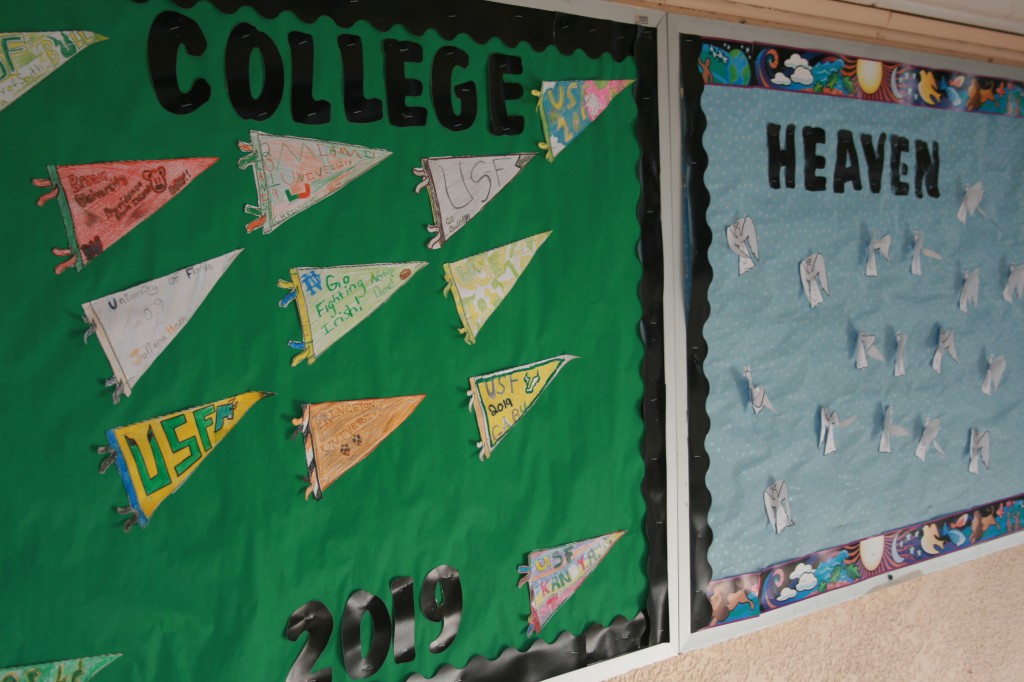
St. Joseph's goals for students are evident throughout the school.
Students know their priorities the moment they enter St. Joseph Catholic School. A sign by the front door reads, “Our Goals: College. Heaven.’’
Inside the West Tampa school’s cafeteria, boys and girls gather for Holy Karaoke, a morning program that encourages them to dance and sing, and focus on the lessons ahead.
Cartoon pumpkins belt out “Blue Moon’’ while bobbing across a giant movie screen. Sister Nivia Arias, in full habit, croons along at the pulpit before prompting her charges to recite daily affirmations.
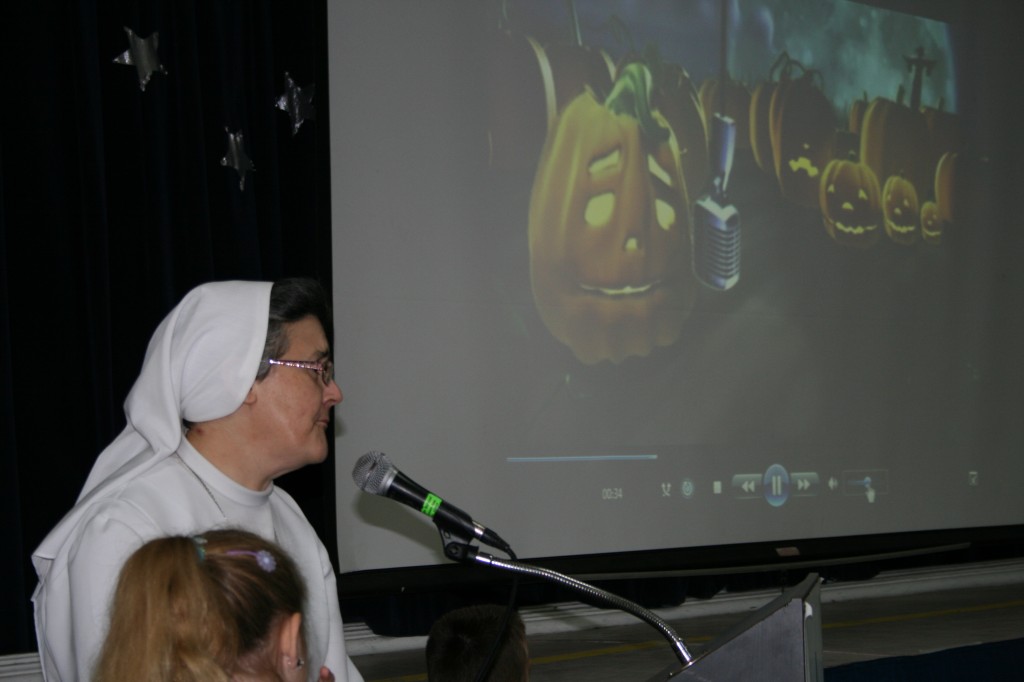
Sister Nivia Arias oversees St. Joseph Catholic School's Holy Karaoke morning show.
“We are active learners who do our best work every day,’’ little voices say in unison. “We do the right thing at the right time.”
The saying sums up the philosophy of this 116-year-old parochial school once run by Salesian nuns. It may also be prophetic.
Like other Catholic schools across the nation, St. Joseph struggles with limited resources while trying to attract students and teachers. But a new partnership with the Diocese of St. Petersburg and the University of Notre Dame might be the right thing at the right time.
St. Joseph and another local Catholic school, Sacred Heart in Pinellas Park, are among five schools in the nation taking part in the Notre Dame ACE Academies, a pilot program in conjunction with the university's Alliance for Catholic Education that aims to strengthen Catholic schools and the communities they serve.
The idea is to boost enrollment and help schools develop better leadership, curriculum, instruction, financial management and marketing. (more…)
Fox 13, a TV station in Tampa, Fla., did a nice piece this week about a unique partnership that shows how much and how fast education is changing. It’s between Khan Academy and Step Up For Students, the nonprofit that administers Florida’s tax credit scholarship program for low-income kids (and, full disclosure, co-hosts this blog). The story focused on Gateway Christian Academy, one of 10 private schools that accept scholarship students and volunteered to join the effort.
Like other partnership schools, Gateway Christian is holding “Khan Nights” to show parents how Khan Academy works, how the school is incorporating it into its curriculum and how it can make a difference for their children. As you’ll see from the clip, it’s using this technology, and reeling in a diverse group of moms and dads, all so it can maximize the academic outcomes for its kids.
As we wrote a few months back, the Khan Academy/Step Up venture is only one of a handful that Khan Academy has established with school districts nationwide, and the only one outside of California that involves a network of private schools. The way we see it, it’s a beautiful marriage between school choice and the latest learning tools, with a heavy dose of parental engagement thrown in. Thanks, Fox 13, for giving your viewers a peek at the future.

