
During a 1916 football game between Georgia Tech and Cumberland, Georgia Tech coach John Heisman famously urged his players on to victory- “You're doing all right, team, we're ahead. But you just can't tell what those Cumberland players have up their sleeves. They may spring a surprise. Be alert, men! Hit 'em clean, but hit 'em hard!” Cumberland committed 15 turnovers in the game and had one of their players getting tackled for a six-yard loss on an attempt at an offensive rush declared their “play of the game.” Georgia Tech won the game 222 to 0.
This story has repeatedly come to mind repeatedly over the last decade while reading stories about the competition between surging Florida and floundering New York.
The New York Post reports that New York City Schools will spend $42,000 per student this year. Spending $840,000 on a classroom of 20 fourth graders might seem a bit pricey, especially given that judging on their 2024 NAEP performance, nine of them will be reading at “below basic.” New Yorkers must pay sky-high taxes to support the world’s most expensive illiteracy generator/job programs, which is one of the reasons so many New Yorkers keep becoming Floridians. Now, however, it isn’t just people and companies migrating from New York to Florida; New York’s Success Academy schools are also heading south.
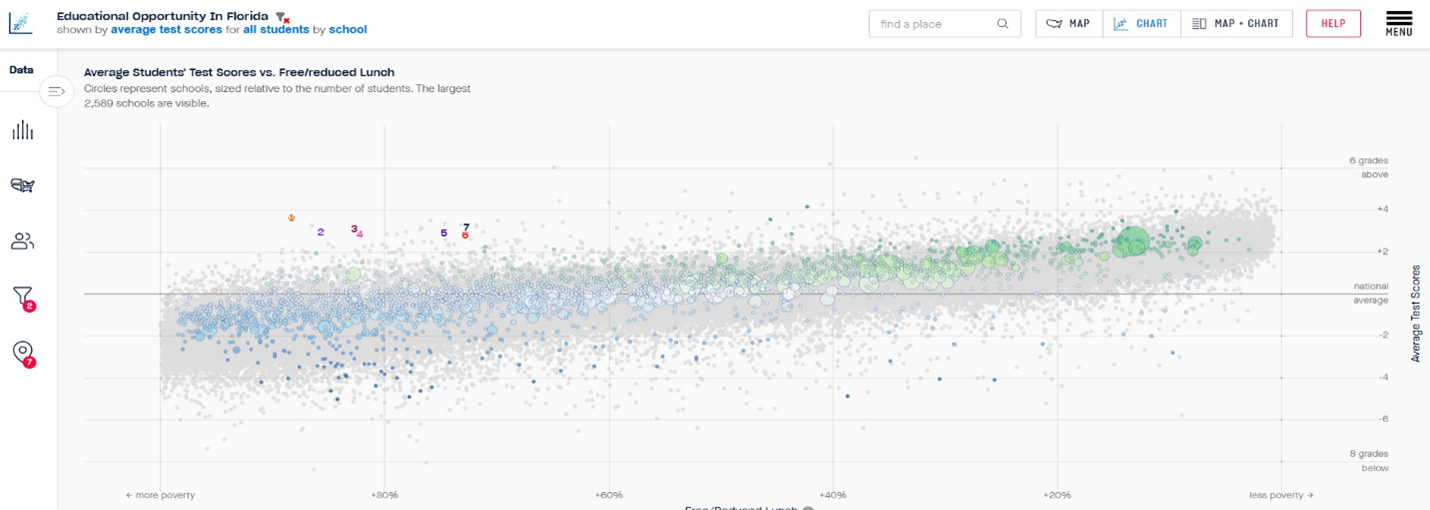
Through the wizardry of Stanford’s Educational Opportunity Project graph generator, I’ve placed New York Success Academies (Marked 1-7) in the graph for the overall state of Florida for academic proficiency. Schools are dots; green dots are higher than average, blue below average, etc.
You don’t see many high-poverty schools (graph runs from low poverty on the right to high poverty on the left) with students scoring 3ish grade levels above average, but that is exactly what Success Academy has consistently delivered in New York.
Being a rational human, you might think that New York policymakers would be falling over themselves to get as many Success Academies operating as possible, but that is just you being silly again. New York lawmakers maintain a statewide cap on the number of charter schools. Apparently, New York lawmakers feel the need to keep safe from, well, learning.
Florida, on the other hand, does not have a cap on charter schools. Rather than treating highly successful schools specializing in educating disadvantaged students as a public menace, Florida is rolling out the red carpet for highly effective school models. Success Academy plans to open 40 schools in Florida over the next 10 years, something which New York law prohibits.
Is it too much? Too much winning? No, Florida, you have to win more! Or to paraphrase Coach Heisman “You're doing all right, Florida; you’re ahead. But you just can't tell what those New Yorkers have up their sleeves. They may spring a surprise. Be alert, men! Hit 'em clean, but hit 'em hard!” Capitalizing on the abject folly of New York policymakers is hitting both clean and hard.
The renowned New York charter school operator Success Academy moved a step closer to opening new schools in Florida, as the state Board of Education approved it as the state's sixth Hope operator.
The designation, created by the 2017 Schools of Hope legislation, allows nationally recognized charter networks with a proven record of raising student achievement to receive startup funding and a streamlined approval process to open schools in areas with low-performing schools or high levels of economic disadvantage.
The network would still have to submit a notice of intent and enter a charter agreement with a school district before it can open schools. If it takes that step, this would be Success’s first schools outside New York.
Success founder Eva Moskowitz told board members that Florida's charter-friendly policies were a major reason why the network considering a Sunshine State expansion.
“I have been doing this in a rather hostile political environment, and one of the things that I’m so impressed with [in Florida] is a desire for innovation and really leading the country,” she said. “This nation needs this kind of innovation, particularly for our poorest and most vulnerable children.”
Success’s credentials are not in doubt. The network is known for serving predominantly low-income student populations that stun the state with their high test scores and college-going rates.
Education Commissioner Manny Diaz Jr. helped pass legislation that created the Schools of Hope Program.
“This is exactly what we were envisioning, to have a charter network to come in and serve those populations that are in need of this kind of academic rigor, this performance,” he said. “Over the next decade, hopefully we’re going to look back and remember this instance where we changed the lives of so many students.”
Board of Education members said they were happy to roll out the welcome mat.
"I think they're going to have greater success in Florida, because they're going to have a willing partner at the state level," Chairman Ben Gibson said.
Florida's decade-long efforts to recruit more high-quality charter school operators to the state could be on the verge of a major breakthrough.
Tomorrow, the state Board of Education is set to consider an application from New York-based Success Academy as a designated Schools of Hope operator.
The Schools of Hope program was created in 2017 to help draw more high-performing charter school organizations to the Sunshine State. It scored a few successes, helping bring IDEA Public Schools to Jacksonville and Tampa, as well as KIPP to Miami.
Florida education leaders had for years bemoaned that major national nonprofit charter networks with strong track records of improving outcomes for low-income students had largely steered clear of the nation's third-largest state, despite a steadily growing charter school sector that now enrolls nearly 400,000 students.
One of the leaders working to make the state more friendly to top charter operators was then-state legislator Manny Diaz Jr., who is now the state's education commissioner.
Success fits the profile of operators Florida has long hoped to attract. Its schools boast the best math achievement in New York State while serving a student population of predominantly low-income children of color. All of its graduates get accepted to four-year colleges. The network is known for a relentless commitment to high expectations and celebrated efforts to deliver an academically demanding curriculum at scale.
But it's never opened a school outside New York City.
That may be about to change.
"We are immensely excited at the prospect of bringing our success to Florida and look forward to exploring what we can accomplish together, given that Florida is a national leader in educational choice, as the Schools of Hope program demonstrates," Success Academy's founder, Eva Moskowitz, wrote in a cover letter accompanying its Hope application. "Success believes its innovative model would translate well in Florida to bring further educational choice and opportunities to deserving Florida families."
Schools of Hope was designed to eliminate barriers for top charter operators, such as startup funding, facilities and local school board politics. In the just-completed legislative session, lawmakers set aside $6 million in funding to help Hope Operators with teacher training and startup costs.
The state's charter schools have scored other under-the-radar policy wins in recent years. The state created new exemptions from local zoning rules, convened a statewide authorizing commission, and is gradually phasing in close-to-equal per-student funding with district schools.
Combined with the state's continued enrollment growth, these policies have made Florida fertile ground for new charter schools.
New York's cap on the number of allowable charter schools has one of the state's best charter networks looking at other options for growth to help more students, including expansion to Florida, a state with a favorable policy environment, said Derrell Bradford, president of the education advocacy group 50CAN.
"Growth has been a priority for Success Academy for a very long time, because the network wants to give as many families access to a quality education, regardless of their ZIP code, as possible," said Bradford, who is also a member of the charter network's board.
Success has worked to spread its impact beyond the 53 schools it runs, publishing curriculum guides online and creating an education institute that offers training and resources for teachers.
"Right now, this is the best way for us to make sure that an example of what is possible exists beyond New York," Bradford said.
Editor's note: Former CNN host turned ed reform advocate Campbell Brown gave a speech Tuesday night at the American Federation for Children summit in Florida. Here are her remarks as delivered:
Campbell Brown
I’m so grateful to be part of this conversation as we talk about some of the challenges that lie ahead, and how we keep trying to move the ball forward. I get asked a lot about how I got involved in this, in education, and advocating for school choice. And the answer for me is pretty much the same as Lisa (Leslie, the former WNBA star who spoke earlier) and Faith (Manuel, the mother of a tax credit scholarship student, who also spoke earlier): I became a mother. …
And that’s probably the same answer a lot of other people in this room would have. Like every mother, like every other parent, I remember holding my son Eli in my arms for the very first time and looking at him and realizing that the life I knew was over. (laughter) And going forward, my life would be dedicated to caring for this child, and protecting this child, and trying to ensure that he had every opportunity possible to be all that he could be. And No. 1 on my list, in thinking about this, and thinking about both my kids now, I have two boys, is and was their education.
And I was thinking how fortunate I had been in my life. I had this career in television. And I lived in New York City. And my kids were going to have so many options available to them. I had so many choices and they would throughout their lives have so many opportunities because of this. And I think with that comes the recognition that that’s not the case for most people. And those choices and those options are not available to mothers who care about their kids just as much as I do, and have the same hopes and dreams for their children that I have for mine. And who want their child to have every opportunity in life just like I did. If we believe that education is a fundamental right, then everyone should have that choice.
It never ceases to amaze me that this very simple idea, that a parent who wants to try to find a school, a better school to try to give their child a better life, should have that choice. The idea that this is somehow controversial is amazing to me.
I spent most of my professional life in television journalism. I was at NBC News for 11 years. … I mostly covered politics. I had a show on CNN for almost three years after that. My first boss in TV was Tim Russert, the late host of Meet the Press, who was a wonderful man and a great friend and mentor to me. And he taught me, when I was young and pretty clueless, the ways of the old school journalism. This was before MSNBC and before FOX. And so back then, I remember going to work every day, as Tim had taught us, believing basically when you were covering a story, both sides had some merit. And both sides deserved a fair hearing. And your job as a reporter was essentially to referee the match. But, as I think a lot of you know, sometimes you look at a problem, you evaluate a problem, and it’s very clear that both sides do not have merit. And referee is not a role you can play when the lives of children are hanging in the balance. (applause) (more…)

