When he first came on the scene, he was in and out of prison, recording freestyles with his cousins in Southern California. But more than two decades after he first made it big, parents no longer fear him. He's at home in Katy Perry videos and Old Navy commercials.
In this way, longtime school choice advocate Howard Fuller said Snoop Dogg's trajectory parallels that of charter schools, which celebrated their 25th birthday this week during a national conference in Nashville. In the late '80s and early '90s, it may have been hard to imagine them breaking into the establishment, but now, for all the political battles they face, they've become entrenched.
"We're heading towards being mainstream," Fuller said during a discussion of what the charter movement can expect at future big anniversary celebrations. "I hope there's someone out there, selling mixtapes out of the back of their car."
In Florida, there are still educators launching innovative, inner-city startup schools on shoe-string budgets, from Orlando to Overtown. But in many cases, they aren't starting charter schools. They're starting private schools where students rely on school choice scholarships to cover tuition. The barriers to opening a new charter school are getting higher. Startup funding is harder to come by. While they get less funding per student than charters, these private schools are constrained by fewer regulations.
Fuller said charter schools need an "innovation strategy" that embraces entrepreneurial educators looking to break free from conventional schooling models. In that vein, he added, the school choice movement needs to think about all three sectors of public education — four if you count homeschooling — and how they fit together.
(Fuller also gave an opening speech that brought the house down, in which he called for the movement to refocus its energies on "the poor, disinherited, and dispossessed.")
Philanthropy only goes so far
The Walton Family Foundation decided to give charters a massive anniversary gift: $250 million for school facilities.
In a speech announcing the Building Equity Initiative, Marc Sternberg, the foundation's K-12 program director, said the foundation wants to help educators worry less about real estate, so they can focus on the classroom. Eventually, it hopes to create space in high-performing charter schools for 250,000 more students. (more…)
A new report argues supporters of private school choice can learn from public charter schools and should look for ways to "break down the walls" between the two sectors.
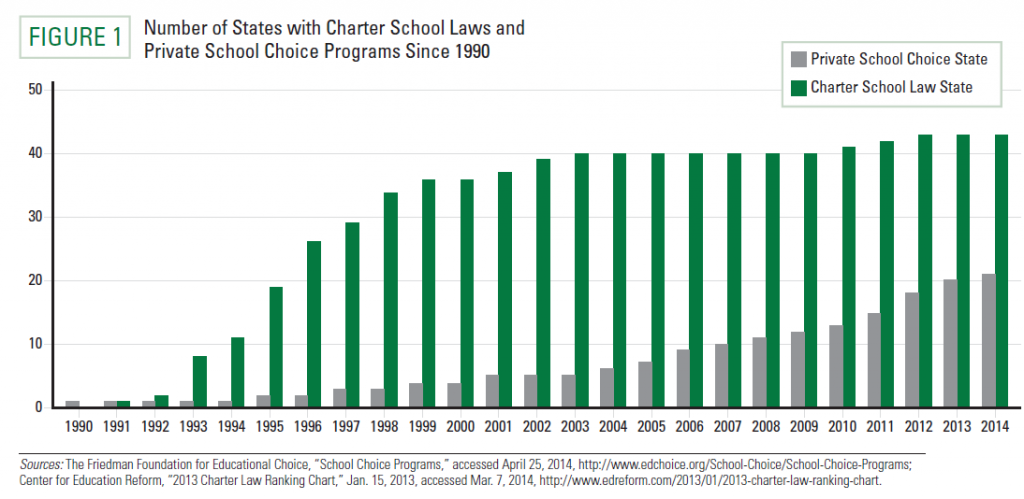
While most states have authorized charter schools for more than a decade, private school choice programs are starting to become more widespread. Chart from the Friedman Foundation's report.
Private school choice programs serve only a few hundred thousand students nationally, a fraction of the 2.3 million enrolled in charters. But more states have created tax credit scholarship and voucher programs in recent years, and existing programs, including the tax credit and McKay scholarships in Florida, are growing.
A report released this morning by the Friedman Foundation for Educational Choice argues that as private school choice programs grow and proliferate, they can draw a few lessons from the charter sector about how to create more quality options for students.
Report author Andy Smarick - a consultant at Bellwether Education Partners who's among the leading proponents of a "three-sector approach" to education reform - writes that private schools could learn from charters' use of networks and incubators to improve their operations. He also advocates for a charter-style approach to accountability, in which participating schools get screened by authorizers — agencies that hold them to performance-based contracts in exchange for more freedom to operate.
That idea may prove controversial among private schools that have traditionally not seen as much regulation as their publicly funded counterparts. But as states debate how they will regulate private school choice programs, Smarick writes that authorizers would be in a position to fine tune their judgement calls about how private schools are evaluated. For example: Should they be publicly accountable for the performance of all their students, or just the performance of students who receive tuition subsidies through tax credit or voucher programs?
"The contractual relationship, if implemented properly, will also be more nuanced - rendering fairer judgments and respecting the unique characteristics of private schools - than, say, a single letter grade for a school that would be generated via a state’s accountability system," he writes.
Other insights from the charter sector are more straightforward, such as the use of incubators and networks. (more…)

