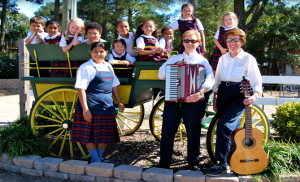
Montessori Lab School in Chesapeake, Virginia, offers students a bilingual, Christian-oriented learning environment that is nurturing, consistent, safe, and peaceful.
Editor’s note: This article appeared Monday on Virginia’s wjla.com.
Virginia Lt. Governor Winsome Earle-Sears renewed her call for school choice after Virginia’s Advanced Placement ranking dropped from ninth in the nation in 2021 to eleventh in 2022. In 2015, Virginia ranked in third place.
“This is very disheartening information, and for me and as well for parents, but when you think about it from the student’s perspective, it's devastating,” said Earle-Sears. “When I was on the school board, we had much higher standards and you see what happens when you lower the standards. And these are children's lives.”
Earlier this year, Earle-Sears pushed for a bill that would allow parents to use state education funding to cover the costs of educational opportunities outside the public school system, an effort that failed in the Virginia legislature this year, but Earle-Sears said she’d like to renew in the next legislative session.
“It's ESA accounts and it's where two-thirds of the funds that would normally go to the public school would stay in the public school even though the child isn't there,” she said. “One-third would go with the child and so what it would do is also reduce class size in the public schools.
“And then the one thing that goes with the child would be for extra tutoring. It would be for homeschooling, a private school, public school, whatever that the parent wanted to do.”
To continue reading, click here.

Little Flock Christian School in Fairfax, Virginia, one of 945 private schools in the state serving more than 144,000 students, is a non-denominational Christian school committed to exposing children to strong biblical values and teaching that will prepare them for life.
Editor’s note: This article appeared Tuesday on Virginia’s wusa9.com.
Virginia Lt. Gov. Winsome Sears and Delegate Glenn Davis, both Republicans, unveiled legislation last week that would essentially redirect money the Commonwealth spends on a student’s education in a public school to new individual savings accounts, if a parent asks.
The education success accounts, which could amount to between $4,000 to $6,000, could be used to pay for tuition, and other education essentials, in non-public school settings.
"It’s just like your health savings account,” Sears said. “Where you put some money in and then you choose your doctor, and et cetera, it's the same principle.”
She said the proposal is based on her efforts to fight for parents who want more of a say in their kids’ education.
“This is our new Board versus Brown fight,” she said. “And, what is that, it was never about Black children being able to attend white schools. It was always about a parent being able to make the best educational decision for their child. So, that’s what we’re trying to do.”
Critics on the other side of the aisle are already taking aim at Sears’ proposal, however.
Mayor Justin Wilson, D-Alexandria, says the legislation is just another attempt to defund public schools in Virginia.
"For far too long, the Commonwealth has actually underfunded local school divisions and the Commonwealth needs to be talking about how to increase the funds to our public schools to support our kids," he said.
To continue reading, click here.
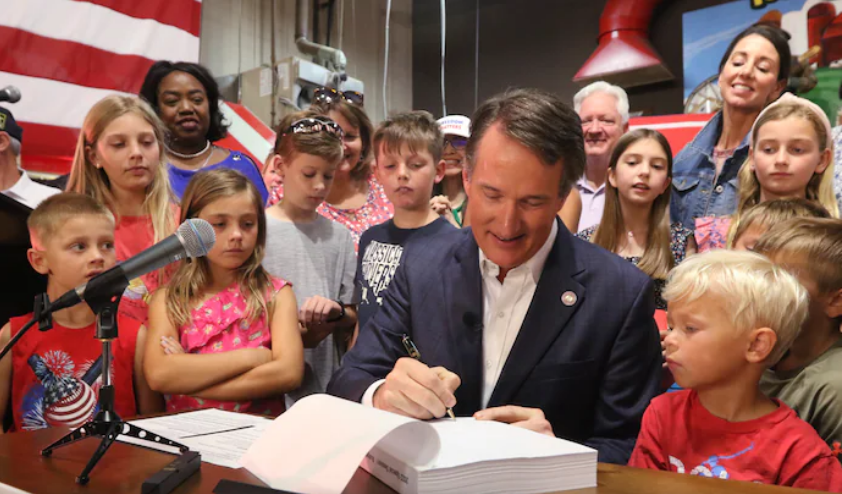
Virginia Gov. Glenn Younkin ceremonially signed the state’s two-year budget Tuesday at a Richmond grocery store. PHOTO: Associated Press
Editor’s note: This article appeared Monday on thecentersquare.com.
The final budget for Virginia included full funding for a school choice scholarship program and funding for the creation of laboratory schools, but advocates for education choice are urging the government to do more in the future.
Lawmakers approved two key budget amendments proposed by Gov. Glenn Youngkin, which included full funding for the Education Improvement Scholarships Tax Credits program. The program provides a 65% tax credit for individuals and businesses who donate to scholarships for students to attend private schools and nonpublic preschool programs.
The EISTC program will receive the same level of funding as provided in the previous budget, which is $25 million annually thanks to an amendment from the governor, which removed a provision that would have cut the program funding by more than half. The amendment received unanimous support in the Senate and some bipartisan support in the House.
“Virginia Gov. Glenn Youngkin stood firm by his commitment to support parental rights in education last week by removing a budget provision that would have gutted the state's tax credit scholarship program,” Corey DeAngelis, the national director of research at the American Federation for Children, told The Center Square.
“The House and Senate both concurred with the Governor's budget amendment, saving the state’s program that empowers thousands of families to choose the education providers that best meet their children's needs,” DeAngelis added. “This is a win for Virginia families – and it should be celebrated – but it's just a start.”
DeAngelis said there is still more the state can do, such as expanding the EISTC tax credit to 100%, rather than 65%, and expanding eligibility for families. He said the state should also support an education savings account program.
To continue reading, click here.
 Editor’s note: This commentary from Dan Lips, visiting fellow in education at the Foundation for Research on Equal Opportunity and a reimaginED guest blogger, appeared last week on the foundation’s blog, FREOPP.org. Be sure to watch for his mention of reimaginED executive editor Matt Ladner’s commentary based on research from the Educational Opportunity Project at Stanford University.
Whether parents should have the power to shape their children’s education became a defining issue of Virginia’s gubernatorial race. Glenn Youngkin will soon have an opportunity and obligation to answer the concerns of the voting bloc that helped him become the commonwealth’s next governor.
While many political pundits have associated Virginia parents’ frustration with their children’s public schools with the ongoing culture war between right and left, many Virginia parents (including those who voted for Joe Biden 12 months ago) likely have more practical concerns.
First, many of Virginia’s school districts were closed for long periods during the pandemic. Second, many parents (particularly those living near Washington) are paying high housing costs for public schools that aren’t providing a high-quality education.
According to Burbio, Virginia was among the states that offered the fewest days of in-person learning during the 2020-21 school year. Despite public health guidance from the American Academy of Pediatrics that it was safe to reopen schools in 2020, many of Virginia’s large school districts remained closed into the spring of 2021.
That was long after teachers had been offered vaccines and many school districts across the country had reopened safely. These prolonged school closures harmed children and parents, particularly those from low-income households and children with disabilities.
To continue reading, click here.
As election day dawned this morning in Virginia, a new Cygnal poll of 800-plus likely voters shows Terry McAuliffe and Glen Youngkin are running neck-and-neck for the governor’s race.
As is the case in many states, education has become a key issue in Virginia, leading pollster Brent Buchanan to proclaim that independent voters and parents of K-12 students are “stampeding” to support Youngkin.
Meanwhile, results from a recent WFXR (Virginia) News/Emerson College poll show the issues that are most important to voters are education, jobs, COVID-19, healthcare, and taxes – in that order. When broken down by party, two issues make the top five for both Republicans and Democrats: education and jobs.
In the Virginia race, the candidates have starkly different positions on education.
In a candidates’ debate in late September, McAuliffe stated: "I don’t think parents should be telling schools what they should teach." In contrast, Youngkin is on record as being committed to keeping public schools open, making them better, and encouraging school choice that aims to create at least 20 new charter schools across the state.
While Virginia parents have choices, ranging from charters to a tax credit scholarship to attend private schools, these choices are limited, and the scholarship is not large enough to help the 1.2 million students attending public schools in Virginia.
The National Alliance for Public Charter Schools recently reported that there are only eight charter schools – free public schools that are exempt from some of the rules that apply to traditional public schools – in the state of Virginia.
When it comes to allowing low-income families to have access to private school options, only 4,498 students are participating in the tax credit scholarship, a life-changing program, given that the program funding is capped at $25 million per year for a population of over one million K-12 students.
While Virginia did well in the latest round of National Assessment of Educational Progress (NAEP) testing, Virginia parents clearly need options for reasons not necessarily based on test scores. Parents across the country have been showing up in droves to school board meetings to voice their discontent at what’s being taught in public schools. In Virginia, many are speaking out against the majority-white racial makeup of school boards, asking that minorities be given more support.
Hispanic and Black parents’ voices need to be heard. They need to be able to help their children succeed, but they continue to be underrepresented. According to a study released in April from Education Reform Now, Blacks and Hispanics account for 34% of Virginia's college-age population. Yet just three of Virginia's 15 four-year public universities have Black and Hispanic enrollment levels that match the population.
If the last year and a half taught us anything, it is that a one-size-fits-all education system does not work for families. A candidate for governor who says parents shouldn’t be telling schools what they should teach is sending the wrong message if he expects to win their votes on election day.

Gov. Terry McAuliffe
Virginia Gov. Terry McAuliffe vetoed a trio of school choice bills this week —including one establishing education savings accounts (ESAs) for students with special needs.
The vetoes came just a month after McAuliffe vetoed a pair of bills allowing home education students to participate in public school sports.
The education savings accounts could have been the sixth such program nationwide, the first approved by a Democratic governor, and the second private school choice program in Virginia. (The commonwealth offers a small tax credit scholarship program for low-to moderate-income students. That program launched in 2013.)
The governor provided three reasons for the veto of the education savings account legislation (House Bill 389). (more…)
 Florida: The Seminole County School District, one of the state's biggest, offers more online classes and other educational options to compete with private and charter schools and home schooling (Orlando Sentinel). Meanwhile, another large district receives 36 applications for new charter schools (Palm Beach Post).
Tennessee: Gov. Bill Haslam says questions remain on a voucher proposal that's expected to get legislative attention next year (Nashville Public Radio). State education officials and the Nashville school board are in a standoff over a proposed charter school that wants to open in an affluent part of the city (Education Week).
Louisiana: In the wake of the new voucher program, state education officials will consider tightening rules for the establishment of new private schools. (New Orleans Times Picayune) Expanded online learning options give Louisiana students a chance to graduate early or catch up on credits. (The Advocate)
Washington: The state PTA opposes the charter school initiative on the November ballot. (The News Tribune)
Texas: Some charter school supporters oppose a state education funding lawsuit that suggests state resources are inadequate. (Austin American Statesman)
Indiana: Between vouchers and charter schools, northwest Indiana parents have more school choices than ever before. (Post Tribune) (more…)
 Colorado: Former Florida Gov. Jeb Bush lays out his education reform formula, with expanded school choice a key plank. (Education News Colorado)
Pennsylvania: Hundreds of Catholic school students in Philadelphia rally for a voucher bill. (CBS Philly)
Michigan: State lawmakers consider funding cyber schools on performance rather than enrollment. (MLive.com)
Washington: Expanded school choice in the form of charter schools - Washington is one of the few states without any - is an issue in the governor's race. (Seattle Times) (more…)

