The big story: Nearly 3,000 low-income students and their families now find themselves scrambling for education options a month into the new school year after the South Carolina Supreme Court tossed out the state’s fledgling education savings account program as unconstitutional.
The state Department of Education announced on Wednesday afternoon that it has halted all tuition and fee payments being directed to private schools and courses. However, a department spokesperson said the actions relate only to payments made on or after Sept. 11 and that families would not have to return funds already spent. Also, all other allowable expenses would continue to be paid.
"The Department will work closely with parents to assess viable alternatives for their children if continued attendance at their current school is no longer an option, thanks to this lawsuit and subsequent ruling," department spokesperson Jason Raven said.
Raven added that the department will "do everything in its power to work with the Governor, General Assembly, and impacted schools to support the low-income families who are the victims of this ruling and will communicate with them regarding options that remain within the Education Scholarship Trust Fund program."
State Education Superintendent Ellen Weaver blasted the timing of the lawsuit, which the state NEA affiliate filed six months after the law’s passage and said the ruling “wreaks havoc” on families.
 “Families cried tears of joy when the scholarship funds became available for their children, and today’s Supreme Court ruling brings those same families tears of devastation,” said Weaver, a school choice champion. “While I respectfully disagree with the holdings of the majority decision, I remain committed to working with the governor and the General Assembly to find a way forward to support these students and educational freedom for all South Carolina families. These students deserve better, and I will not rest until they get it.”
The ruling: The 3-2 decision, handed down Wednesday, ruled that taxpayer dollars can’t be used to pay for private school tuition. It relied on the state’s Blaine Amendment, which keeps popping up as the battle for education choice shifts from federal to state courts in the wake of landmark U.S. Supreme Court rulings. The wording varies by state, with South Carolina’s version stating that taxpayer dollars cannot directly benefit private schools. At issue was what qualified as a direct benefit.
Specifically, the court struck down broad sections of the Education Scholarship Trust Fund (ESTF) – a program created last year by lawmakers and administered by the South Carolina Department of Education, which provides roughly 5,000 academic scholarships totaling $6,000 each for eligible K-12 students.
Justice Garrison Hill wrote for the majority that the program already in place for this school year violates the state constitution’s prohibition against public dollars directly benefiting private schools and said he found the arguments in support of the program’s constitutionality were “unconvincing.”
“They read our Constitution as allowing public funds to be directly paid to private schools as tuition as long as the funds are nudged along their path by the student, who may, through an online portal, choose to use the funds that way,” Hill wrote, with former Chief Justice Donald Beatty and acting Justice James Lockemy concurring.
The other side: In a scathing dissent, newly installed chief justice John Kittredge, backed by justice John Few, wrote that “the majority opinion pays lip service to the policy-making role of the legislature.”
“Our constitution allows the legislature — and only the legislature — to make this policy decision,” he wrote.
Kittredge added that the funds flow through the state treasury to a third-party trust fund, then to a family’s account, which parents can direct to the school of their choice, which includes some private schools.
“The majority opinion finds this is a direct benefit to the private school, that is, that public funds are ‘immediately’ going from the State Treasury to the private school,” he wrote.
Kittredge also disputed that the program, which includes $30 million of the state’s $14 billion education budget, has harmed district schools, noting that the legislature has steadily increased funding each year and approved a record amount this past year.
School choice leaders across the nation criticized the decision and expressed sympathy for the participating families.
“Today, a court overturned a duly passed piece of legislation on the basis of an indefensible misreading of the words of our State Constitution,” said Wendy Damron, president of Palmetto Promise Institute, a think tank that supports education choice. “It is unconscionable that the Supreme Court would rip away these scholarships from children and families counting on the funds for their education this year.” Damron encouraged state education officials to appeal.
Neal McCluskey, director of the Cato Institute's Center for Educational Freedom, responded in a post on X: “Sad news for South Carolinians.” He added that Cato filed a brief in the case “making clear, among other things, that by empowering diverse families to freely seek what they think is right, choice is important to defusing social conflict.”
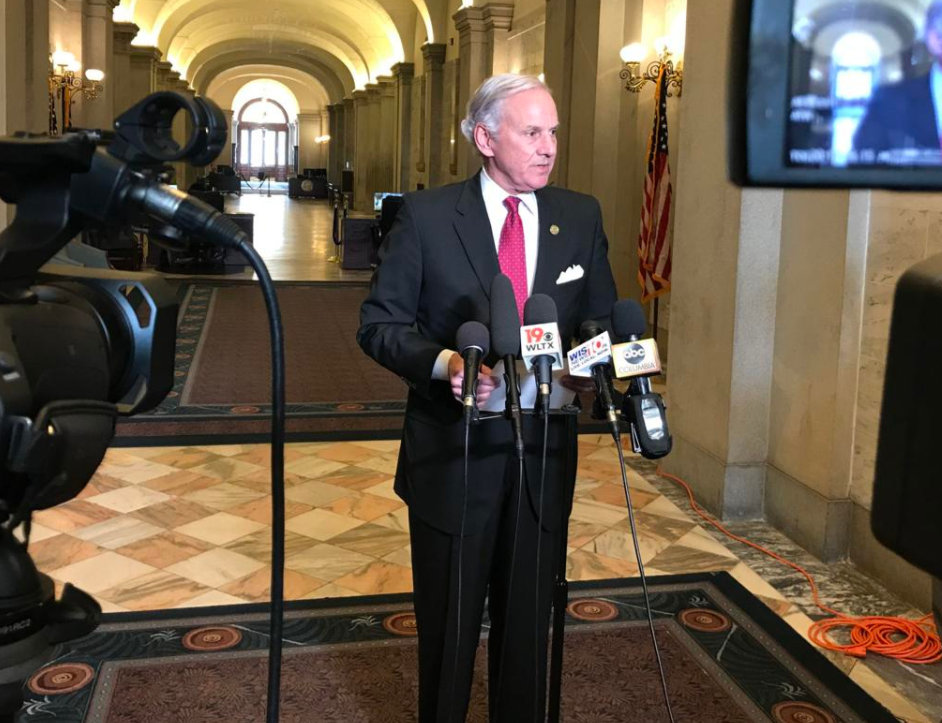
Next steps: Gov. Henry McMaster said the state would ask the court to “expeditiously reconsider” its ruling due to concerns about effects it may have on other programs.
Fallout for pre-Kand college programs: The ruling comes despite the existence of other state programs that have allowed pre-kindergarteners and college students to use public funds at private schools, which choice advocates say supports the constitutionality of the K-12 ESA program. The pre-K program “is clearly in violation of the state constitution based on the school choice ruling,” Shawn Peterson, president of Catholic Education Partners, noted in an X post to point out the double standard.
Possible long-term solution: Jason Bedrick, a research fellow at the Heritage Foundation suggested that the legislature act quickly and examine other funding methods such as a tax credit program in the wake of the court’s “flawed decision.”

South Carolina Gov. Henry McMaster announced in July the allocation of $32 million from the Governor's Emergency Education Relief (GEER) fund to create one-time grants to help parents pay tuition for their children at the state's private schools.
Editor’s note: This commentary from Katherine Kellett Bathgate, a senior policy adviser for State Policy Network and CEO and co-founder of SchoolForward, first appeared on The 74.
The American Federation of Teachers recently made headlines when it passed a resolution expressing support for any chapter that wishes to strike over schools reopening. Since then, there have been increased rumblings about possible strikes in several states.
I sympathize with teachers who are afraid to return to work, especially those who are not using the threat of strikes to achieve political goals, as some unions have done. I feel for school administrators having to make tough decisions about student and staff safety.
But if schools don’t reopen, whether because of a strike or a state or district decision, the taxpayer money that funds those schools should go to the impacted students and families.
A recent nationwide poll of 1,000 parents of K-12 children commissioned by State Policy Network showed that in the spring, during school shutdowns, families spent on average $200 total and 10 hours a week supporting their children’s education. It also revealed that 40% of parents believe their children are behind academically because of those school closures.
America cannot afford to have children fall further behind as we ride out this pandemic, and families can’t afford to continue subsidizing their children’s education like they did this spring.
Districts are announcing new closures and delayed starts every day, and parents are still grappling with whether they feel safe sending their kids back to their schools (the same poll showed only one-third to be comfortable under current conditions). As a result, some parents have turned to ideas like learning pods, where a handful of families team up to hire a teacher together or share the responsibility of homeschooling.
As this entrepreneurial idea has taken hold, and as mom Facebook groups are exploding with ideas about pods and requests to join, some have rightly questioned how equitable this is. What happens to students whose parents don’t have the financial means to hire a teacher? Or who have working parents who can’t help homeschool?
The answer has been around for nearly 10 years. It’s been tested and implemented, and all we need to do is act.
Education savings accounts, first passed in Arizona in 2011, allow families to spend a portion of their child’s state education funding on qualifying education expenses. This could be used for homeschooling, online tutoring or even chipping in to hire a teacher for a neighborhood learning pod.
Support for this idea is high, with 63% of parents in the poll saying they support passing “emergency” or “pandemic” ESAs and 35% saying they would be very or extremely likely to use a program like this if available in their state.
The challenge will be how to make ESAs a reality fast enough for families. Historically, states have taken a year or more to implement these programs once they’re passed into law. Families don’t have that kind of time right now.
But there are other ways. One example is using CARES Act funding. In South Carolina, Gov. Henry McMaster recently announced a $32 million SAFE Grants program to give low-income families up to $6,500 to fund their child’s education. As every governor has discretion to use education funds under the CARES Act, there’s no reason other states could not follow suit and direct this money to families as an ESA instead of a grant program.
States could also use special sessions to pass one-time emergency or pandemic ESAs to give a portion of each student’s funding back to the families.
Every parent of school-age children in the country has tough decisions to make as we head into the fall. As a working mom with two kids and another on the way, I empathize greatly with what parents are going through right now. We must adjust public policy to meet these needs and lighten the burden families are facing.
Now is the time to be bold and act quickly, lest we lose another year of education for millions of students.
And as someone who works in education policy, I know that we cannot afford to lose another year — or even a half year — with our children’s learning. Achievement gaps will widen further and too many kids will fall behind, especially in low-income and underserved areas. Every family, regardless of their means, should have the ability to choose the education path that is right for their child, especially this year.
So, teachers unions: Go ahead and strike. School districts: Go ahead and decide not to open. You may have legitimate health reasons for doing so. But don’t be surprised when there’s a groundswell of parents asking for their money back.