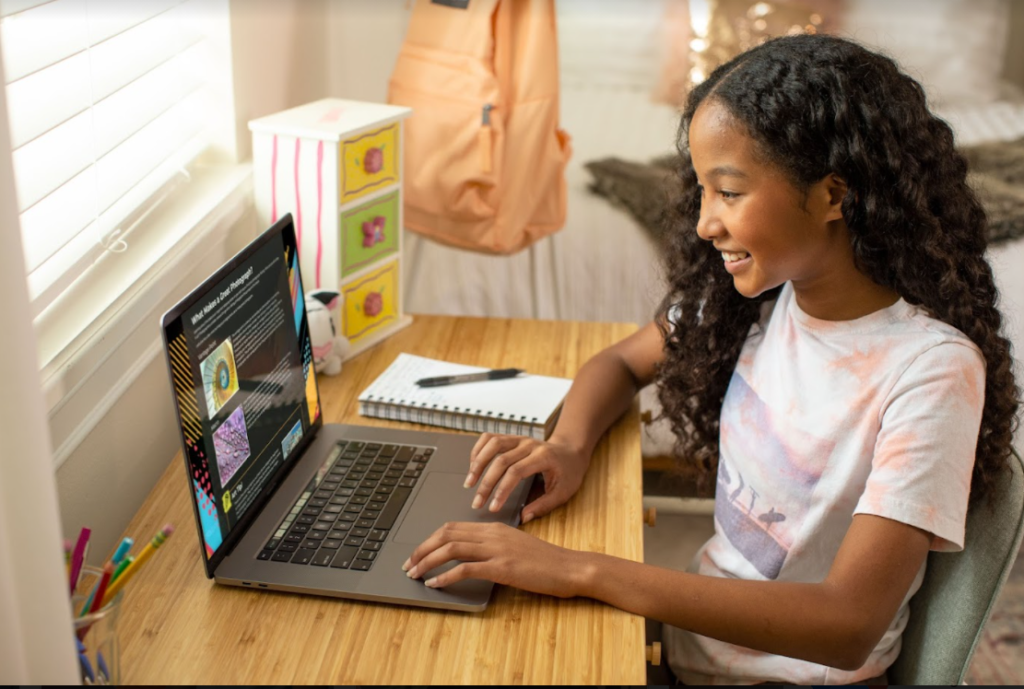
 When the coronavirus pandemic hit in 2020, Florida Virtual School came to the rescue of more than just students in the Sunshine State. It jumped at the opportunity to partner with more than 160 new schools and districts to quickly put in place online learning programs.
This week, the organization unveils its new brand, FlexPoint Education Cloud, to reflect its worldwide focus and provide school districts around the globe with tools and resources to provide online learning programs for students in kindergarten through 12th grade.
The program’s new, trademarked name reflects a more than 20-year reputation for providing schools and districts worldwide with digital curriculum and educator training. The FlexPoint launch will provide resources to even more learners, teachers, schools, districts, and beyond as cultural norms around the world continue to shift and students’ educational journey becomes more individualized.
“Launching FlexPoint is personal to us because we are educators at heart,” said Louis Algaze, president and chief executive officer of Florida Virtual School, as it will continue to be known as in its home state. “We know firsthand the challenges school administrators face every day because we are a public school district, and our virtual doors opened in 1997. We understand what truly matters to them, which is the success of their students and that teachers feel supported.
“We are thrilled to work with schools and districts to continue individualizing the student learning experience by equipping them with the tools and training they need to drive high student performance outcomes in an online learning environment.”
A new FLVS survey conducted in August revealed that more than 75% of parents believe online learning allows their children to gain critical skills they would not acquire in a traditional in-person setting, from communication and time management skills to online behavior etiquette. Most parents also note that online learning positively impacts their children’s education experience, resulting in increased ability to focus, motivation to finish homework, and the confidence to be authentically themselves.
Among the 160 new schools and districts that partnered with FLVS as they looked for ways to quickly implement online programs:
Alaska Department of Education & Early Development (AK DEED) In early 2020, before the pandemic, AK DEED already was working with FLVS to create its first statewide virtual school. Then the COVID-19 pandemic hit, forcing school closures and requiring AK DEED to press fast forward on their plans. In a matter of two weeks, FLVS partnered with AK DEED to launch Alaska State Virtual School in March 2020, two years ahead of schedule. FLVS also licensed its digital curriculum with more than 180 courses and hosted intensive teacher training for more than 190 Alaskan teachers who wanted to help as many of their students as possible by teaching online during the pandemic.
Michigan’s Grand Ledge Public Schools (GLPS) When the COVID-19 pandemic forced GLPS to start the 2020-21 school year remotely, the district partnered with FLVS to provide the school district’s approximately 5,000 kindergarten through 12th grade students with an online learning option. Through their work with FLVS, GLPS offered more than 180 customizable digital courses to support student learning and was able to serve all its students safely and effectively. Throughout the 2020-21 school year, the district maintained an average weekly participation rate of 94%.
FlexPoint has worked with schools and students around the nation and worldwide in 65 countries and three U.S. territories. FlexPoint offers more than 180 engaging and effective digital courses that can be customized to various state standards and seamlessly implemented across a variety of online platforms, extensive staff training and professional development, and around-the-clock customer service support to ensure that educators are getting what they need, when they need it.
Editor's note: Be sure to listen to the first podcast in this series here.
In the second in a two-part series hosted by Kevin Roberts of the digital innovation firm Robots and Pencils, Tuthill and Bradshaw continue discussing a partnership between Step Up For Students and Jacksonville-based artificial intelligence company NLP Logix that aims to create a simple and customizable online platform for families who use education savings accounts to support their children’s education.
Tuthill, Roberts and Bradshaw discuss the new platform and its potential to create greater social capital for families that traditionally lack the resources of more affluent communities. They also discuss how tools such as artificial intelligence-based predictive analysis can assist families in successfully navigating the complex decisions they need to make to support their children’s unique educational needs.
“Having an (artificial intelligence and data) partner to educate us about what kind of data to collect privacy issues to manage ... having that relationship is really important. It's going to be transformational for education choice."
EPISODE DETAILS:

Editor’s note: This commentary from Denisha Merriweather, founder of Black Minds Matter and a reimaginED guest blogger, appeared this morning on the Washington Examiner.
Those who say school choice has racist roots are implying that parents, especially lower-income, black parents, should stay trapped in public schools that have failed their children for decades and continue to do so to this day.
To recount the history of racism in the American education system, one must start at the origin of schooling in America.
Why do we prop up the public education system as a symbol of education equity when it was once the primary mechanism for segregation?
Eventually, the federal government decided to provide support for freed blacks through the Freedmen’s Bureau . The bureau’s role was to help transition African Americans from slavery to freedom. It took responsibility for building all-black public schools, converting black independent schools into public schools, supporting existing independent black schools, and funding for volunteer teachers.
The commission of the Freedmen's Bureau was short-lived, but the desire for education freedom never waned. James Forman Jr. states that “in the clearest example of nineteenth-century black 'school choice,' some blacks continued building private schools even after the Freedmen’s Bureau opened publicly supported schools.”
To continue reading, click here.
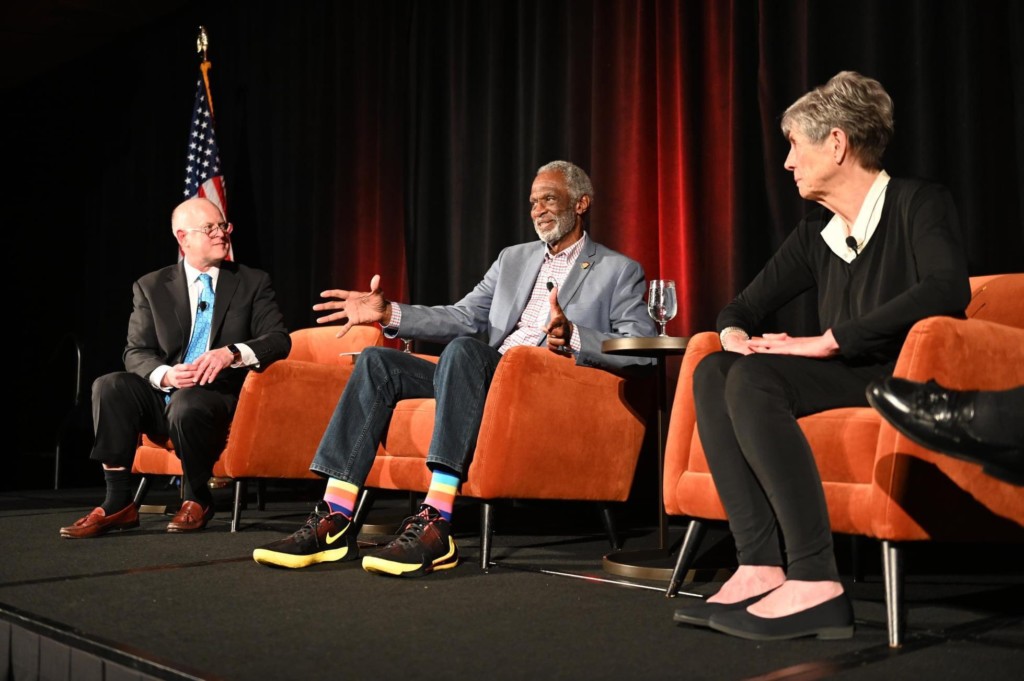
From left, former Wisconsin House Speaker Scott Jensen, education choice pioneer Howard Fuller, and School Choice Wisconsin founder Susan Mitchell share the stage at a session during the American Federation for Children National Policy Summit Sept. 29-30 in Milwaukee.
Editor’s note: The American Federation for Children held its national policy summit Sept. 29-30, welcoming key figures in the education choice movement as well as policymakers intent on expanding education opportunities for families. AFC communications specialist, former Florida Tax Credit Scholarship recipient and reimaginED guest blogger Nathan Cunneen was there and shares his observations in this post.
MILWAUKEE – The future of the school choice movement must include the beneficiaries of school choice themselves. This is the core belief behind the American Federation for Children’s Future Leaders Fellowship Program, which helps school choice beneficiaries who have reached college age combine their powerful stories with political advocacy training to help them grow into powerful voices for school choice.
Fellows of the leadership program had the opportunity this past week to address the conference through a panel titled, “The Future of School Choice Advocacy.” It was our intent to share how school choice affected our lives and to offer a hopeful roadmap for further progress.
We explained how even the most eloquently presented education choice myths fall apart quickly when confronted with honest testimony from a confident, well-spoken young person who attributes part of his or her success to school choice.
Those who oppose education freedom do everything they can to keep the discourse focused on abstract principles like school funding, democracy, or “health and safety.” The Future Leaders Fellows make that impossible.
Gissell Vera, for example, explained how she came to the United State from Mexico in search of more life options through education. In her small village growing up, she was expected to do exactly what her mother had done – grow up, marry a fisherman and become a housewife.
Gissell knew she had so much more inside of her. She came to the United States, used the Milwaukee Parental Choice Program to obtain access to a private school, graduated as her high school’s valedictorian, and earned full-ride scholarships to Marquette and Georgetown. As Gissell explained to our crowd, none of this would have been possible without school choice.
Next, we discussed the rising importance of school choice in political campaigns.
Hera Varmah, from Florida, explained how she sees school choice as an up-and-coming tentpole voting topic.
“This is going to be a bigger and bigger issue,” she said. “I went to Florida A&M University, and everyone thought that Andrew Gillum was going to be governor a few years ago. But Ron DeSantis won, and the Wall Street Journal credits school choice moms as the reason. Politicians need to know that voters care about school choice.”
Lastly, we wanted to be sure to tie our panel into the overall theme of this year’s Summit.
The event celebrated 30 years of the Milwaukee Parental Choice Program, and the opening dinner was a dedication to the innovative and reform-minded leaders who helped create the nation’s first school choice program decades ago. Former Wisconsin House Speaker Scott Jensen, as well as education choice pioneer Howard Fuller, School Choice Wisconsin founder Susan Mitchell, and former Wisconsin Gov. Tommy Thompson regaled the crowd with stories from their perspective and detailed the political challenges of passing such a program.
Unbeknownst to our honorees, four Future Leaders Fellows who directly benefitted from the program were in the audience.
This was something we desperately wanted to incorporate into our panel. Our moderator, Walter Banks Jr., masterfully navigated the conversation toward this topic. He explained how this year’s legislative wins will directly affect more students like us. Then he asked some questions: After such an amazing year of school choice victories, can we still be hopeful for the future? What role do the Fellows have to play in that? Why are they so important?
He illuminated. AFC’s Future Leaders Fellowship program trains and empowers those who have benefited from school choice in the past so that they can advocate for it in the future. How fitting, I thought, that in Milwaukee, as we celebrate three decades of school choice champions, the next generation of advocates is sitting right here.
I took my chance to build on that:
“We’re so honored to be a part of this movement, which so powerfully stands up for families and started right here in Milwaukee. I think I speak for all our Fellows and for AFC staff when I say that our honorees last night started this movement, but we want to be a part of the group that finishes it. We want to be a part of the generation that completes this mission by finally giving all families the freedom to choose the best education for their student.”
This is a foundational component of our fellowship, and the root of out panel.
If it’s possible that a school choice beneficiary can grow up to become a school choice advocate, then we want these young people to know that what is possible is only limited by what they believe to be possible. With the power of our personal stories and strong support from the seasoned advocates in this space, we believe that universal school choice in America is something achievable in our lifetimes.
We want that vison to personify the “future” of school choice in America. We said so on stage.
 Editor’s note: This news story appeared on The Center Square.
A South Carolina bill that would create education scholarship accounts for K-12 students was not heard during the first half of the General Assembly’s biennium session but is poised to advance when lawmakers convene in January.
The South Carolina Education Scholarship Account Act, House Bill 3976, was filed in February and referred to the House Ways and Means Committee.
The bill, which has 64 Republican co-sponsors, including House Speaker Jay Lucas, was reviewed by Ways and Means’ Revenue Policy Legislative Subcommittee on April 20 but never was introduced to the full committee before the session adjourned.
Creating ESAs as part of school-choice expansion has been on South Carolina Republicans' radar for years. A 2019 bill that had 58 cosponsors, including several Democrats, failed to advance from committee.
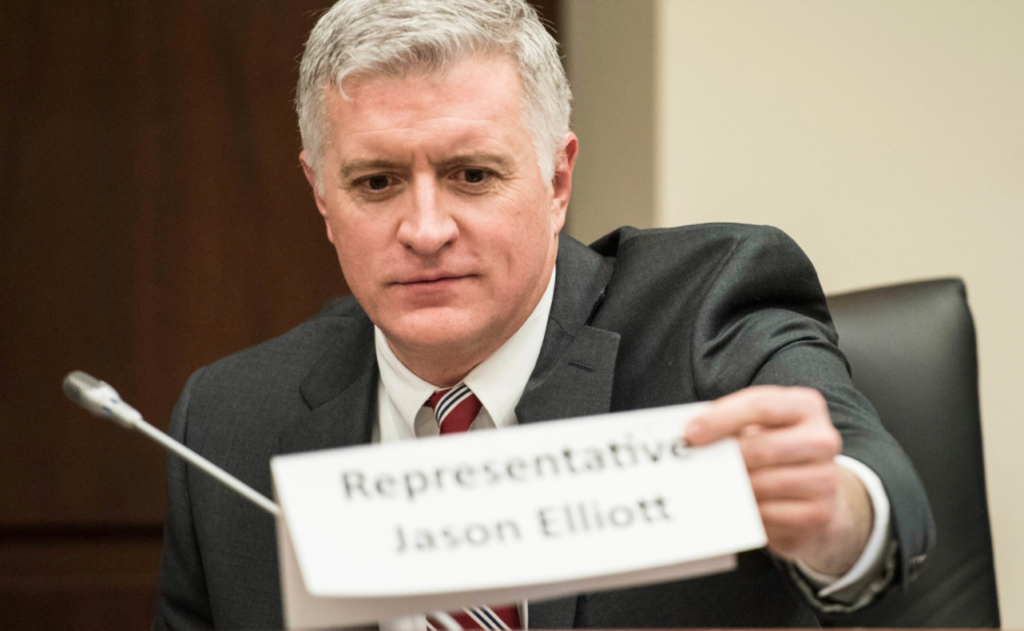
Rep. Jason Elliott, R-Greenville, said last week there is a lot of interest among his constituents about the bill and assured HB 3976 will be heard and adopted during the 2022 session.
“We saw and are seeing during this pandemic that one size doesn’t fit all students,” Elliott told Greenville's WYFF-TV, adding ESAs would put parents “in charge” and allow “families to decide” where the state spends its education funding.
“What I see in South Carolina is many needs that have not been met,” Elliot said. “I think we start with building upon a better education system for all students by providing freedom and opportunity to empower parents to make this critical decision about what is best for their individual child.”
To continue reading, click here.
Christina Sheffield knew the Christian school she chose for her son, Graham, was high quality. It met the expectations she and her husband had for religious instruction. But Graham, who always finished his assignments ahead of his classmates, needed more of a challenge on the academic front.
When he completed his work, he would either just sit at his desk or be asked to help struggling classmates, a situation that Sheffield thought shortchanged her son.
“School was way too easy for him,” Sheffield said. “He was bored. He was forced to help others rather than being given something a bit more challenging.”
By the time Graham recached third grade, she said, “we knew we weren’t serving him correctly.”
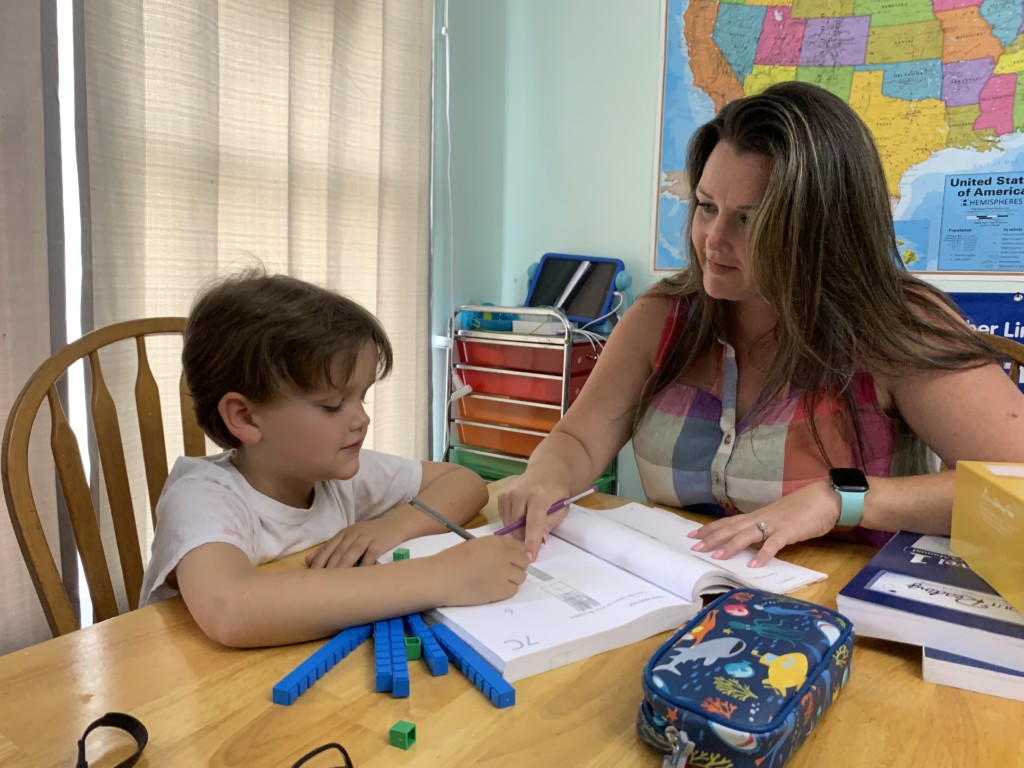
So, Sheffield, a certified district elementary school teacher who switched to teaching virtual school after Graham was born, filed the paperwork with her district to begin homeschooling, which in Florida was illegal until 1985. Parents who dared to attempt it kept it hush-hush and made sure the blinds were closed. Over the years, she designed a customized learning plan for her son, now a seventh grader who loves computer coding.
Sheffield is one of a growing number of parents who has blurred the lines between the original definition of homeschooling, where the parent teaches his or her child in person all day, and the modern understanding that includes new approaches such as microschools, virtual schools, part-time in-person school, and community resources such as city recreation centers, public libraries and nonprofit fine arts centers.
In a word, “unbundled” education services, which allow parents to piece together customized learning plans for their children.
After doing some thorough online research, Sheffield bought the curriculum her son’s former school used and enhanced it with projects to give Graham a deeper dive. She made the decision to “start with what he knew and what I knew.”
It lasted about a semester. Graham, at the time an only child, craved socialization. So, she enrolled him at Wellmont Academy, a hybrid school that he attended two days a week and allowed him to learn from home the rest of the week.
That didn’t work so well either.
“Everything was too super easy for him,” Sheffield said.
Sheffield decided to have Graham, then in fifth grade, tested for academic giftedness through the Pinellas County School District. The results confirmed her suspicions that Graham was gifted.
Now officially identified, Graham, like other gifted homeschoolers, was entitled to district services for such students. He started going to a weekly class offered at his zoned elementary school. There, he was able to interact with other students whose intellect matched his.
“It was his favorite day of the week,” Sheffield said. “After I picked him up on the first day, he said, ‘Mom, I finally feel like I fit in.’ That made my mom’s heart happy.”
Sheffield finally had things figured out. She enrolled Graham in a part-time virtual gifted program at Florida Virtual School, with part-time classes in the Pinellas County School District’s virtual program. For enrichment, she turned to the Dunedin Fine Arts Center and Chosen, a Pinellas County homeschool co-op sponsored by a local church, which offers classes in everything from cooking to drama to skateboarding.
Graham participates in P.E. classes for homeschoolers through several community organizations and takes Tai Kwan Do lessons to stay fit and participate in a sport.
“There are a lot of little jewels and gems,” Sheffield said.
Though it’s clearly the best option for a lot of students, Sheffield said, it can get pricy.
Co-op fees can run several hundred dollars per year, depending on the level of participation. While that could be a deal breaker for families of modest means, more states are making education savings accounts available. ESA’s allow parents to withdraw their children from public district or charter schools and receive a deposit of public funds into government-authorized savings accounts with restricted, but multiple uses.
Those funds can cover private school tuition and fees, online learning programs, private tutoring, community college costs, higher education expenses and other approved customized learning services and materials. Some allow students to use their funds to pay for a combination of public school courses and private services, following the model Sheffield embraced years ago.
You can read about how Florida allows select students to use education savings accounts here.
Sheffield tweaks the formula each year to do what works best for Graham. Now that he is in middle school, that means full-time enrollment in Florida Virtual School’s gifted program. Because his district middle school’s daily programs for gifted students conflicted with his co-op electives, Graham has stopped attending those but gets the intellectual stimulation he needs from the FLVS program, Sheffield said.
“In the past year, I saw growth in him in a way I hadn’t seen,” she said. For the first time, she said, Graham had to work at doing well in school.
“He’s still a straight-A student, but he’s gone from K-5 where he was good at doing things and done in a hot second,” she said. “Things aren’t supposed to be handed on a silver platter to kids; they need to work through things and problem solve and learn about taking notes and using those notes.”
Sheffield makes it all look easy today, but there were hurdles to clear in the beginning. The first was her husband, who worried Graham would be stereotyped as “nerdy” and the family assumed “outside society’s mainstream.” A co-worker put those concerns to rest, telling him her kids are busier now than they were in “regular school.”
Today, Sheffield said no one has any regrets, especially Graham, who is thriving with a plan designed just for him.
“Graham says there’s no way he would ever go back,” Sheffield said.
 Editor’s note: This commentary from former Florida Gov. Jeb Bush appeared earlier this week on RealClear Education.
The past two years have shined a bright light on widespread inequalities in education. As state after state dealt with pandemic disruptions, we’ve seen painful reminders of what’s always existed: some kids have access to great schools, multiple options for learning, and abundant resources like computers and high-speed internet access, advanced courses, online classes, and modern buildings with science labs and excellent libraries.
And other kids are left behind, decade after decade, assigned to government-run underperforming and failing schools, without a chance for anything better. That’s painfully true in Michigan, where a student’s ability to move to a better school is limited by antiquated state laws that don’t serve the needs of each and every individual student.
Consider Michigan’s failure in teaching students to read according to the “Nation’s Report Card.” For a dozen years, Michigan’s 4th grade reading scores have been below the national average, and, in 2019, six out of 10 Michigan 4th graders were not proficient in reading. These scores touch all parts of Michigan, including the urban centers of Detroit, Flint, and Grand Rapids, and rural communities throughout the state. Math scores are below the national average, and there’s a growing achievement gap between white and Black students.
But why?
If we’ve learned one thing from the pandemic, it’s that our education system must be flexible and centered around students. A single, one-size-fits-all pathway for every kid will never deliver great results. A quality education that meets a child’s needs unlocks countless doors. It can break cycles of poverty, lift up communities, and help ensure all students can reach their God-given potential.
To read more, click here.

 A parent’s story: How a Florida education choice scholarship may have saved my daughter’s life
Rayonna faced some challenges in school with somebody that was once her friend. This girl started to bully my daughter because she did not want Rayonna to talk to a girl she didn’t like. My daughter was uncomfortable in this situation, and I started getting calls from her while I was at work. She explained the situation to me, and she kept telling me, “Mommy, I don’t want to get into a fight, but this person keeps coming at me. I know I’m going to end up fighting her.” My daughter was never someone who concerned herself with violence, but now she was telling me this. READ MORE
 podcastED: SUFS president Doug Tuthill and NLP Logix client delivery manager Jen Bradshaw discuss future of education savings accounts (Part 1)
On this two-part episode hosted by Kevin Roberts of the digital innovation firm Robots and Pencils, Tuthill and Bradshaw discuss a partnership between Step Up For Students and Jacksonville-based artificial intelligence company NLP Logix, which aims to create a simple and customizable online platform for families who use education savings accounts to support their children’s education. Tools such as artificial intelligence-based predictive analysis must be deployed to bring education savings accounts to scale in public education and to help families READ MORE
 Communities should use pandemic recovery funds inside, outside traditional school to benefit K-12 kids, families
COVID-19 school shock disrupted our way of doing education, unbundling the familiar division of responsibilities among home, school and community organizations. Nearly every parent of school-age children had to create from scratch a home learning environment using online technology, rebundling school services to meet their needs. Most parents accepted whatever teaching, learning and support services their district offered, supporting their child’s learning as best they could. Other parents sought new learning options. READ MORE
 Results from a new poll from RealClear Opinion Research indicates that voters have a problem with lawmakers who oppose school choice for others but exercise it for their own children.
According to a survey conducted this month of more than 2,000 registered voters, 62% would be less likely to vote for a candidate who opposes education choice policies yet sends his or her own children to a private school. The sentiment was evenly shared by those who identified as Democrat, Republican and Independent.
Researchers asked the question: If an elected official or political candidate sends their own children to private school but opposes school choice for other families, would that make you more likely to vote for that candidate, less likely to vote for that candidate, or would it not make a difference?
Here is the breakdown among political affiliation:
Democrats were 56% less likely to vote for such a candidate; Republicans were 66% less likely; and Independents were 65% less likely.
American Federation for Children CEO Tommy Schultz said in response to the poll results that it’s unfortunate that politicians block expanded educational opportunities for others while exercising that freedom for their own children.
“From president of the United States governors to state lawmakers and school board members, many in such places of privilege disregard the needs of families who want nothing but the same opportunity to access an educational environment that meets their own children’s needs,” Schultz said.
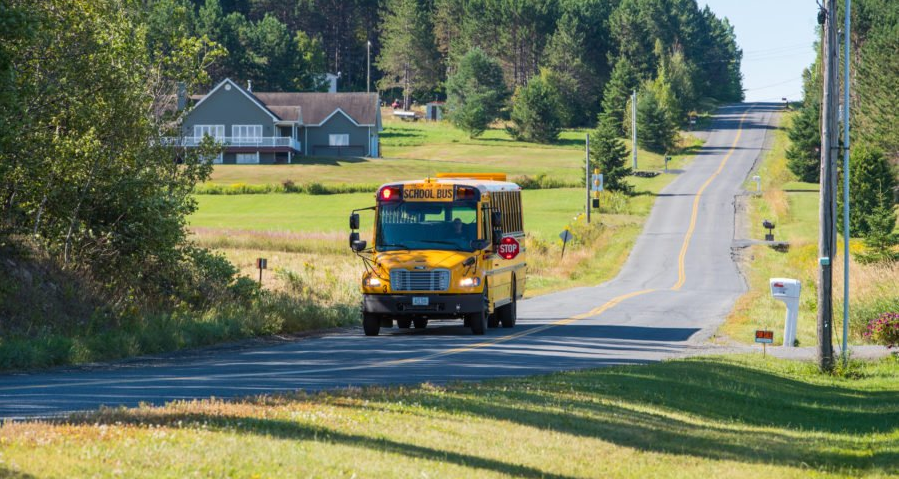 Editor’s note: reimaginED welcomes its newest guest blogger, Garion Frankel, with this post on a viable education choice alternative for rural families.
The past two years have seen an unprecedented string of victories for parental choice advocates. After the events of the COVID-19 pandemic, more than two dozen states now offer some form of voucher program.
But amid this expansion of school choice, the concerns of rural Americans are often overshadowed. Millions of American students attend a rural school, and many families interpret vouchers of any kind as a threat to their way of life. This resentment often influences policy.
For example, the Texas House of Representatives, based on the support of rural Republicans, added an amendment banning the use of vouchers to the state budget, which will be in effect until 2023.
"The reality is we have plenty of options and choice within our public schools,” said state Rep. Dan Huberty, a Republican who has long opposed voucher-driven school choice.
Rural concerns are valid. Anyone who has ever seen an episode of Friday Night Lights knows what the local public schools can mean to a rural community. Rural schools can employ half a town, and the other half will pack the bleachers for a high school football game.
These are institutions that can’t simply be overlooked. Furthermore, it’s true, at least historically, that rural access to voucher programs has been poor.
But there is now an option that can adequately serve both a single mother from Baltimore and a family with deep roots in rural Wyoming. Education savings accounts can satisfy the needs of all Americans, and arguably strengthen rural schools in the process.
Like traditional vouchers, ESAs enable parents to withdraw from their traditional public school and receive a deposit of public funds into a state-authorized savings account. Families can usually access this account via a debit card, and the money may be used for limited, but varied uses, such as private school tuition and supplemental instruction.
The difference, however, comes in the breadth of ESAs. They are not really vouchers. Instead of being specifically directed towards private schools, ESAs allow families to effectively design an educational program from scratch. In some cases, as with West Virginia’s Hope Scholarship Program, some students can use ESAs to support their public education.
In addition, ESAs can actually increase public school per-student spending. When families elect to participate in an ESA program, they receive only the state-allotted portion of their education. Sure, the public school district wouldn’t receive that portion of their funding, but it would be able to keep the locally sourced revenue that would normally have gone toward serving that student. As such, school districts can increase their per-student spending when ESAs are available.
For rural school districts, this extra spending would be particularly important. Before and during the COVID-19 pandemic, rural schools struggled to provide adequate internet services as well as the technology to access them. ESAs could open the door for higher-quality internet or laptops for students to use during class.
On the other hand, those rural families who do want something different would be able to pursue other options without feeling like they are destroying a pillar of their community. Nobody should feel guilty for doing what they think is best for their child’s future, and with ESAs, that choice could ever enhance their community.
There is no time like the present to implement school choice measures, and with ESAs, rural communities could comfortably join the broad, nationwide coalition of parental choice advocates.
There are no more excuses for blocking school choice efforts. Standing against ESAs is neither conservative nor acting in the interest of preserving communities; it is merely selfish and narrow-minded.
Rural communities arguably are the heart and soul of American culture and identity. That should apply to school choice too.

